

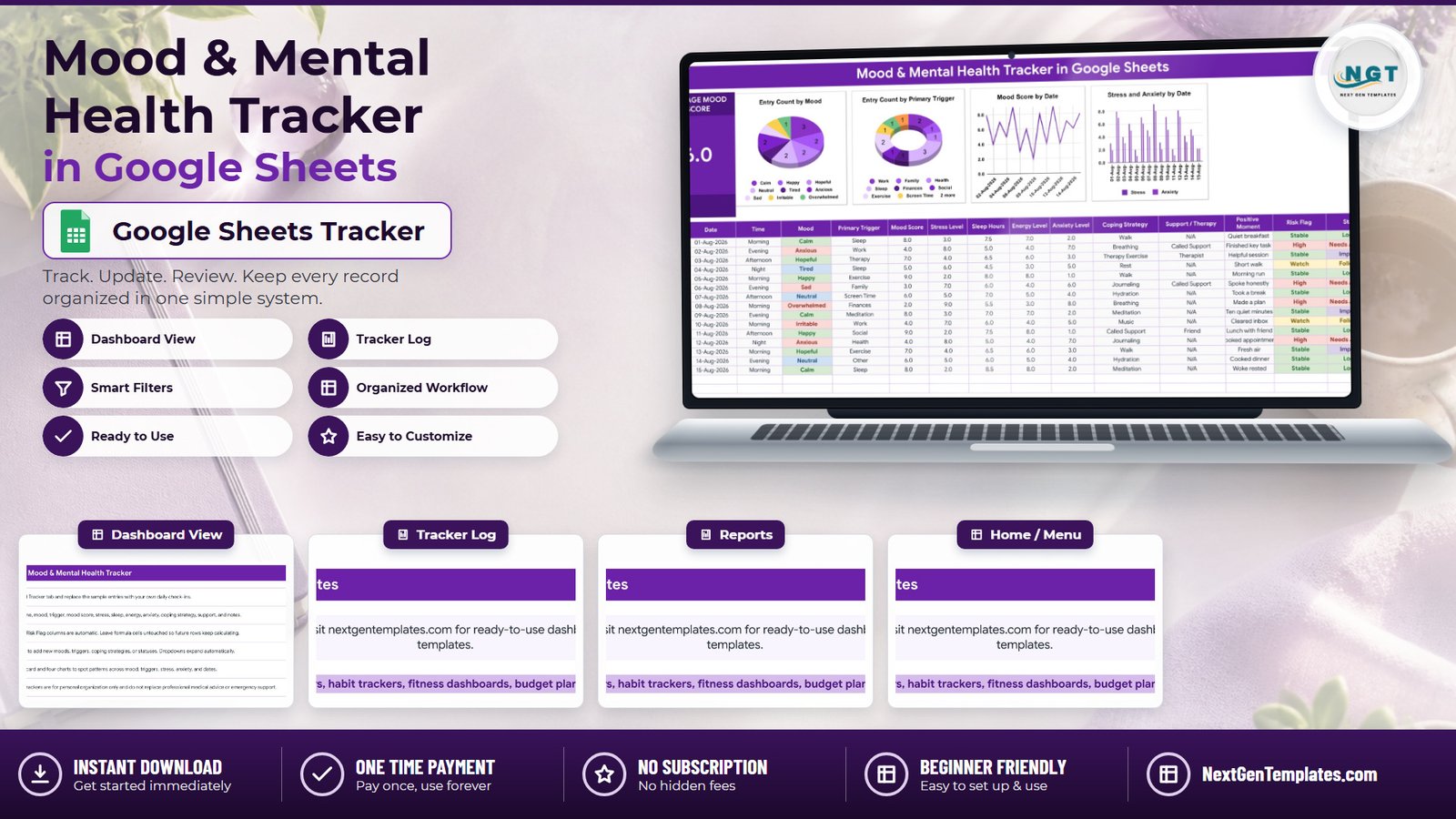
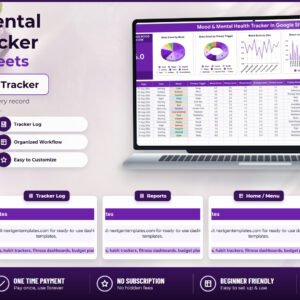
The Mood & Mental Health Tracker in Google Sheets is a one-page personal check-in log. Every entry takes 15 columns, 2 of them fill themselves, the pick-lists come from a single List tab, one Average Mood Score card sits at the top and 4 charts redraw as you type. Fifteen worked sample rows dated 01-Aug-2026 to 15-Aug-2026 ship inside it, so nothing is blank the first time you open it. It is a one-time purchase at $6.99 rather than a monthly app fee, the copy lands in your own Google Drive, and you can delete it, export it or keep it private forever.
Please read this before buying. This is a spreadsheet you type into. It is not a medical device, it is not a clinical or diagnostic tool, it is not therapy, and it is not a substitute for professional care. It does not detect, diagnose or treat anything. The Risk Flag column is an ordinary formula that groups the numbers you typed – it is not a clinical assessment and “High” means a formula matched your own entry, nothing more. The file has no encryption and no secure storage of any kind, so it is not appropriate storage for clinical records and it is not HIPAA- or GDPR-compliant. If you are struggling or in distress, please contact a qualified mental-health professional; in an emergency, call your local emergency number.
Key Features of the Mood & Mental Health Tracker in Google Sheets
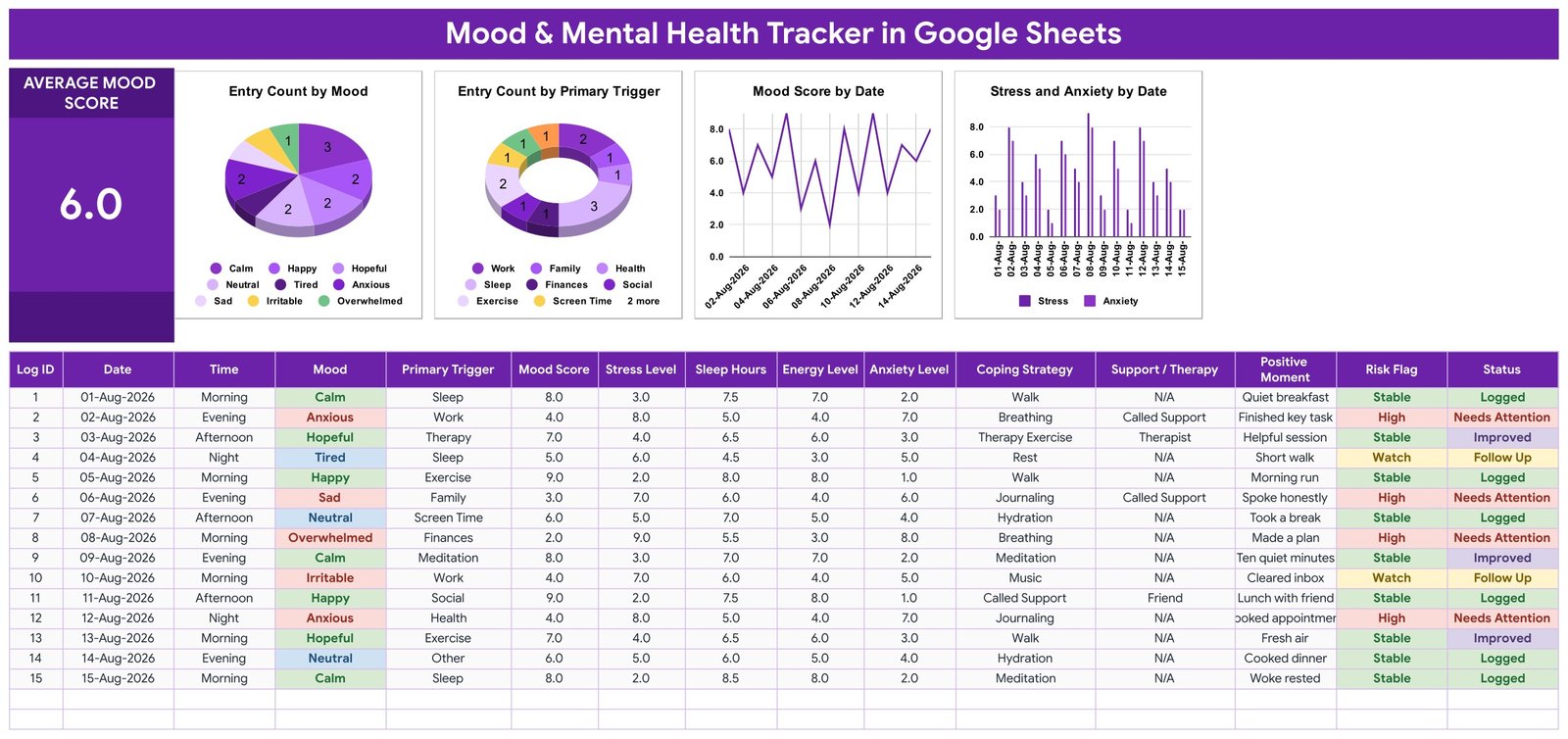
- 15 columns per check-in – Log ID, Date, Time, Mood, Primary Trigger, Mood Score, Stress Level, Sleep Hours, Energy Level, Anxiety Level, Coping Strategy, Support / Therapy, Positive Moment, Risk Flag and Status.
- 2 self-filling columns – Log ID numbers each row, and Risk Flag returns Stable, Watch or High from the scores you entered. Both are plain formulas; leave the cells alone and new rows keep calculating.
- Dropdowns from one List tab – Mood, Primary Trigger, Coping Strategy and Status all read the List tab, so you edit one place and every dropdown follows.
- Dropdowns grow automatically – add your own moods, triggers or coping strategies to the List tab and they appear in the pick-lists with no data-validation editing.
- Average Mood Score card – one headline number, recalculated on every entry. The sample data shows 6.0.
- 4 live charts – Entry Count by Mood, Entry Count by Primary Trigger, Mood Score by Date and Stress and Anxiety by Date.
- Colour-coded moods and flags – Calm, Happy and Hopeful, Tired and Neutral, Sad, Anxious, Irritable and Overwhelmed each carry their own shading, and Stable / Watch / High are banded so a month of rows has a shape you can read at a glance.
- 15 worked sample rows – a full fortnight of realistic entries. Delete them when you start your own.
- 4 tabs only – Mood Tracker, List, How to Use and Explore More Templates. There is nowhere to get lost.
- Yours, in your Drive – one-time price, no subscription, no account to create beyond a free Google account.
What’s Inside the Mood & Mental Health Tracker in Google Sheets
Mood Tracker. The single working page. The Average Mood Score card sits on the left, the four charts run across the top, and the entry table fills the rest. You type left to right: date, time of day (Morning, Afternoon, Evening, Night), how you felt, what set it off, then the five numbers – Mood Score, Stress Level, Sleep Hours, Energy Level and Anxiety Level – followed by what you did about it, whether you reached out to anyone, and one good thing from the day in the Positive Moment column. Log ID and Risk Flag fill in behind you.
List. The vocabulary tab. Moods, primary triggers, coping strategies and statuses all live here. The dropdowns read down the tab, so adding “Long commute” or “Cold-water swim” is a one-cell job rather than a trip through Data validation.
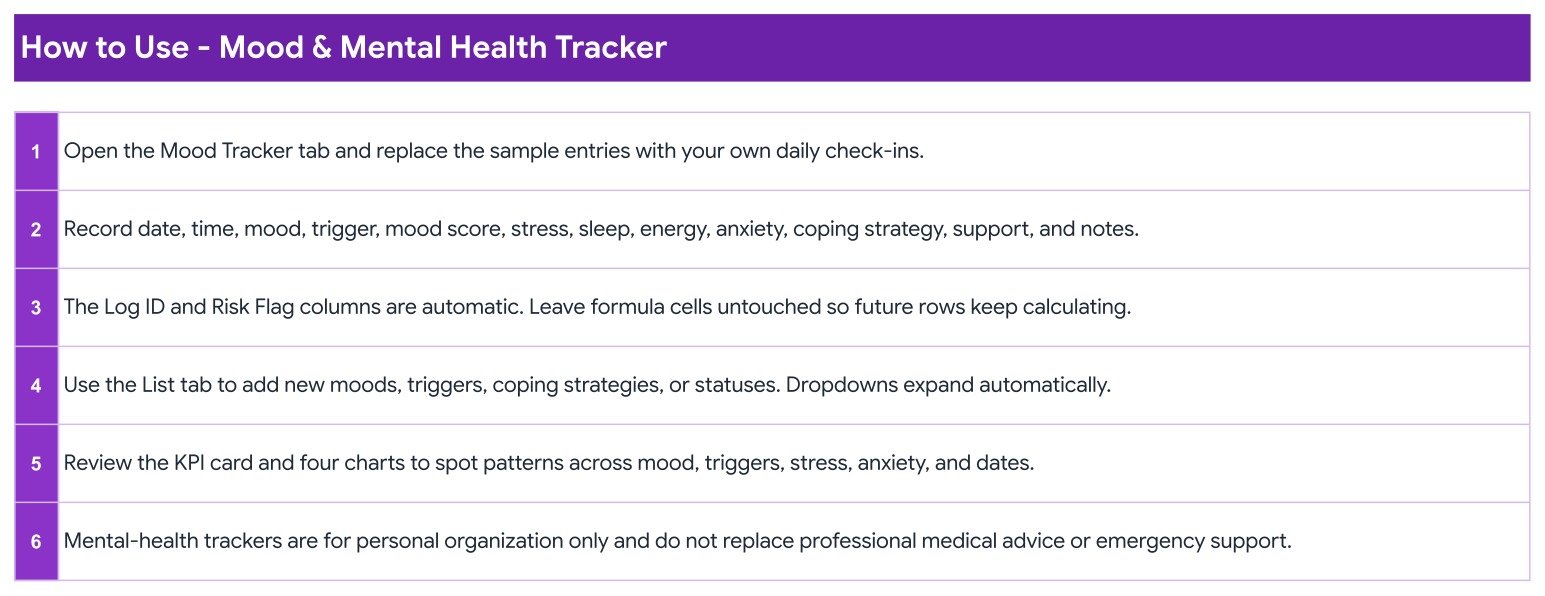
How to Use. Six numbered steps written on the sheet itself, including the plain statement that a mental-health tracker is for personal organisation only and does not replace professional medical advice or emergency support.
Explore More Templates. A closing tab pointing to the wider NextGenTemplates range.
Mood & Mental Health Tracker vs. an Excel Mood Log vs. a Paid Mood-Tracking App – Where This Fits
| This Google Sheets tracker | DIY Excel mood log | Paid mood app (Daylio Premium, Bearable, Moodfit) | |
|---|---|---|---|
| Cost | $6.99 once | Free, but you build it | Roughly $3-$10 per month, forever |
| Platform | Google Sheets, any browser | Microsoft Excel | The vendor’s phone app |
| Setup time | Click the copy link, start typing | Hours of columns, formulas and charts | Minutes, but inside their structure |
| Real-time sharing with a partner or coach | Yes, Google Sheets sharing | Only by emailing the file | Usually not, or a paid tier |
| Mobile access | Google Sheets mobile app | Excel mobile, awkwardly | Yes – that is the point of them |
| Customisable fields | Every column and every dropdown | Anything you can build | Whatever the app allows |
| Share with a link | Yes, view-only or editable | No | Rarely |
| Year-1 cost for a household of 5 | $6.99 total | $0 plus your time | $180-$600 |
| Reminders and notifications | None | None | Yes |
| You own and can export the raw data | Yes, it is a spreadsheet | Yes | Varies by vendor |
The honest summary: a phone app will nag you to check in and this will not. What this gives you instead is your data in a plain grid you can sort, filter, chart, hand to someone or delete, with no account tied to it and no renewal date.
Who This Template Is For – and Who It’s Not For
It is for anyone keeping a private daily check-in; someone asked by a therapist or GP to bring a few weeks of notes to the next appointment; a student or shift worker trying to see whether sleep hours really track with the bad days; a parent logging a teenager’s own self-reported check-ins with them; a coach or wellbeing lead who wants a simple shared log rather than a platform.
It is not for storing anyone else’s clinical records – it has no encryption, no access control beyond Google Drive sharing, and no compliance certification of any kind. It is not for crisis management: it sends no alerts, no reminders and no emails, and nothing happens unless you open it. It is not for a clinic that needs a patient database with audit trails. And it is not a screening instrument – it contains no validated scale such as PHQ-9 or GAD-7, only the numbers you choose to type.
How to Use the Mood & Mental Health Tracker in Google Sheets
- Open the PDF in your download and click the Google Sheets copy link. A private, editable copy appears in your own Drive.
- Open the List tab first and replace the sample moods, triggers, coping strategies and statuses with words you would actually use.
- Go to the Mood Tracker tab, delete the 15 sample rows, and log your first check-in.
- Leave Log ID and Risk Flag alone – they are formulas. Drag them down when you add rows below the last one.
- After a fortnight, read the four charts together: which moods dominate, which trigger recurs, how the mood line moves, and whether stress and anxiety rise on the same dates.
- Take what you notice to a qualified professional. The sheet organises the record; it does not interpret it.
Real-World Use Cases
Priya, 29, between therapy sessions. Her therapist asked her to note what happens before a low evening. Six weeks in, the Entry Count by Primary Trigger chart is unambiguous: Work and Screen Time dwarf everything else. She shares the sheet view-only before the session instead of trying to remember.
Daniel, 41, shift worker. He suspected his worst days followed short nights but had never checked. Logging Sleep Hours next to Mood Score for two months gave him a line chart he could put in front of his GP – not a diagnosis, just a record that made the conversation faster.
A small workplace wellbeing circle. Five colleagues each keep their own private copy of the same template and only bring anonymised themes to the monthly session. One $6.99 template, five separate sheets, no platform and no shared database.
Frequently Asked Questions
Is this a medical device, a diagnosis, or therapy?
No, to all three. It is a spreadsheet you type into. It does not detect, diagnose or treat anything, it gives no medical advice, and it is not a substitute for professional care. The Risk Flag column is a plain formula grouping the scores you entered – “High” means a formula matched your own numbers, nothing more. If you are in distress, contact a qualified mental-health professional; in an emergency, call your local emergency number.
Is my data secure or private?
The template itself stores nothing securely. It has no encryption, no password protection and no compliance certification, and it is not HIPAA- or GDPR-compliant storage. Your copy sits in your own Google Drive under whatever sharing settings you apply. Never use it for anyone else’s clinical records.
Will it remind me to check in?
No. It sends no notifications, emails or alerts of any kind. Nothing happens unless you open the sheet.
What exactly do I get?
A PDF containing a Google Sheets copy link. Click it and a fully editable copy lands in your own Drive. There is no add-on to install and no account to create beyond a free Google account.
Can I change the moods, triggers and coping strategies?
Yes, and that is the intended first step. Type your own into the List tab and the dropdowns pick them up straight away.
Does it work on a phone?
Yes, through the Google Sheets mobile app. Typing a check-in works well; the four charts are easier to read on a larger screen.
Can I share it with my therapist or a family member?
Yes – share it view-only with a link, or download it as a PDF before an appointment. Remember it is a personal record, not a clinical document.
About the Author
Built by PK – Microsoft Certified Professional with 15+ years of Excel, Google Sheets, and Power BI experience. Founder of NextGenTemplates, reaching 300K+ subscribers across YouTube channels. Every template is hand-built and tested before release.
Explore Related Templates
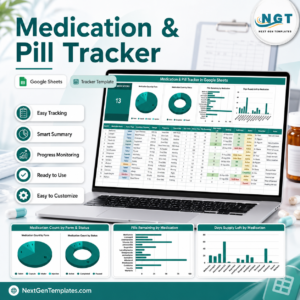
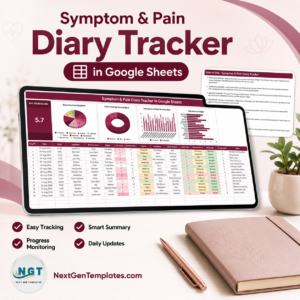
The closest companion is the Sleep Tracker in Google Sheets, since sleep hours are one of the five numbers on this sheet. Alongside it: the Symptom & Pain Diary Tracker in Google Sheets for physical symptoms, the Medication & Pill Tracker in Google Sheets for what you take and when, the Yoga & Stretching Practice Tracker in Google Sheets, and the Daily Steps Tracker in Google Sheets. Every one of them is a personal log with exactly the same limits described above. The full range sits in Google Sheets Trackers, inside the wider Google Sheets collection.

Get the Mood & Mental Health Tracker in Google Sheets for $6.99 (regular $12.99). Instant download, one-time payment, no subscription, and the copy is yours in your own Google Drive. A full walkthrough is on the blog: Mood & Mental Health Tracker in Google Sheets.
Watch the step-by-step video Demo:
Last updated: 31 August 2026.
Compatibility and Requirements
- Works in Google Sheets. You need a free Google account and a web browser, and the copy lands in your own Google Drive.
- Mood, Primary Trigger, Coping Strategy and Status are dropdowns that read the List tab. Google explains dropdowns in Create an in-cell dropdown list.


















Reviews
There are no reviews yet.