

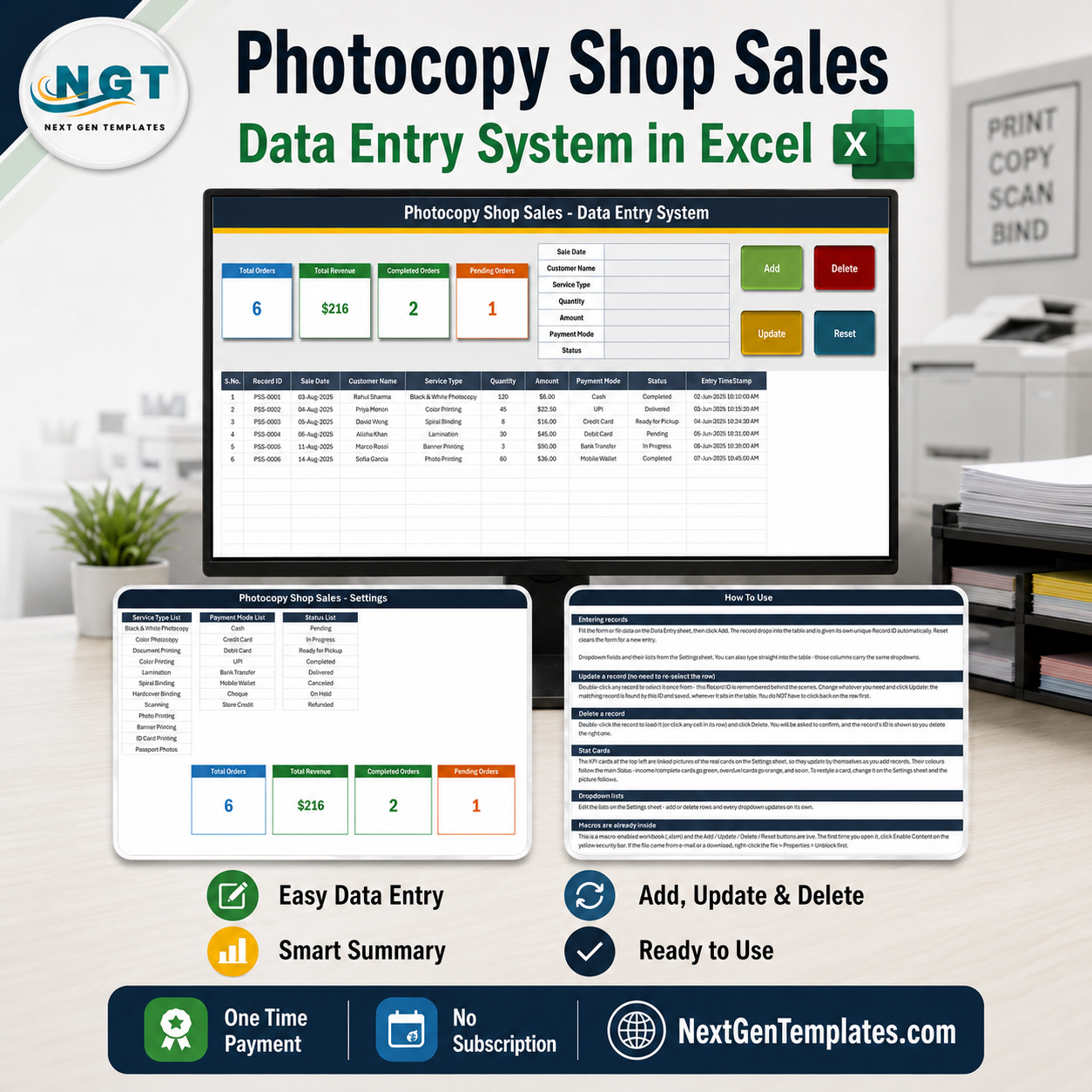
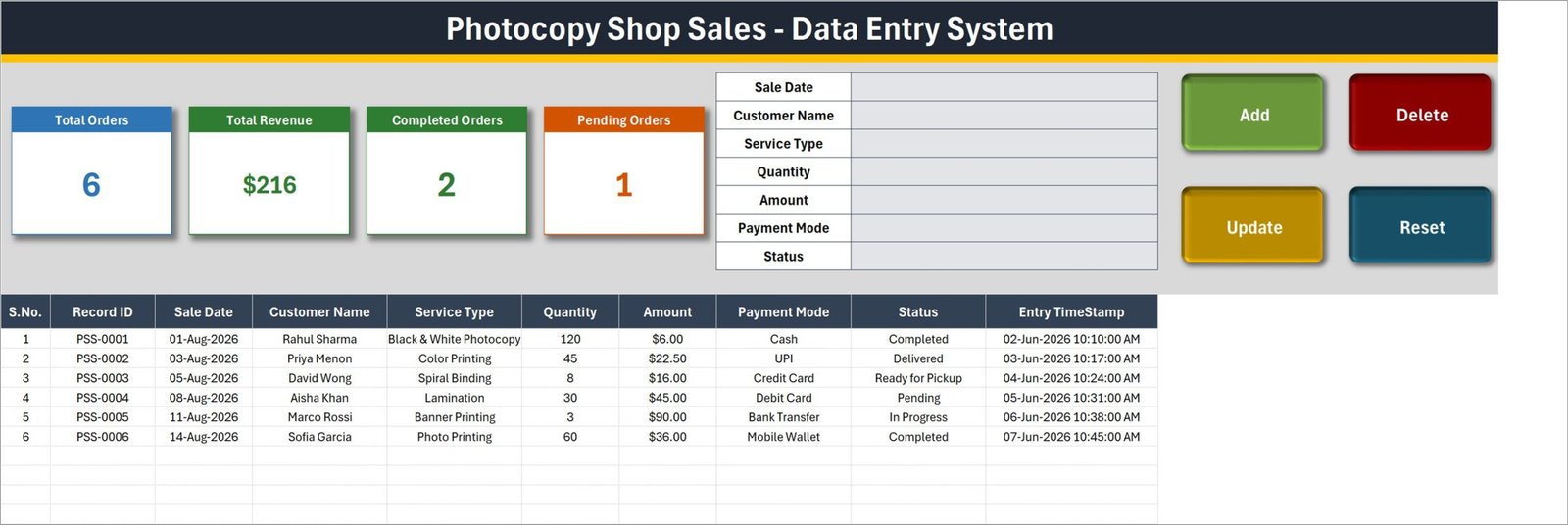
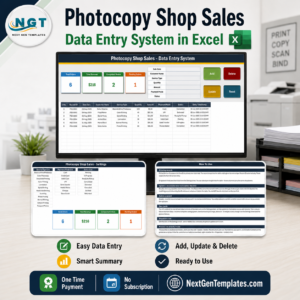
The Photocopy Shop Sales Data Entry System in Excel is a four-sheet macro-enabled workbook that files one counter sale at a time through a seven-field form and drops it into a ten-column table with its own PSS-0001 style Record ID and an automatic entry timestamp. Four live stat cards sit above the form – Total Orders, Total Revenue, Completed Orders and Pending Orders – and recalculate from the records themselves. Built by PK, a Microsoft Certified Professional, and hand-tested before release. Instant download, lifetime access, no subscription, and support if the workbook does not work as this page describes.
Key Features of the Photocopy Shop Sales Data Entry System in Excel
- Seven-field entry form – Sale Date, Customer Name, Service Type, Quantity, Amount, Payment Mode and Status, laid out down the middle of the Data Entry sheet.
- Four VBA buttons – Add (green), Delete (red), Update (amber) and Reset (teal). They are real macros, not formulas, so the file must be opened in Excel for Windows with content enabled.
- Automatic Record ID – every sale is filed as PSS-0001, PSS-0002 and onward, so two walk-in customers with the same name never collide.
- Entry TimeStamp column – the date and time the row was created is written for you, separately from the Sale Date you type.
- Update by ID, not by row – double-click any record to pull it back into the form; the macro finds it again by its Record ID wherever it has been sorted to.
- Four live stat cards – Total Orders, Total Revenue, Completed Orders and Pending Orders, all driven by COUNTA, SUM and COUNTIF over the records table. Read the honest note on what these cards do and do not count further down this page.
- Three dropdown lists you own – 12 service types, 8 payment modes and 8 order statuses, all edited on the Setting sheet.
- 200 pre-formatted record rows – rows 15 to 214 already carry the dropdowns, the date, currency and timestamp formats and the S.No. formula.
- Delete asks first – the confirmation names the Record ID it is about to remove.
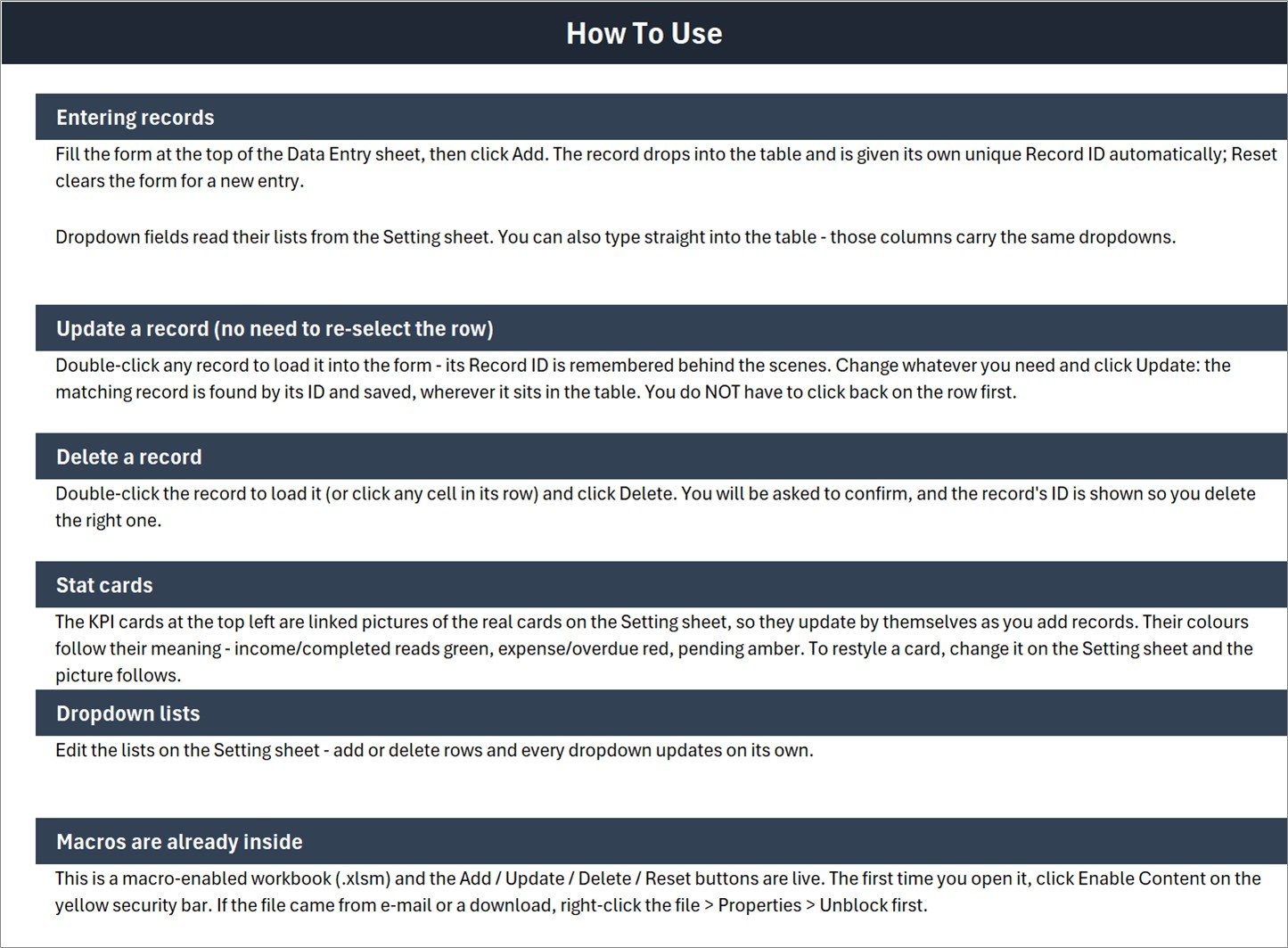
- A How To Use sheet inside the file – six short sections, so nobody has to come back to this page to remember how Update works.
What’s Inside the Photocopy Shop Sales Data Entry System in Excel
The download is a ZIP containing one macro-enabled workbook, Photocopy_Shop_Sales_System.xlsm (about 64 KB). It has exactly four sheets and no other files.
1. Data Entry. The working sheet. A navy title banner, the four stat cards, the seven-field form, the Add / Delete / Update / Reset buttons, and below them the records table: S.No., Record ID, Sale Date, Customer Name, Service Type, Quantity, Amount, Payment Mode, Status, Entry TimeStamp. Six sample sales ship with it – 120 black and white copies at $6.00 paid in cash, 45 colour prints at $22.50 on UPI, 8 spiral bindings, 30 laminations, 3 banners at $90.00 and 60 photo prints – so you can watch Add, Update and Delete work before you clear them out.
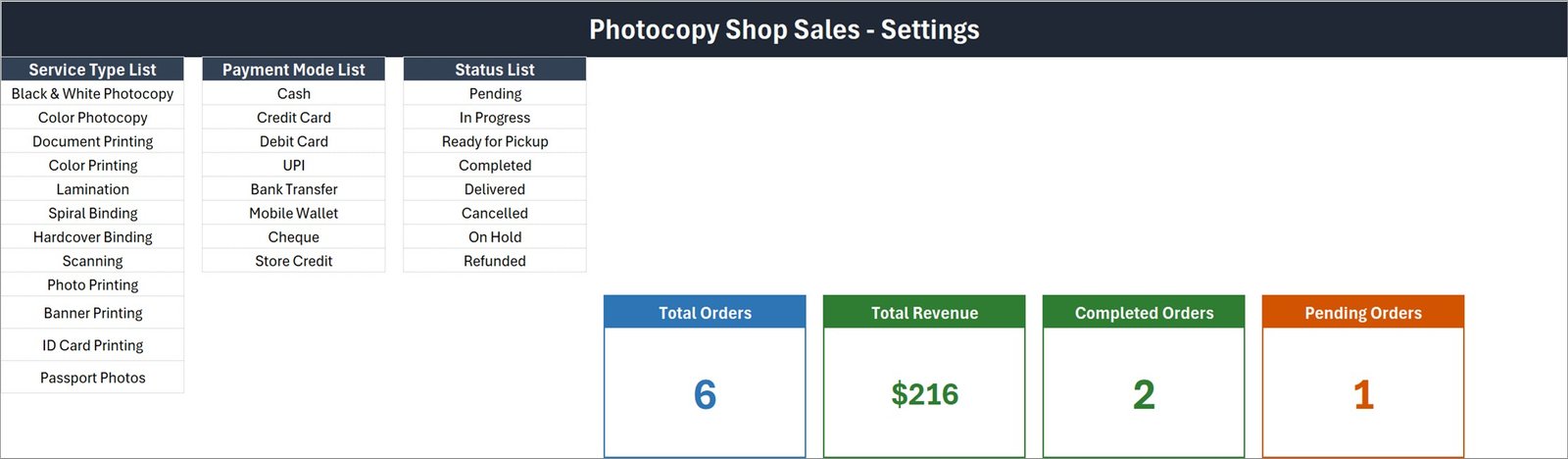
2. Setting. Three editable lists and the four real stat cards. Service Type List ships with Black & White Photocopy, Color Photocopy, Document Printing, Color Printing, Lamination, Spiral Binding, Hardcover Binding, Scanning, Photo Printing, Banner Printing, ID Card Printing and Passport Photos. Payment Mode List holds Cash, Credit Card, Debit Card, UPI, Bank Transfer, Mobile Wallet, Cheque and Store Credit. Status List is Pending, In Progress, Ready for Pickup, Completed, Delivered, Cancelled, On Hold and Refunded. Replace any of them with the services and payment methods your counter actually offers and every dropdown follows.
3. How To Use. Six sections – entering records, updating without re-selecting the row, deleting, how the stat cards work, editing the dropdown lists, and enabling macros.
4. Get More Templates. Links back to the NextGenTemplates store.
What This Workbook Is Not
This is a sales register, not a shop billing system, and the page you are reading is written from the file itself rather than from a marketing brief.
- Amount is typed, not calculated. There is no price list and no rate per copy anywhere in the workbook, so Quantity and Amount are two independent numbers you key in. Nothing multiplies 120 copies by your per-copy rate.
- Quantity is never totalled. The six sample rows come to 266 copies, prints and bindings, and no card, formula or summary anywhere shows that figure.
- Total Revenue is an unfiltered SUM.
Setting!I13 = SUM('Data Entry'!$G$15:$G$1048576)adds every Amount in the table regardless of Status. On the shipped sample data the card reads $216 while only $42.00 sits on rows marked Completed – the rest is Pending, In Progress, Ready for Pickup and Delivered. A Cancelled or Refunded row would be added in too. Treat the card as “value entered”, not “money taken”. - Only two of the eight statuses have a card. Completed Orders and Pending Orders are COUNTIFs; In Progress, Ready for Pickup, Delivered, Cancelled, On Hold and Refunded are counted nowhere. That is why 2 + 1 does not reconcile to Total Orders 6 on the sample data.
- Total Orders counts the Sale Date column.
Setting!G13 = COUNTA('Data Entry'!$C$15:$C$1048576)counts column C, not the Record ID in column B, so a row saved without a date is stored but never counted. Repointing it at column B is a one-cell edit. - The card format hides cents. The Total Revenue cell is formatted
"$"#,##0, so the true $215.50 of the sample data renders as $216. - The three dropdown ranges are fixed, and all three are exactly full. Service_TypeList is Setting!$A$3:$A$14 (12 of 12), Payment_ModeList is $C$3:$C$10 (8 of 8) and StatusList is $E$3:$E$10 (8 of 8). The How To Use sheet says the lists update on their own – a 13th service typed under the list will not reach the dropdown until the range is widened in Name Manager. Replacing an existing entry works immediately; adding a new one does not.
- No invoices, receipts, GST or tax fields, no customer balances, no charts and no per-service or per-day breakdown. There is one table and four counts.
- Windows desktop Excel only, one file and one editor at a time, 200 pre-formatted rows out of the box.
Photocopy Shop Sales Data Entry System in Excel vs. Google Sheets vs. Shop Billing Software – Where This Fits
| This Excel system | A Google Sheets form | Shop billing / POS software | |
|---|---|---|---|
| Cost | $6.99 once | Free, build it yourself | $10-$50 per month |
| Platform | Excel for Windows, desktop | Browser, any device | Desktop, tablet or phone |
| Setup time | About 10 minutes to swap the three lists | Hours of building | Days, plus your price list |
| Prints a customer bill or receipt | No | No | Yes |
| Rate per copy, automatic amount | No – Amount is typed | Build it yourself | Yes |
| Tax or GST handling | No | Build it yourself | Yes |
| Two people entering at once | No – one file, one editor | Yes | Yes |
| Works on a phone at the counter | No – the VBA buttons need the desktop app | Yes | Yes |
| Unique ID and timestamp per sale | Yes, automatic | Build it yourself | Yes |
| Owns its own data file | Yes – one .xlsm you keep | In your Google account | In the vendor’s system |
| Year-1 cost | $6.99 | $0 | $120-$600 |
Who This Template Is For – and Who It’s Not For
It is for a single-counter photocopy, printing or stationery shop, a cyber cafe, a college print point or a documentation centre that currently writes the day’s jobs in a notebook and wants a form, a unique ID per sale, a timestamp and four honest counts at the top. One person, one file, on a Windows PC in the back office.
It is not for anyone who needs to hand the customer a printed bill, price jobs automatically from a rate card, charge tax, or track what a corporate account owes across the month – none of that is in the file. It is not for two people billing at the same counter at once, it is not for phones or Excel for the web, and it is not an inventory tool: paper, toner and consumable stock are not tracked anywhere. If you want charts and trends over a whole print business rather than a register of sales, start with the Printing and Publishing Dashboard in Excel instead.
How to Use the Photocopy Shop Sales Data Entry System in Excel
- Unzip the download and open the .xlsm in Excel on Windows. Click Enable Content on the yellow bar. If the file came by e-mail, right-click it first, choose Properties and tick Unblock.
- Go to the Setting sheet and replace the three lists with the services, payment modes and statuses your shop uses. Keep the counts the same where you can – the ranges are fixed at 12, 8 and 8, so a longer list needs the named range widened in Name Manager.
- Back on Data Entry, delete the six sample rows once you have seen the buttons work.
- Fill the form and click Add. The sale lands in the table with its own Record ID and timestamp; Reset clears the form for the next customer.
- To correct a job, double-click its row, edit the form and click Update. To remove one, load it and click Delete, then confirm the Record ID shown.
- Watch the four cards. They recalculate on their own – just remember that Total Revenue counts every row, whatever its status.
Real-World Use Cases
Ramesh, who runs a copy shop beside a college. Forty to sixty small jobs a day. He keys each one as it is handed over – service, quantity, amount, payment mode, Pending – and changes the status to Ready for Pickup when the job is off the machine. At closing he sorts by Status to see what is still uncollected.
A documentation centre with a corporate counter. Binding and lamination jobs go in against the customer’s name with Payment Mode set to Store Credit, and the owner filters the Payment Mode column at month end to see which jobs still need invoicing outside the workbook.
A stationery shop that also prints. The owner replaced four of the twelve service types with passport photos, ID cards, banners and thesis binding, and uses Total Orders as the day count she writes in her cash book.
Frequently Asked Questions
Do I have to enable macros?
Yes. Add, Update, Delete and Reset are VBA. Without macros enabled the buttons do nothing, though you can still type directly into the table because those columns carry the same dropdowns.
Will it work on a Mac, on Excel for the web, or in Google Sheets?
It is built and tested for Microsoft Excel on Windows desktop. Excel for the web does not run these macro buttons, and Google Sheets cannot run VBA at all.
Does it calculate the amount from the quantity?
No. There is no rate card in the workbook, so Quantity and Amount are two separate numbers you type. If you want per-copy pricing you would add a rate column and a formula yourself.
Does it print a bill or receipt for the customer?
No. There is no bill layout, no receipt, no tax or GST field and no invoice numbering. This is the shop’s own record of what was sold.
Why does Total Revenue look higher than the money I took?
Because it sums every Amount in the table regardless of Status – Pending, In Progress and even Cancelled rows are included. On the sample data it reads $216 while only $42.00 is on Completed rows. Filter or subtotal the Amount column by Status when you want cash actually taken.
How many sales can it hold?
Rows 15 to 214 are pre-formatted and validated, which is 200 records out of the box. You can carry on past row 214, but you would need to extend the data validation yourself.
Can I add my own services to the dropdown?
You can replace any of the twelve services on the Setting sheet freely. Adding a thirteenth needs one extra step: the named range Service_TypeList is fixed at A3:A14 and is exactly full, so widen it in Formulas > Name Manager or the new entry will not appear in the dropdown. The same applies to the eight payment modes and eight statuses.
Can I add fields such as phone number or job deadline?
You can add columns to the table by hand. The form and its four buttons stay at the seven fields shown unless you edit the VBA, which is unlocked and readable.
What happens if I sort the table?
Nothing breaks. Update and Delete match on Record ID rather than row position, which is exactly why the ID exists. The S.No. column is a simple row-position formula and renumbers itself.
Can I change the stat cards?
Yes. The four cards on the Data Entry sheet are linked pictures of the real cards on the Setting sheet, so editing the formula or the colour in Setting row 13 updates the picture. That is also where you would fix Total Orders to count Record ID, or point Total Revenue at Completed rows only.
About the Author
Built by PK – Microsoft Certified Professional with 15+ years of Excel, Google Sheets, and Power BI experience. Founder of NextGenTemplates, reaching 300K+ subscribers across YouTube channels. Every template is hand-built and tested before release.
Explore Related Templates
- Uniform Sales Data Entry System in Excel – the same form-and-register pattern for a counter selling sized goods.
- Supplement Sales Data Entry System in Excel – product sales rather than print jobs.
- Newspaper Subscription Data Entry System in Excel – recurring subscribers instead of walk-in sales.
- Printing and Publishing Dashboard in Excel – charts and trends for a whole print business.
- Browse every Excel VBA tool in the store.
Add the Photocopy Shop Sales Data Entry System in Excel to your cart and your first job will be filed, with a Record ID and a timestamp, about ten minutes after the download finishes. Instant download, lifetime access, free bug fixes to this file. A full sheet-by-sheet walkthrough is on the blog: Photocopy Shop Sales Data Entry System in Excel.
Last updated: 2 September 2026.
Watch the demo video:
Compatibility and Requirements
- Works in Microsoft Excel desktop on Windows with macros enabled. It does not run in Excel for the web, Google Sheets or on mobile.
- Add, Delete, Update and Reset are VBA buttons, so click Enable Content when the file opens. Microsoft explains the steps in Enable or disable macros in Microsoft 365 files.















Reviews
There are no reviews yet.