

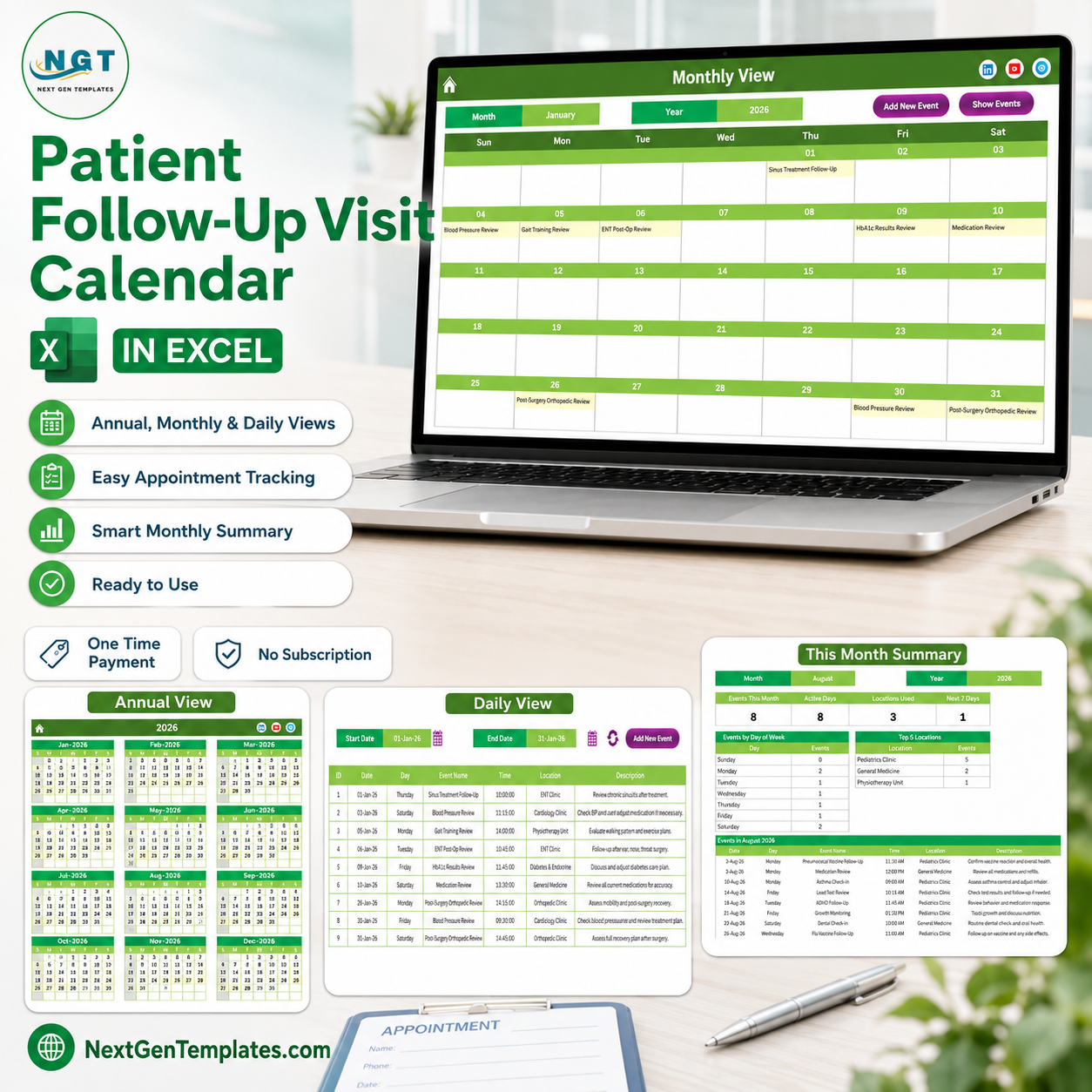
The Patient Follow-Up Visit Calendar in Excel is a 7-worksheet, macro-driven calendar workbook that ships with 100 pre-filled sample follow-up visits dated across the whole of 2026 – from 1 January to 30 December, with every month populated – spread over eight clinic departments: General Medicine, Diabetes & Endocrine, Cardiology Clinic, Orthopedics Clinic, Pediatrics Clinic, ENT Clinic, Physiotherapy Unit and Oncology Clinic. Every record carries the same seven fields (ID, Date, Day, Event Name, Time, Location, Description), and the Annual, Monthly, Daily and This Month views all rebuild from that one Events sheet. Setup takes under 10 minutes.
🌍 Join 8,400+ teams in 40+ countries using NextGenTemplates to replace paid SaaS tools with one-time-purchase Excel, Google Sheets, Power BI and HTML templates.
✅ Instant download · One-time payment · No subscription · No per-user fees · Lifetime access
⚠️ Please read this before you buy. This workbook is a scheduling calendar and nothing more. It is not a patient record system, not an EHR or EMR, and not a practice management or patient-recall system. It is not HIPAA, GDPR or any other health-data-protection compliant or certified. It has no access control, no encryption and no audit trail; it does not secure anything you type into it. It takes no online bookings, sends no reminders, recalls, SMS or email notifications, connects to no clinical, insurance or billing system, and tracks no treatment plans, outcomes or clinical progress. It supports no clinical or continuity-of-care decision. The workbook holds only what the owner types into their own copy of the file, and a spreadsheet that gets emailed around a clinic is not an appropriate place to store patient-identifiable information. Notably, the Events sheet has no patient name and no patient ID column at all – the shipped sample is written entirely as visit types, departments, dates and times, and that is how it is meant to be used.
🔑 Key Features of the Patient Follow-Up Visit Calendar in Excel
- 📅 Four linked views from one events list. Annual View, Monthly View, Daily View and This Month all read the same Events sheet, so a visit typed once appears everywhere. There is no second copy of the schedule to keep in step.
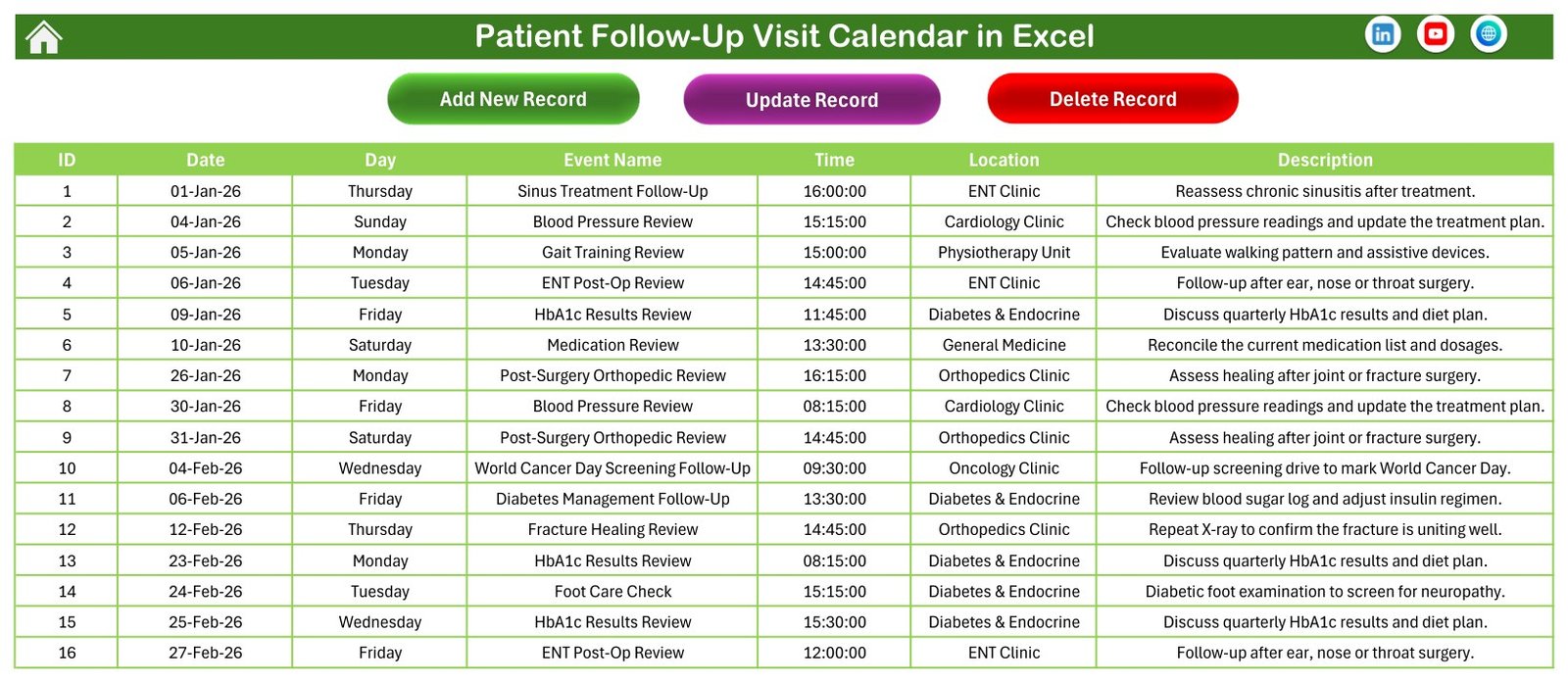
- 🖱️ VBA record management. Add New Record, Update Record and Delete Record buttons sit above the Events table, and an Add New Event button repeats on the Monthly and Daily views alongside Show Events and a refresh control.
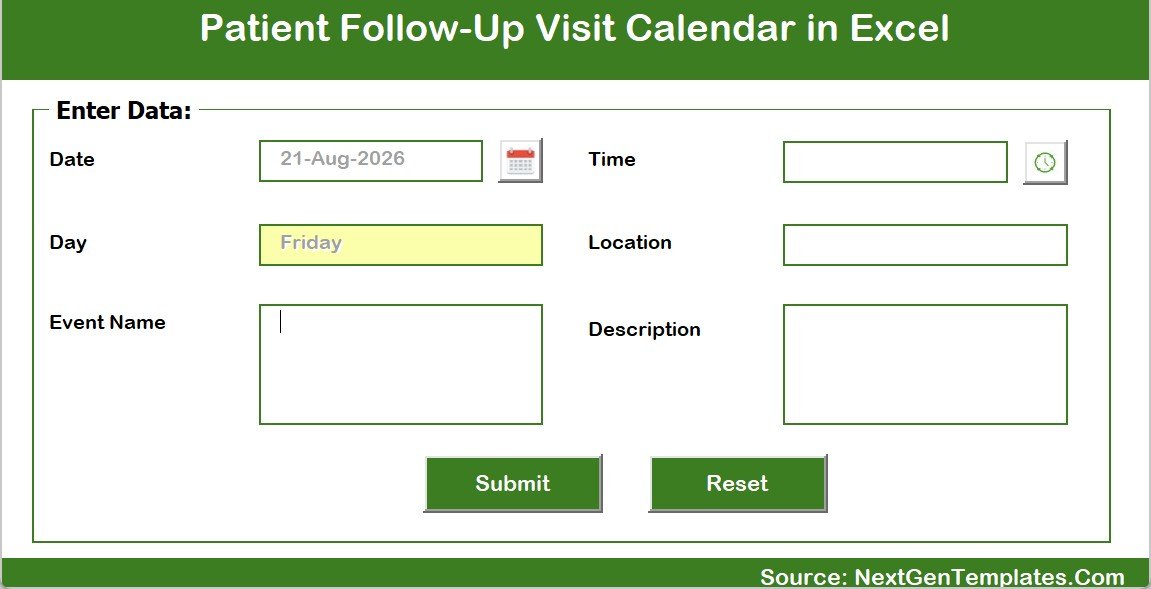
- 📝 A six-field pop-up entry form with a date picker on Date and a clock picker on Time. It captures Event Name, Location and Description, fills Day automatically from the date chosen, and has Submit and Reset buttons. There is deliberately no patient-identity field.
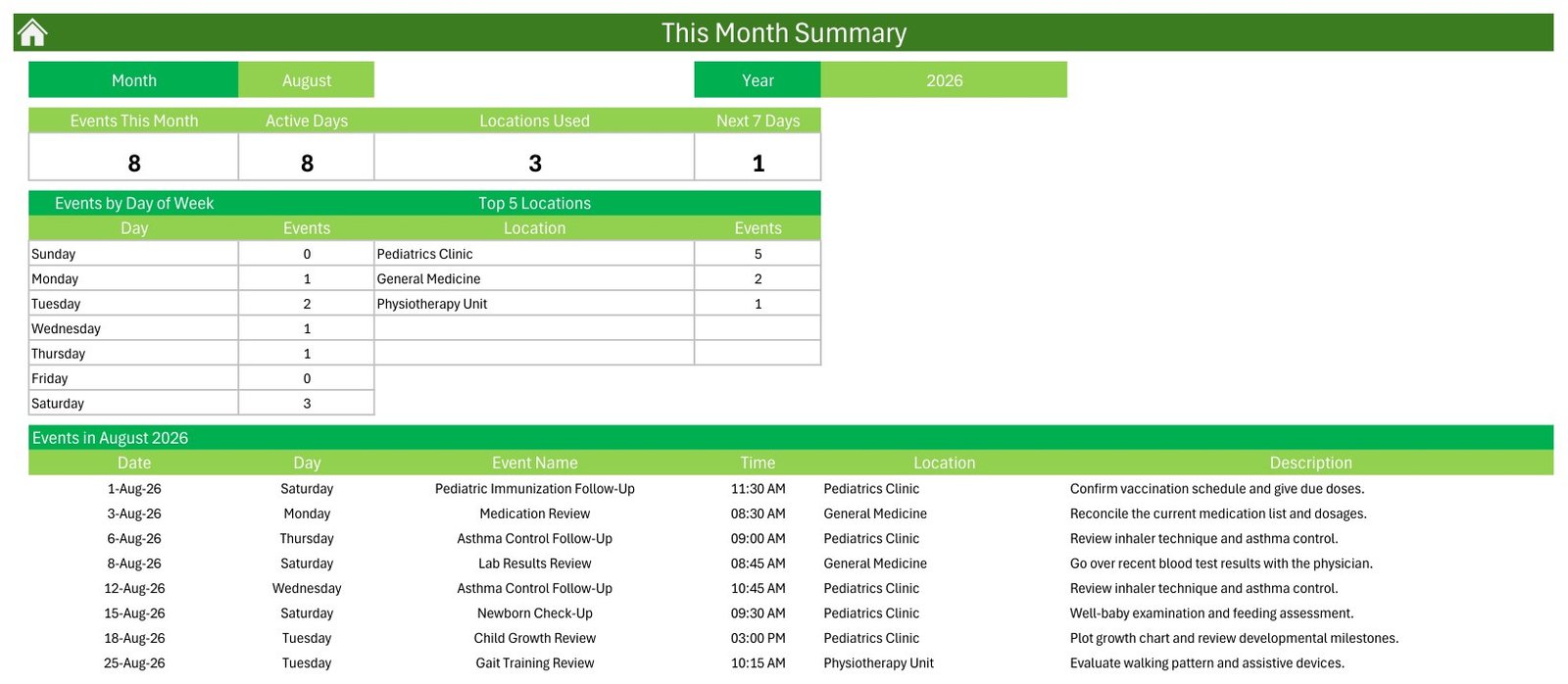
- 📊 A This Month summary that counts for you. Four cards – Events This Month, Active Days, Locations Used and Next 7 Days – sit above an Events by Day of Week table and a Top 5 Locations ranking, with the full month’s visits listed underneath. In the shipped August 2026 sample the cards read 8, 8, 3 and 1.
- 🏥 100 follow-up visits already written in clinic language. Forty-four distinct visit types across the sample year – HbA1c Results Review, ENT Post-Op Review, Medication Review, Post-Surgery Orthopedic Review, Post-Angioplasty Review, Heart Failure Monitoring, Gait Training Review, Fracture Healing Review, Pediatric Immunization Follow-Up, Tumor Marker Review and more – not “Event 1, Event 2”.
- 🎨 A Setting sheet that re-skins the workbook. Any year from 2021 to 2051, the starting month, the week start day, two highlight weekdays, an event-shading switch and five colour themes: Default, Blue, Red, Black and Orange. It ships set to 2026, starting in January, with weeks beginning on Sunday.
- 💾 Yours offline, forever. One .xlsm file on your own machine or clinic share. No login, no seat count, no renewal, no cloud account.
📦 What’s Inside the Patient Follow-Up Visit Calendar in Excel
Sheet 1: Home Menu
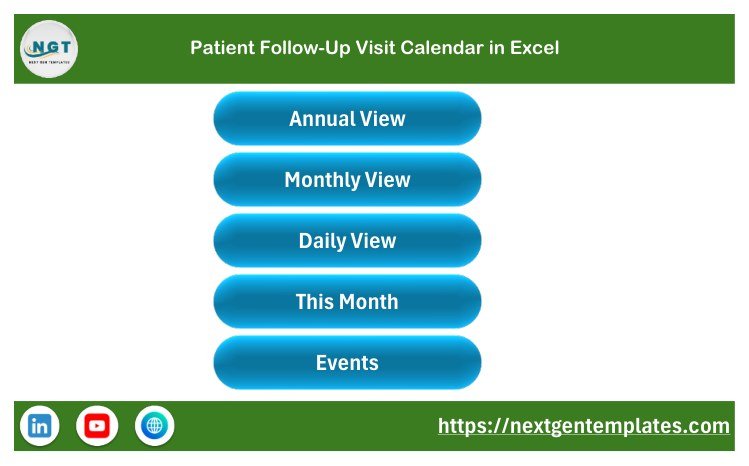
The landing sheet carries the workbook title and five navigation buttons – Annual View, Monthly View, Daily View, This Month and Events – so anyone at a reception desk reaches a view in one click.
Sheet 2: Annual View
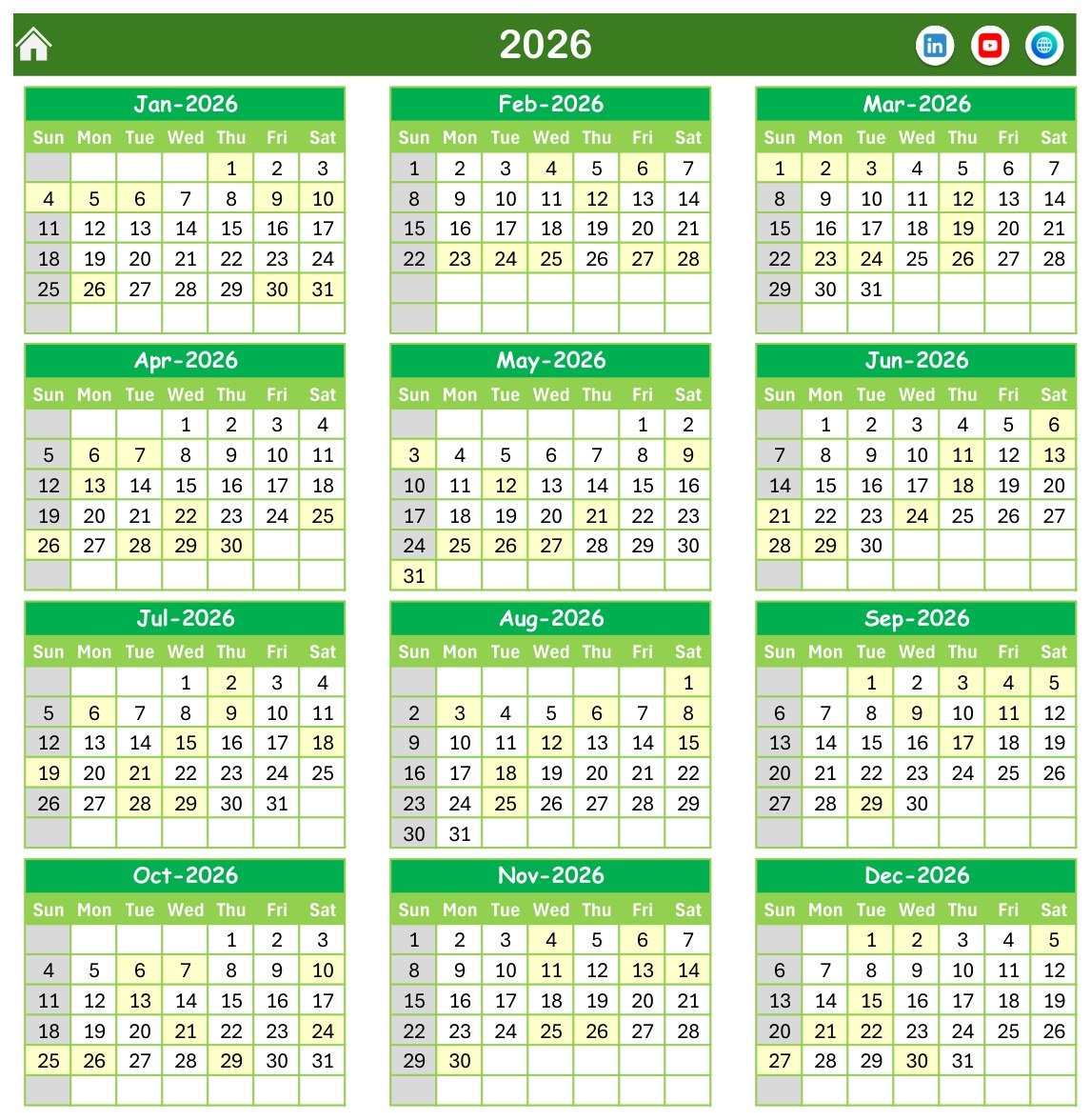
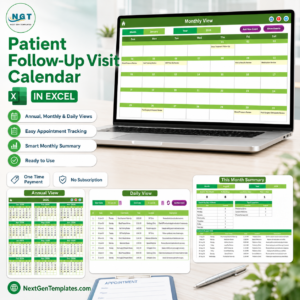
All twelve months of the selected year on one page, four rows by three columns, with Sun-to-Sat headers. Days carrying a follow-up visit are shaded, so the shape of the year – the busy stretches and the empty weeks – is visible without scrolling.
Sheet 3: Monthly View
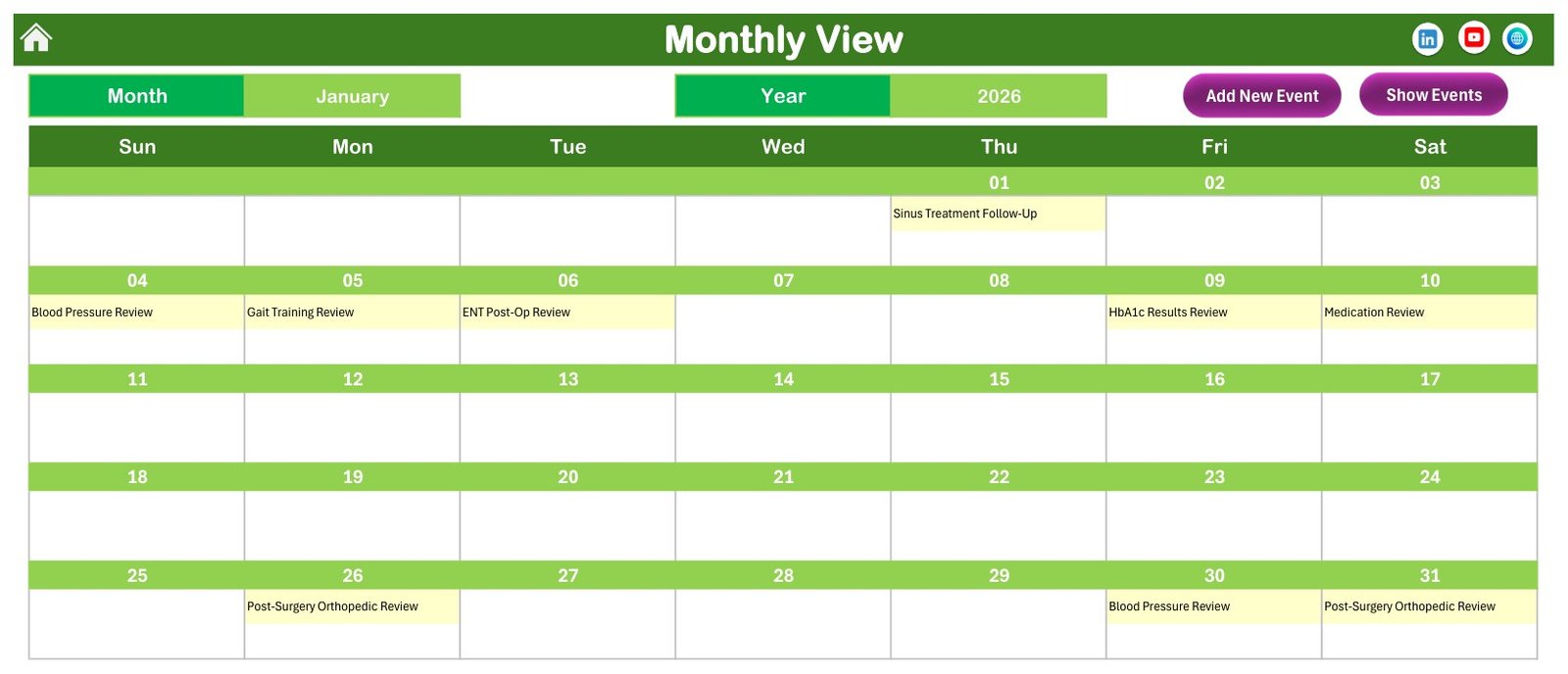
A month grid driven by Month and Year selectors, with the visit name printed inside each date cell and Add New Event / Show Events buttons in the header. The January 2026 sample shows nine visits: Sinus Treatment Follow-Up on the 1st, Blood Pressure Review on the 4th, Gait Training Review on the 5th, ENT Post-Op Review on the 6th, HbA1c Results Review on the 9th, Medication Review on the 10th, Post-Surgery Orthopedic Review on the 26th, Blood Pressure Review on the 30th and Post-Surgery Orthopedic Review on the 31st.
Sheet 4: Daily View
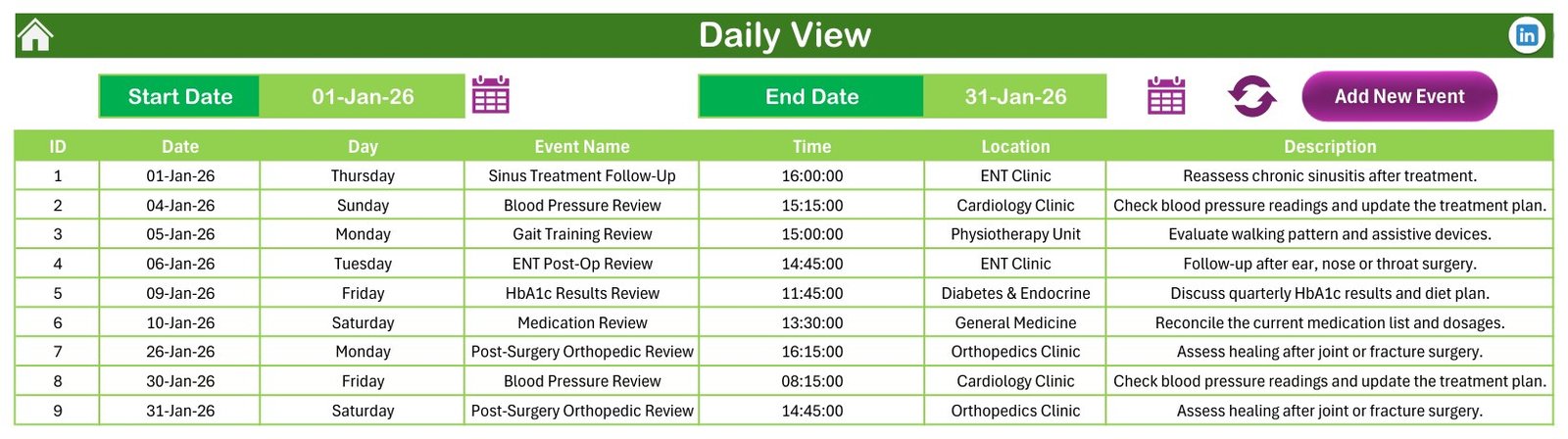
Set a Start Date and an End Date and the sheet lists every visit in that window as a printable run sheet: ID, Date, Day, Event Name, Time, Location and Description. The shipped range is 01-Jan-26 to 31-Jan-26 and returns the nine January visits, each with its department and a one-line note such as “Discuss quarterly HbA1c results and diet plan.”
Sheet 5: This Month Summary
Pick a month and year and the sheet counts for you. Four cards – Events This Month, Active Days, Locations Used, Next 7 Days – sit above an Events by Day of Week table and a Top 5 Locations ranking, with the full month listed beneath. In the shipped August 2026 sample the cards read 8, 8, 3 and 1; the weekday table shows three Saturdays, two Tuesdays and one each on Monday, Wednesday and Thursday; and the locations rank Pediatrics Clinic 5, General Medicine 2, Physiotherapy Unit 1. Only three rows appear under Top 5 Locations because only three departments were used that month.
Sheet 6: Events Database
The single source every view reads from: 100 rows under seven columns – ID, Date, Day, Event Name, Time, Location and Description – with Add New Record, Update Record and Delete Record buttons above the table. The sample runs from 1 January to 30 December 2026 and covers all twelve months. Department volumes in the sample are General Medicine 15, Diabetes & Endocrine 15, Cardiology Clinic 14, Orthopedics Clinic 14, Pediatrics Clinic 12, ENT Clinic 11, Physiotherapy Unit 11 and Oncology Clinic 8.
The entry form
Clicking Add New Record opens a pop-up “Enter Data” form: Date with a date picker, Day filled automatically, Event Name, Time with a clock picker, Location and Description, plus Submit and Reset. Records go in through the form, so dates and times stay in a consistent format and every view keeps working.
Sheet 7: Setting
The control panel behind the calendar. Choose the year (2021 to 2051), the month the calendar starts with, the day your week begins, two weekdays to highlight, whether event days are shaded, and one of five colour themes: Default, Blue, Red, Black or Orange. Change the year and every view redraws around your own dates.
📊 Patient Follow-Up Visit Calendar in Excel vs. a Google Sheets Calendar vs. Paid Clinic Booking Software
| Feature | Patient Follow-Up Visit Calendar in Excel | Google Sheets calendar equivalent | Practice booking software (e.g. Cliniko, Jane App) |
|---|---|---|---|
| Cost | $4.99 one-time | Free with a Google account | Typically $45-95 per practitioner / month |
| Platform | Excel for Windows desktop (.xlsm, macros required) | Browser, any device | Browser and mobile app |
| Setup time | ✅ Under 10 minutes | ✅ Under 10 minutes | Days – onboarding, imports, training |
| Works fully offline | ✅ Yes | ❌ No | ❌ No |
| Annual, Monthly, Daily and summary views in one file | ✅ All four, built in | Usually one view | ✅ Yes |
| Sample data written for follow-up clinics | ✅ 100 visits, 44 visit types, 8 departments | ❌ Build it yourself | ❌ Empty on day one |
| Patient self-booking online | ❌ No | ❌ No | ✅ Yes |
| Automated recalls, SMS or email reminders | ❌ No – it sends nothing | ❌ No | ✅ Yes |
| Patient records, clinical notes, billing | ❌ No – a calendar, not a clinical system | ❌ No | ✅ Yes |
| Access control, encryption, audit trail | ❌ None | ❌ Sharing permissions only | ✅ Yes |
| Year-1 cost for a 5-practitioner clinic | $4.99 total | $0 | $2,700-5,700 |
| You own the file, no vendor lock-in | ✅ Yes | Tied to a Google account | ❌ No |
For a small clinic or department that wants its follow-up sessions laid out clearly by date, time and room – without paying per practitioner every month for booking software it does not need – the Patient Follow-Up Visit Calendar in Excel sits in the sweet spot. If patients must book themselves online, if recalls have to go out automatically, or if you need clinical notes, buy real practice software instead. This workbook does none of those things.
👥 Who This Template Is For – and Who It’s Not For
✅ This template is built for:
- Small clinics and outpatient departments laying out follow-up sessions by date, time and department
- Receptionists and coordinators who print a week’s run sheet from the Daily View and pin it up
- Multi-department practices juggling cardiology, orthopedics, ENT, diabetes and physiotherapy slots in one shared diary
- Anyone planning a year of review clinics in advance and wanting to see the busy and quiet stretches at a glance
- Excel users who would rather own a file than rent a seat
❌ This template is NOT for:
- Storing patient-identifiable or clinical information – the file offers no access control, no encryption and no audit trail, and there is no patient field in it by design
- Anyone needing an EHR, EMR, practice management or patient-recall system – this is none of those
- Clinics needing online self-booking, automated recalls, SMS or email reminders, insurance claims or billing
- Practices that require a HIPAA, GDPR or otherwise certified, access-controlled system; this workbook makes no such claim
- Anything that informs clinical or continuity-of-care decisions – it is a diary, not a clinical tool
- Mac-only or tablet-only teams – the buttons and pop-up form need Excel for Windows desktop with macros enabled
- Teams needing several people editing the same calendar simultaneously – use a Google Sheets calendar instead
⚙️ How to Use the Patient Follow-Up Visit Calendar in Excel
- Unzip the download and open the .xlsm in Excel for Windows. Click Enable Content – the buttons and the pop-up form are VBA and will not run otherwise.
- On the Setting sheet, pick your calendar year, the starting month, the day your week begins, your highlight weekdays and one of the five colour themes.
- On the Events sheet, look at how the 100 sample rows are structured, then delete them when you are ready to enter your own.
- Click Add New Record and fill the form: date, time, department in Location, the visit type in Event Name, and a short note in Description. Keep it to visit types and internal references – never patient names or clinical detail.
- Check the Monthly View: the visit now sits inside its date cell, and the Annual View shades that day.
- Use the Daily View with a start and end date to print a day’s or a week’s run sheet.
- Open This Month for the counts – visits this month, active days, departments used, what falls in the next 7 days, the weekday spread and the busiest departments.
- To change or remove a visit, select its row on the Events sheet and use Update Record or Delete Record.
- Save as .xlsm. Saving as .xlsx silently strips the macros and the buttons stop working.
💼 Real-World Use Cases
A multi-department outpatient clinic. Eight departments share one diary. The coordinator books review slots into the Events sheet and prints Monday’s list from the Daily View; This Month tells her that Pediatrics carried five of August’s eight sessions.
A diabetes review clinic. Quarterly HbA1c reviews, insulin titration visits and diabetic foot checks are laid out a year ahead in the Annual View, so the team can see which quarters are already full before agreeing to add a new clinic.
A small orthopedic practice. Post-surgery reviews, fracture healing checks and cast removal follow-ups sit in the Monthly View with the room in the Location field, so nobody double-books the plaster room.
A department planning its awareness calendar. Fixed-date sessions such as a World Diabetes Day follow-up camp or a World Cancer Day screening follow-up go in once, in the right month, and stay visible in the Annual View all year.
❓ Frequently Asked Questions
Is the Patient Follow-Up Visit Calendar in Excel a patient record system, and is it HIPAA or GDPR compliant?
No. It is an offline scheduling calendar and nothing more. It is not an EHR, EMR, practice management or patient-recall system, it holds no clinical record, and it is not HIPAA, GDPR or any other health-data-protection compliant or certified. It has no access control, no encryption and no audit trail, and it does not secure whatever is typed into it. Do not store patient-identifiable information in it.
Will it send follow-up reminders or recalls to patients?
No. The workbook sends nothing at all – no SMS, no email, no recall letters, no notifications of any kind. It does not connect to a clinic, insurance or billing system, and it takes no online bookings. It is a file you open and fill in yourself. If you need automated recalls, use dedicated practice software.
What should I type instead of patient details?
Use the visit type and, if you need one, an internal reference code – “HbA1c Results Review” or “Ref 4182 – post-op review”. The workbook has no patient name or patient ID column, and the 100 shipped samples contain no patient identifiers anywhere; it is built around visit types, departments, dates and times and works perfectly well that way. Keep real clinical detail in your governed clinical system.
Does it track treatment plans, outcomes or continuity of care?
No. It records that a visit is scheduled on a date, at a time, in a department, with a short free-text note. It carries no clinical status, no outcome, no history and no linkage between visits, and nothing in it should be used to inform a clinical or continuity-of-care decision.
Do I need macros, and does it work on Mac?
Yes to macros. The Add New Record, Update Record and Delete Record buttons and the pop-up entry form are VBA, so the workbook needs Excel for Windows desktop with content enabled. Excel for Mac, Excel on the web and mobile Excel do not run these forms reliably. Save the file as .xlsm, never .xlsx.
How long does setup take?
Under 10 minutes. Unzip, enable macros, set your year and theme on the Setting sheet, clear the 100 sample visits and start adding your own. Every view rebuilds from the Events sheet, so there is nothing else to configure.
Can I use it for a year other than 2026?
Yes. The Setting sheet offers any year from 2021 to 2051, plus the starting month and the day your week begins. Change the year and the Annual, Monthly and Daily views redraw around your own dates.
Can several people use it at the same time?
Not comfortably. It is a desktop workbook, so one person edits it at a time and shares the file. If simultaneous editing matters more than the VBA forms, a Google Sheets calendar is the better fit.
👤 About the Author
Built by PK – Microsoft Certified Professional with 15+ years of Excel, Google Sheets and Power BI experience. Founder of NextGenTemplates, reaching 300K+ subscribers across YouTube channels (@PK-AnExcelExpert, @NextGenTemplates, @NeoTechNavigators). Every template is hand-built and tested before release.
🔗 Explore Related Templates
- Dental Clinic Appointment Calendar in Excel – the same calendar engine built around a dental caseload.
- Physiotherapy Session Calendar in Excel – the same engine for rehab groups, hydrotherapy and home-visit rounds.
- Healthcare Staff Duty Calendar in Excel – the staff rota companion to this visit calendar.
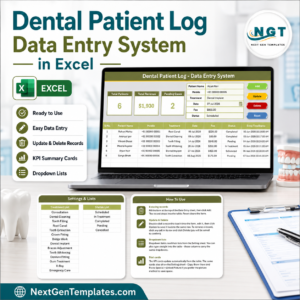
- Dental Patient Log Data Entry System in Excel – a searchable visit log with a form and summary cards rather than a calendar grid.
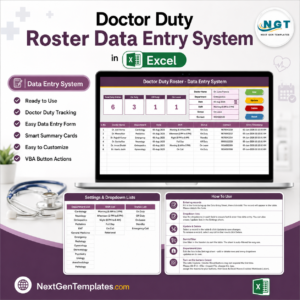
- Doctor Duty Roster Data Entry System in Excel – who is on duty, alongside what is scheduled.
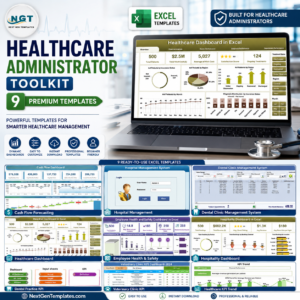
- Healthcare Administrator Toolkit – nine premium Excel templates for healthcare administration in one discounted bundle.
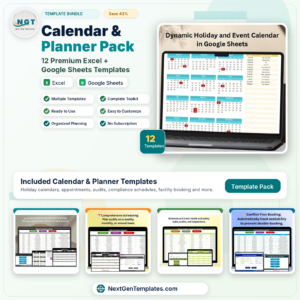
- Calendar & Planner Pack – twelve premium Excel and Google Sheets calendar templates at a bundle price.
Also available as a Google Sheets alternative in the Medical Appointment Calendar in Google Sheets. Browse the whole Calendar Templates range, or our wider MS Excel Templates library.
📖 Click here to read the Detailed Blog Post
🎥 Visit our YouTube channel for step-by-step video tutorials
👉 YouTube.com/@NextGenTemplates
📅 Last updated: August 2026














Reviews
There are no reviews yet.