


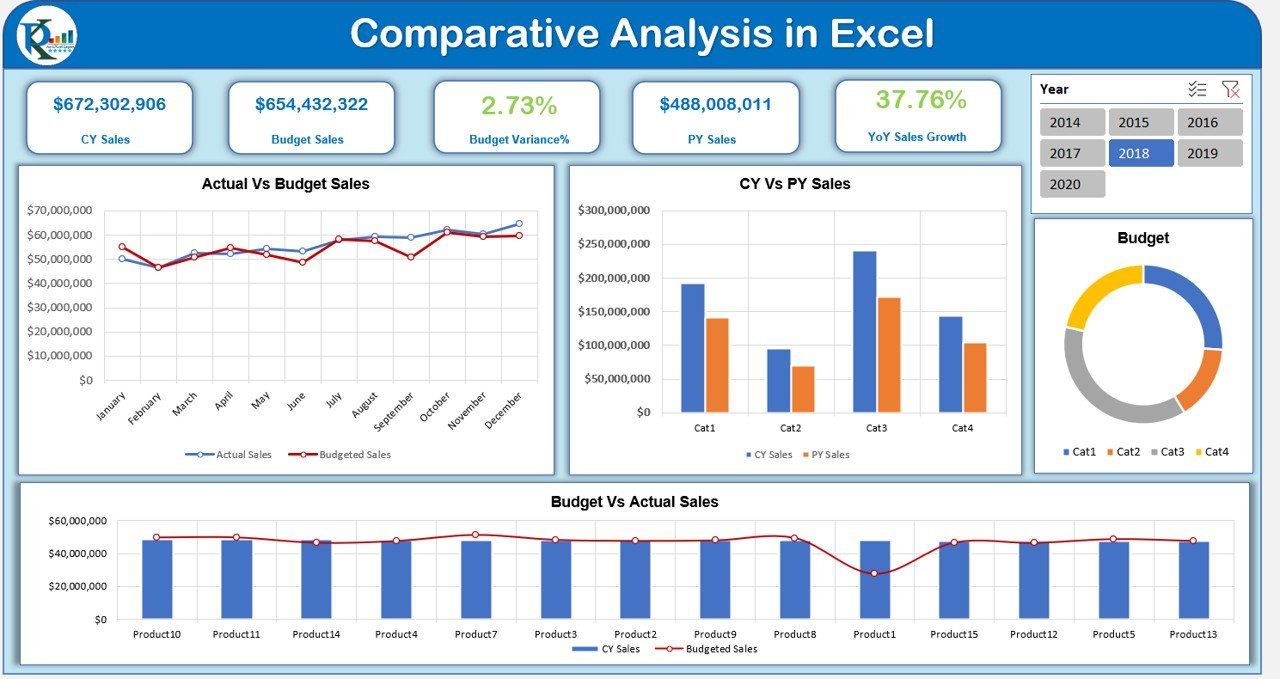
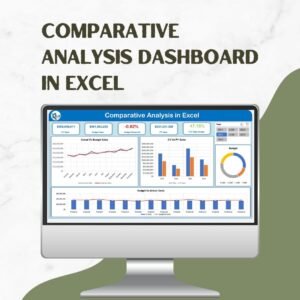
The Comparative Analysis Dashboard in Excel is a ready-made, interactive template for comparing actual sales against budget, tracking variances and analysing product performance in one place. It is built for business owners, managers, finance teams and sales analysts who need clear budget vs actual reporting. It combines a dynamic data model, DAX-powered calculations and interactive visuals, so you can spot revenue gaps and make data-driven decisions faster.
Key Features of the Comparative Analysis Dashboard
1. Dynamic Data Model Integration
The dashboard is built on a robust data model that connects three key Excel tables. Because the datasets are linked, you can analyse trends across budget, product and sales data and get a complete view of business performance.
2. Sales and Budget Variance Tracking
Variance, the difference between actual performance and planned targets, is central to financial management. This dashboard uses clear visualizations and KPI indicators to highlight:
- Positive variances: when sales exceed the budget.
- Negative variances: when sales fall short of the target.
- Percentage deviation from planned figures.
This variance analysis helps managers address revenue gaps early and adjust sales strategies.
3. Advanced DAX Measures for Insightful Analysis
The template includes calculated DAX measures (Data Analysis Expressions) for deeper analytics:
- Year-over-Year (YoY) Growth Rates: compare performance across time periods.
- Sales Performance by Category/Product: identify top-performing and underperforming products.
- Budget Adherence Ratio: measure how closely actual sales match the budget.
With these metrics you can assess profitability, identify trends and make better decisions.
4. Interactive Visuals and Filters
- Slicers and dropdown filters to drill down by region, product category and time period.
- Dynamic charts showing budget vs actual sales performance.
- Conditional formatting that highlights areas needing attention.
5. Automated Reporting and Business Intelligence
This Excel sales dashboard cuts down manual reporting by:
- Updating automatically when inputs are refreshed.
- Generating real-time reports based on the latest sales and budget data.
- Providing executive-level insights in an easy-to-read format.
The automated workflow supports accuracy and reduces the time spent on data analysis.
What’s Inside the Template
| Component | Purpose |
|---|---|
| Budget Table | Stores planned revenue figures for each product and period. |
| Product Master Table | Maintains product details, including categories and pricing. |
| Sales Table | Captures actual sales figures for an accurate performance comparison. |
| Data Model and DAX Measures | Links the tables and calculates YoY growth, category/product performance and budget adherence ratio. |
| Dashboard | Interactive charts, KPI indicators, slicers, dropdown filters and conditional formatting for variance analysis. |
Who Is This Dashboard For?
- Business Owners and Managers: track sales and budget compliance.
- Finance and Accounting Teams: monitor revenue trends and plan financial strategies.
- Sales Teams and Analysts: evaluate product performance and improve selling strategies.
Why Choose This Dashboard?
- No complex formulas required: DAX-powered automation handles the calculations.
- Customizable: adapt it to your organization’s reporting needs.
- Visually intuitive: variance tracking and trend analysis in one place.
How to Use It
- Enter your products, categories and pricing in the Product Master Table.
- Add planned revenue for each product and period in the Budget Table.
- Record actual sales in the Sales Table.
- Refresh the data so the model and DAX measures update.
- Use the slicers and dropdown filters to explore budget vs actual results by region, product category and time period.
Click here to read the detailed blog post
Watch the step-by-step video tutorial:
Frequently Asked Questions
What does the Comparative Analysis Dashboard in Excel do?
It compares actual sales with budgeted figures, shows positive and negative variances and percentage deviation, and uses DAX measures to calculate YoY growth, category/product performance and a budget adherence ratio.
Which data tables does it use?
It uses three linked Excel tables: a Budget Table, a Product Master Table and a Sales Table, connected through a data model.
Do I need to write formulas myself?
No. The calculations are handled by built-in DAX measures, so you only need to enter or refresh your data.
Can I filter the results?
Yes. Slicers and dropdown filters let you drill down by region, product category and time period, and the dynamic charts update accordingly.
Can I customize the dashboard?
Yes. The template is customizable, so you can adapt it to your organization’s specific reporting needs.
Is there a tutorial?
Yes. A detailed blog post and a step-by-step video tutorial are linked above.
Also check our Inventory Management Form in Excel.
Last updated: October 2026
Compatibility and Requirements
- Works in Microsoft Excel desktop (Excel 2016 or later, or Microsoft 365).
- Slicers and dropdown filters are standard Excel features. Microsoft explains slicers in Use slicers to filter data.
Related Budget and Variance Templates
- Comparative Analysis Dashboard in Power BI: the same dashboard for Power BI users
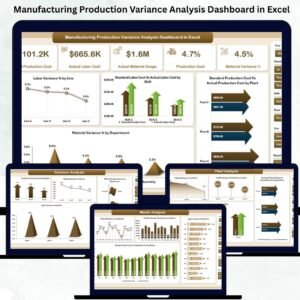
- Manufacturing Production Variance Analysis Dashboard in Excel: variance analysis for production
- Dynamic Variance Arrows Chart with Slicers: a variance chart you can filter
- Finance & Accounting Command Center: 8 premium finance templates in one bundle
Browse all Excel dashboards or the Excel sales and marketing templates.




Reviews
There are no reviews yet.