

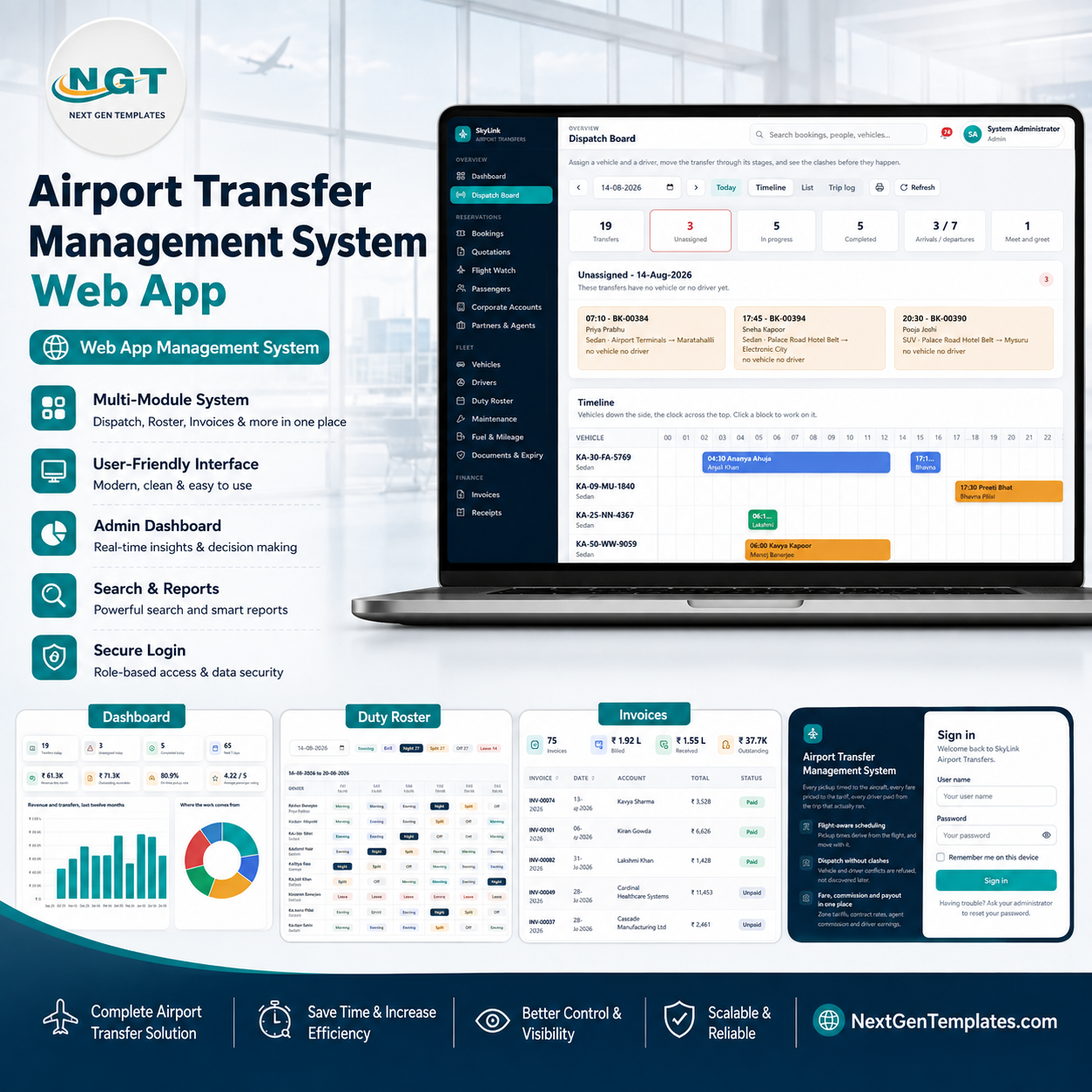
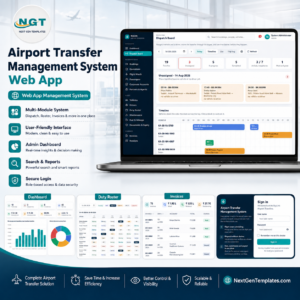
The Airport Transfer Management System Web App is a 34-page booking and dispatch record system for airport transfer, chauffeur and ground-mobility operators, built on Google Apps Script and Google Sheets. It ships with 37 database tables, 7 sign-in roles, a tariff matrix of 160 rate rows across 8 vehicle classes, 22 operating reports and a demo database seeded with 5,983 records – 520 bookings, roughly 380 flights, 26 vehicles and 30 drivers – so every screen and every chart is populated the moment you open it. One payment, no monthly seat fee, and the whole thing runs inside your own Google account. Try the live demo below before you spend anything.
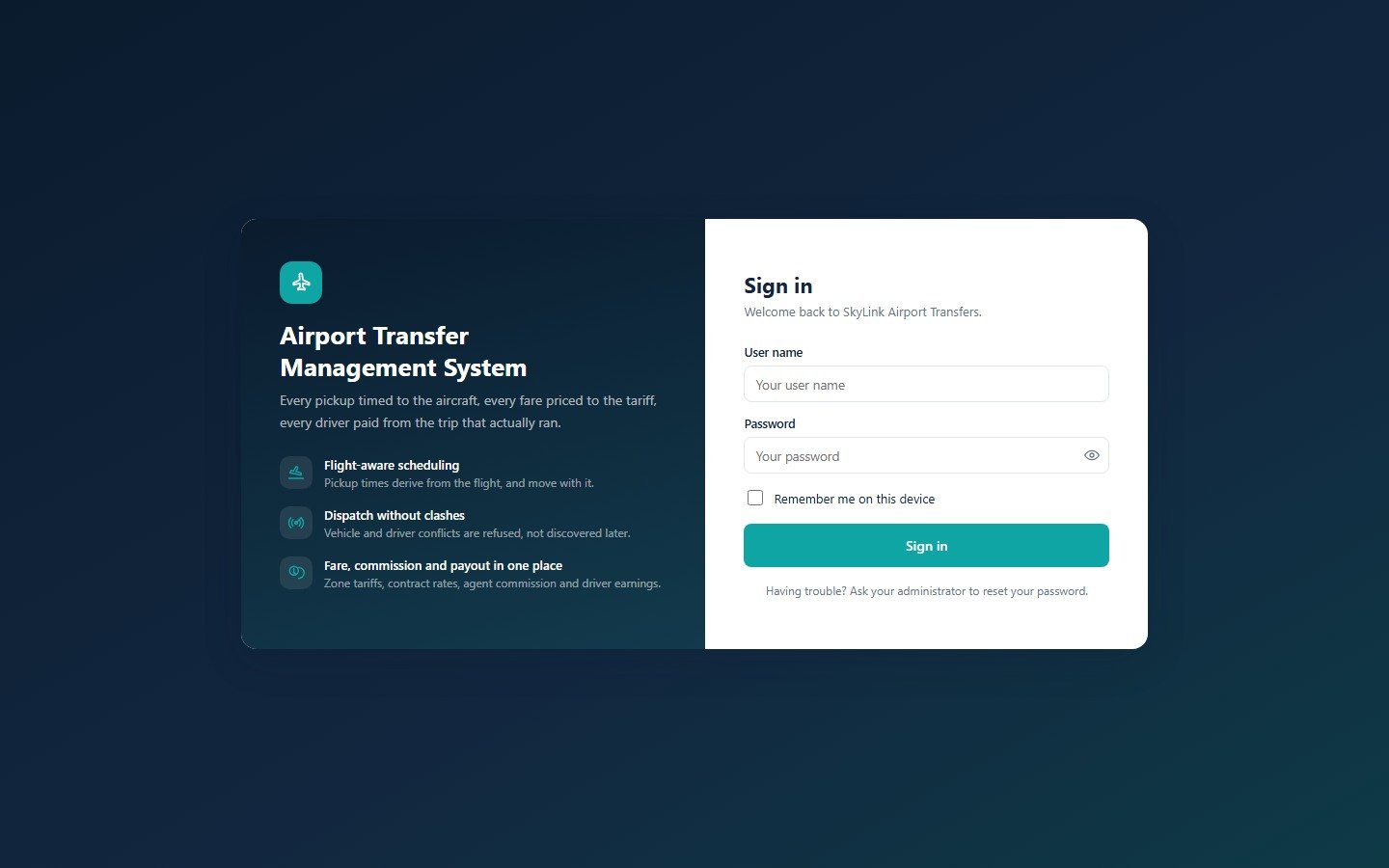
The sign-in screen
Each of the seven roles signs in here against its own account. The menu that loads afterwards only contains the modules that role is allowed to open, and the server re-checks the permission before it touches any data.
🚀 Try the Live Demo Before You Buy
We have deployed this web app in our own Google account so you can test every page, every role and every report – with the full seeded demo dataset – before purchasing. No signup, no email required.
🔑 Test Login Credentials
Sign in as admin to see everything including Users, Settings and the archive, or as dispatch to see how much a restricted role is refused – no pricing edits and no finance. Sign in as finance and the dispatch board disappears from the menu entirely. That role separation is the point of the product, so it is worth two minutes.
💡 These are public demo logins. They belong to a shared demonstration instance that is periodically reset – not to a customer deployment, and not to a system you are buying access to. Anything you type into the demo may be wiped or seen by another visitor, so do not enter real passenger or business data. What you get after purchase: the full source code (Code.gs + Index.html) plus a step-by-step deployment guide, so you can stand up your own private instance in your own Google account, with your own passwords, in under 15 minutes.
Key Features of the Airport Transfer Management System Web App
- Pickup times derived from the flight, not guessed. Each airport carries four buffers – domestic and international arrival clearance, domestic and international check-in lead. Change a flight’s estimated time in Flight Watch and every linked pickup is re-derived, with a preview before you apply it.
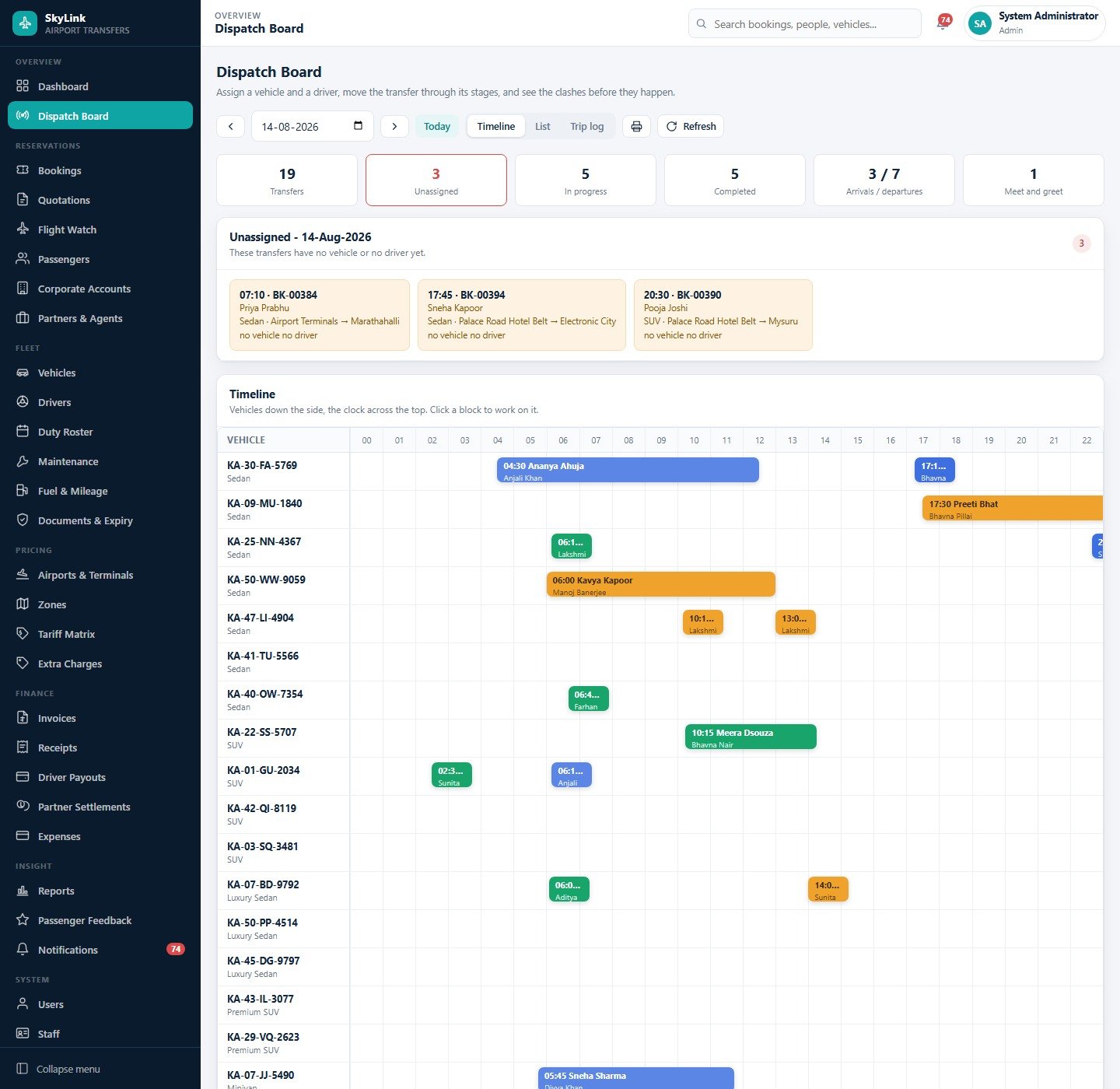
- A dispatch board that shows clashes before they happen. Vehicles down the side, the clock across the top, an unassigned strip at the head of the day, and six counters: transfers, unassigned, in progress, completed, arrivals versus departures, and meet-and-greet jobs.
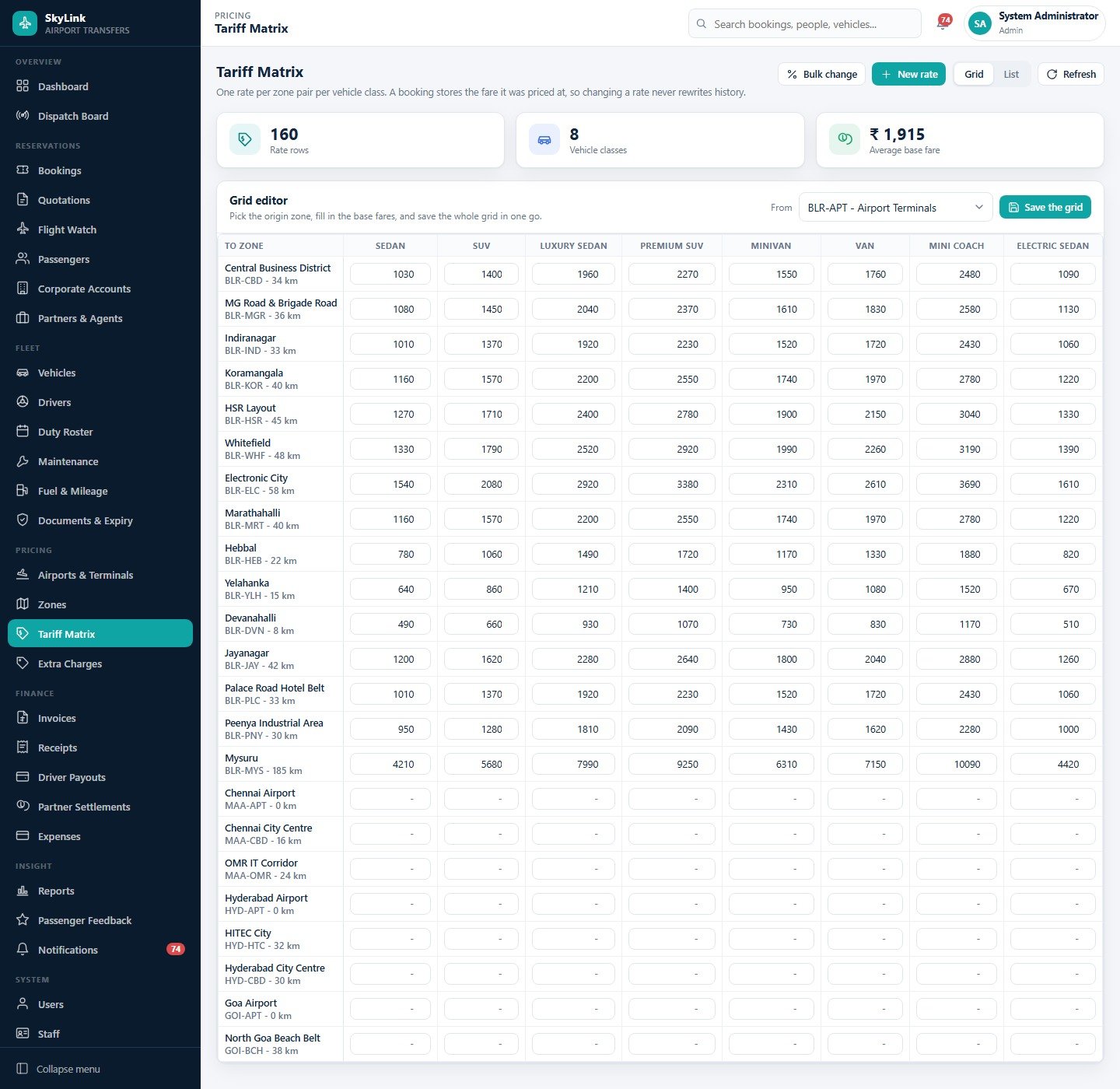
- A 160-row tariff matrix. One rate per zone pair per vehicle class across 8 classes, edited in a grid or a list, with a bulk percentage change that previews first. A booking stores the fare it was priced at, so changing a rate never rewrites history.
- 14 extra charges the reservations desk simply ticks. Flat, per-unit and per-hour rates, each with its own taxable flag and its own “applies to” rule – airport pickup only, intercity only, or everything.
- Four driver payout models. Fixed per trip, per kilometre, percentage of fare, or monthly salary, with allowances and deductions, built from the trips that actually ran rather than the trips that were booked.
- Partner and agent commission in the same ledger. Flat per trip, percentage of net, or a net-rate card, settled per period into a statement you can print or email.
- Corporate accounts with credit control. Contract rates, a credit limit, payment terms in days, and a weekly, fortnightly or monthly consolidated invoice per account.
- A document expiry register you maintain. One place for insurance, permits, fitness certificates, driving licences and airport badges, with the dates you enter, a days-left column and an optional morning digest email.
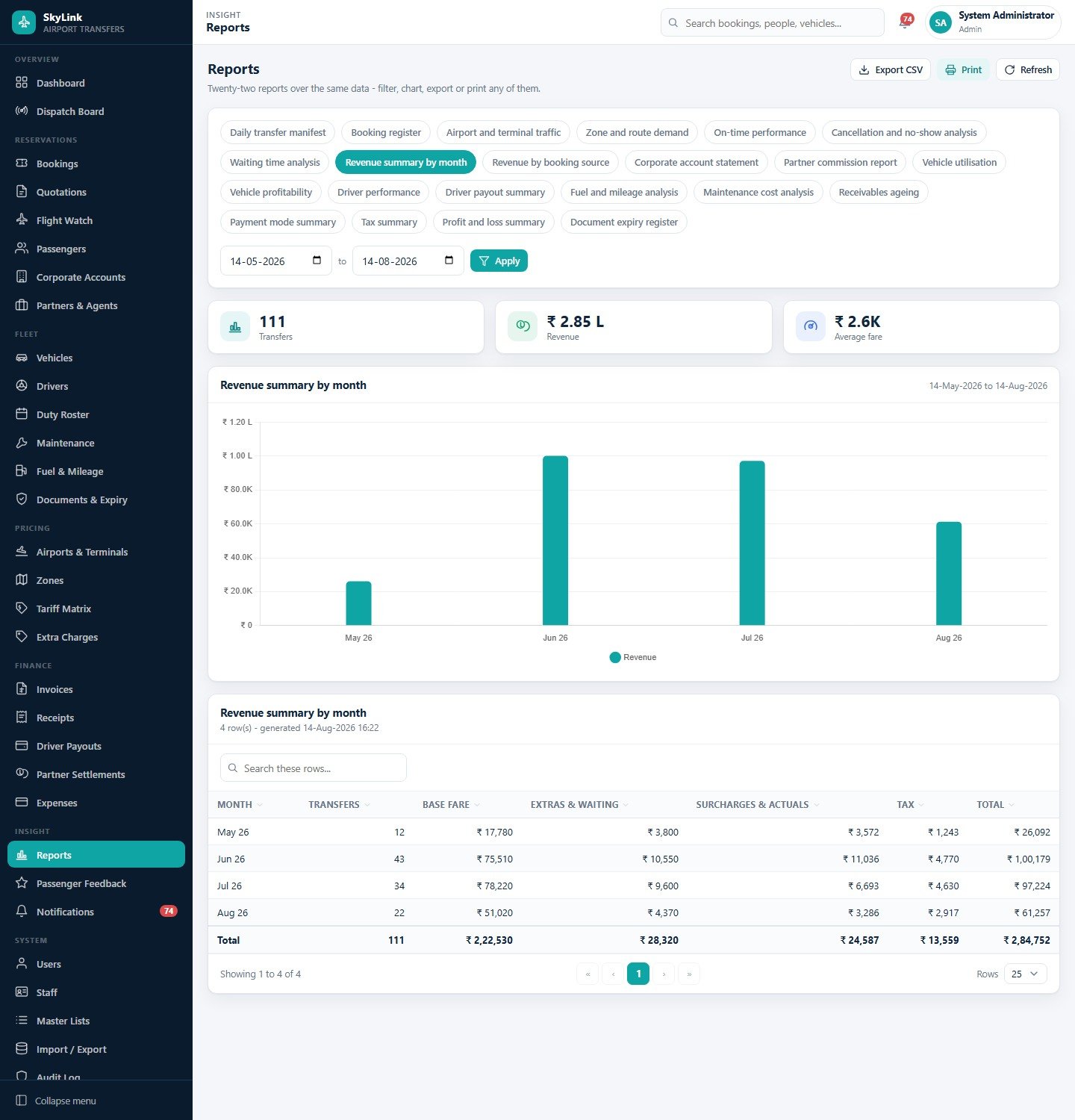
- 22 reports over the same data. Daily transfer manifest, on-time performance, waiting time analysis, zone and route demand, vehicle profitability, driver payout summary, receivables ageing, tax summary, profit and loss summary and more – each filterable, chartable, printable and exportable to CSV.
- Runs in your own Google account. Apps Script plus Google Sheets. No server to rent, no per-seat licence, and the database is a spreadsheet you own outright.
What’s Inside the Airport Transfer Management System Web App
Thirty-four in-app pages sit behind the sign-in screen, grouped into Overview, Reservations, Fleet, Pricing, Finance, Insight, System and Support. Everything below was photographed from the shipped build running on its seeded demo database.
Dashboard
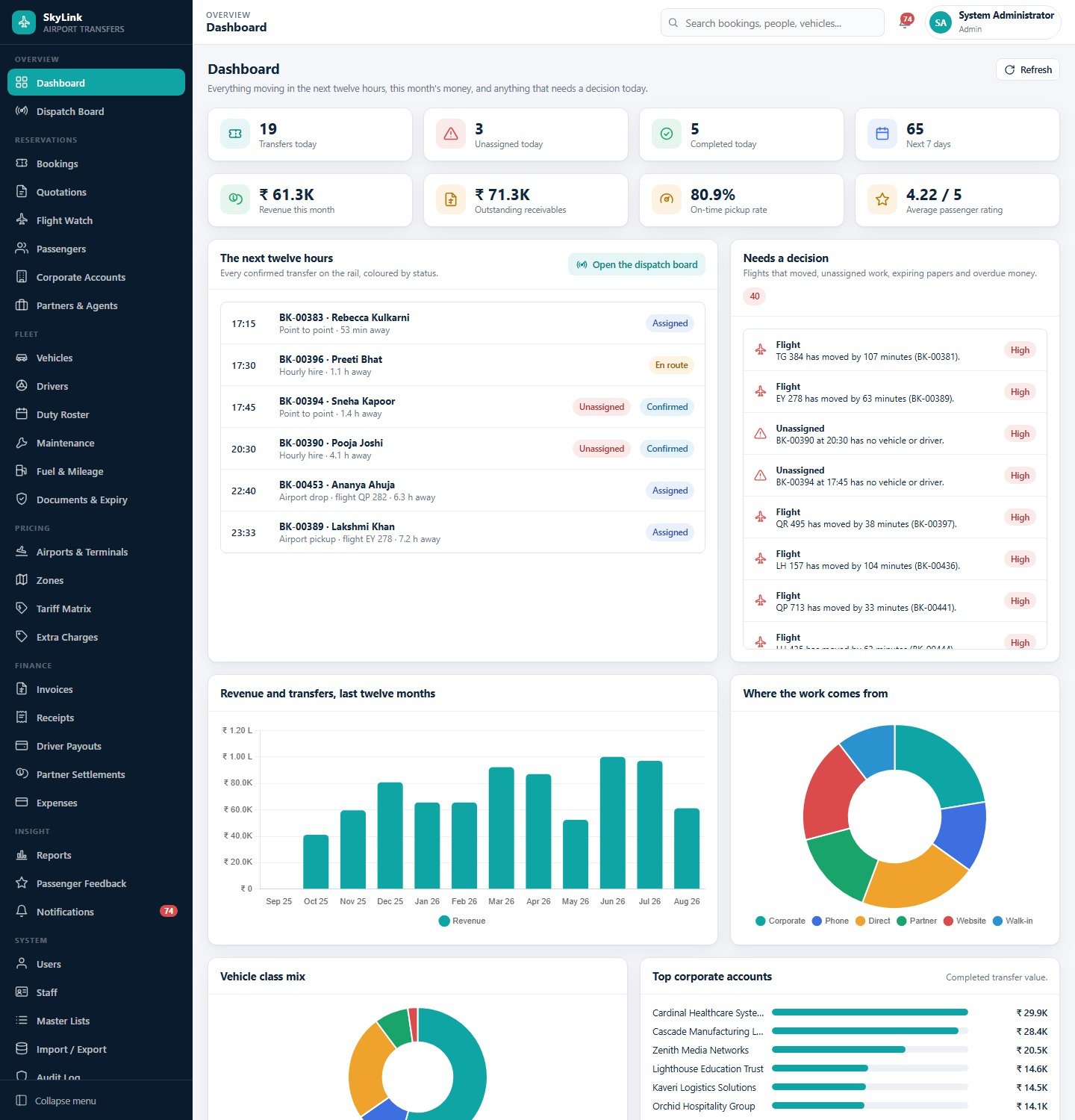
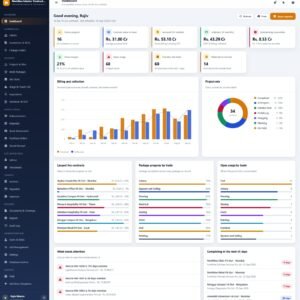
Eight cards across the top – transfers today, unassigned today, completed today, the next seven days, revenue this month, outstanding receivables, on-time pickup rate and average passenger rating. Below them a twelve-hour rail of every confirmed transfer coloured by status, a “needs a decision” queue of moved flights, unassigned work, expiring papers and overdue money, then revenue over twelve months, a booking-source donut, the vehicle class mix and the top corporate accounts by completed transfer value.
Dispatch Board
Pick a date, clear the unassigned strip, then move each transfer through its stages and complete it with the real odometer and waiting minutes so the fare and the driver earning are both right. Timeline, list and trip-log views, plus a print button for the day’s sheet.
Bookings
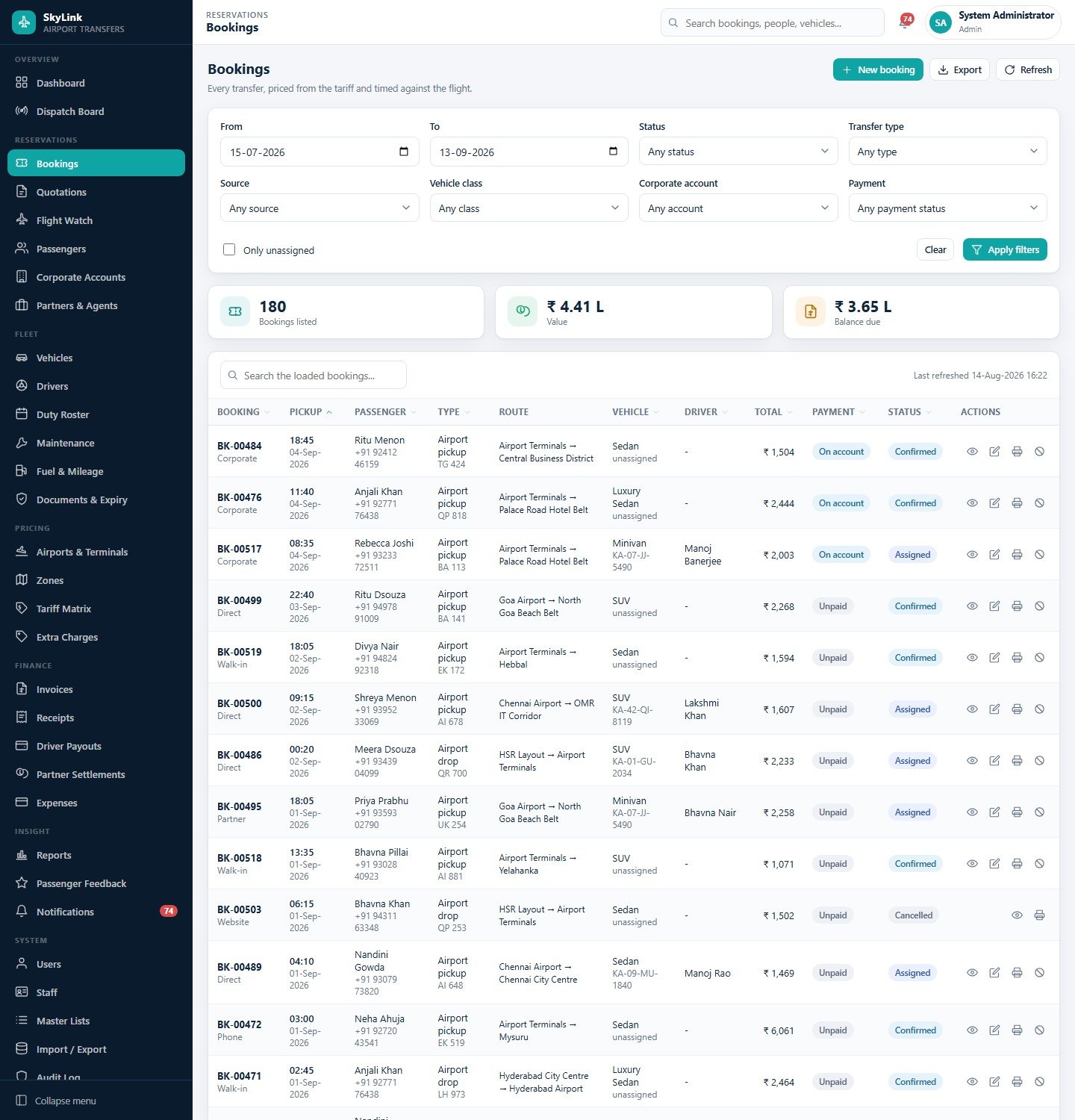
Every transfer, priced from the tariff and timed against the flight. Eight filters – date range, status, transfer type, source, vehicle class, corporate account, payment status and an unassigned-only switch – drive three totals: bookings listed, value and balance due. Each row can be viewed, edited, printed as a job sheet or cancelled.
Flight Watch
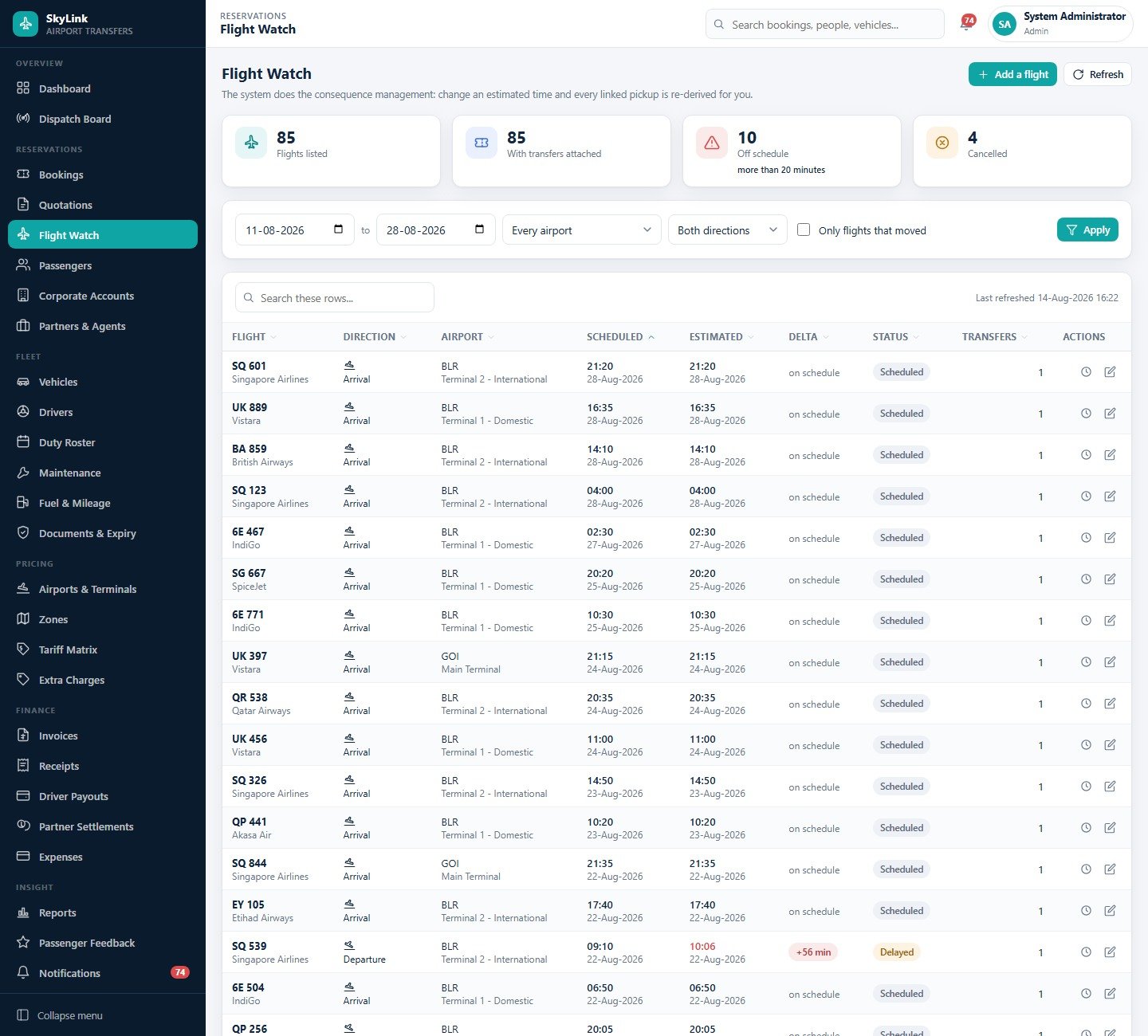
Every flight your transfers are attached to, with its scheduled and estimated time, the delta in minutes and a status. Filter to a date range, one airport, arrivals or departures, or only the flights that moved – then apply the new time and let the system re-derive the pickups.
Vehicles
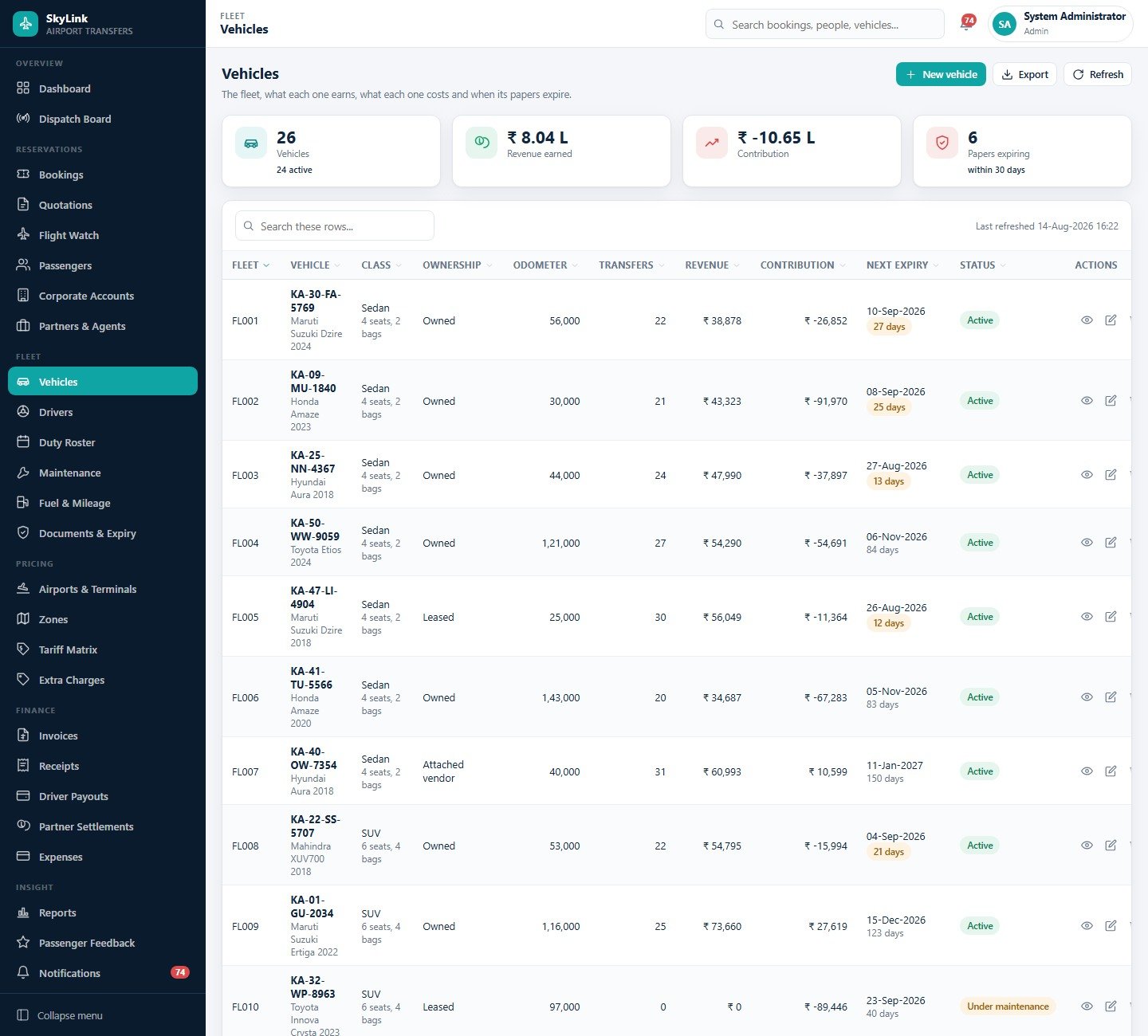
The fleet, what each one earns, what each one costs and when its papers expire. Class, ownership – owned, leased or attached vendor – seat and bag capacity, current odometer, transfers carried, revenue, contribution after its own fuel and maintenance, and the next expiry date with a countdown.
Tariff Matrix
The grid editor: choose an origin zone, type a base fare for every destination zone and vehicle class, and save the whole grid in one go. 160 rate rows, 8 vehicle classes and an average base fare shown at the top. The bulk percentage change previews every affected row before it commits.
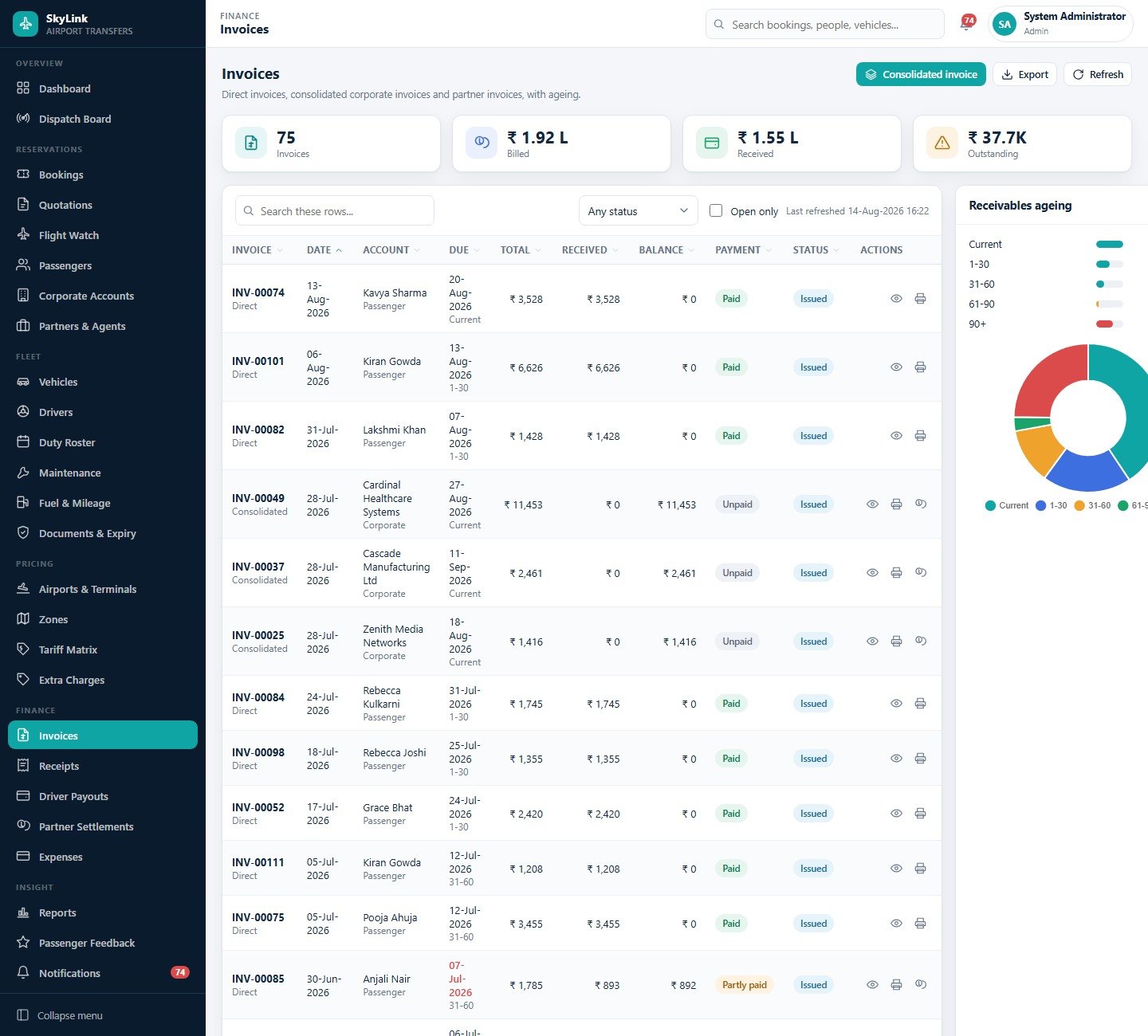
Invoices
Direct passenger invoices, consolidated corporate invoices and partner invoices in one register, with billed, received and outstanding totals and a receivables ageing donut down the right – current, 1-30, 31-60, 61-90 and 90-plus.
Reports
Twenty-two reports over the same data, selected as chips, filtered by date range, and rendered as a chart plus a table with a total row. Export any of them to CSV or send them straight to the printer.
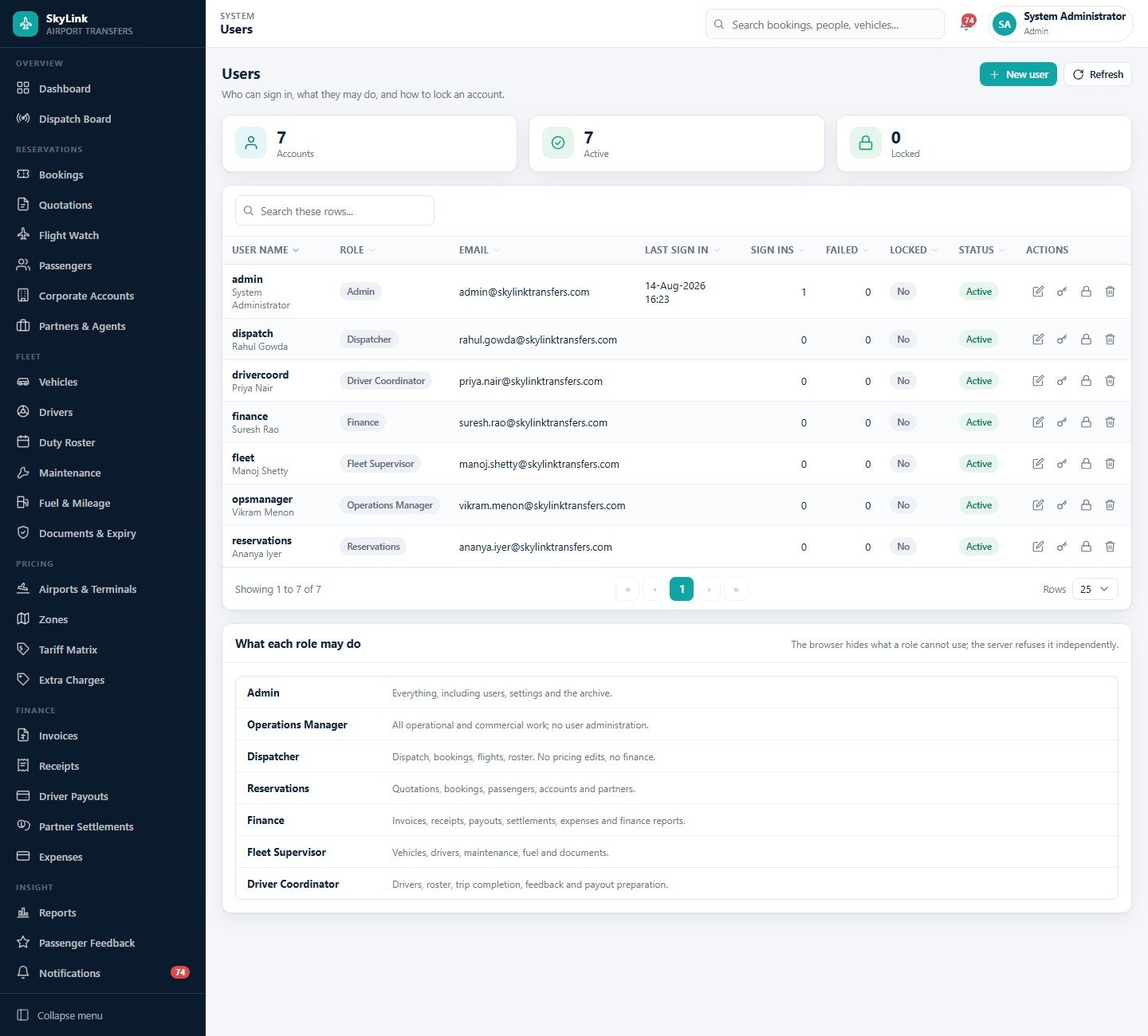
Users and the permission matrix
Seven accounts, each with a role, a last sign-in, a failed-attempt counter and a lock switch. Underneath, a plain-English table of what each role may do – so you can hand the system to a new dispatcher without writing your own policy document.
The rest of the system
Reservations: Quotations price an enquiry with the same engine that prices a booking, then convert the winner in one click. Passengers keeps preferences, transfer history and lifetime value. Corporate Accounts holds contract rates, credit limits and invoice cycles. Partners & Agents carries the sell rate, the net rate and what you owe.
Fleet: Drivers with payout model, on-time percentage and rating. Duty Roster as a week grid of morning, evening, night, split, off and leave, with an “apply a pattern” helper the dispatch board reads. Maintenance with service due by date or odometer, whichever comes first. Fuel & Mileage with per-fill efficiency. Documents & Expiry as the single register for every dated document.
Pricing: Airports & Terminals with entry fees, meeting points and the four clearance buffers. Zones as the geography you price, each with a distance, a drive time and an optional surcharge. Extra Charges as the tickable add-ons.
Finance: Receipts applied against invoices across six payment modes. Driver Payouts built from trips that ran. Partner Settlements per period. Expenses with categories, tax and an approval step.
Insight and System: Passenger Feedback with per-trip driver, vehicle and punctuality scores and a complaint workflow. Notifications for moved flights, unassigned work, expiring papers, overdue money and low ratings. Staff, 28 editable Master Lists that feed every dropdown, CSV Import/Export for 11 tables, a full Audit Log, an eleven-tab Settings screen and a nine-chapter Help & Guide.
Airport Transfer Management System Web App vs. a Spreadsheet vs. Paid Dispatch SaaS – Where This Fits
| This web app | A shared spreadsheet | Paid transfer / dispatch SaaS | |
|---|---|---|---|
| Cost | One payment, no renewal | Free | Typically a monthly fee per user or per vehicle |
| Platform | Google Apps Script + Google Sheets, in your account | Google Sheets or Excel | Vendor-hosted |
| Setup time | Under 15 minutes to deploy; a working day to load your own tariffs and fleet | Immediate, then months of patching | Onboarding call, then configuration |
| Real-time team collaboration | Yes – seven roles, server-side permission checks | Yes, but everyone sees and can break everything | Yes |
| Mobile access | Any browser | Awkward on a phone | Usually a dedicated driver app |
| Customisable fields | Yes – 28 master lists, and the source code is yours | Yes | Only what the vendor exposes |
| Share with a link | Yes – one web app URL | Yes | Login required |
| Year-1 cost at 5 users | The purchase price, once | 0 | Recurring, and it repeats every year |
| Flight-derived pickup times | Yes – four buffers per airport, re-derived on change | Manual | Usually, often with a paid flight-data feed |
| Your data stays in your Google Drive | Yes | Yes | No – it lives in the vendor’s database |
Who This Template Is For – and Who It’s Not For
It fits an airport transfer or chauffeur company running roughly 5 to 60 vehicles that has outgrown a WhatsApp group and a spreadsheet; a hotel or travel desk that arranges transfers and needs the commission and the settlement in one place; a ground-mobility operator that bills corporate accounts monthly and needs a consolidated invoice; and anyone who wants the records in a Google Sheet they own rather than in a vendor’s database.
It does not fit if you need a live GPS map with vehicle tracking, a native driver app with push notifications, a passenger-facing booking website with online card payments, an automated live feed of airline schedule data, or a system that will handle tens of thousands of bookings a month – Google Sheets is a comfortable home for a few hundred thousand rows, not millions.
What it is not: this is a record-keeping and scheduling tool that works on the data you enter. It does not verify driver licences or vetting, does not assess or guarantee passenger safety, does not provide or check insurance, and it makes no claim to satisfy aviation, transport-licensing, tax or payment-card requirements in your jurisdiction. The expiry register tracks the dates you type in – keeping the underlying documents valid, and meeting whatever rules apply to your business, remains entirely your responsibility.
How to Use the Airport Transfer Management System Web App
- Try the live demo first. Open the green box above, sign in as
admin, and click through the dispatch board, a booking and a report. Ten minutes there will tell you more than any description – and it costs nothing. - Deploy your own copy. Unzip the download, create a new Apps Script project, paste
Code.cs.txtintoCode.gs, add an HTML file namedIndexand pasteIndex.txtinto it, then deploy as a web app with access set to “Anyone”. - Run setup once. Open your web app URL and press “Run setup now” on the first-run panel. It builds all 37 tables, seeds the demo dataset and creates the Drive folder tree in about a minute.
- Change every password. Sign in as admin, then use System > Users to reset the seven seeded accounts and delete the roles you do not need. Do this before anyone else gets the URL.
- Fill in Settings. Company details print on every document; Regional sets currency, date format and distance unit; Flight holds the four buffers; Fare, Cancellation, Driver, Print, Email and Security each get a tab.
- Build your pricing. Add your airports and terminals, then your zones with distances and drive times, then fill the tariff matrix in the grid editor and review the extra charges.
- Load your own records. Add vehicles, drivers, corporate accounts and partners – or bring them in through System > Import / Export, which gives you a CSV template per table and a validated preview before anything is written. Then clear the seeded transactional rows and go live.
Real-World Use Cases
Vikram runs a 22-car airport transfer fleet. His morning is the dispatch board: clear the unassigned strip, check Flight Watch for anything more than twenty minutes off schedule, apply the new times, and let the pickups re-derive themselves. What used to be four phone calls is now one screen.
Ananya takes the reservations. A corporate travel desk asks for a price on three airport pickups. She raises a quotation, the same engine that prices bookings gives her the fare, she emails it, and when it is accepted she converts it to a booking without retyping anything.
Suresh closes the month. He generates one consolidated invoice per corporate account, prepares the driver payouts from the trips that actually ran rather than the trips that were booked, settles the ten agents on their own commission models, and prints the profit and loss summary and the receivables ageing for the owner.
Frequently Asked Questions
Can I try it before buying?
Yes. The green box above holds a live, fully seeded deployment and the sign-in details for all seven roles. Open it, click through every page, run the reports. Those credentials are public and belong to a shared demo instance that resets periodically – they are not a customer deployment, so please do not put real data into it.
What exactly do I download?
A ZIP containing Code.cs.txt (the Apps Script server code), Index.txt (the single-page front end) and a PDF user manual covering every module, the roles, the fare engine and the deployment steps.
Do I need to know how to code?
No. Deployment is copy, paste and press Deploy – the manual walks through it with the exact menu names. You only touch the code if you want to change something.
Where is my data stored?
In a Google Sheet named “Airport Transfer Management System – Database” that is created in your own Google Drive, alongside a folder tree for booking documents, invoices, expenses and backups. Nothing is sent to us and nothing is sent to a third-party server.
How many bookings can it hold?
The demo database carries 5,983 records across 37 tables and stays responsive. Google Sheets tolerates several hundred thousand cells per file comfortably, and the built-in archive moves older periods out of the working tables when you want to keep things light. If you are writing tens of thousands of bookings a month, you have outgrown this design.
Does this make my operation compliant?
No. It is a record and scheduling tool that reports on the data you enter. It does not verify licences, insurance or vetting, does not assess passenger safety, and makes no claim about aviation, transport-licensing, tax or payment-card requirements. Those remain your responsibility.
Can I change the modules, fields or documents?
Yes – you own the source. 28 master lists already control every dropdown without touching code, and Settings covers company details, print sizes and email. For anything larger, email [email protected] and we will quote the customisation.
About the Author
Built by PK – Microsoft Certified Professional with 15+ years of Excel, Google Sheets, and Power BI experience. Founder of NextGenTemplates, reaching 300K+ subscribers across YouTube channels. Every template is hand-built and tested before release.
Explore Related Templates
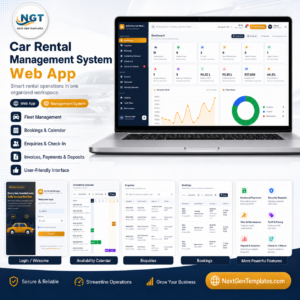
- Car Rental Management System Web App – the closest neighbour: same fleet, documents and payout thinking, built around rentals instead of transfers.
- Bike and Two-Wheeler Rental Management System Web App – the same pattern at a smaller vehicle size.
- Ambulance Fleet and Dispatch Management System Web App – dispatch, duty roster and vehicle documents for emergency ground fleets.
- Auto Garage Job Card Management System Web App – useful alongside this one if you service your own vehicles.
- Adventure Sports Booking Management System Web App – the same booking, partner-commission and reporting engine for activity operators.
- Browse every Mini Web App – ready-to-run management systems for dozens of trades.
One payment. Your own Google account. Your own data. Launch the live demo above, sign in as any of the seven roles, and see the whole system working on real seeded records before you decide. When you are ready, the download gives you the source code and a step-by-step deployment guide, and you will be running your own private copy in about fifteen minutes.
Last updated: 15 August 2026. Version 1.0.0. Questions or customisation requests: [email protected]






















Reviews
There are no reviews yet.