

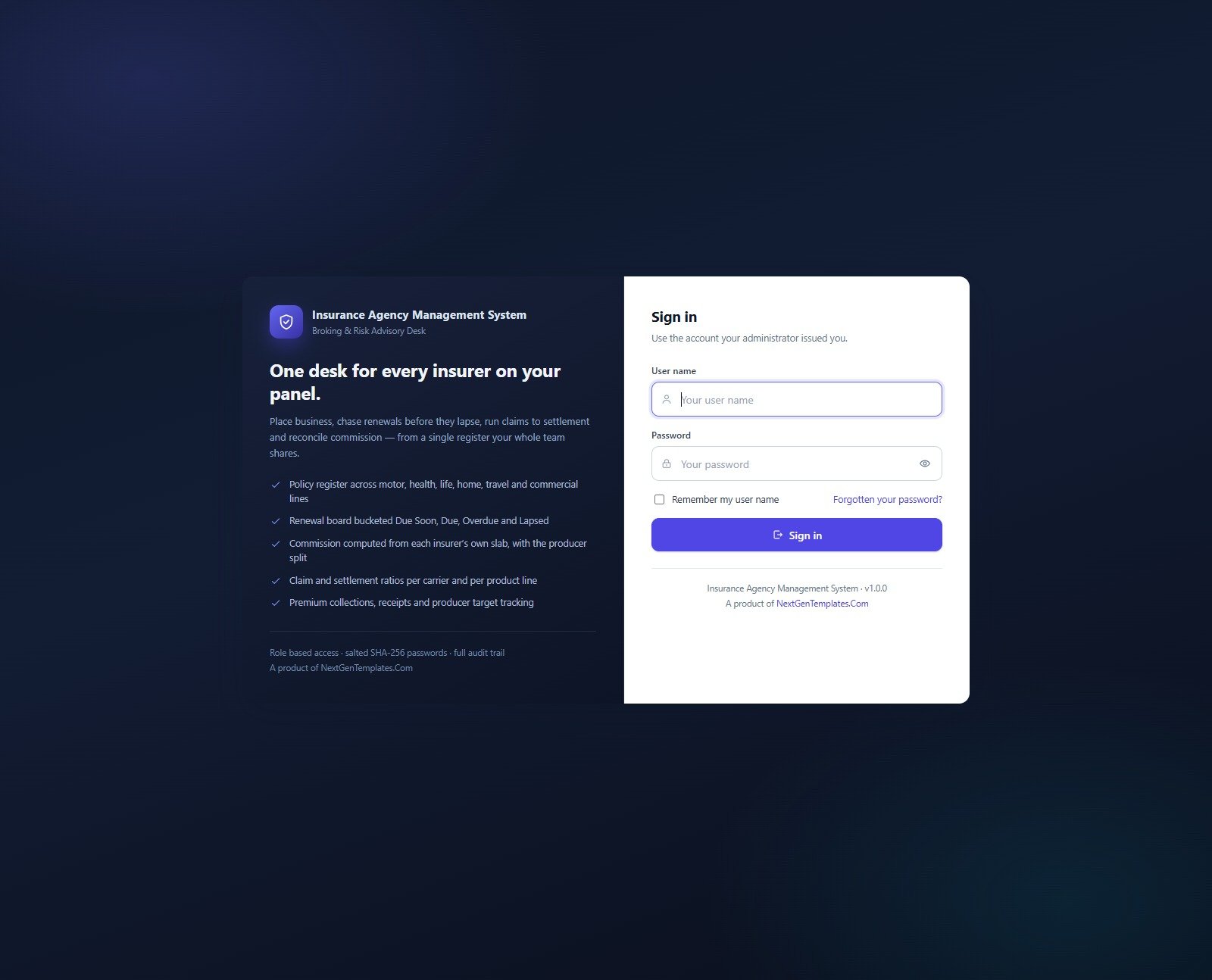
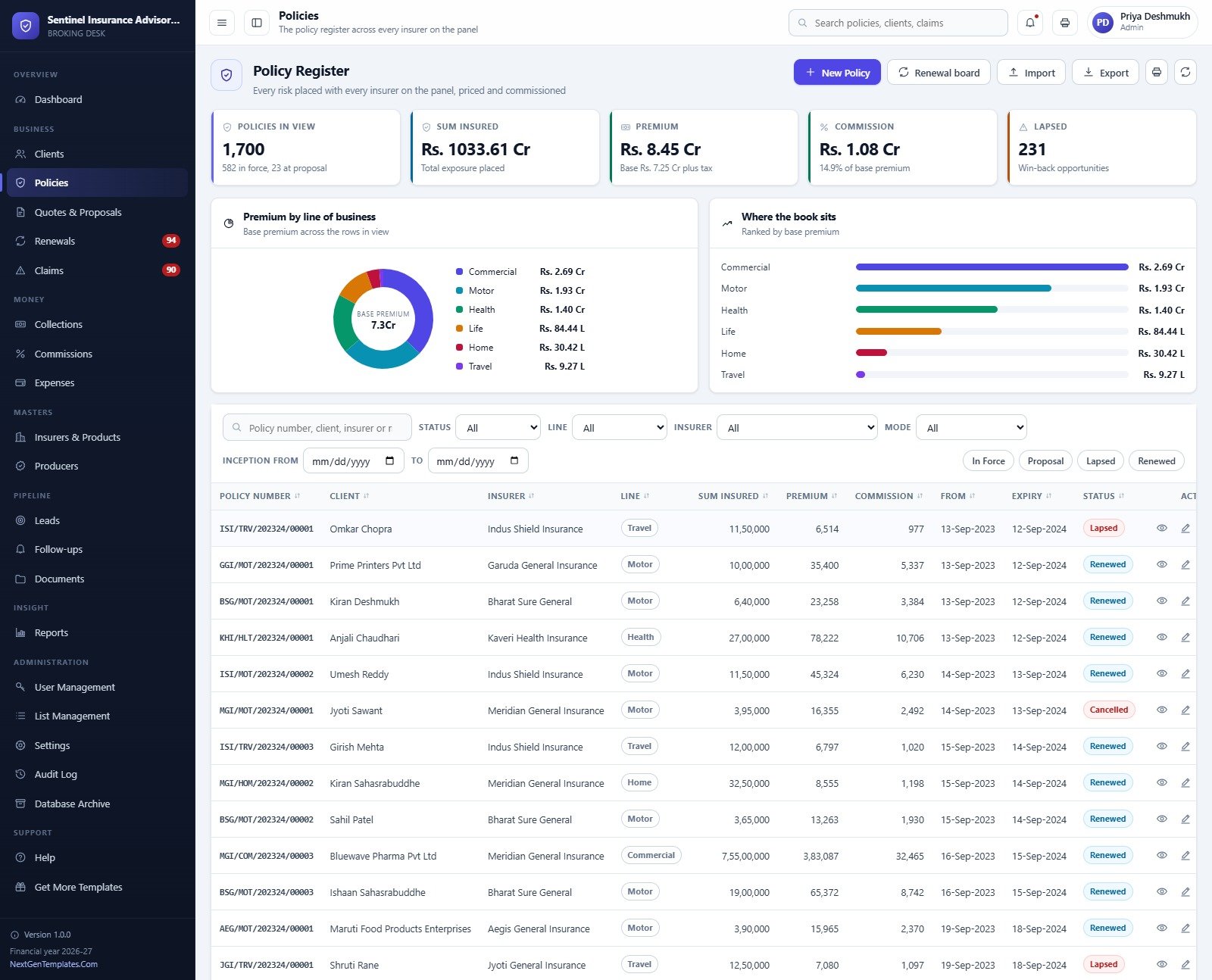
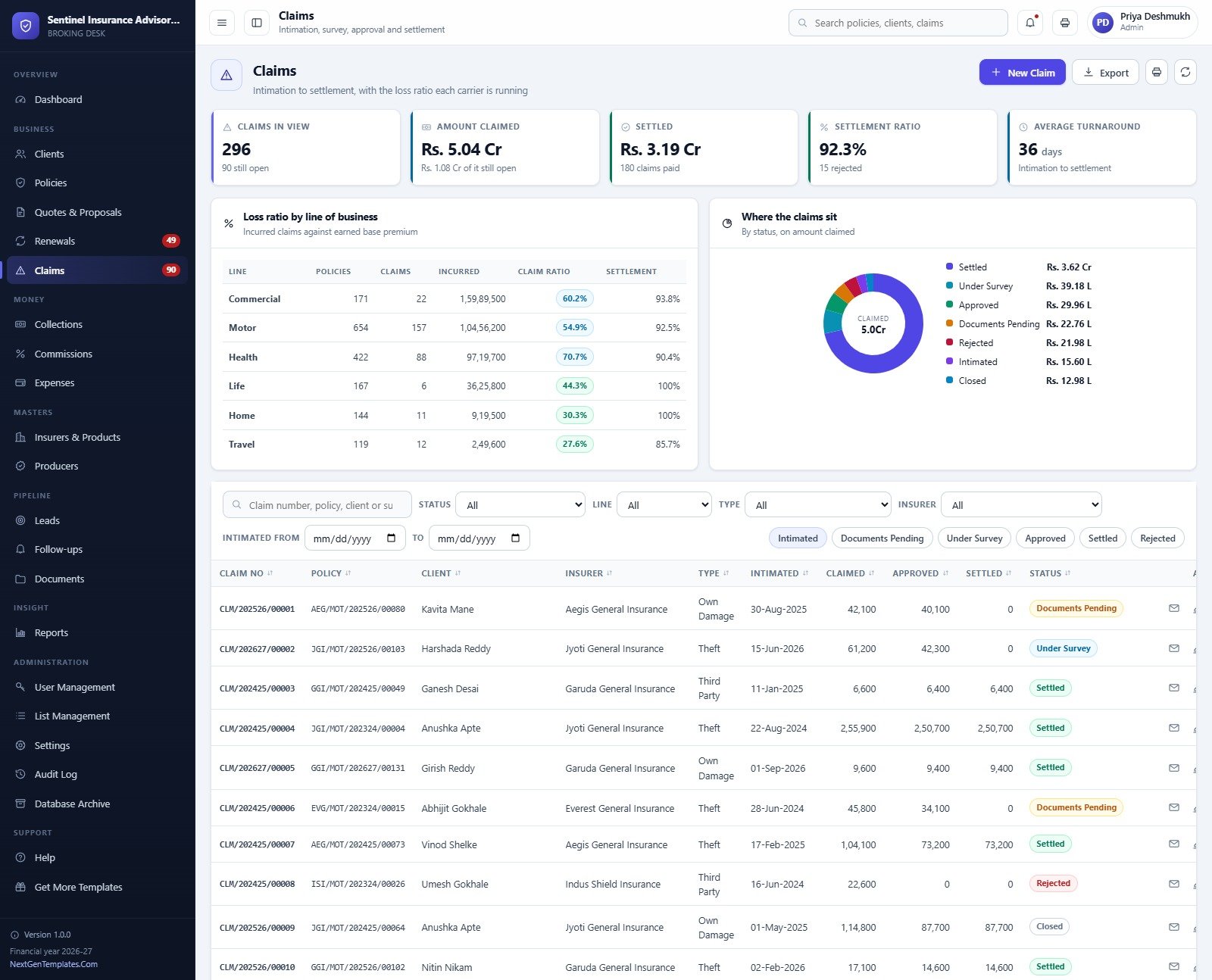
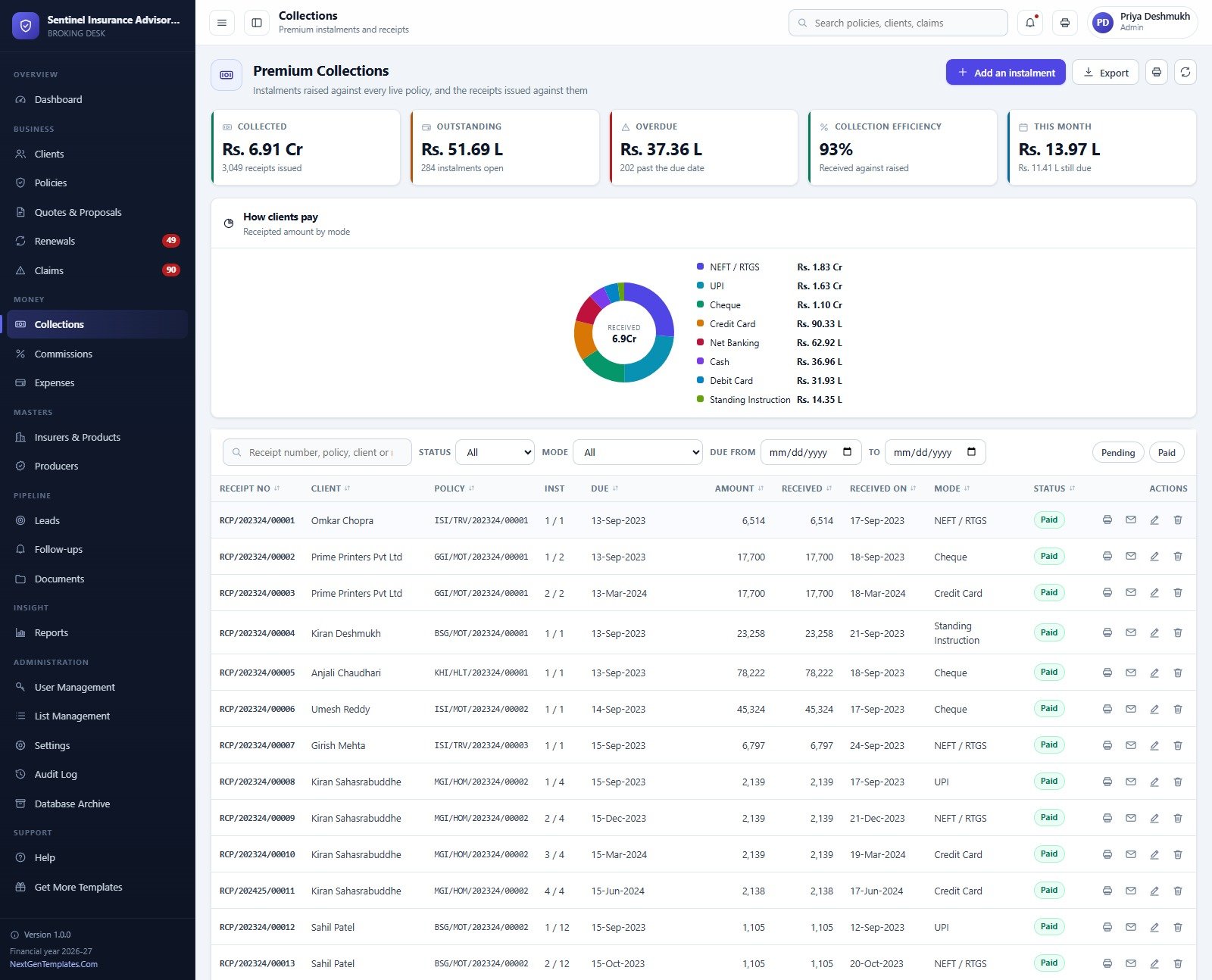
The Insurance Agency Management System Web App is an insurance agency management system for multi-insurer brokerages and agency offices. It puts the client register, the policy register, quotes, renewals, claims, premium collections, commission statements, producer targets, leads and a document library behind one sign-in. It is a Google Apps Script web app that builds its own Google Sheets database on first run, so there is no server to rent and no monthly platform fee.
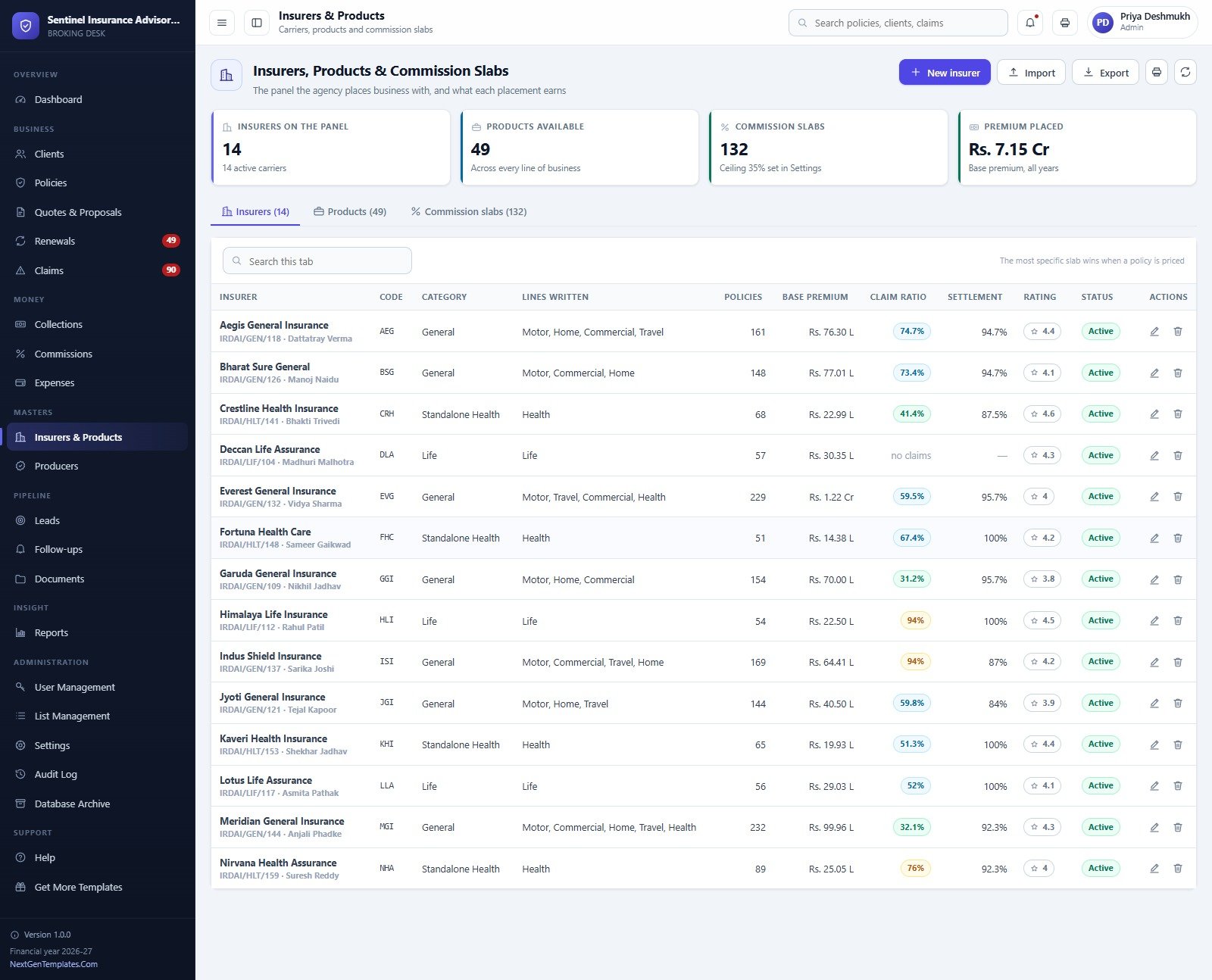
Every screenshot below comes from the shipped build with its demonstration dataset loaded: a fictional brokerage called Sentinel Insurance Advisors LLP with 14 fictional carriers, 520 clients, 1,700 policies, 296 claims, 3,333 receipts and 11,777 rows in total. All sample data is fictional: agency, insurers, people, phone numbers, licence numbers and registration codes. The numbers show how the screens behave. They are not a forecast for your business.
Try the Live Demo
Open the deployed system and sign in with any role. There is nothing to install and nothing to pay, and it is the same build you receive.
Demo sign-in details: all eight seeded accounts
| Role | Username | Password | What that role can reach |
|---|---|---|---|
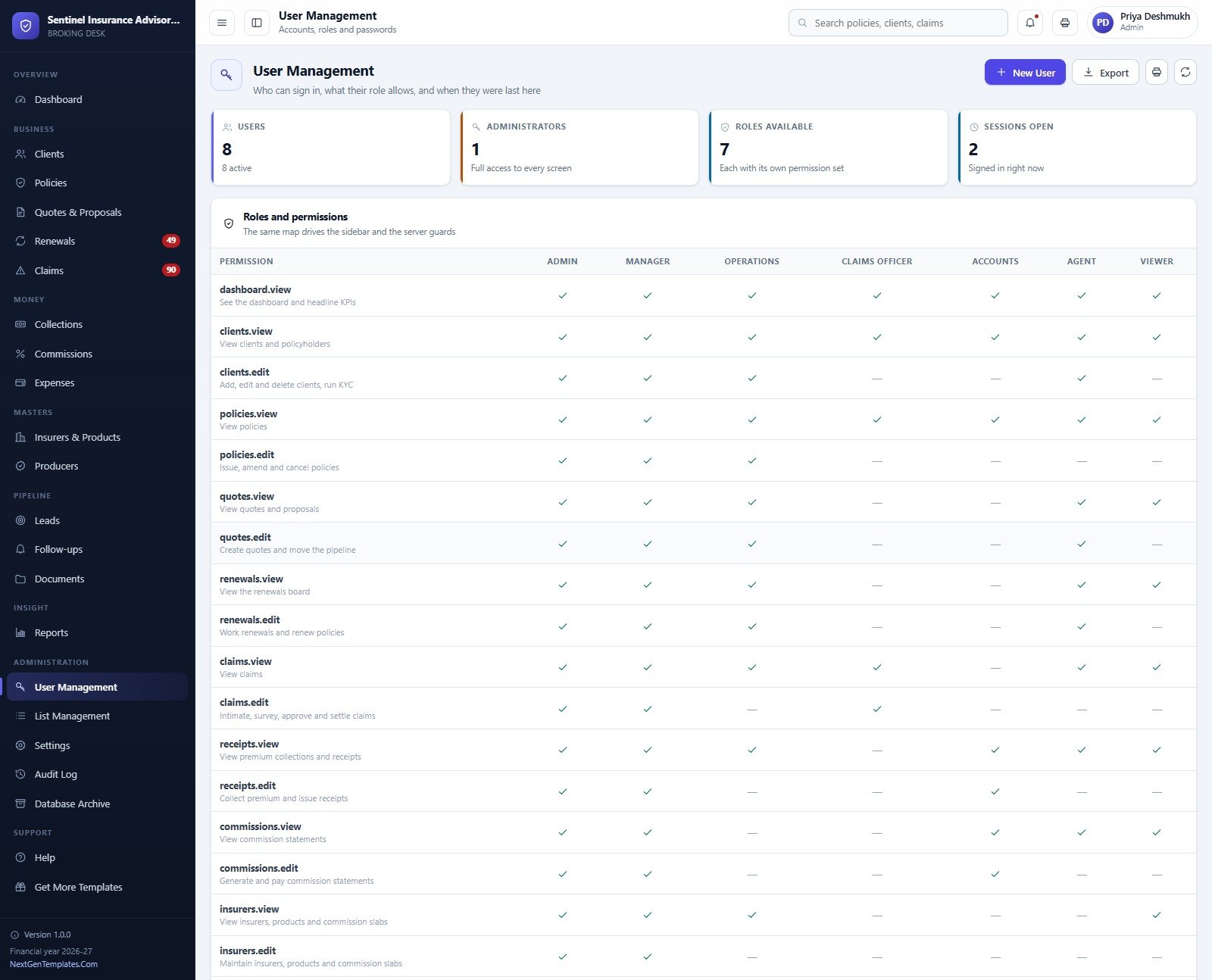
| Admin | admin | Admin#2026 | Everything, including User Management, Settings, Audit Log and Database Archive |
| Manager | manager | Manager#2026 | The whole business and the audit log. No users, settings or archive |
| Operations | ops | Ops#2026 | Servicing desk: clients and KYC, policies, quotes, renewals, claim viewing, documents, leads |
| Claims Officer | claims | Claims#2026 | Claims from intimation to settlement, with read access to the policy and client |
| Accounts | accounts | Accounts#2026 | Collections and receipts, commission statements, office expenses, all reports |
| Agent | agent | Agent#2026 | Their own book only, filtered to the linked producer |
| Agent | agent2 | Agent#2026 | A second agent linked to a different producer, so you can compare two books |
| Viewer | viewer | Viewer#2026 | Read only across the business, for an auditor or an owner who does not key data |
These credentials are public on purpose. The demo is a shared instance seeded with fictional sample data, not a customer deployment, and it resets. Your own copy builds a private database in your own Google Drive, and the manual tells you to change all eight passwords on day one.
Key features of this insurance agency management system
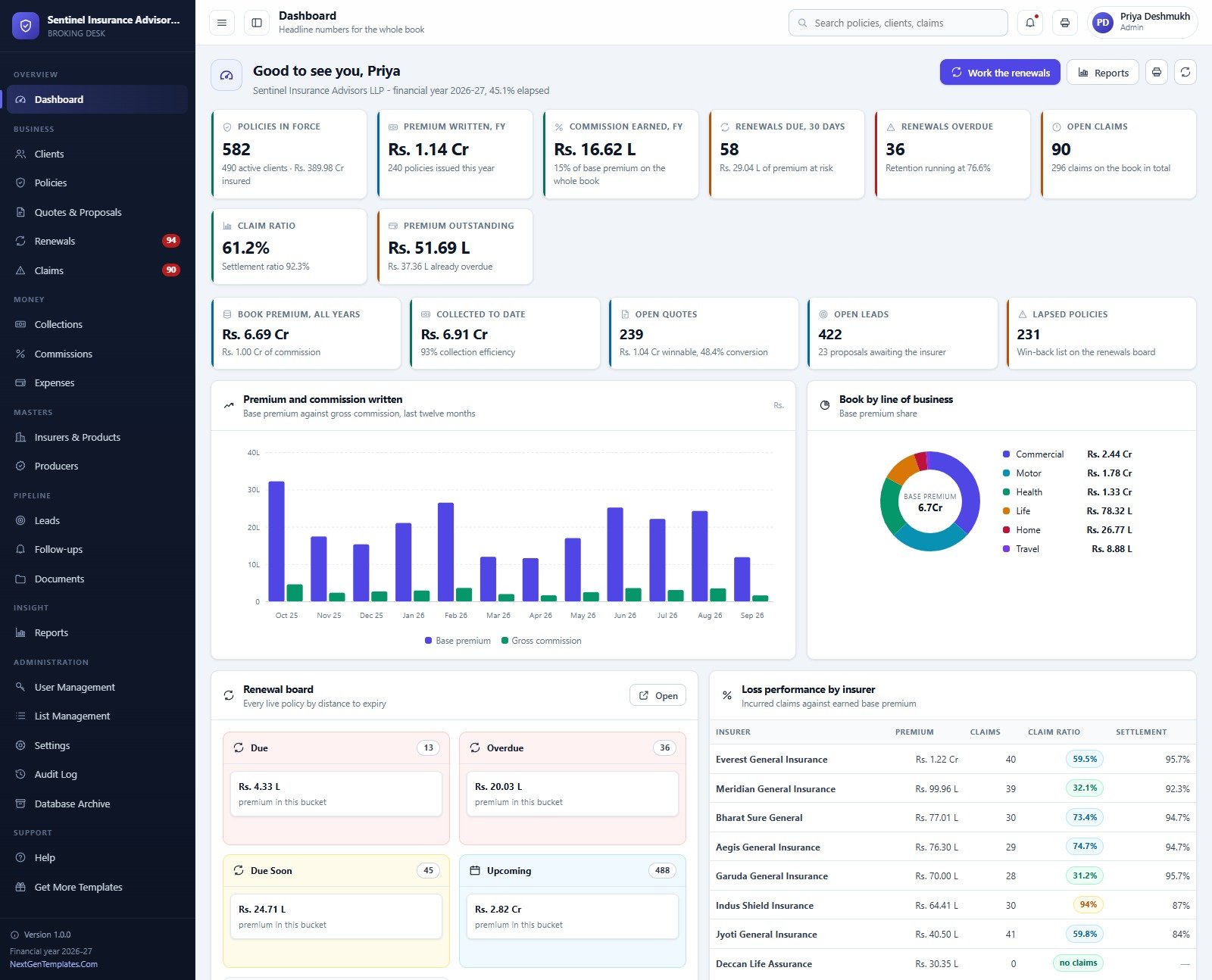
- A dashboard for the whole book. Policies in force, premium written and commission earned this financial year, renewals due in 30 days, renewals overdue, open claims, claim ratio with settlement ratio, and premium outstanding. A second row adds book premium for all years, collected to date, open quotes, open leads and lapsed policies. Below them sit a twelve-month premium and commission chart, a book-by-line-of-business donut, the renewal board and a loss-performance-by-insurer table.
- Clients and policyholders with KYC. Individuals, family floaters, proprietorships, partnerships, private limited firms, LLPs and trusts, each with phone, city, KYC status (Verified, Pending, Rejected), a risk band, live policy count and lifetime premium. The KYC Outstanding card tells the desk who to chase before the next renewal.
- One policy register across six lines of business. Motor, Health, Life, Home, Travel and Commercial, across every insurer on your panel. Each policy carries sum insured, premium, commission, dates and a status (In Force, Proposal, Renewed, Lapsed, Cancelled), with filters for status, line, insurer, payment mode and inception date.
- Commission from each insurer’s own slab. Load your insurers, their products and their commission slabs. Premium and commission are calculated from those rate cards, the most specific slab wins, and a commission ceiling in Settings catches a mis-keyed slab.
- Quotes and proposals. A pipeline from Enquiry through Quoted, Proposal Sent and Negotiation to Won, Lost or Expired, with the commission each quote would earn, a conversion rate, and a Commission at Stake figure if every open quote converts.
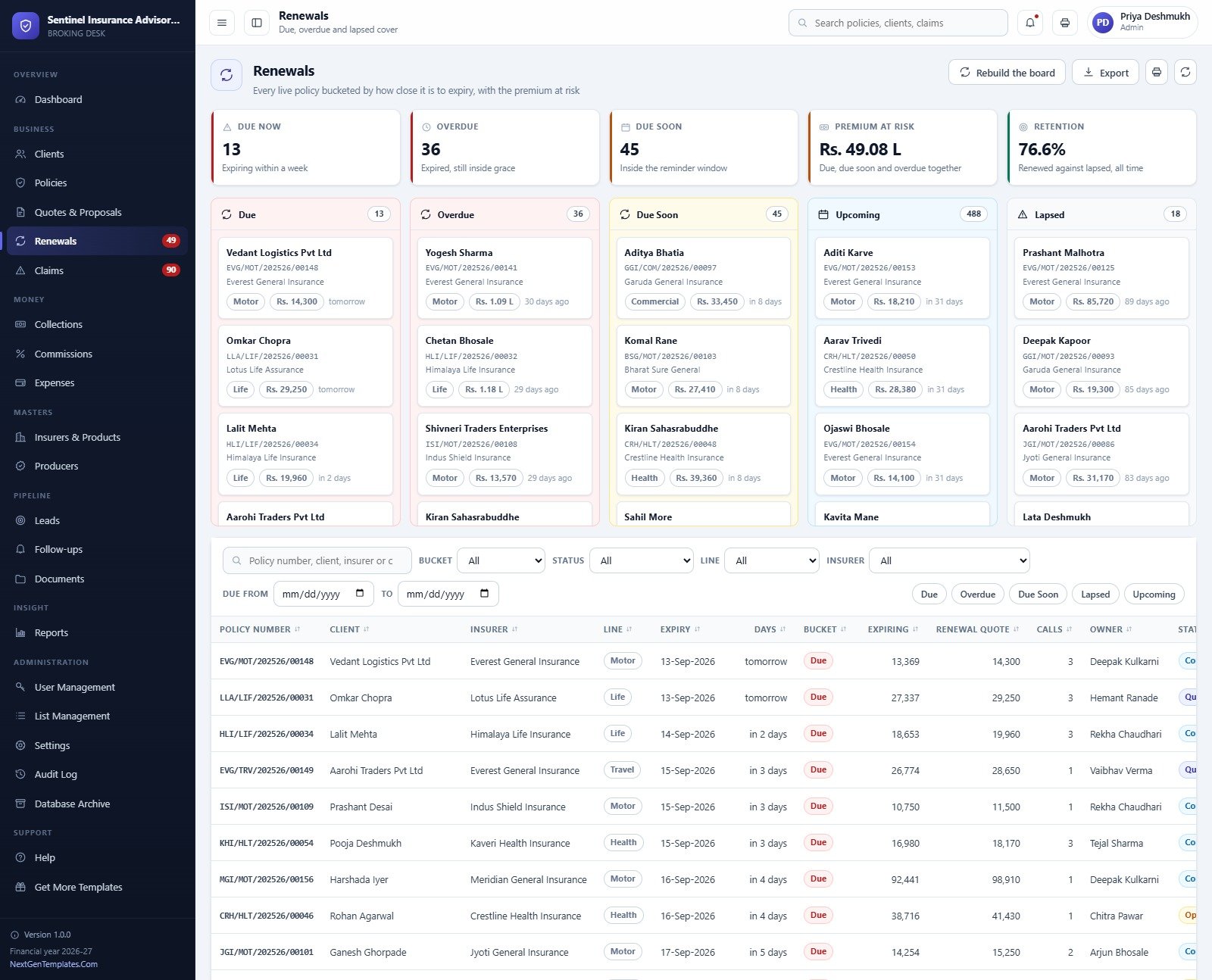
- A renewal board that protects retention. Every live policy sits in a bucket: Due, Overdue, Due Soon, Upcoming or Lapsed. Each shows the premium at risk, the renewal quote, call count and owner, and the day windows and grace period are settings.
- Claims from intimation to settlement. Intimated, Documents Pending, Under Survey, Approved, Settled, Rejected and Closed, with claimed, approved and settled amounts, a loss ratio by line of business, a settlement ratio and average turnaround in days. The system records the insurer’s decision. It does not make one.
- Premium collections and receipts. Instalments raised against every live policy, receipts by mode (NEFT/RTGS, UPI, Cheque, Credit Card, Net Banking, Cash, Debit Card, Standing Instruction), overdue instalments and collection efficiency. Receipts can be printed or emailed.
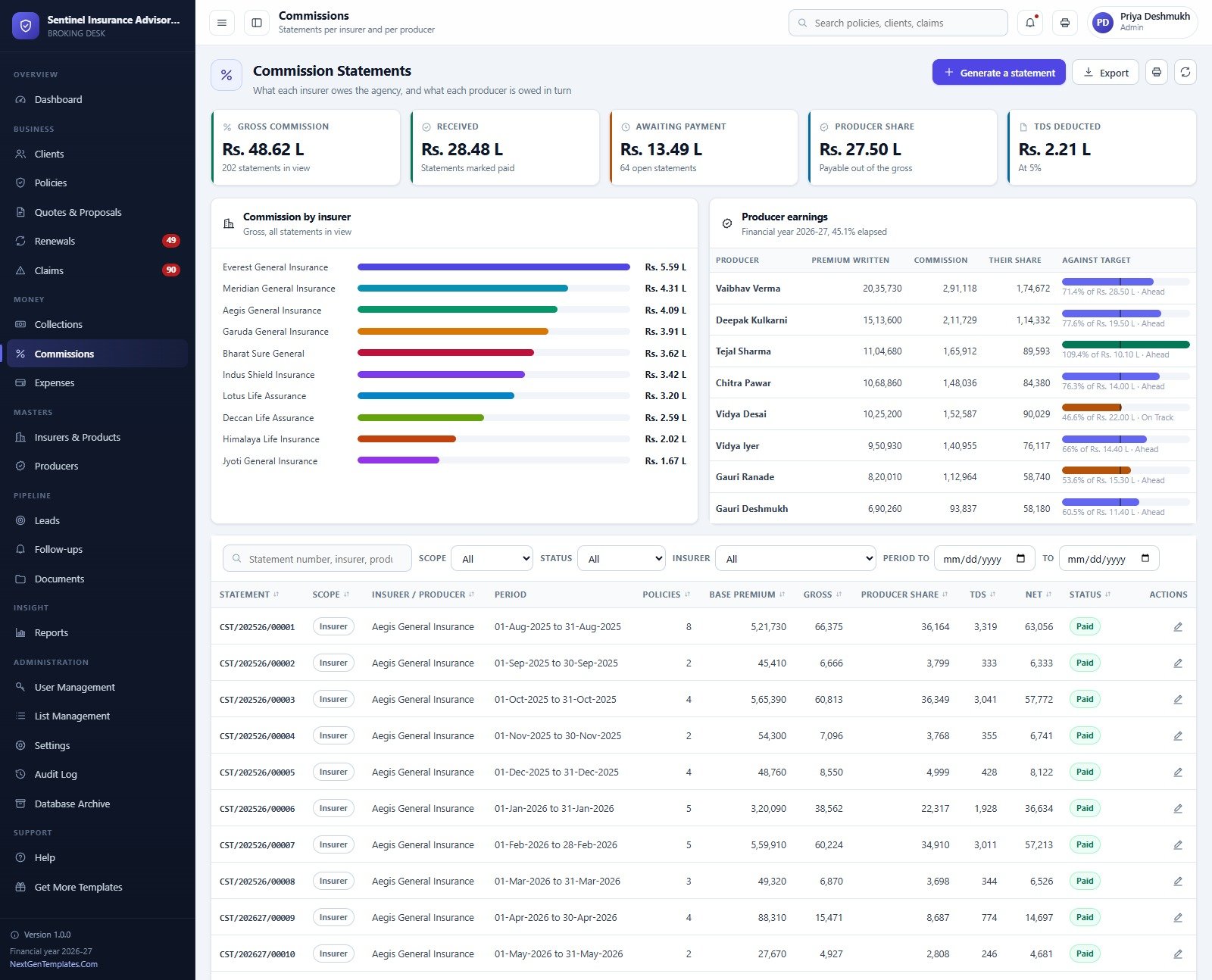
- Commission statements. Statements per insurer and per producer, showing gross commission, producer share, TDS at the rate you set, net, and whether each one is paid or still awaiting payment.
- Producers and targets. Relationship managers and point-of-sale persons with designation, financial-year target, premium written, progress against a straight-line pace, and licence expiry dates, including a count of licences expiring within ninety days.
- Leads and follow-ups. Leads with source, interest line, estimated premium, a score out of 100, stage and next call date. The follow-up list pulls leads, renewals, claims and quotes into one call list with channel, due date, outcome and priority.
- Document library in Google Drive. Policy schedules, proposal forms, KYC papers, survey reports, discharge vouchers and invoices, linked to the client, policy or claim and stored in a Drive folder tree.
- Office expenses. Vouchers across twelve categories with tax, payment mode, approver and status, plus a monthly run rate so you can see what the desk costs against the commission it earns.
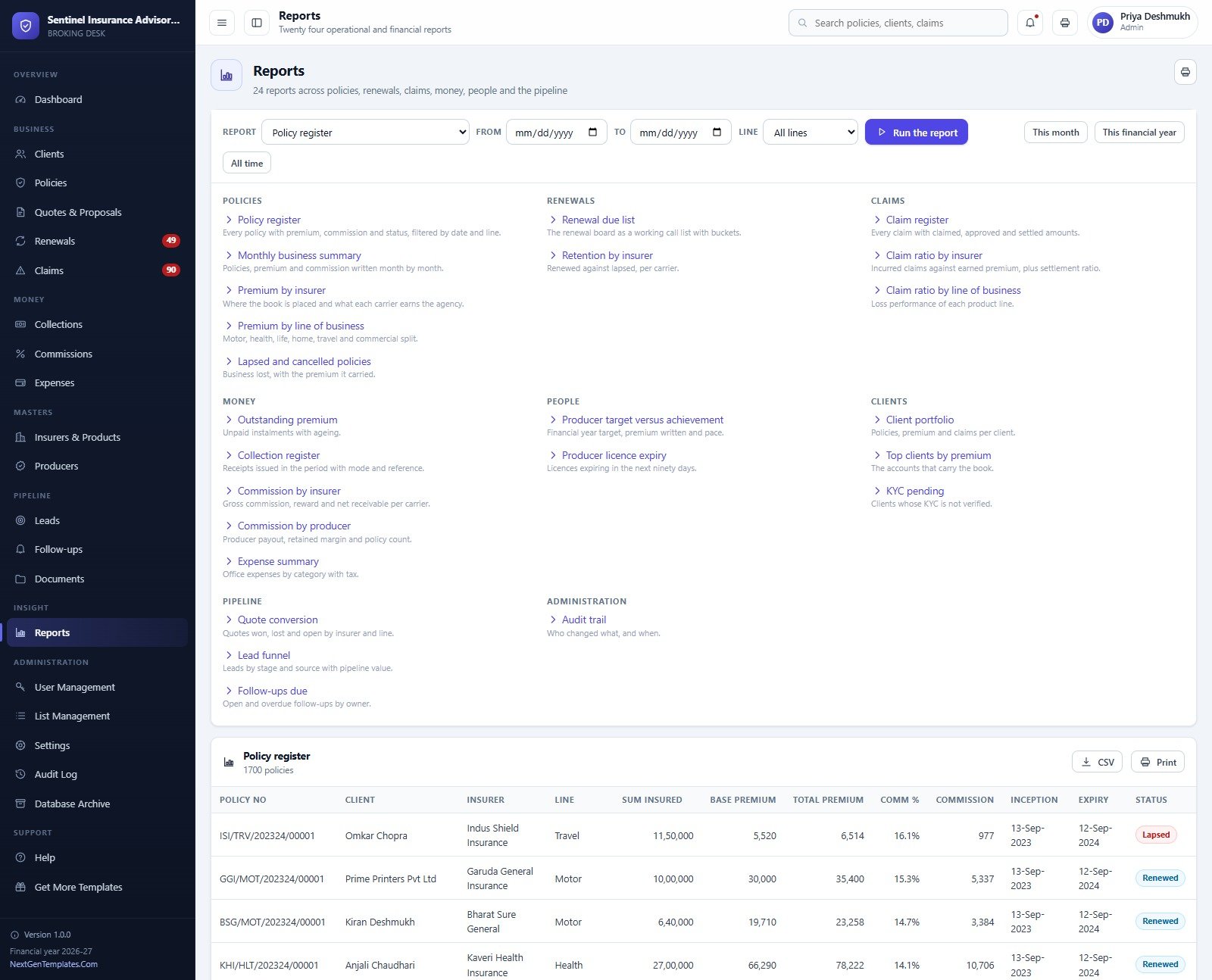
- Twenty-four reports. Grouped into Policies, Renewals, Claims, Money, People, Clients, Pipeline and Administration. They include the policy register, monthly business summary, retention by insurer, claim ratio by insurer and by line, outstanding premium, commission by producer, producer licence expiry, KYC pending, quote conversion, lead funnel and the audit trail. Each runs over a date range and line, and exports to CSV or prints.
- Import, export, print and email. Clients, policies, leads and other masters import from Excel or CSV. Lists export, and receipts, schedules and reports print at 3 inch, 4 inch or A4.
- Audit log and database archive. Every create, change, delete, sign-in and refused action is logged with the user and role. When the sheet gets heavy, the archive copies the whole spreadsheet to Drive first, then removes closed transactions older than the retention window. Master data is never touched, and a policy with an open claim or an unpaid instalment is left behind.
Roles that are enforced, not decorative
Seven roles, eight seeded accounts and a catalogue of 35 permissions. The same permission map drives both the sidebar and the server-side guard, so a role cannot reach a screen or an action it is not entitled to, whichever route it tries. An Agent account linked to a producer sees only that producer’s policies, renewals, claims, collections and commissions. Without a link it sees an empty book. Passwords are stored only as a salted SHA-256 hash, so nobody can read one back, and a forgotten password has to be reset.
What you get in the download
A single ZIP holding three files: Code.cs.txt (the Apps Script server code), Index.txt (the single-page front end) and the Insurance Agency Management System user manual PDF. The manual covers every screen, the role matrix, deployment and the settings to change first.
Setting it up
- Try the demo first using the green box above. Sign in as
agentand then asclaims, and you will see what role separation does in about ten seconds. - Create a new Apps Script project, paste
Code.cs.txtover the defaultCode.gs, add an HTML file named exactlyIndexand pasteIndex.txtinto it. - Deploy as a Web app (Execute as: Me, Who has access: Anyone) and accept the permission prompt for Sheets, Drive and Gmail.
- Run setup once, either from the First run panel on the sign-in card or by running
setup()in the editor. It creates its own Google Sheets database with 22 tables and the demonstration dataset. Setup is staged and resumable, so if it hits the Apps Script time limit it queues itself and carries on. - Sign in as
adminand change all eight passwords. Then set your agency name, address, licence number and GSTIN, currency and digit grouping, financial year start, print size, renewal windows, commission ceiling, producer share and TDS rate. - Replace the fourteen sample carriers with your own panel, load each product’s rate card and each insurer’s commission slabs, add your producers, and attach
dailyHousekeeping()to a daily trigger so the renewal board and notifications refresh themselves.
After any later code edit you must publish a new version from Manage deployments. Saving in the editor does not update the live app.
Who this is for
Independent insurance agencies, multi-insurer brokerages, corporate agents, point-of-sale teams and advisory desks that place motor, health, life, home, travel and commercial business with several carriers. It suits an office of a few people up to a busy single-branch desk that wants renewals, claims follow-up and commission reconciliation in one place without a monthly SaaS fee.
Honest limitations: what this does not do
- It is not an insurer’s policy administration system. It does not issue policies on behalf of any insurer, connect to insurer portals or APIs, or pull policy data automatically. You key what the insurer issues.
- It makes no licensing, compliance or regulatory claim. It is a record-keeping and workflow tool. Nothing in it certifies, or replaces, your obligations as a licensed intermediary. The licence numbers and registration codes in the demo are fictional placeholders.
- You are responsible for policyholder data protection. Your copy stores client details, KYC documents and medical or claim papers in your own Google account. Deciding what to collect, who gets access, how long to keep it and how to meet the data-protection law that applies to you is the buyer’s responsibility. Use the roles, keep the Viewer and Agent accounts tight, and restrict the Drive folder.
- No payment gateway. Collection modes are recorded after the money arrives. Nothing is charged, no card details are stored and there is no auto-debit.
- Not accounting software. The TDS and tax figures are calculated lines on statements and vouchers. It does not file GST or TDS returns or connect to any tax portal.
- WhatsApp, SMS and phone are logged, not sent. Follow-ups record the channel you used. Only email is sent from the application, through your own Google account and its daily quota.
- No customer-facing portal. Policyholders cannot sign in to see their own policies. Staff do that for them.
- Google’s quotas apply. This is an Apps Script web app on a Google Sheets database. It is comfortable for a single agency office, not a replacement for a hosted core platform at enterprise scale.
Three things worth knowing before you buy
We open every screenshot before writing a listing, so here is what we found.
- Premium totals differ between screens because they count different rows. The dashboard’s book premium for all years reads Rs. 6.69 Cr, the Insurers screen shows Rs. 7.15 Cr of base premium placed, and the Policies screen shows Rs. 7.25 Cr of base premium across all 1,700 rows in view. Read the subtitle on each card before quoting a number to a partner.
- The sample audit history is synthetic. A few seeded audit entries show a role doing something its permission set would refuse, for example the claims account renewing a policy. The live permission guard is enforced, and new entries in your copy reflect what actually happened. Only the demonstration history was generated.
- The renewal numbers reconcile. The dashboard’s 58 renewals due in 30 days equals the renewal board’s 13 Due plus 45 Due Soon, and the 36 overdue match on both screens.
How it compares to our other insurance templates
| Template | What it is | Multi-user with roles | Renewals, claims and commission workflow | Sale price |
|---|---|---|---|---|
| Insurance Agency Management System Web App | Apps Script web app with its own database | Yes, 7 roles | Yes | 39.99 |
| Insurance Agency Dashboard in Google Sheets | Analytics dashboard | No | Reporting only | 9.99 |
| Insurance Policy Analytics Dashboard in Google Sheets | Analytics dashboard | No | Reporting only | 9.99 |
| Insurance Policy and Premium Tracker in Google Sheets | One-page tracker | No | Tracking only | 6.99 |
| Insurance Agency Dashboard in HTML | Browser dashboard | No | Reporting only | 12.99 |
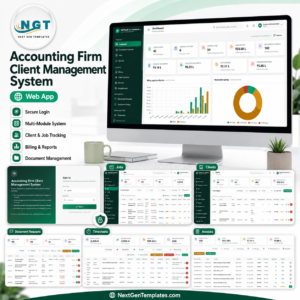
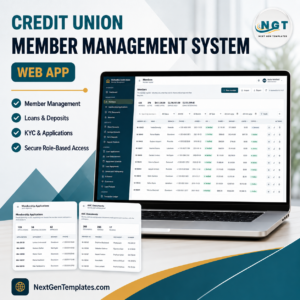
The dashboards and the tracker are the analytics view. This web app is the operational desk that keys the business, and the two can sit side by side. If you run a financial-services office of a different shape, the Credit Union Member Management System Web App and the Accounting Firm Client Management System Web App are built on the same architecture. A full walkthrough of this system is on NeoTech Navigators.
Frequently asked questions
Can I try this insurance agency management system before buying?
Yes. The green box above is a live deployment of exactly this build, with all eight demo accounts listed. Sign in as an Agent first, because it is the quickest way to judge whether the permission model matches your office.
Is it certified or approved by any insurance regulator?
No. It is a workflow and record-keeping template and makes no licensing, compliance or certification claim. Your regulatory obligations stay with you.
Does it connect to insurer portals?
No. There is no insurer API or portal integration. Policies, endorsements and claim decisions are entered by your staff.
Where is policyholder data stored, and who protects it?
In a Google Sheets database and Drive folder in your own Google account. Protecting that data and complying with the privacy law that applies to you is the buyer’s responsibility. The demo holds only fictional records.
What currency does it use?
Whatever you set. The currency symbol, Indian or western digit grouping, date format and financial-year start are all in Settings. The demo was seeded in Indian Rupees, which is why the screenshots read “Rs.”.
Do I need Google Workspace?
No. A normal Google account is enough to deploy and run it.
Can each agent see only their own clients?
Yes. Link an Agent account to a producer, and every screen filters to that producer’s book.
Will the demo data get in my way?
No. Delete the data rows from the transaction tabs in the database spreadsheet, or delete the spreadsheet and run setup again for an empty database.
Can I get changes made?
Yes. Customisation is offered from the Get More Templates screen inside the app, or write to info@NextGenTemplates.Com with a short brief.
The bottom line
This insurance agency management system gives a multi-insurer desk one register for clients, policies, renewals, claims, collections and commission. It has 22 screens, 22 database tables, 7 roles, 35 permissions and 24 reports, and you own it outright. Open the live demo above, sign in as an agent, work a renewal and watch the renewal board and the commission statement move together.