
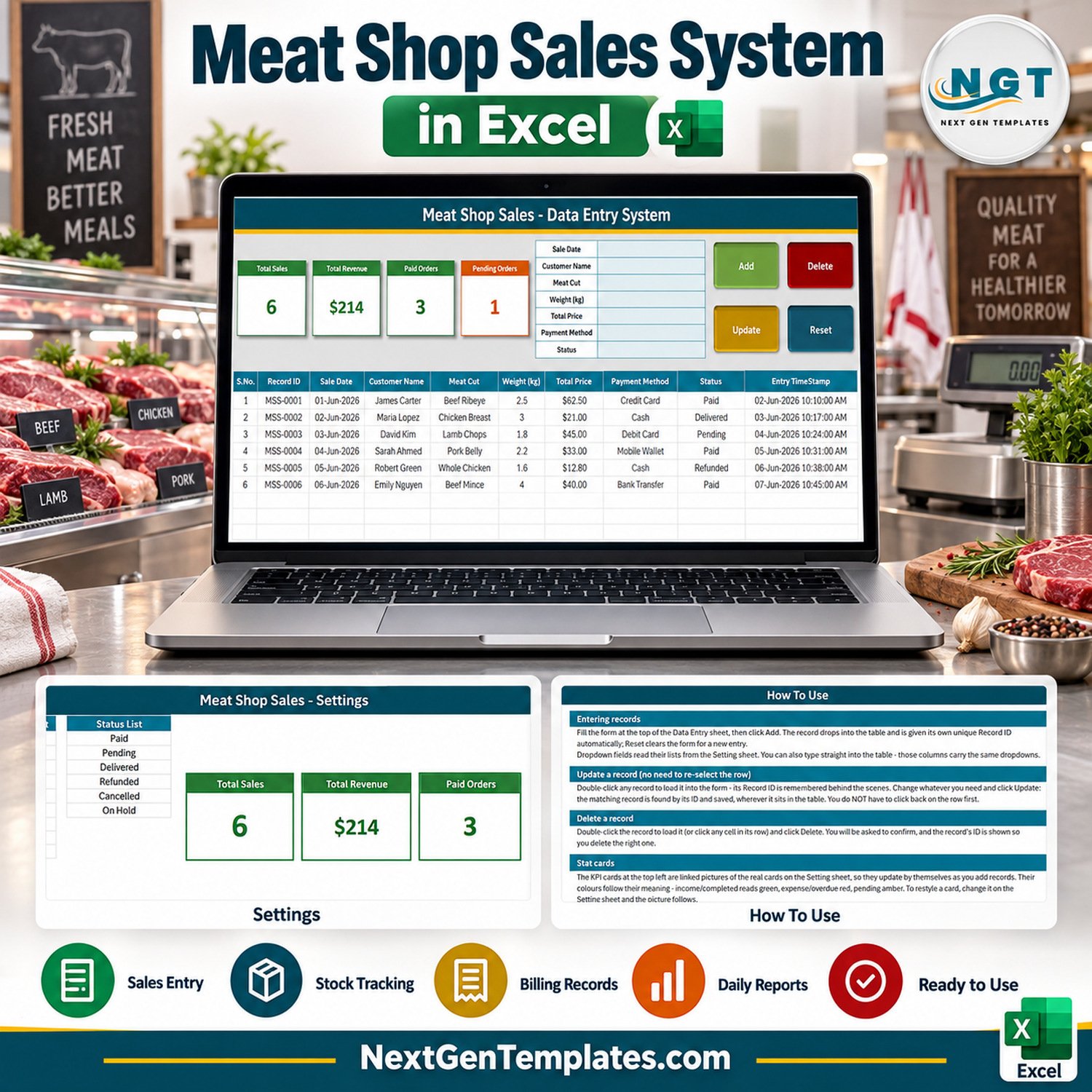
The Meat Shop Sales Data Entry System in Excel is a macro-enabled workbook for logging butcher-counter sales: who bought, which cut, how many kilograms, the total price, how it was paid and whether the order is paid, pending, delivered or refunded. It gives you a 7-field entry form, 4 live VBA buttons, 4 self-updating stat cards and 3 editable dropdown lists holding 26 ready values – 12 meat cuts, 8 payment methods and 6 statuses. Fill the form, click Add, and the sale lands in a 10-column records table with its own Record ID and timestamp.
It is a sales register, not a point-of-sale till, not a billing or invoicing tool, not a weighing-scale link, not stock or inventory control and not accounting software. It answers the questions a meat shop owner asks at the end of the week – how many sales were logged, how much was written up, and how many orders are paid or still pending – without scrolling back through a counter notebook.
✅ Instant download · One-time payment · No subscription · No per-user fees · Fully unlocked and editable
🔑 Key Features of the Meat Shop Sales Data Entry System in Excel
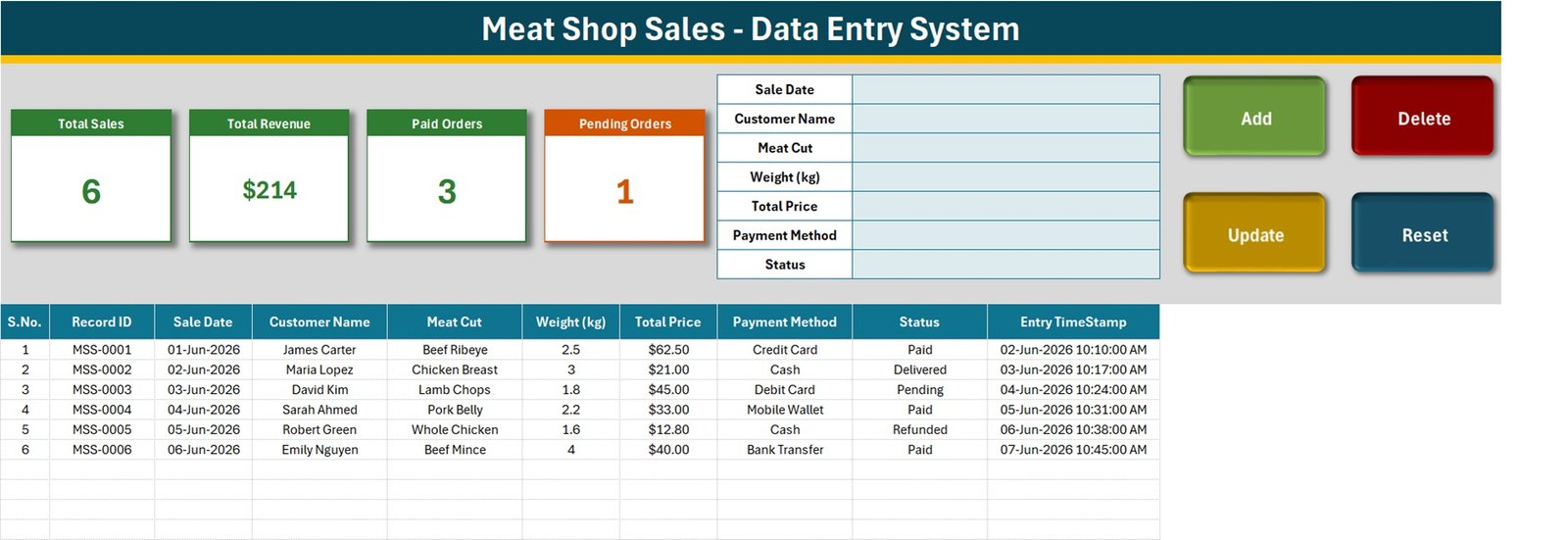
- 🧾 A seven-field entry form – Sale Date, Customer Name, Meat Cut, Weight (kg), Total Price, Payment Method and Status – placed beside the stat cards on the Data Entry sheet, so one screen covers entry and review.
- 🔘 Four live VBA buttons. Add saves the form as a new record, Update rewrites the record you loaded, Delete removes a record after a confirmation that shows its Record ID, and Reset clears the form without touching the table.
- 🔢 Automatic Record IDs in the MSS-0001 series plus an Entry TimeStamp on every saved sale. The next ID is always one more than the highest ID in the table, so a number is never reissued after a delete.
- 🖱️ Double-click editing. Double-click any row and it loads back into the form. The macro remembers the Record ID, so Update finds the right row even if you have clicked somewhere else in the meantime.
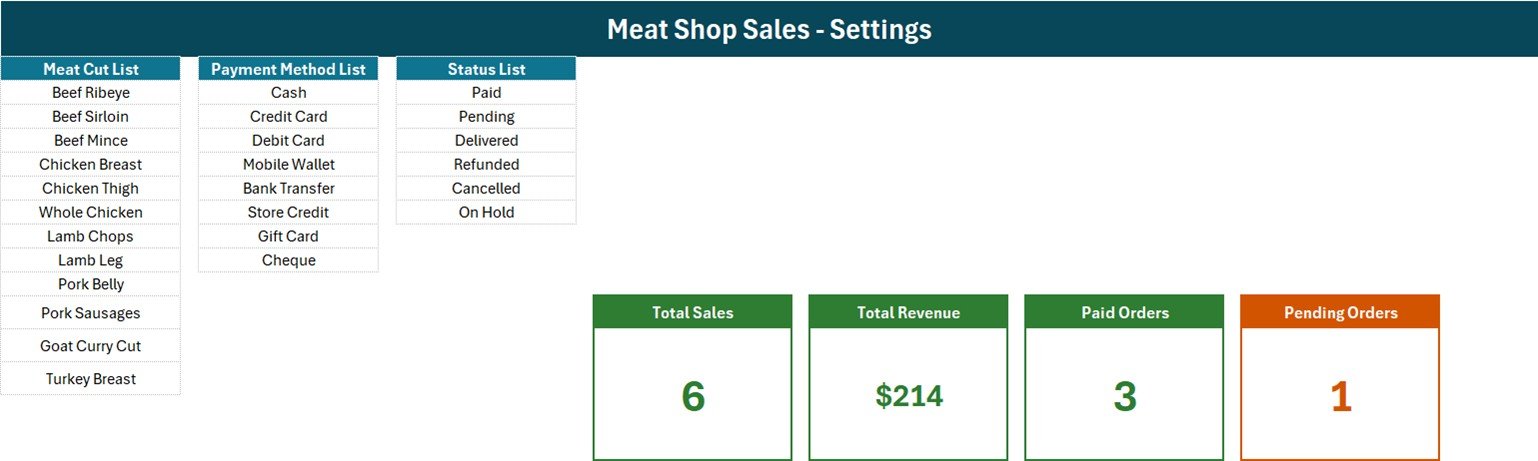
- 📋 Three dropdown lists on the Setting sheet – Meat Cut (Beef Ribeye, Beef Sirloin, Beef Mince, Chicken Breast, Chicken Thigh, Whole Chicken, Lamb Chops, Lamb Leg, Pork Belly, Pork Sausages, Goat Curry Cut, Turkey Breast), Payment Method (Cash, Credit Card, Debit Card, Mobile Wallet, Bank Transfer, Store Credit, Gift Card, Cheque) and Status (Paid, Pending, Delivered, Refunded, Cancelled, On Hold). The same dropdowns sit on the form and on table rows 15-214.
- 📈 Four stat cards – Total Sales, Total Revenue, Paid Orders and Pending Orders. They are linked pictures of formula cards on the Setting sheet, so they recalculate the moment a record is added, updated or deleted.
- 🔓 Nothing locked. No sheet protection and no VBA password – rename a column, add a meat cut or change a card formula yourself.
📦 What’s Inside the Workbook
One .xlsm file with four sheets: Data Entry, Setting, Instructions (headed How To Use) and Get More Templates. Six fictional sample sales are included so you can see the register working before you clear it.
Sheet 1: Data Entry
The working screen. The form and the four buttons sit at the top beside the stat cards; below them is the records table with S.No., Record ID, Sale Date, Customer Name, Meat Cut, Weight (kg), Total Price, Payment Method, Status and Entry TimeStamp. The six samples read 6 sales, $214 revenue, 3 paid orders and 1 pending order.
Sheet 2: Setting
Holds the Meat Cut List, Payment Method List and Status List that feed every dropdown, plus the four formula cards the Data Entry sheet displays as pictures. Restyle a card here and the picture follows.
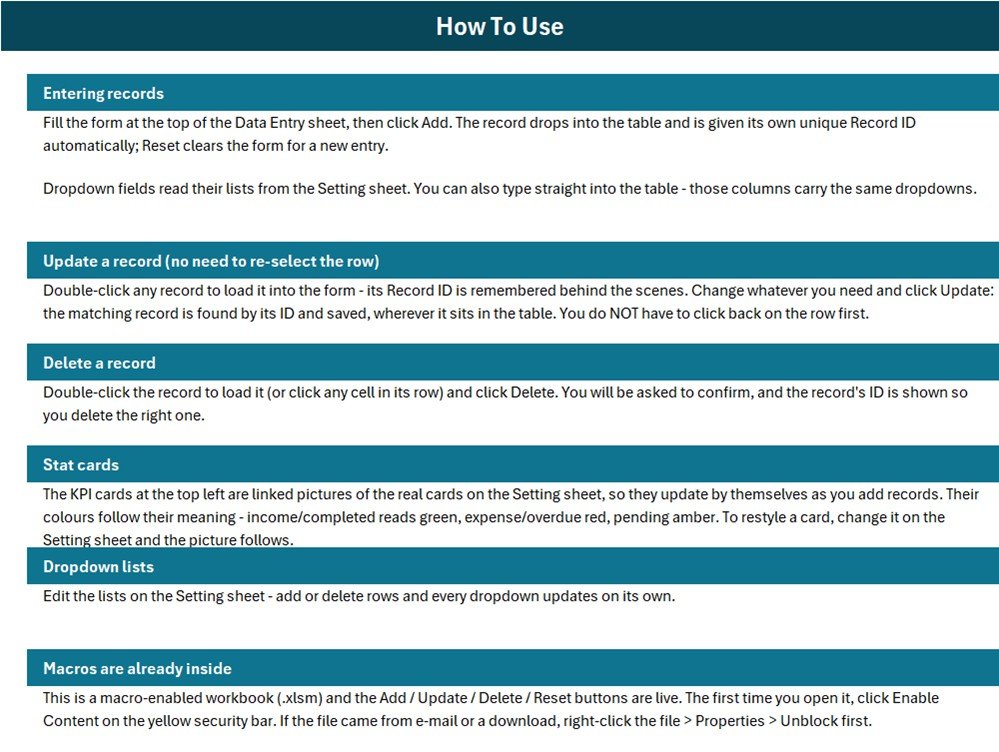
Sheet 3: How To Use
Plain-English instructions for entering, updating and deleting records, how the stat cards work, how to edit the dropdown lists, and how to enable the macros the first time you open the file.
📐 What the Four Stat Cards Actually Count
We read the workbook’s own formulas and macro before writing this page. Four things are worth knowing before you rely on the cards, each with a one-line fix:
- 💵 Total Price is typed, not calculated. There is no price-per-kg field, and Module1 simply copies the Total Price box into column G. Work out kilograms x price per kg yourself – or add a price input named
in_Price_per_kgand change that line tosh.Range("G" & r).Value = sh.Range("in_Weight_kg").Value * sh.Range("in_Price_per_kg").Value. - 🧮 Total Revenue has no status filter.
Setting!I13 = SUM('Data Entry'!$G$15:$G$1048576)adds every Total Price, so Pending, Delivered, Refunded, Cancelled and On Hold rows are all included. The sample $214 (exactly $214.30) holds $45.00 from a pending order and $12.80 from a refunded one, and only $135.50 from Paid rows. For paid revenue use=SUMIFS('Data Entry'!$G$15:$G$1048576,'Data Entry'!$I$15:$I$1048576,"Paid"). - 🚦 Only two of six statuses have a card. Paid Orders and Pending Orders are carded; Delivered, Refunded, Cancelled and On Hold are not, so on the samples 3 + 1 does not reach 6. Add a card such as
=COUNTIF('Data Entry'!$I$15:$I$1048576,"Refunded")for any status you want to watch. - 📋 The dropdown lists are fixed-length named ranges. Meat_CutList is
Setting!$A$3:$A$14, Payment_MethodList$C$3:$C$10and StatusList$E$3:$E$8, and all three are already full. How To Use says every dropdown updates on its own; that is only true when you insert a row inside a list. A value typed below the list never appears. Either insert rows inside the block, or redefine the name as=OFFSET(Setting!$A$3,0,0,COUNTA(Setting!$A$3:$A$100),1).
The Total Sales card counts the Sale Date column, which the Add button always fills, so it matches the number of sales you add through the form.
📊 This Excel Workbook vs. a Google Sheets Log vs. Butcher Shop POS Software
| Feature | Meat Shop Sales workbook (Excel) | Home-made Google Sheets log | Butcher / meat shop POS software |
|---|---|---|---|
| Cost | ✅ $6.99 one-time (regular $11.99) | Free, but you build it yourself | Recurring monthly subscription, often per till or location |
| Platform | Excel for Windows desktop | Any browser | Vendor app, till hardware or browser |
| Setup time | ✅ About 10 minutes – edit three lists | Hours to design form, lists and formulas | Days of onboarding and product import |
| Entry form with Add / Update / Delete | ✅ Built in, VBA | No – typing straight into rows | ✅ Yes |
| Real-time team collaboration | No – one file on one PC | ✅ Yes | ✅ Yes |
| Mobile access | No | ✅ Yes | ✅ Usually |
| Customizable lists and fields | ✅ Fully unlocked | ✅ Yes | Limited to vendor settings |
| Scale link, stock control, invoices | No | No | ✅ Usually included |
| Year-1 cost at 5 users | ✅ One purchase per user licence, no renewal | Free | Subscription x 12 months |
For a small butcher shop that wants a tidy, searchable sales register without paying for POS software it will not fully use, this workbook sits in the sweet spot.
👥 Who This Template Is For – and Who It’s Not For
✅ Built for:
- Butcher shops, halal and poultry counters keeping a daily record of each sale, the cut, the weight and the payment status
- Small meat sellers who take phone or delivery orders and need to see which ones are still pending
- Owners who want paid and pending orders at a glance in a file they fully control
❌ NOT for:
- Shops that need a till, barcode or weighing-scale connection, stock levels, or tax invoices – this is not a POS, billing or inventory system
- Businesses needing accounting ledgers, cold-chain, food-safety or traceability records, or several users editing at once
- Anyone working on a Mac, in Excel for the web or in Google Sheets, where the VBA buttons do not run
⚙️ How to Use the Meat Shop Sales Register
- Unzip the download and open
Meat_Shop_Sales_System.xlsmin Excel for Windows. Click Enable Content; if the file came from a download, right-click it, choose Properties and tick Unblock first. - On the Setting sheet, replace the sample meat cuts and payment methods with your own. Each list is full, so insert a row inside the block to add a value.
- Delete the six sample rows, or keep them while you learn the buttons.
- Fill Sale Date, Customer Name, Meat Cut, Weight (kg), Total Price, Payment Method and Status, then click Add. Sale Date is the one field the macro insists on.
- To change a sale, double-click its row, edit the form and click Update.
- To remove a sale, double-click it (or click any cell in its row), click Delete and confirm the Record ID.
- Decide whether you want the paid-revenue formula above before you start relying on the Total Revenue card.
💼 Real-World Use Cases
Imran runs a family butcher shop. He logs each phone order with the cut and kilograms, marks it Pending until the customer collects and pays, and checks the Pending Orders card every evening before closing.
Claire sells free-range poultry from a farm shop. She keeps Whole Chicken, Chicken Breast and Turkey Breast at the top of the Meat Cut list and filters the table by cut at month end to see what sold best by weight.
A small meat delivery business uses Delivered and Paid as separate statuses, adds a Refunded card with a single COUNTIF, and switches Total Revenue to Paid-only so the top of the sheet matches the cash actually received.
⚠️ Limits to Know Before You Buy
- 🪟 Macros must be enabled, and Windows desktop Excel is required. The buttons do not run on Mac, in Excel for the web, on mobile or in Google Sheets.
- ⚖️ Weight is labelled kg. Items sold by the piece or pack need converting, or rename the column.
- 🗂️ The in-table dropdowns cover rows 15-214, and Delete removes the whole worksheet row, so that formatted block shortens by one row per delete.
- 🔐 Customer names are stored in an unprotected workbook. Keep the file on a secured PC, or record a first name or order reference instead.
- 🧪 The sample customers, cuts and figures are fictional. The workbook makes no halal, organic, food-safety or hygiene claim.
❓ Frequently Asked Questions
What does the Meat Shop Sales Data Entry System in Excel record?
It records one row per meat sale: Sale Date, Customer Name, Meat Cut, Weight in kilograms, Total Price, Payment Method and Status, plus an automatic Record ID and Entry TimeStamp. Four stat cards show total sales, total revenue, paid orders and pending orders.
How long does setup take?
About ten minutes. Enable macros, replace the sample meat cuts and payment methods on the Setting sheet, delete the six sample rows and start adding sales. There is nothing to install and no account to create.
Why is Total Revenue higher than the cash I collected?
Because the card sums every Total Price regardless of Status, including Pending, Delivered, Refunded, Cancelled and On Hold rows. On the samples it shows $214 while Paid rows total $135.50. Replace the formula with the SUMIFS version on this page to count Paid sales only.
Does it calculate the price from weight and price per kg?
No. Total Price is a typed field and there is no price-per-kg column. Enter the final price for each sale, or add a price input and change one line of the macro so Total Price becomes Weight multiplied by price per kg.
Will it work on a Mac or in Excel for the web?
The sheets open, but the Add, Update, Delete and Reset buttons are VBA macros that need Excel for Windows on the desktop with macros enabled. On a Mac, in a browser or in Google Sheets you can only type directly into the table.
How does this compare to butcher shop POS software?
POS systems handle tills, scales, stock and invoices for a monthly fee. This workbook does none of that; it is a one-time $6.99 sales register for recording what was sold, to whom and whether it was paid, in a file you own and can edit.
Is the file locked?
No. There is no sheet protection and no VBA project password, so you can rename columns, extend lists, change card formulas or edit the macro.
👤 About the Author
Built by PK – Microsoft Certified Professional with 15+ years of Excel, Google Sheets and Power BI experience. Founder of NextGenTemplates, reaching 300K+ subscribers across YouTube channels (@PKAnExcelExpert, @NextGenTemplates, @NeoTechNavigators). Every template is hand-built and tested before release.
🔗 Explore Related Templates
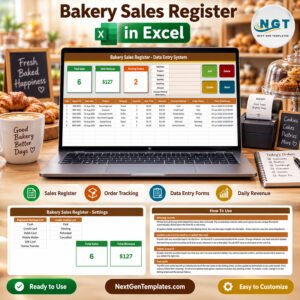
- 🥐 Bakery Sales Register Data Entry System in Excel – the same form-and-cards build for a bakery counter.
- 🛒 Grocery Shopping List Data Entry System in Excel – a simple entry form for planning what to buy.
- 📈 Grocery Delivery Services KPI Dashboard in Excel and Hypermarkets KPI Dashboard in Excel – KPI tracking once you outgrow a simple register.
- 🧾 Optical Shop Sales, Furniture Sales Register and Supplement Sales data entry systems – sales registers for other retail counters.
Browse more Excel VBA tools and Excel sales templates in the store. New to macros? Microsoft explains how to enable or disable macros in Microsoft 365 files.
📖 Click here to read the Detailed Blog Post
🎥 Visit our YouTube channel for step-by-step video tutorials
👉 YouTube.com/@NextGenTemplates
📅 Last updated: September 2026