

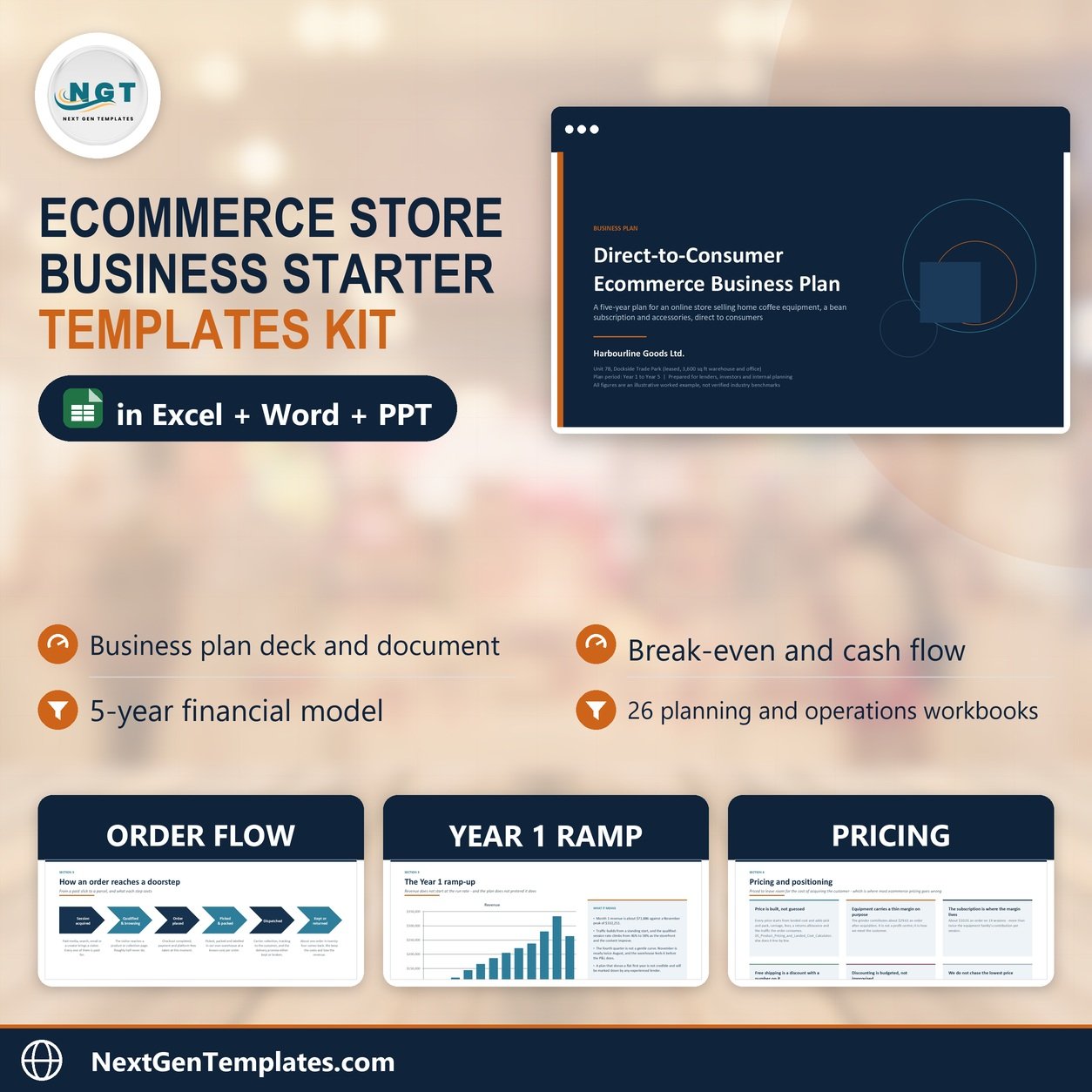
The Ecommerce Store Business Starter Templates Kit is 35 files in nine folders: a 44-slide PowerPoint business plan, a 13-section Word business plan, 26 numbered planning and operations workbooks, three ready-made Excel tools and a 10-page PDF guide. The five-year financial model alone has 13 linked sheets — change one assumption and traffic, orders, revenue, cost, profit, cash flow and break-even all move together. It is an ecommerce business plan template and an operating toolkit in one download.
🌍 Join 8,400+ teams in 40+ countries using NextGenTemplates to replace paid SaaS tools with one-time-purchase Excel, PowerPoint and Word templates.
✅ Instant download · One-time payment · No subscription · No per-user fees · Lifetime access
🔑 Key Features of the Ecommerce Store Business Starter Templates Kit
🛒 Built on traffic, not a guessed revenue line. Sessions are the scarce resource in an online store, so the model starts there: sessions × qualified-session rate × conversion = orders, and every order carries its landed cost, pick and pack, carriage, payment fees, a returns allowance and the traffic it consumed. That is why this online store business plan holds up when a lender asks where the revenue comes from.
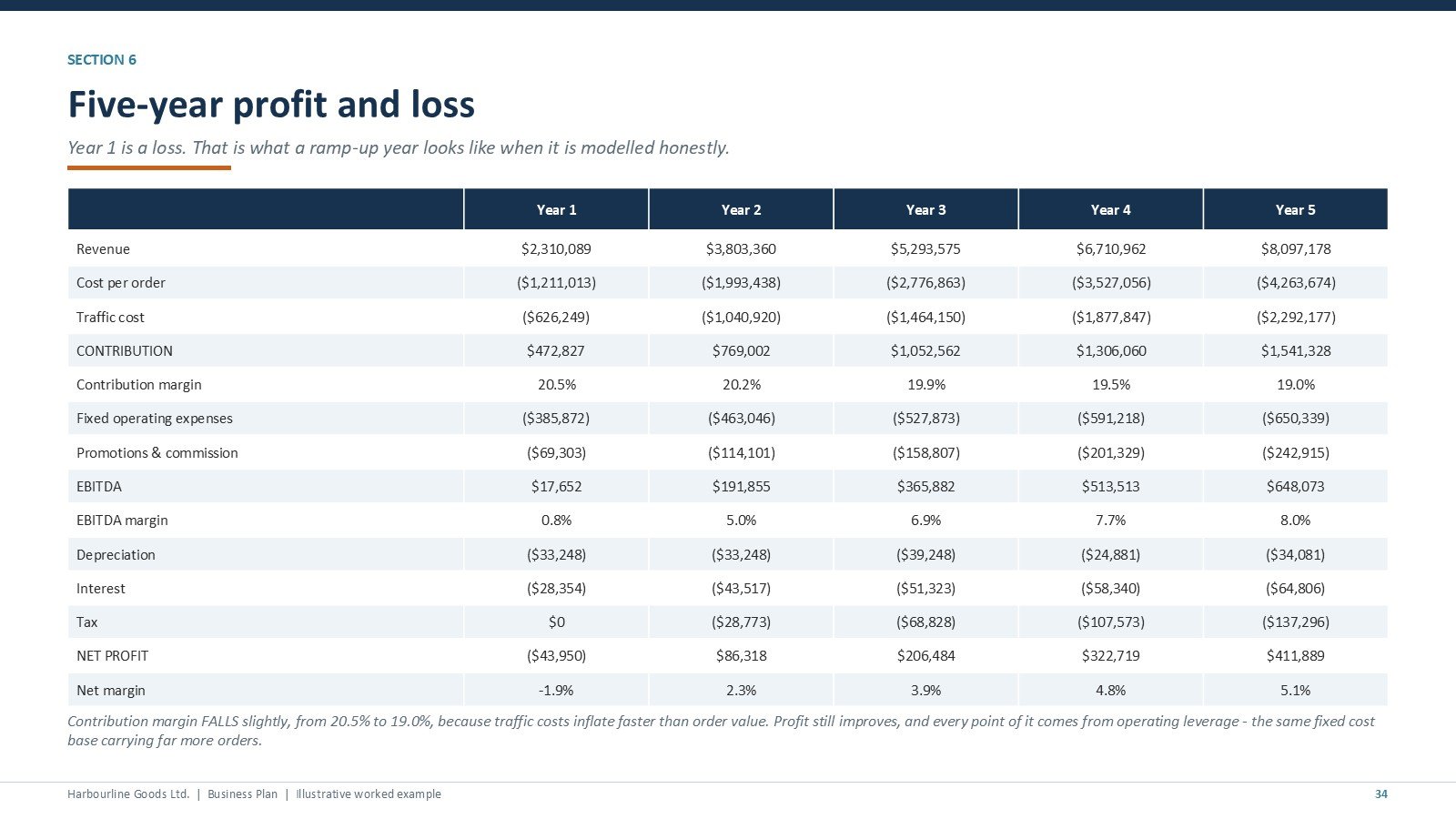
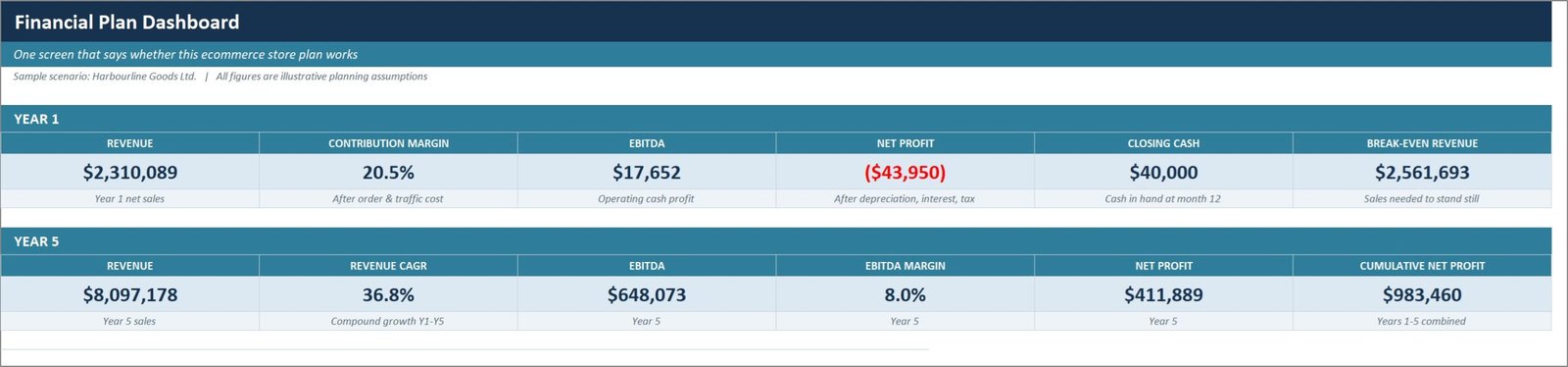
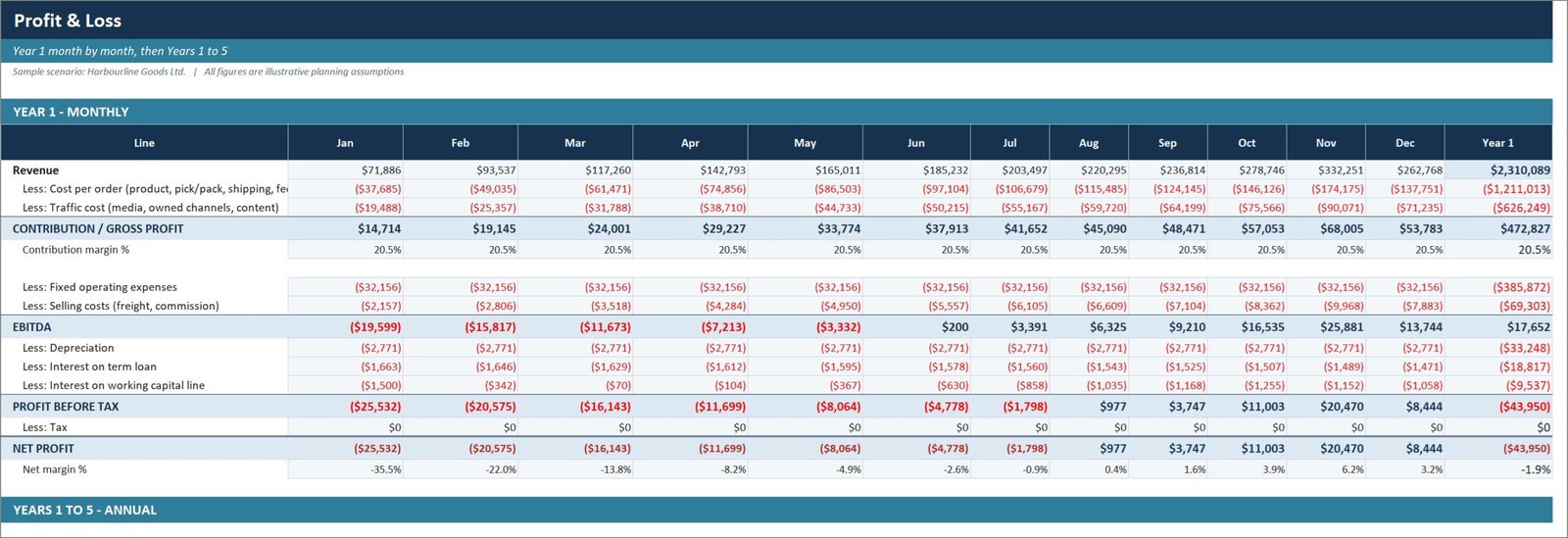
📉 The worked example loses money in Year 1 — on purpose. The fictional sample company, Harbourline Goods Ltd., reaches $2,310,089 of revenue in Year 1 with $17,652 of EBITDA and a ($43,950) net loss, breaks even in month 14, and reaches $8,097,178 revenue, $648,073 EBITDA (8.0%) and $411,889 net profit by Year 5. These are illustrative figures, not benchmarks.
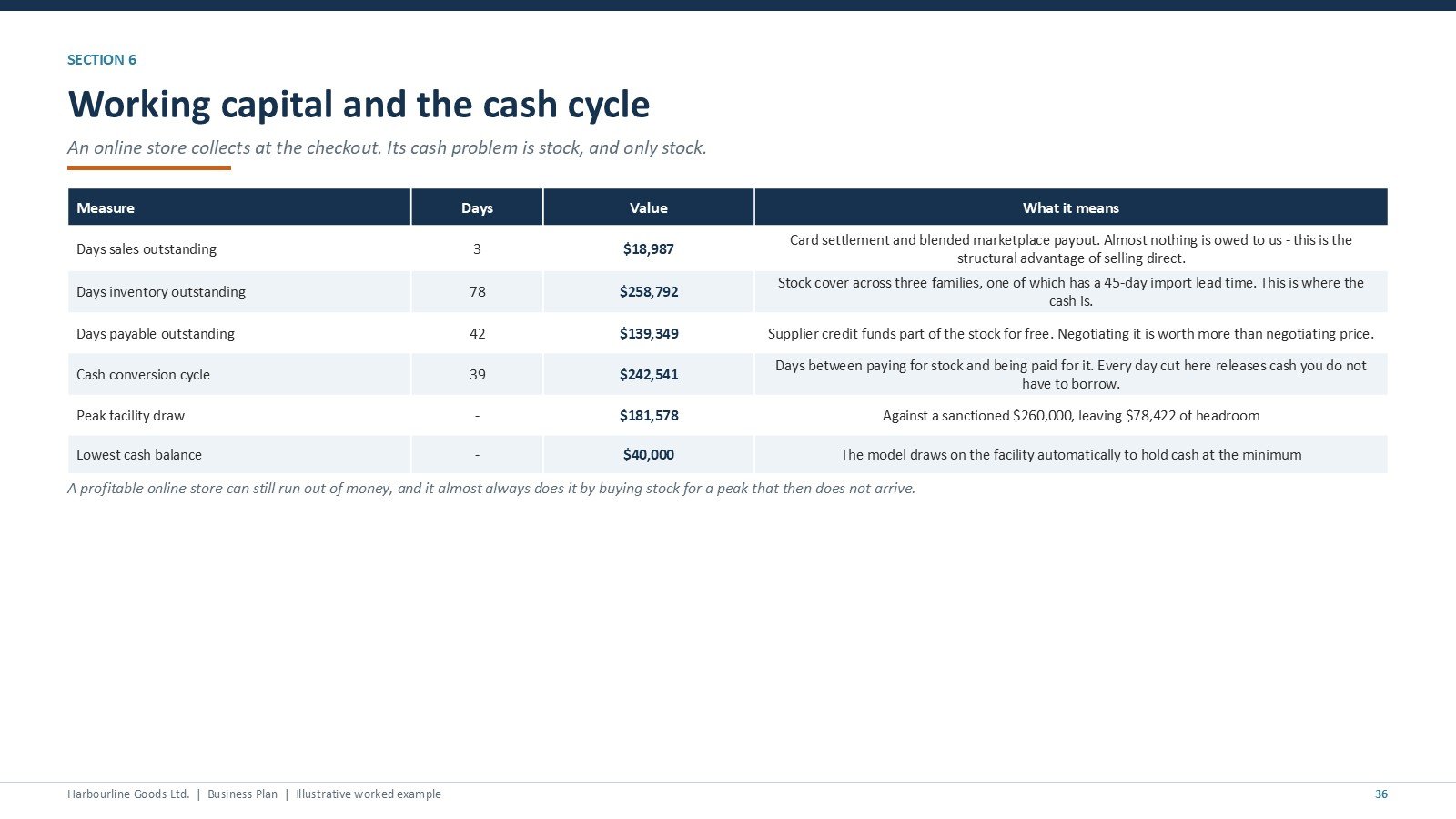
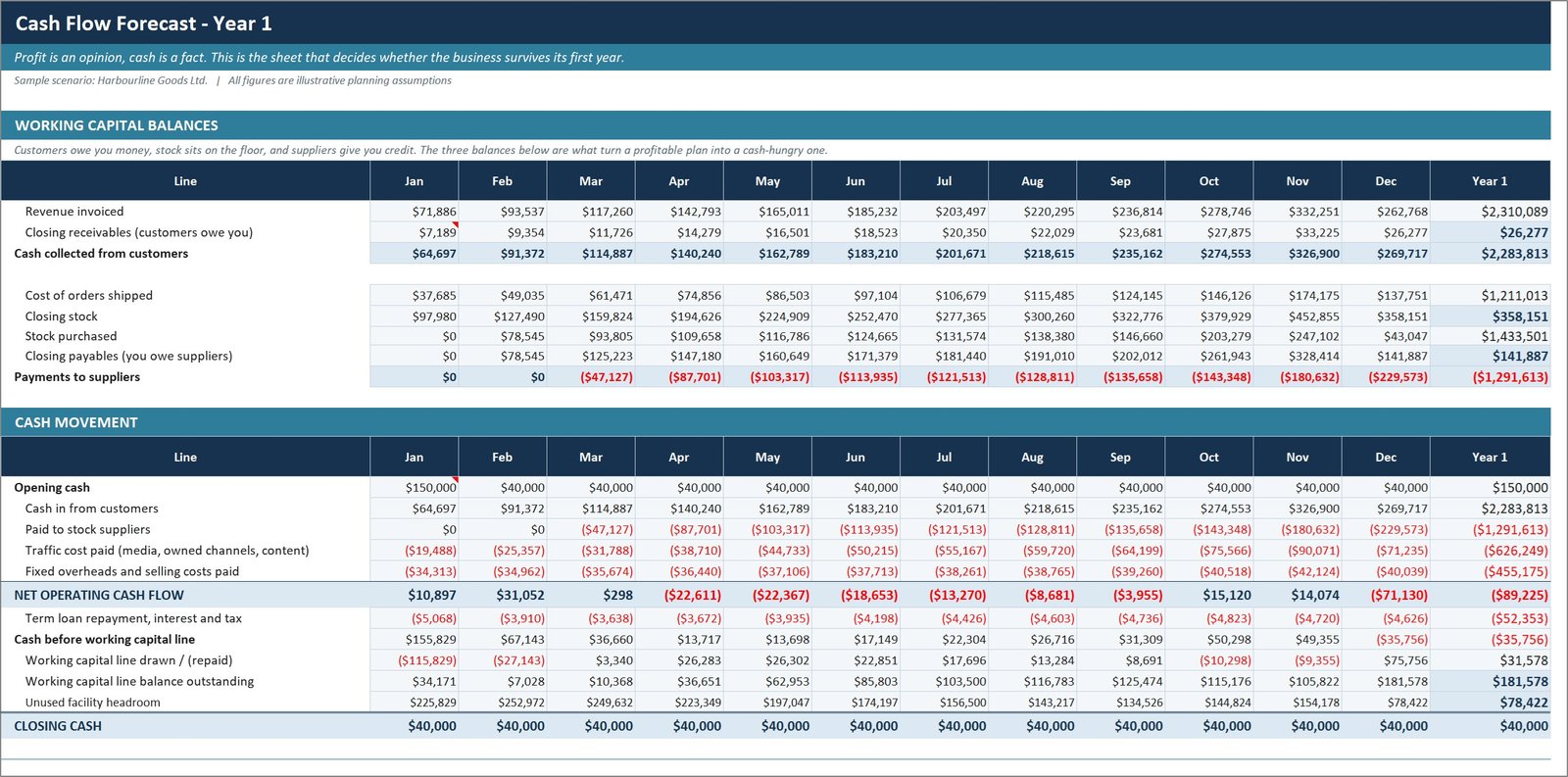
💵 Stock is where the cash goes, and the model shows it. A store collects at checkout, so receivables are tiny (3 days) but inventory sits at 78 days. A working capital facility draws automatically to hold minimum cash; in the example it peaks at $181,578 against a $260,000 limit.
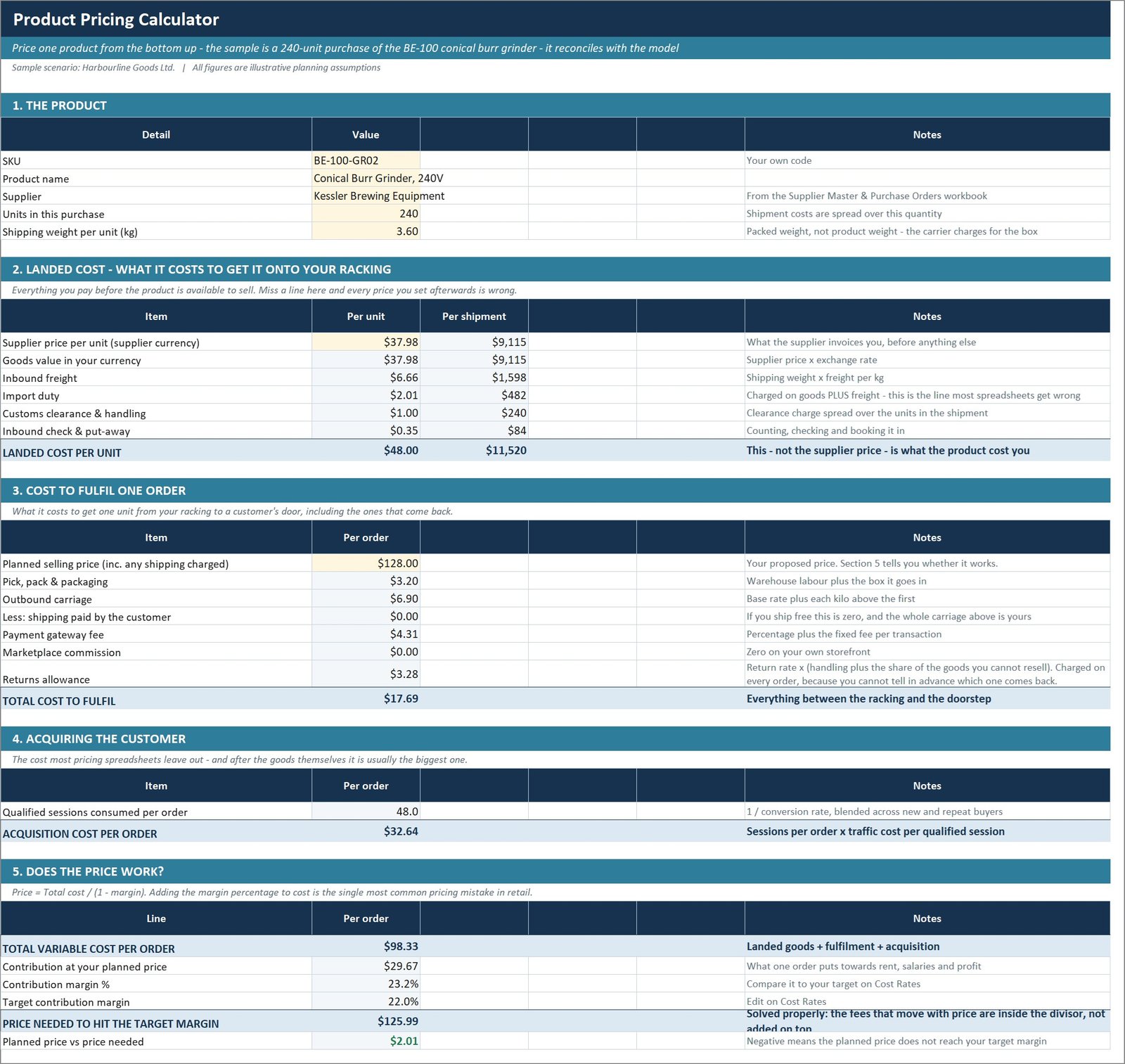
🧮 Pricing that includes the cost of the customer. The pricing calculator builds landed cost (freight, duty, clearance), then fulfilment, fees, returns and acquisition cost per order, and solves the price with Price = Cost ÷ (1 − margin) so fees that move with price sit inside the divisor.
⚙️ Excel 2010 and later, zero formula errors. No XLOOKUP, no dynamic arrays, no add-ins. The only macro file is the bundled Organization Chart Template (.xlsm), which needs macros to draw itself.
📦 What’s Inside the Ecommerce Store Business Starter Templates Kit
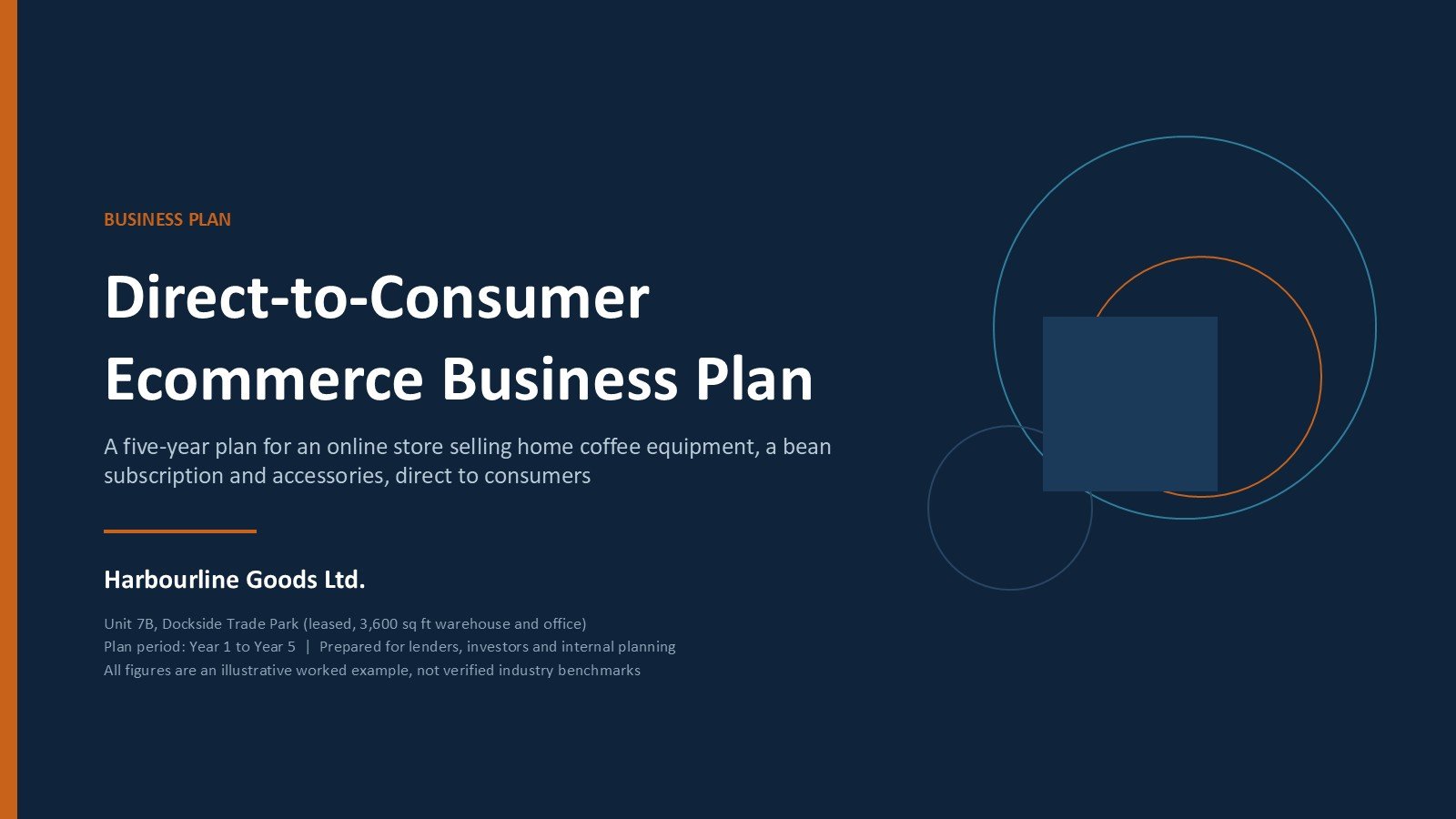
The 44-slide PowerPoint business plan
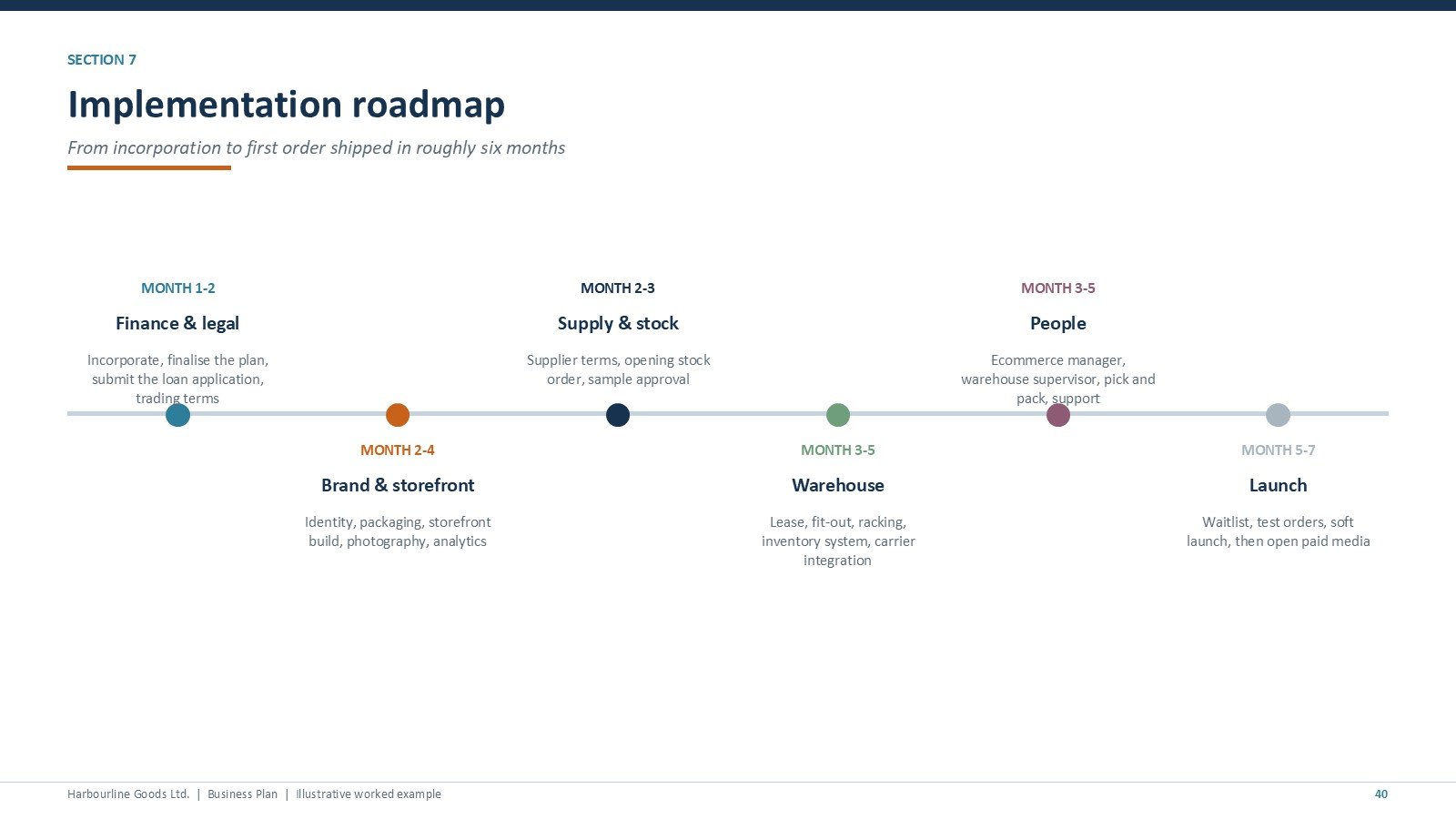
Seven sections — the business, the market, products and operations, sales and marketing, organisation, the financial plan and execution. Native editable charts and tables, speaker notes on 35 slides, and a subtle entrance animation on the content slides.
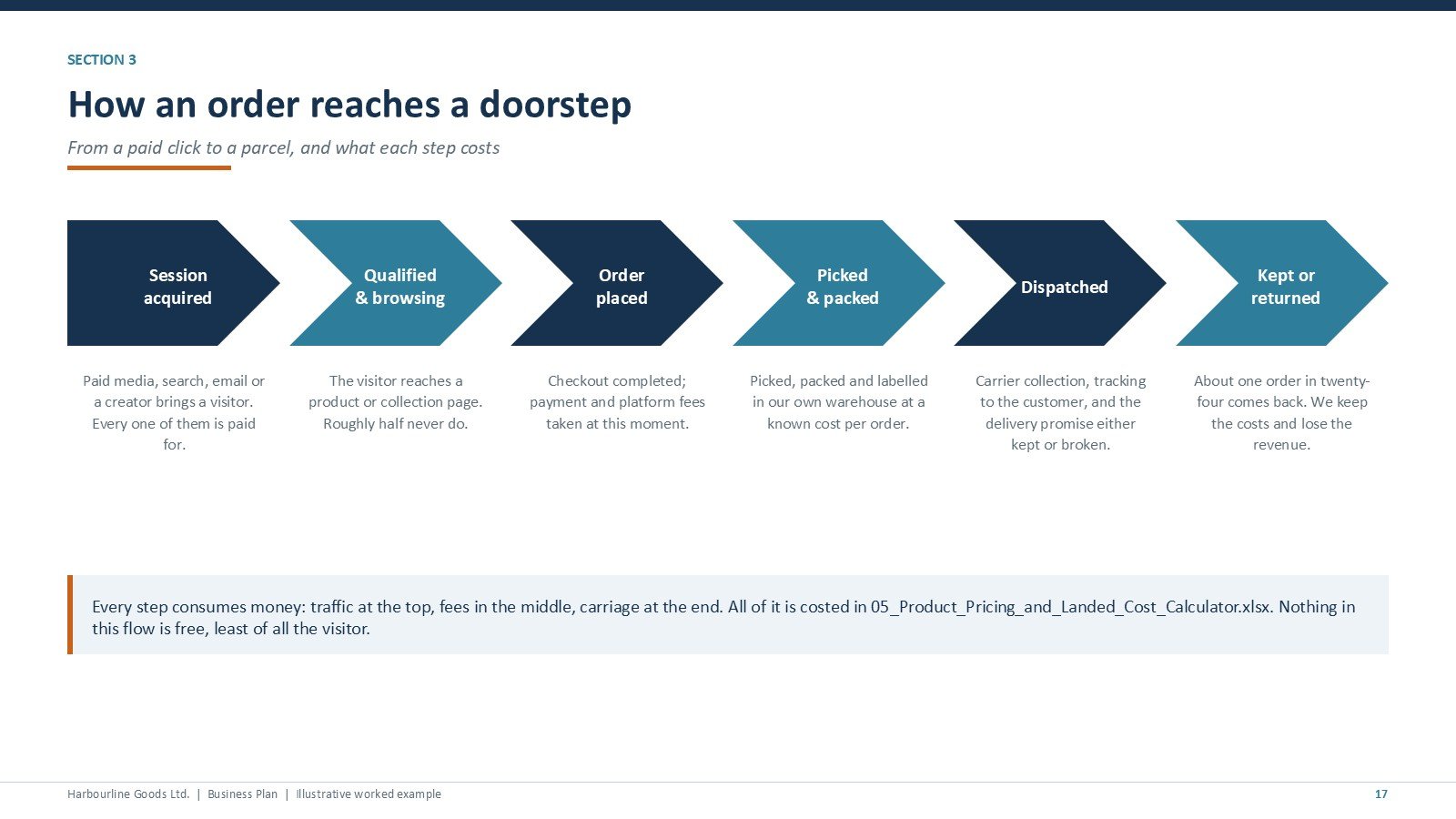
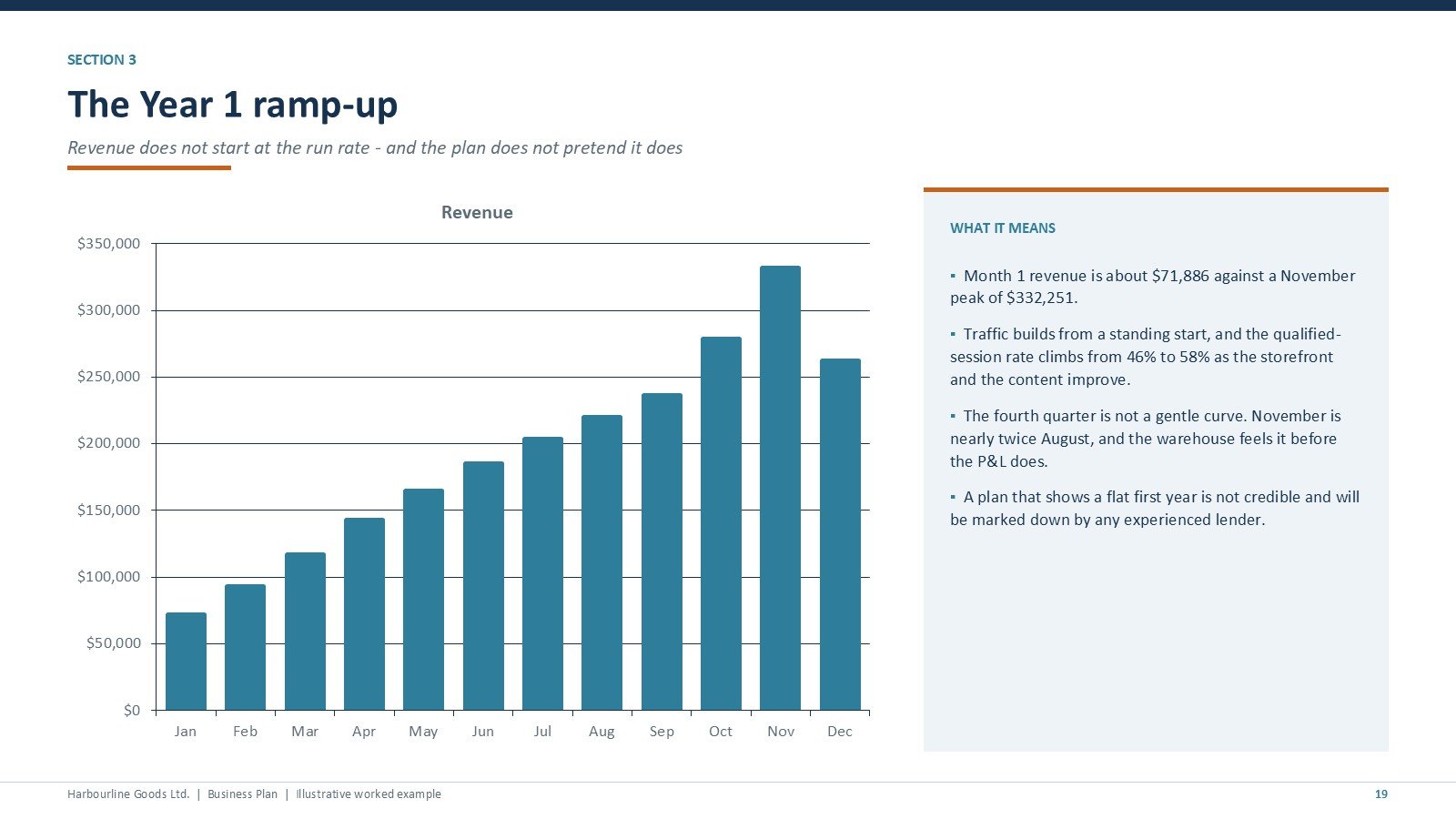
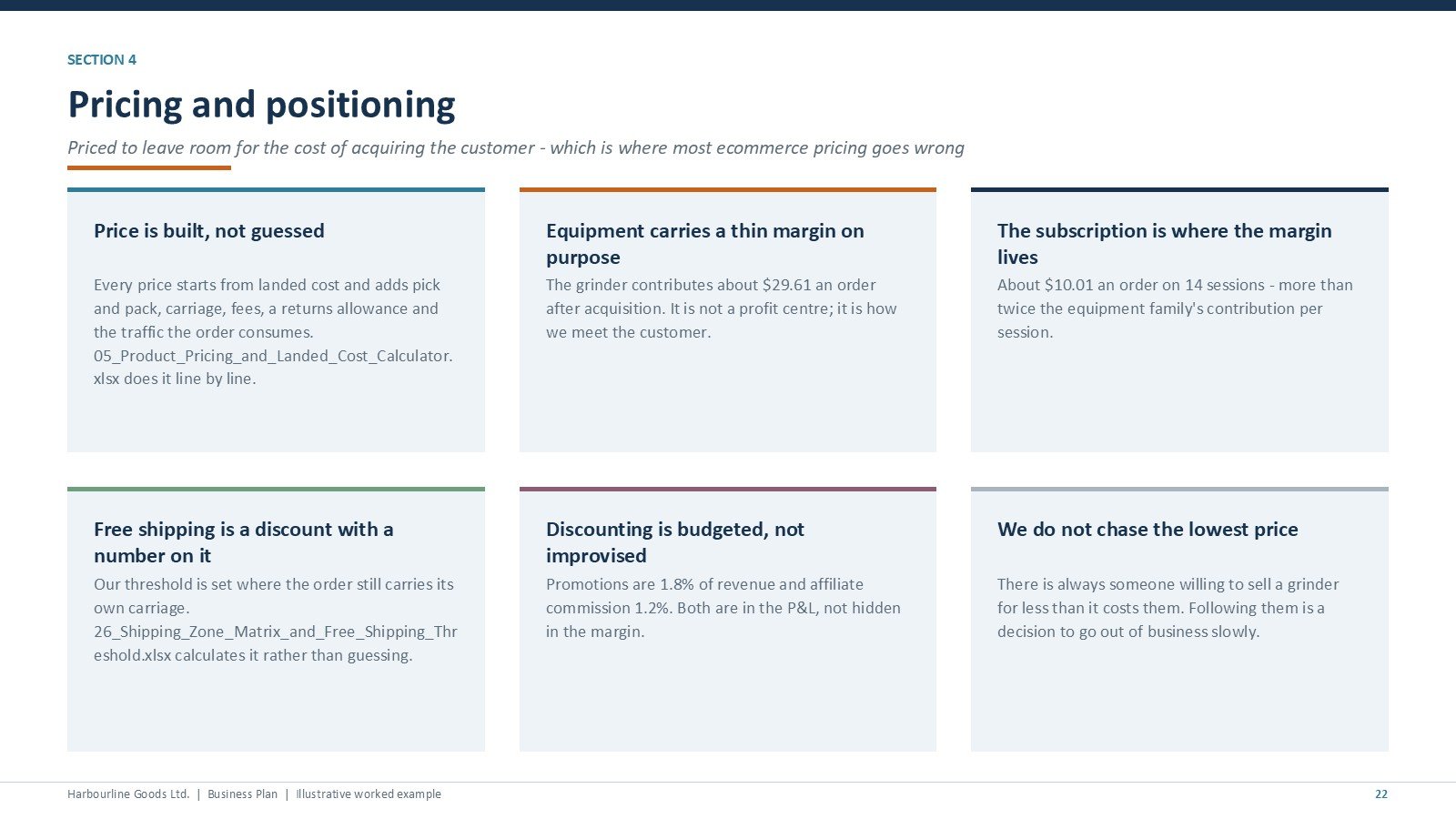
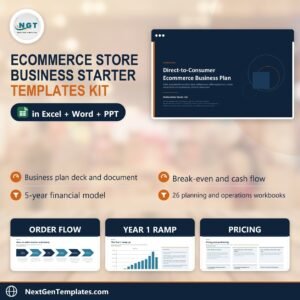
Order flow, Year 1 ramp and pricing slides
How an order reaches a doorstep in six costed steps, the month-by-month Year 1 revenue ramp with a November peak, and the pricing and positioning logic for three product families: brewing equipment, a coffee subscription and accessories.
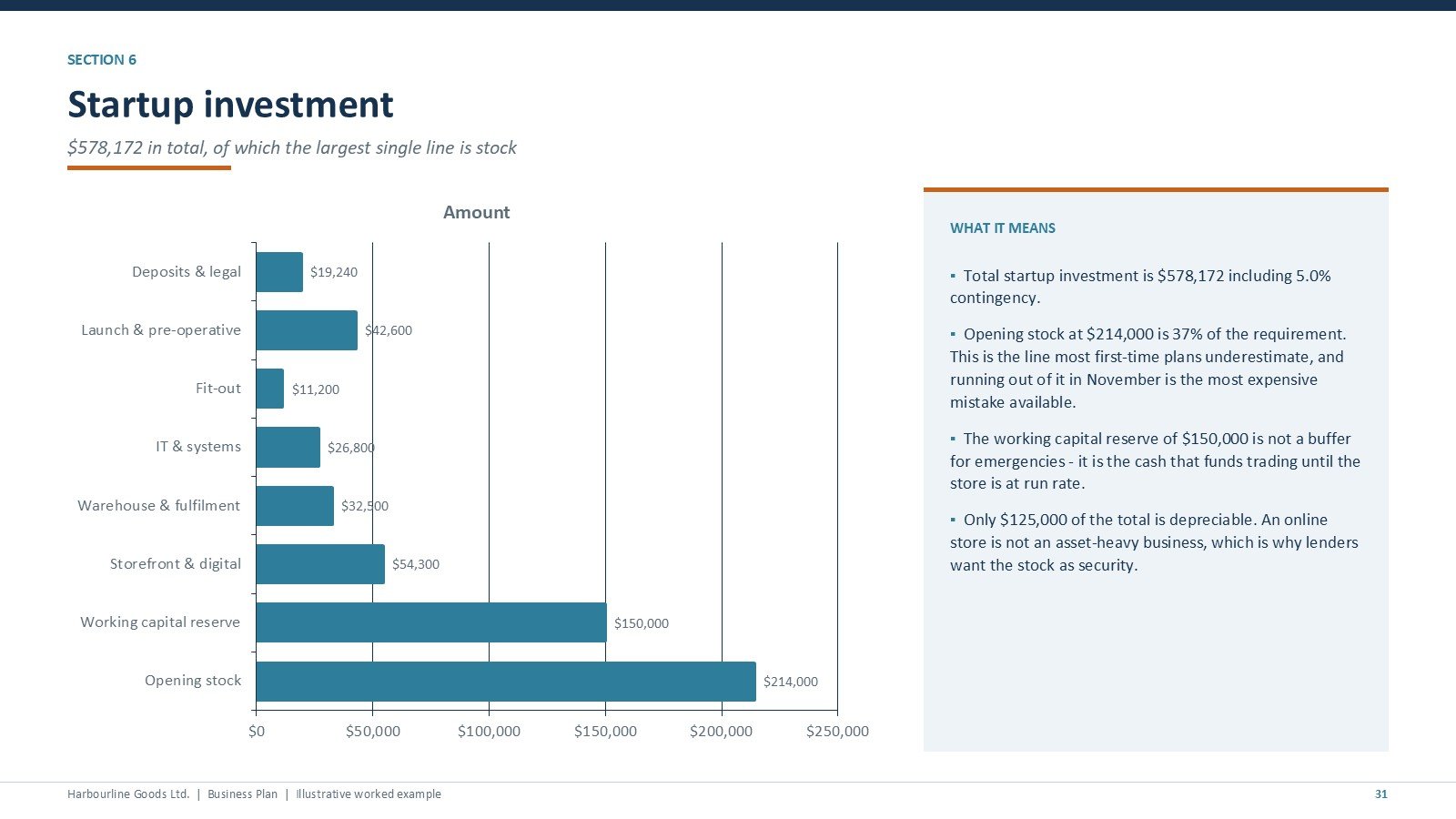
Startup investment, profit and loss, working capital and break-even slides
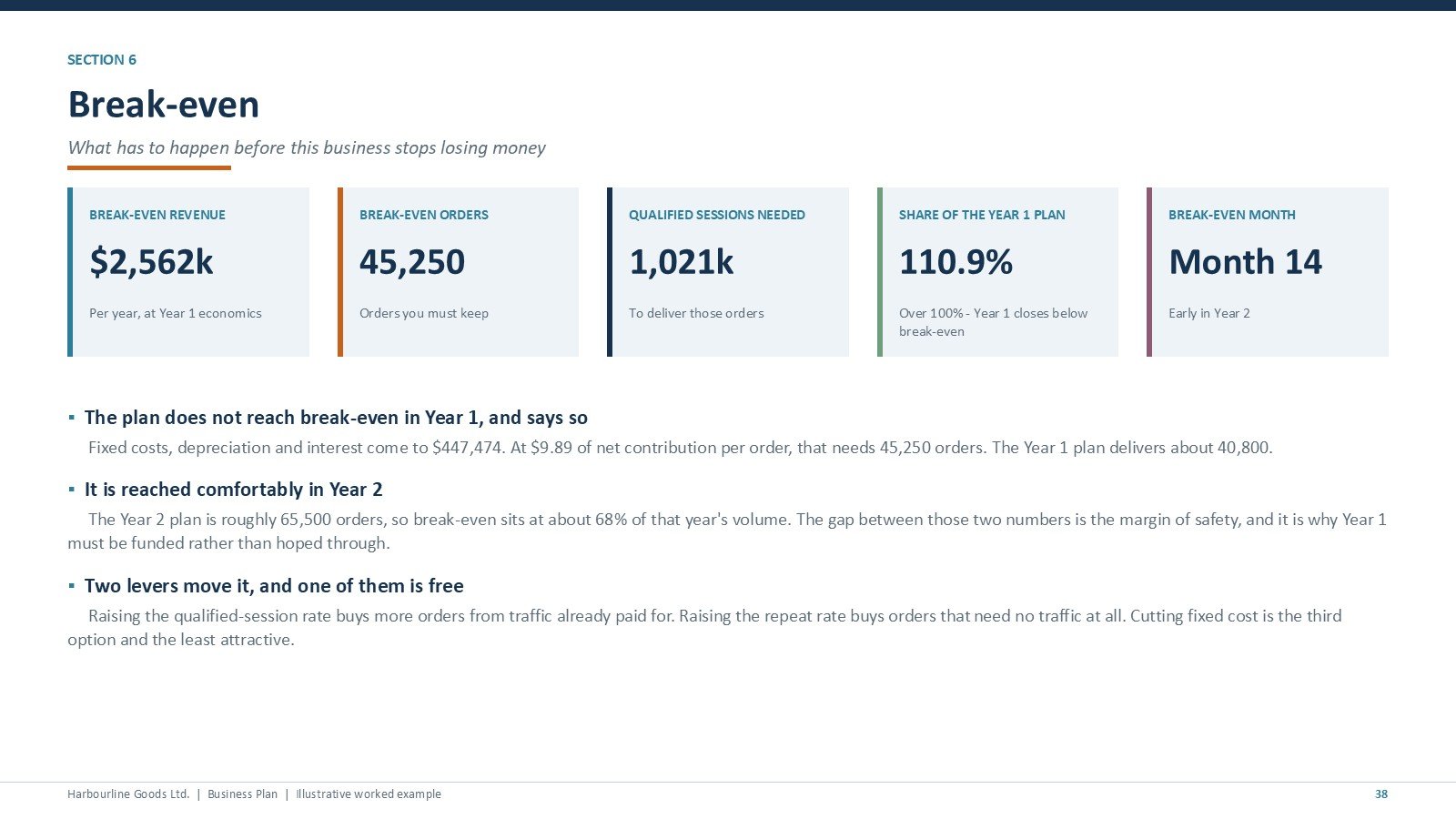
Ecommerce startup costs of $578,172 including a 5% contingency, with opening stock the largest single line; a five-year profit and loss; the cash conversion cycle; and break-even stated as revenue, orders, qualified sessions and the month it arrives.
Workbook 02: the ecommerce financial model in Excel
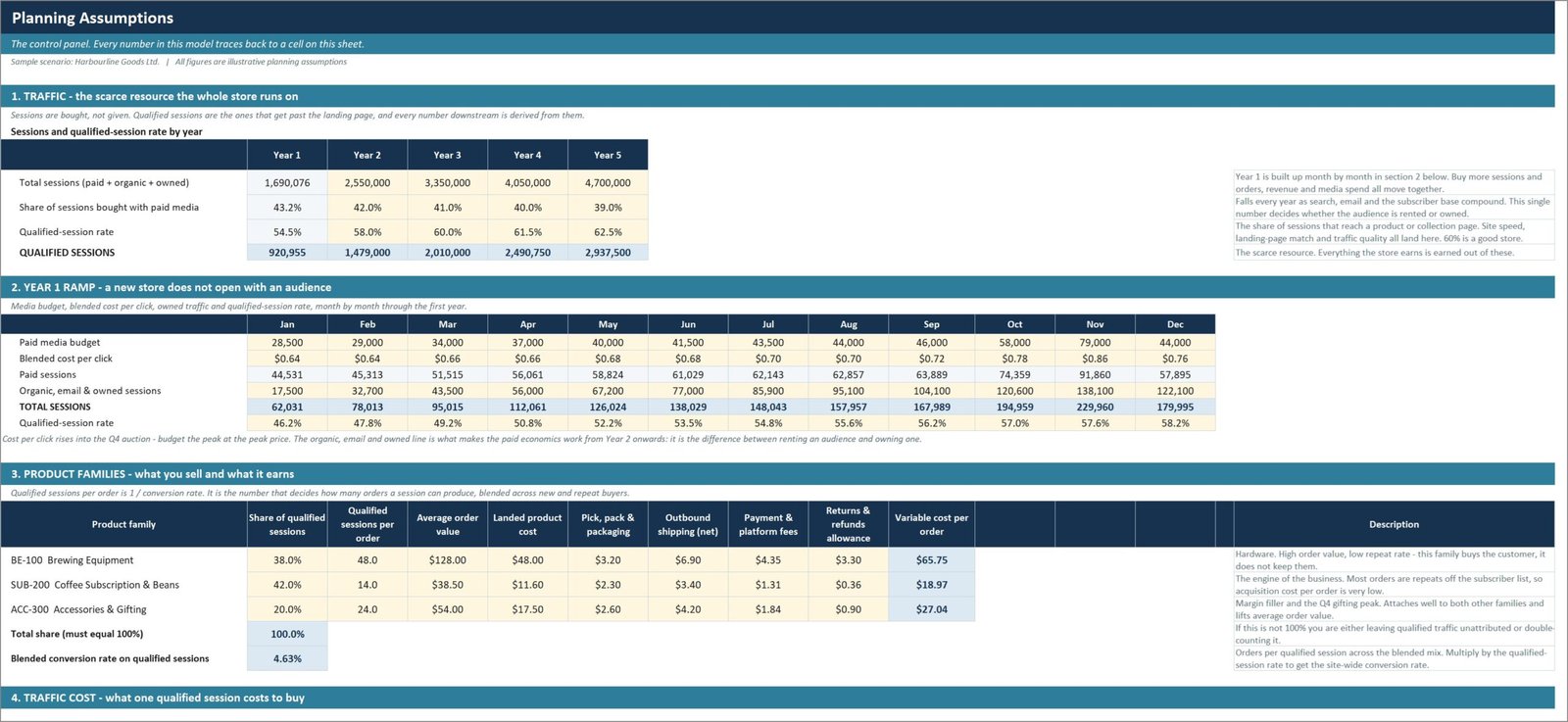
The Dashboard shows Year 1 and Year 5 revenue, contribution margin, EBITDA, net profit, closing cash, break-even revenue and revenue CAGR on one screen. The Assumptions sheet is the control panel: sessions, the Year 1 media ramp, three product families and every cost rate.
Profit and loss, and the Year 1 cash flow forecast
Year 1 month by month then Years 1 to 5, splitting cost per order from traffic cost. The cash flow tracks receivables, stock and supplier payables, then draws and repays the working capital line automatically.
Workbook 01 startup costs, and Workbook 05 pricing and landed cost
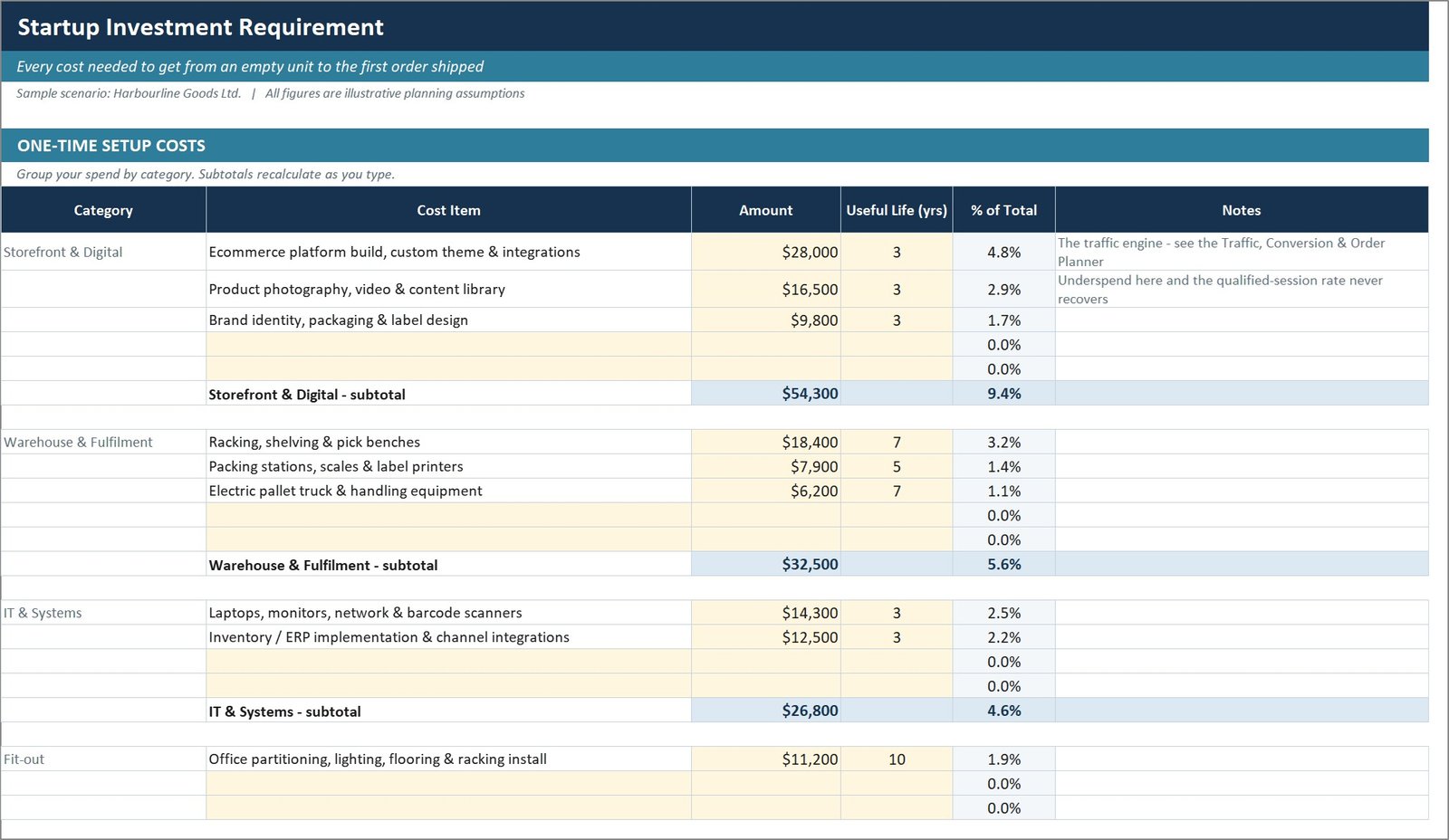
Every cost from empty unit to first order shipped, grouped by category with useful life for depreciation. The pricing calculator takes one SKU from supplier price to landed cost, cost to fulfil, acquisition cost and the price needed to hit your target margin.
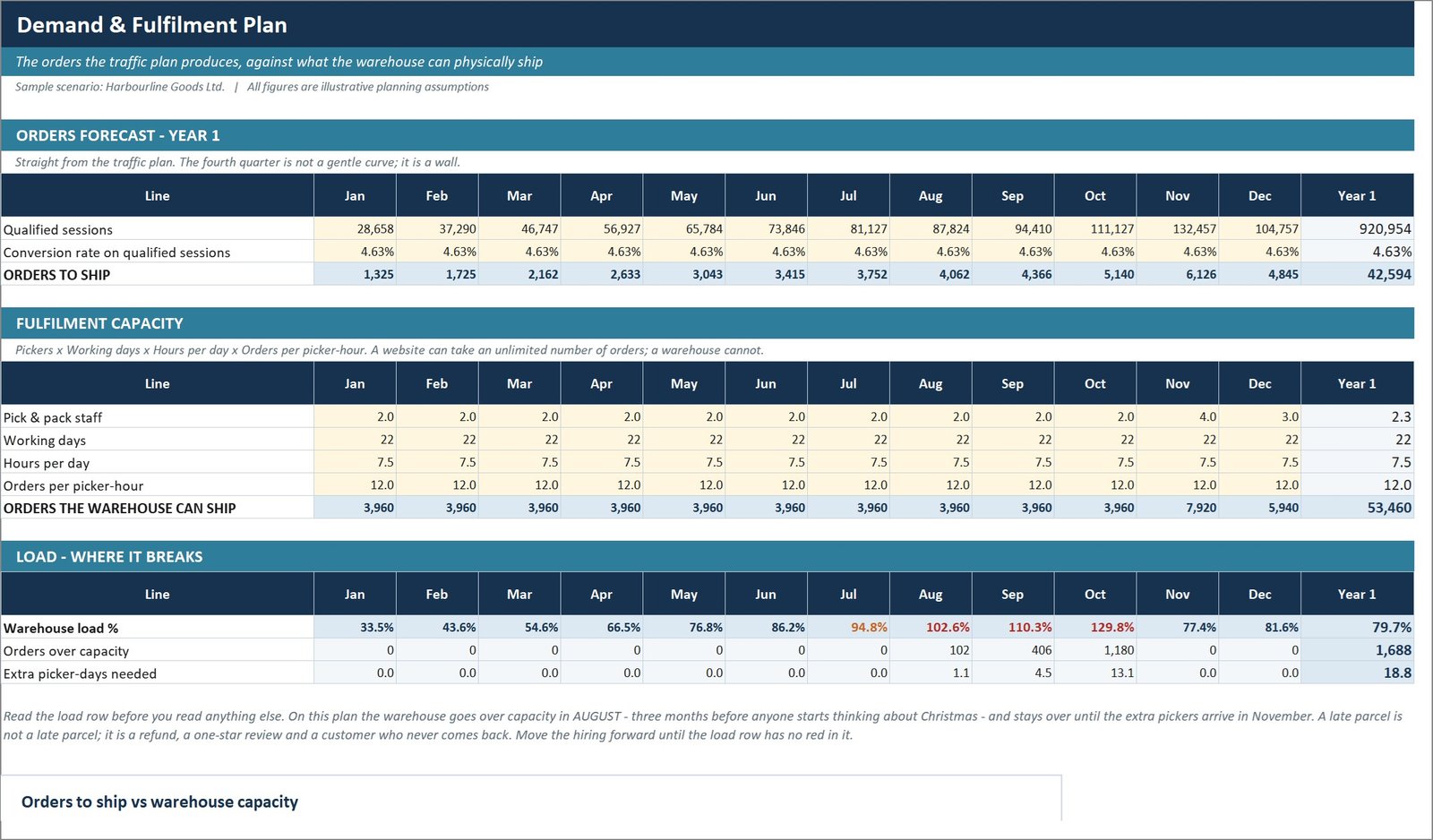
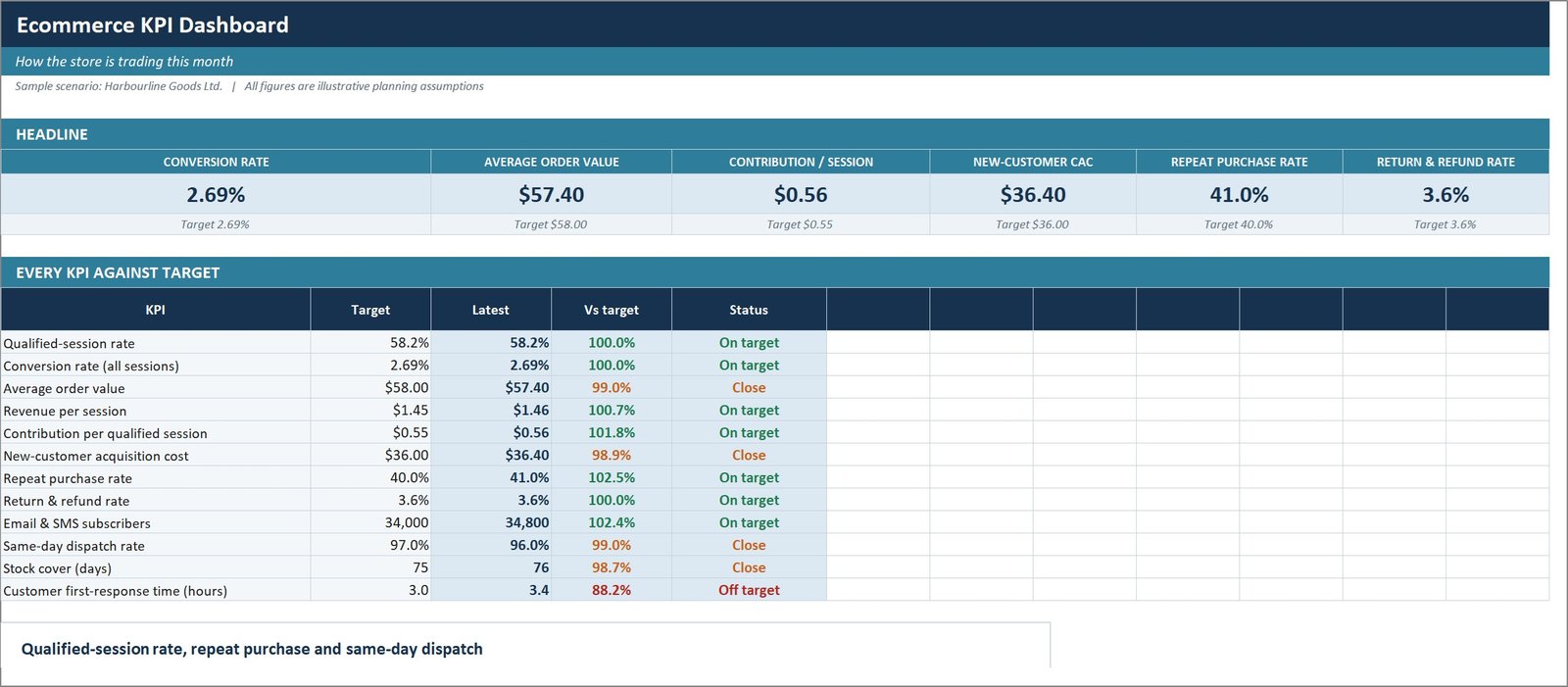
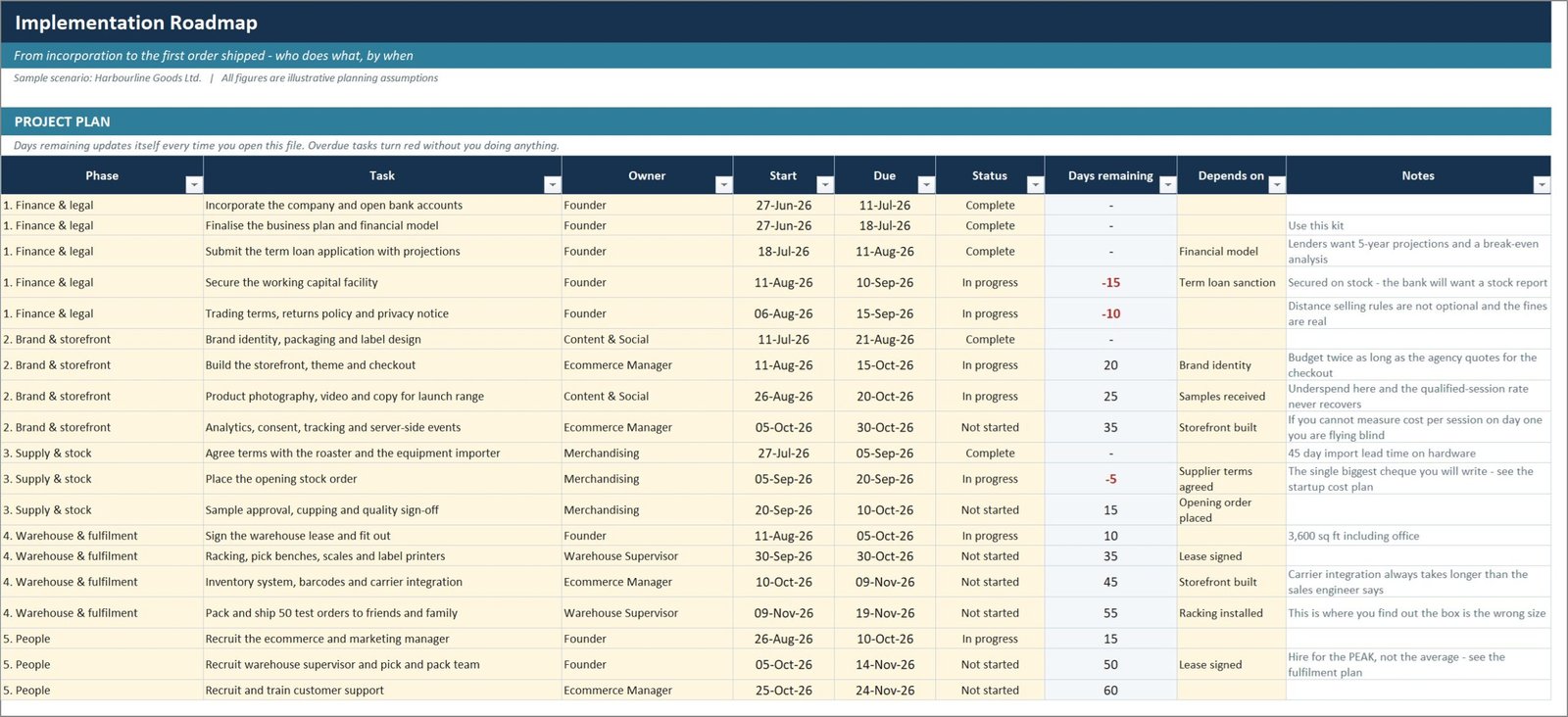
Workbook 07 demand and fulfilment, Workbook 09 KPI dashboard, Workbook 10 roadmap
Orders to ship against what the warehouse can physically pick, with the months that break flagged in red. A 12-KPI dashboard against target. A 29-task roadmap where days remaining update themselves, plus a 12-risk register.
Also included
🔹 Financial Planning: break-even and contribution with scenarios, loan and working capital planner, expense tracker and petty cash, receivables and payables ageing, budget vs actual, and a marketplace and payment fee calculator.
🔹 Sales & Marketing: channels and marketing plan, invoice and quotation, customer master and enquiry tracker, SKU profitability after fees and returns, ad spend ROAS tracker, and customer cohort repeat rate with LTV:CAC.
🔹 Operations: inventory and replenishment planner, supplier master and purchase orders, returns refunds and damages log, and a shipping zone matrix with free-shipping threshold.
🔹 People, admin and tools: employee master, attendance and leave, payroll, asset register, licence and compliance tracker, SOP and quality plan, startup checklist, organisation chart, QC checklist and financial planning calendar.
📊 Ecommerce Store Business Starter Templates Kit vs. a Business Plan Writer vs. LivePlan / Bizplan — Where This Fits
| Feature | This starter kit | Freelance business plan writer | LivePlan / Bizplan |
|---|---|---|---|
| Cost | $23 one-time ✅ | $500 – $3,000 per plan | $20 – $50 / month, ongoing |
| Platform | Excel, PowerPoint, Word — files you own ✅ | Whatever they send back | Browser only |
| Setup time | Under an hour to your own numbers ✅ | 2 – 6 weeks | Several hours of form filling |
| Ecommerce-specific model | Sessions, conversion, fees, returns, CAC ✅ | Depends on the writer | Generic revenue lines |
| Landed cost and pricing tool | Included ✅ | Not included | Not included |
| Operations workbooks after launch | Invoicing, inventory, payroll and more ✅ | Not included | Not included |
| Keeps working if you stop paying | Yes — lifetime access ✅ | Yes | No |
| Year-1 cost | $23 ✅ | $500 – $3,000 | $240 – $600 |
| Lender-ready presentation | 44 editable slides ✅ | Usually a document only | Template export |
For founders who want an ecommerce financial model in Excel without paying a consultant or renting software forever, this starter kit sits in the sweet spot.
👥 Who This Template Is For — and Who It’s Not For
✅ This kit is built for:
- Founders launching a direct-to-consumer online store that holds its own stock
- Small ecommerce brands preparing a bank, investor or grant application
- Existing Shopify or WooCommerce sellers who need pricing, inventory and cash planning in one place
- Consultants and accountants who build plans for retail and ecommerce clients
❌ This kit is NOT for:
- Pure dropshipping or print-on-demand stores with no stock — the working capital logic assumes you buy inventory
- Anyone expecting live platform integration; these are Excel files you update, not an app connected to your store
- Anyone wanting industry benchmark data — every figure is an illustrative worked example you replace
- Anyone who wants the plan written for them; this is a template you complete
⚙️ How to Use the Ecommerce Store Business Starter Templates Kit
- Read 09_Instructions/READ_ME_First.docx and the PDF guide.
- Open workbook 02 and edit the Assumptions sheet: sessions, qualified-session rate, product families and cost rates.
- List your startup costs and funding in workbook 01.
- Price one real SKU in workbook 05 and check it against the model.
- Read the Profit & Loss sheet, then the Cash Flow sheet and the facility peak.
- Check warehouse load in workbook 07 before you hire.
- Replace the example company in the PowerPoint and Word plan.
- Load your own dates, owners and risks into workbook 10.
💼 Real-World Use Cases
Aisha is launching a specialty tea store. She uses the kit to size her opening stock and discovers the facility she needs is driven by a 45-day import lead time, not by her ad budget. She takes the funding plan and five-year model to her bank instead of paying a consultant for a plan she would have revised anyway.
Tom sells outdoor gear on his own store and a marketplace. The marketplace and payment fee calculator shows how much of each order every channel keeps, and the SKU profitability workbook shows which products lose money once advertising and returns are counted.
Elena is a bookkeeper with three online retail clients. She reuses the cash flow, budget vs actual and ageing workbooks for each client, and starts every new online store business plan from the kit rather than a blank workbook.
❓ Frequently Asked Questions
What exactly do I get in the Ecommerce Store Business Starter Templates Kit?
You get 35 files in one ZIP across nine folders: a 44-slide PowerPoint business plan, a Word business plan, 26 numbered Excel workbooks, three ready-made Excel tools, two Word business tools, a READ ME and a 10-page PDF guide. Everything is editable.
How long does setup take?
Under an hour for the core model. The kit is driven from one Assumptions sheet in the five-year model — enter your traffic, conversion, product families and costs, and profit, cash flow, break-even and the dashboard update automatically.
How does this compare to LivePlan or hiring a business plan writer?
A writer costs $500 to $3,000 and takes weeks; LivePlan is a subscription you lose when you stop paying. This kit is a one-time purchase, you own the files and formulas, and the model is built around sessions, conversion, fees and returns.
Does it work in older versions of Excel?
Yes. The workbooks work in Excel 2010 and later, including Microsoft 365. They avoid XLOOKUP and dynamic arrays so nothing breaks on an older build, and no add-ins are required.
Are the numbers real industry benchmarks?
No. Harbourline Goods Ltd. is a fictional direct-to-consumer store selling home coffee equipment, a bean subscription and accessories. Every figure is an illustrative planning assumption that shows how a complete plan fits together. Replace them with your own research.
Do I need macros?
No. Every planning and operations workbook in the kit is macro-free. The one exception is the bundled Organization Chart Template, which uses macros to draw the chart; click Enable Content when Excel asks.
👤 About the Author
Built by PK — Microsoft Certified Professional with 15+ years of Excel, Google Sheets and Power BI experience. Founder of NextGenTemplates, reaching 300K+ subscribers across YouTube channels (@PKAnExcelExpert, @NextGenTemplates, @NeoTechNavigators). Every template is hand-built and tested before release.
🔗 Explore Related Templates
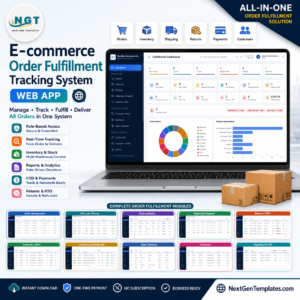
Once the store is trading, pair the kit with a reporting dashboard: the Shopify Store Dashboard in Excel, the Fashion E-commerce KPI Dashboard in Excel and the Dropshipping Dashboard in Excel. For fulfilment at scale, the E-commerce Order Fulfillment Tracking System Web App is the next step.
Planning a different kind of business? The Manufacturing Business Plan Templates Kit is the same format built around machine hours.
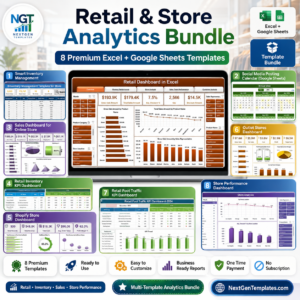
💎 Want more retail analytics? The Retail & Store Analytics Bundle packs 8 premium templates. Browse more in Business Starter Kits, Sales and Marketing Templates and Template Bundles.
📖 Click here to read the Detailed Blog Post
🎥 Visit our YouTube channel for step-by-step video tutorials
👉 YouTube.com/@NextGenTemplates
📅 Last updated: September 2026




Reviews
There are no reviews yet.