

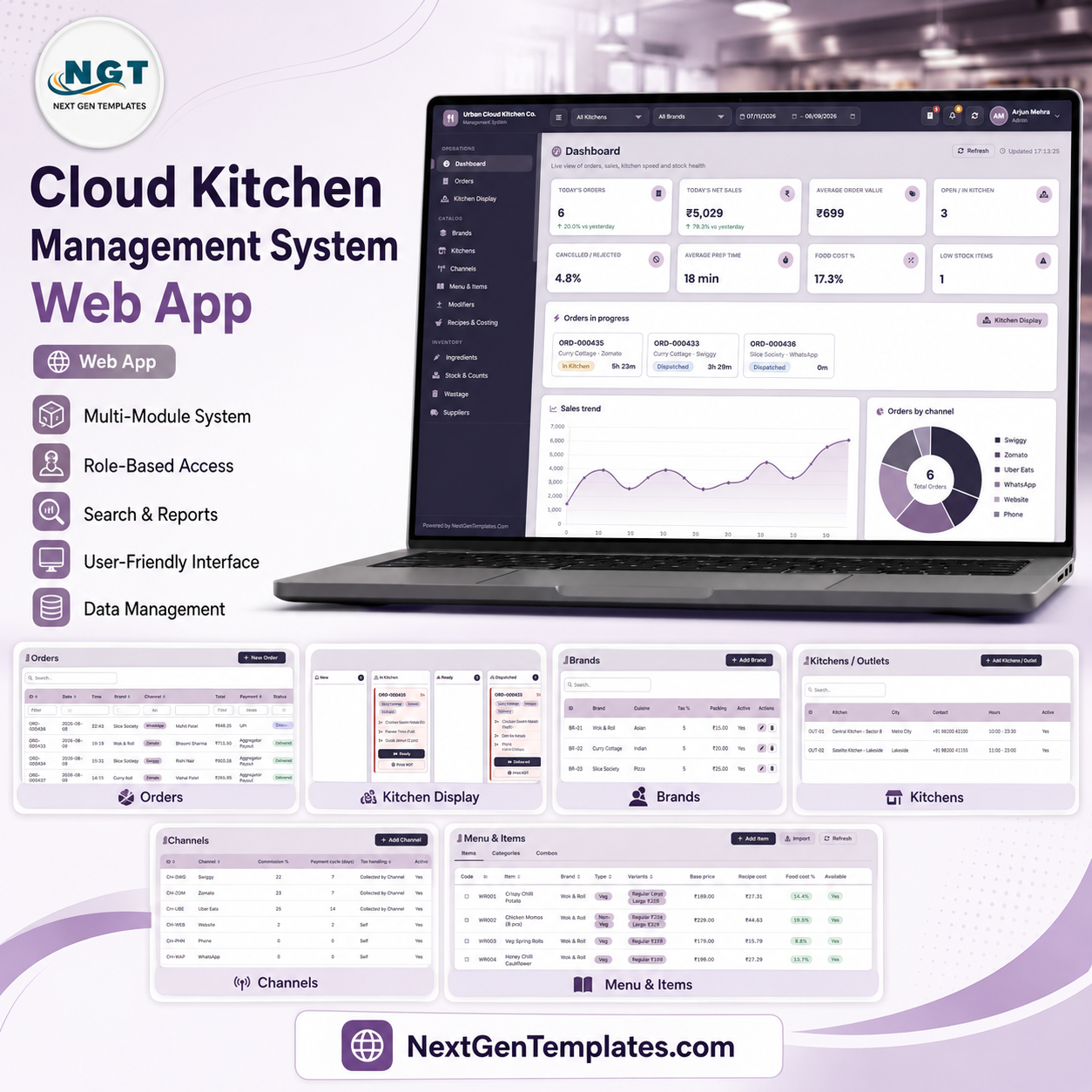
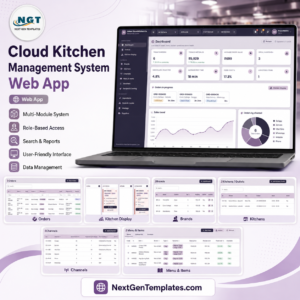
The Cloud Kitchen Management System Web App runs 28 connected operating screens, 8 same-day dashboard KPI cards and 19 management reports from a single Google Apps Script application. It handles unlimited virtual brands, kitchens and delivery channels out of one Google Sheet database, with recipe-linked inventory that turns food cost percentage into a calculated number instead of a monthly guess. Setup takes under 15 minutes – copy the file, deploy it in your own Google account, then replace the sample brands, kitchens and menu with your own.
🌎 Join 8,400+ teams in 40+ countries using NextGenTemplates to replace paid SaaS tools with one-time-purchase Excel, Google Sheets, Power BI and web app templates.
✅ Instant download · One-time payment · No subscription · No per-user fees · Lifetime access
🔑 Key Features of the Cloud Kitchen Management System Web App
- 🍴 Multi-brand, multi-kitchen architecture – every order carries a Brand, Kitchen and Channel tag, so three virtual brands cooking on one production line report sales, food cost and profit separately while sharing the same ingredient store.
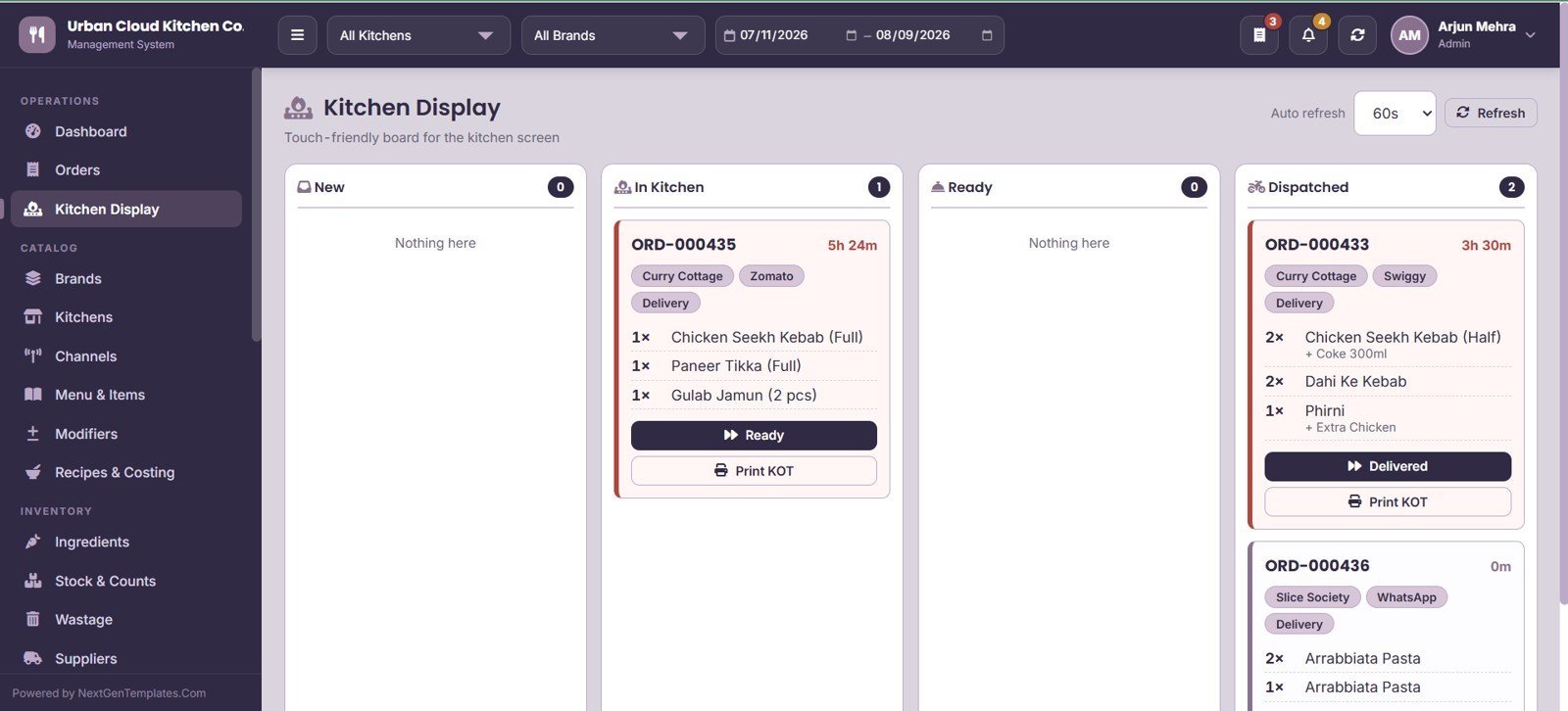
- 🔥 Live Kitchen Display System – a four-lane KDS board (New, In Kitchen, Ready, Dispatched) auto-refreshes on a 60-second cycle, shows elapsed time per ticket, and prints KOTs straight from the browser.
- 🥣 Recipe-linked inventory – each menu item maps to a recipe of ingredients, so delivered orders deduct theoretical consumption from stock and the Consumption vs Theoretical report exposes real portioning variance.
- 💰 Channel commission and settlement tracking – store commission percentage, payment cycle and tax handling per channel, then compare expected payout against what each aggregator actually paid, with short payments flagged automatically.
- 📊 19 management reports across Sales, Operations, Costing, Inventory, Purchase and Money, including the Menu Engineering Matrix, Peak Hour Analysis and Brand-wise Profitability.
- 🗑 Wastage control – log spoilage, over-production, burnt items, quality rejects, spillage and expiry against six reasons with the value lost calculated per entry.
- 🔒 Role-based access and audit trail – Admin and User roles, failed-login tracking, and a full log of every create, update, delete, login and settings change.
- 💾 Database archive – move old Delivered, Cancelled and Rejected orders into archived copies by cut-off date to keep the live sheet fast.
The application is built on Google Apps Script web apps and deployed from your own Drive, so both the database and the source code stay under your control. Browse more Web App templates or the full Google Sheets template range.
📦 What’s Inside the Cloud Kitchen Management System Web App
1. Login Page
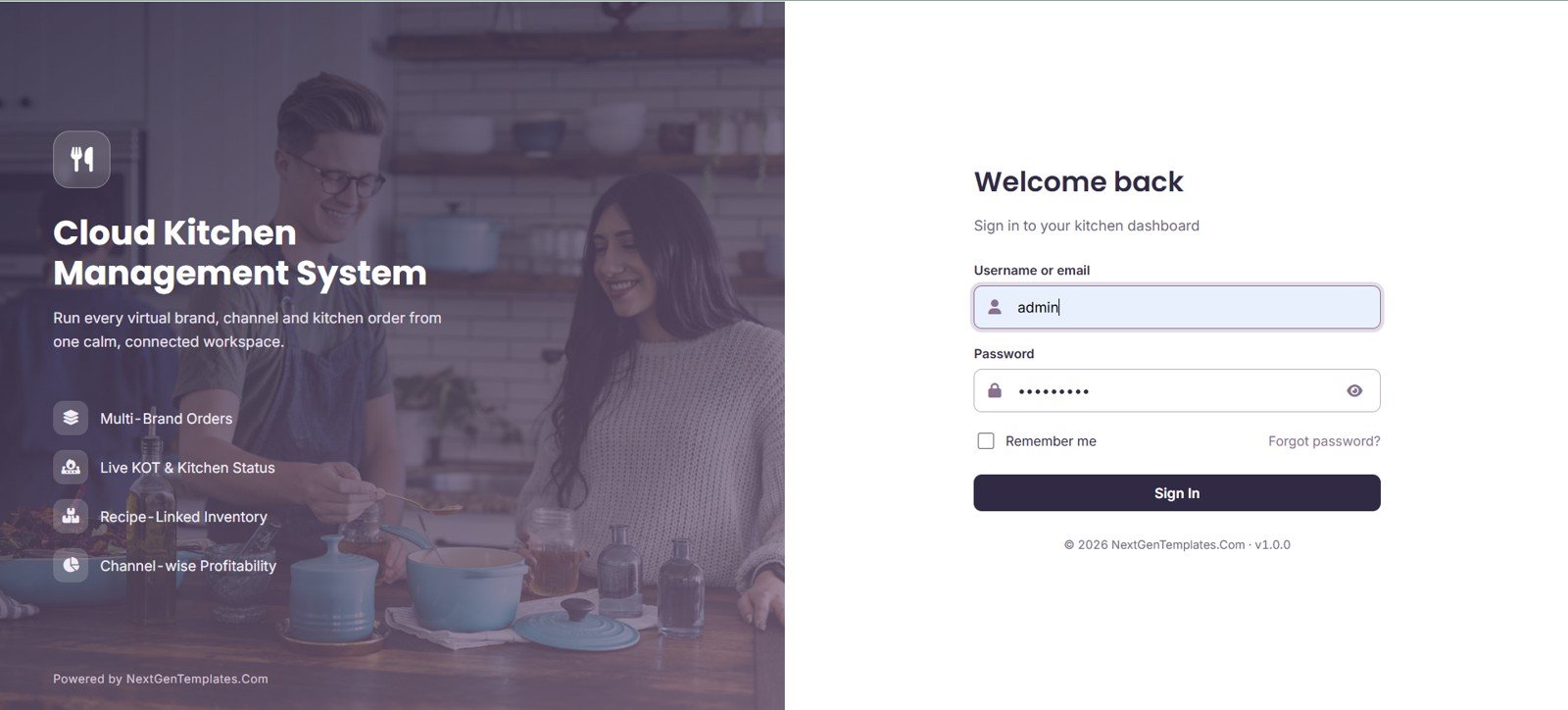
Secure sign-in for the cloud kitchen workspace with username or email, password, Remember Me and Forgot Password. The side panel sets out the four pillars: Multi-Brand Orders, Live KOT and Kitchen Status, Recipe-Linked Inventory and Channel-wise Profitability.
Login Page
🚀 Try the Live Demo Before You Buy
We have deployed this web app in our own Google account so you can test every page, every module and all five user roles — with real sample data — before purchasing. No signup, no email required.
🔑 Test Login Credentials
Sign in as admin to unlock every module including Settings, User Management, List Management, Audit Log and Database Archive — or try any of the four staff logins below to see exactly how role-based access control restricts each team member. 💡 Tip: log in as admin first for the full picture, then switch roles to compare the menus.
💡 What you get after purchase: The full source code (Code.gs + Index.html) plus a step-by-step deployment guide so you can deploy your own private instance in your own Google account in under 15 minutes.
2. Dashboard
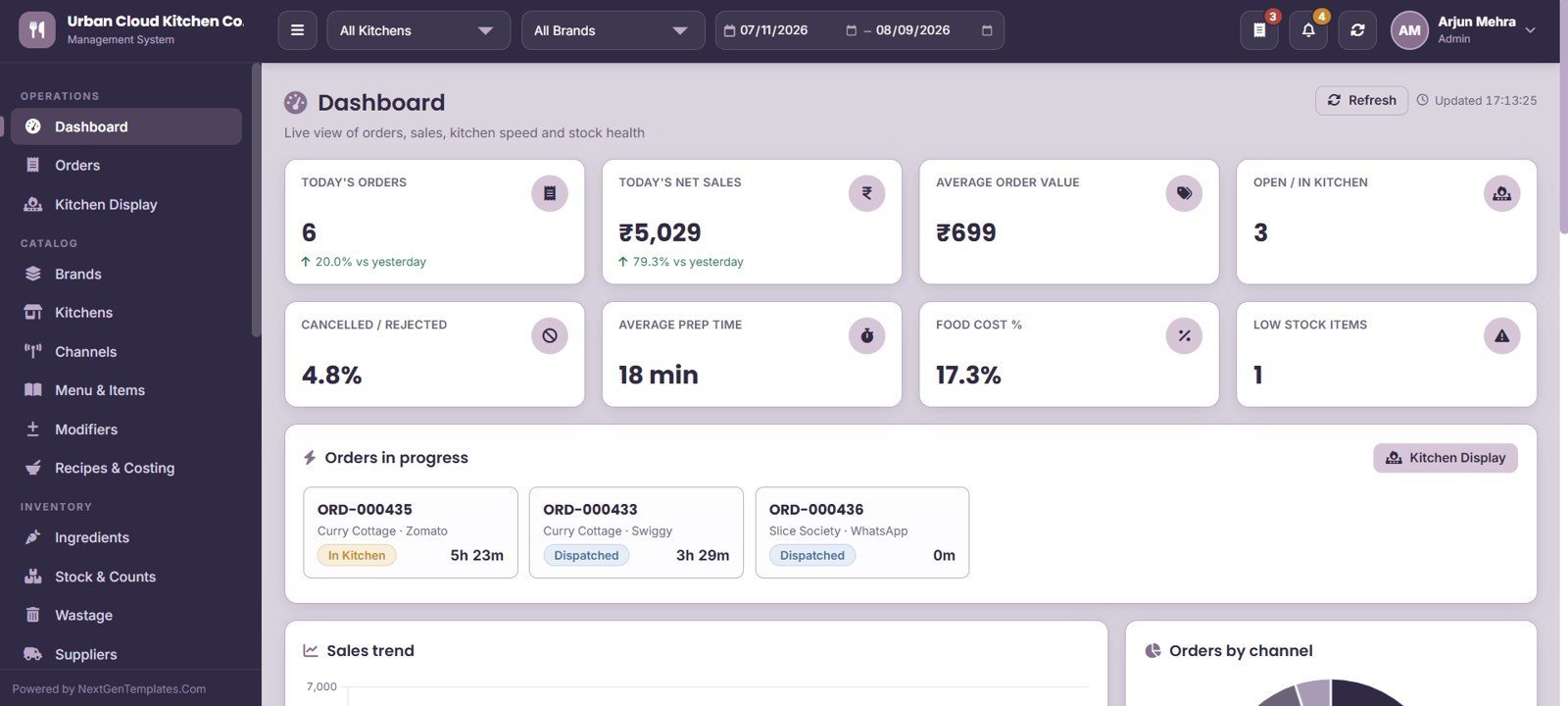
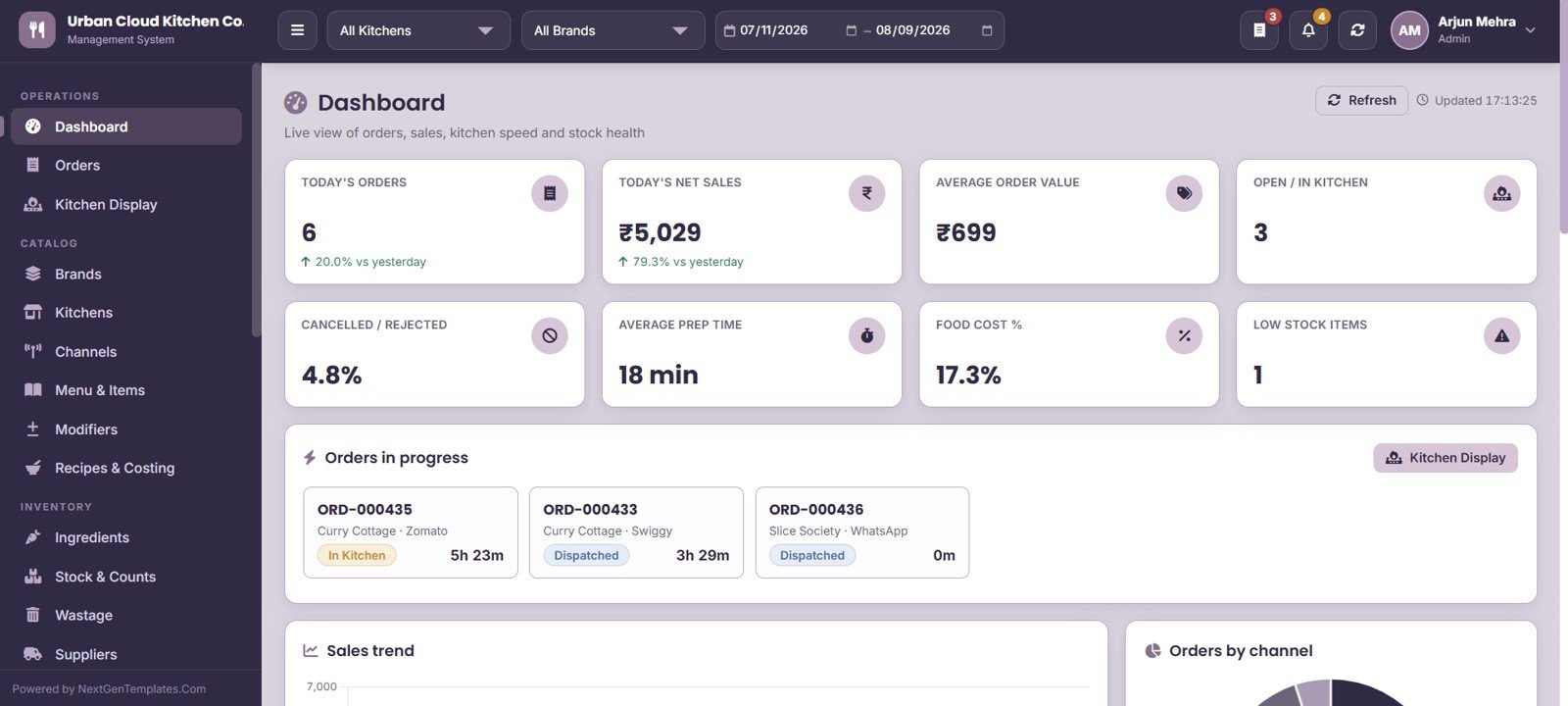
Eight KPI cards cover Today’s Orders, Today’s Net Sales, Average Order Value, Open / In Kitchen, Cancelled / Rejected, Average Prep Time, Food Cost % and Low Stock Items. Below sit an Orders in Progress panel, a Sales Trend chart and an Orders by Channel breakdown, filtered by Kitchen, Brand and date range.
Dashboard
3. Orders
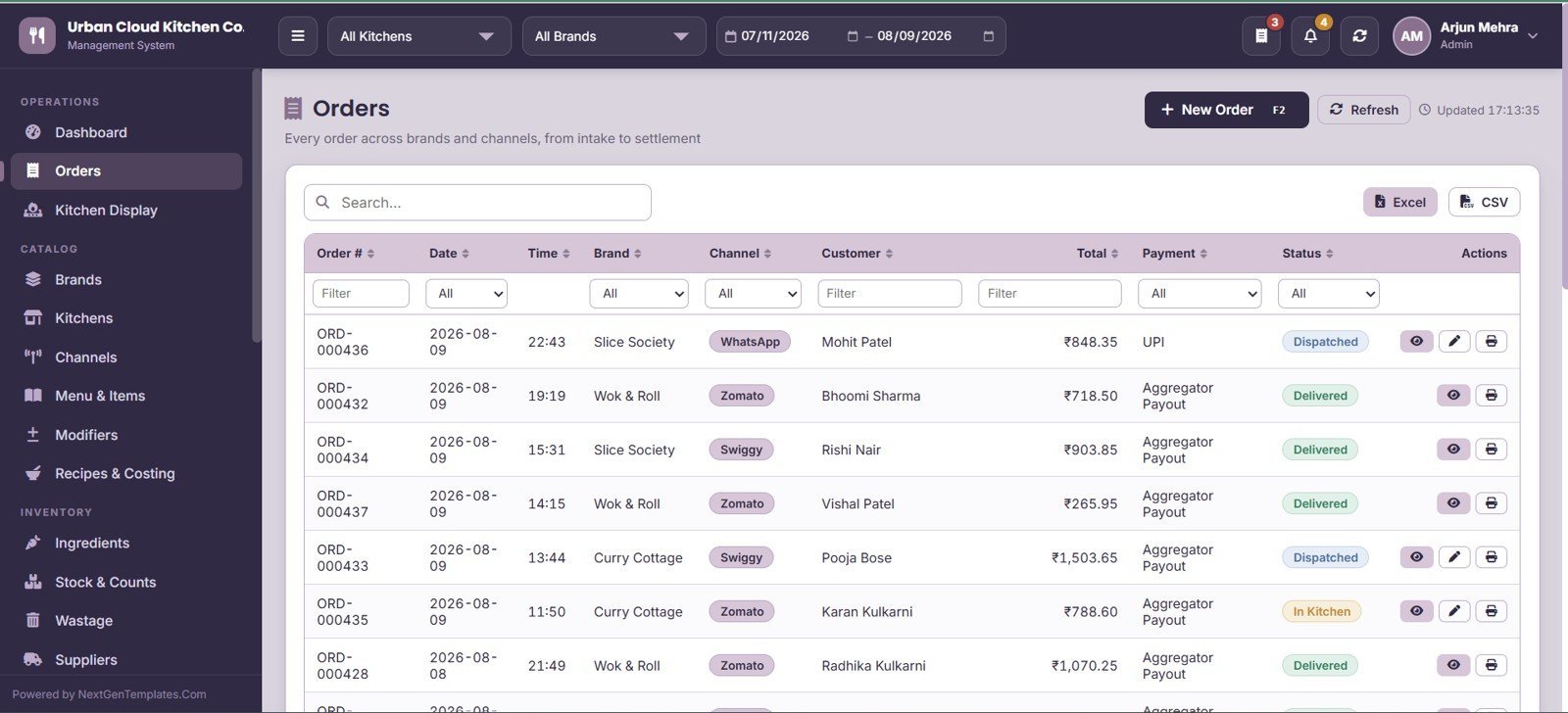
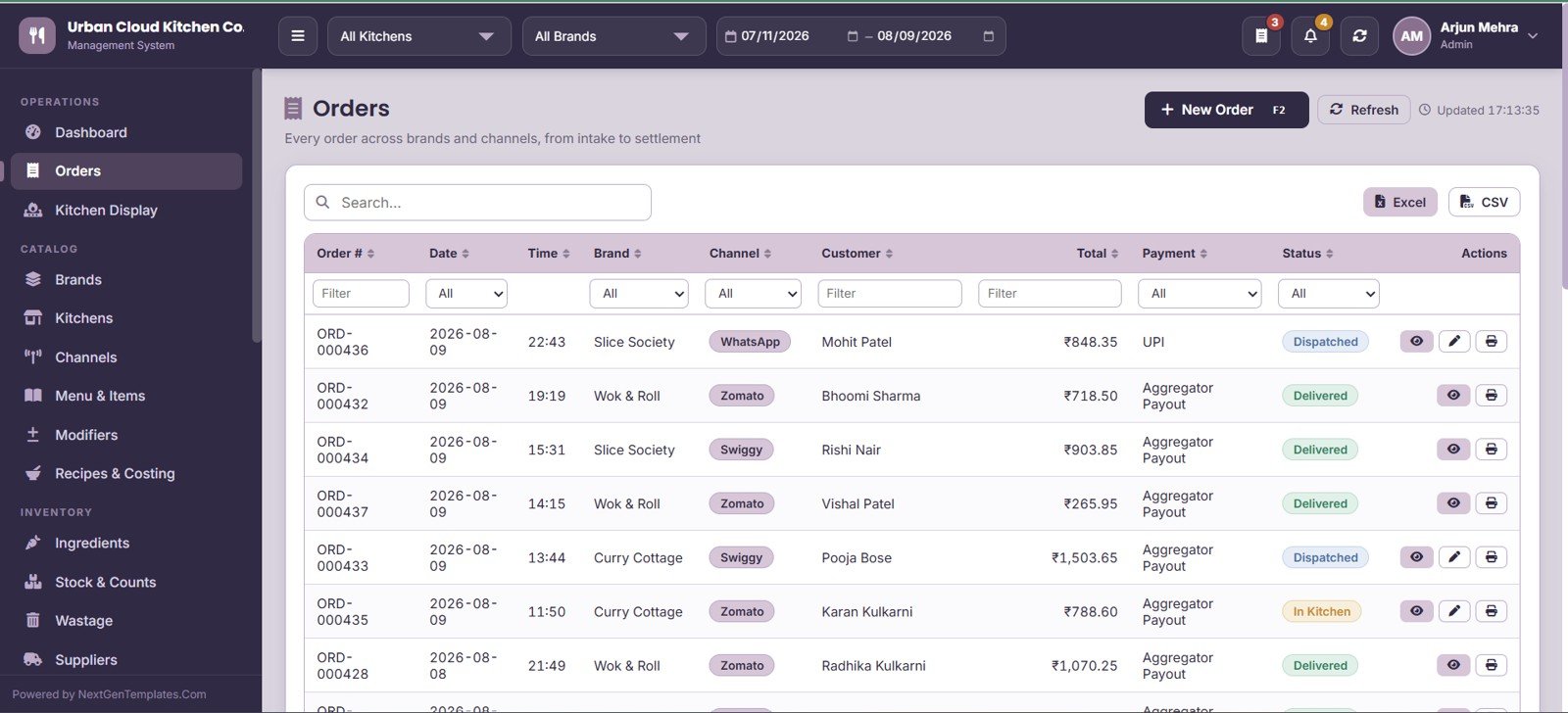
The central order register with Order #, Date, Time, Brand, Channel, Customer, Total, Payment and Status. Raise new orders here and export the whole grid to Excel or CSV in one click.
Orders
4. Order Filters and Actions
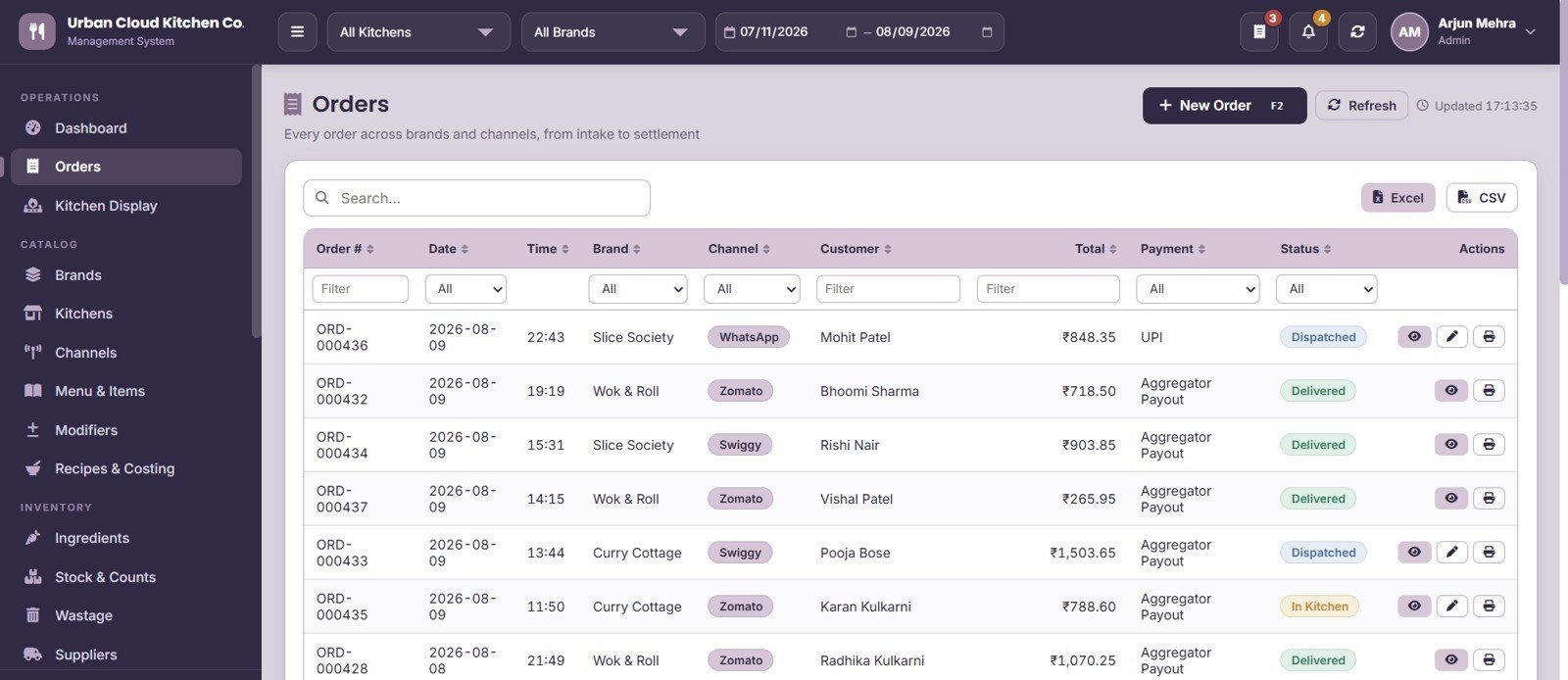
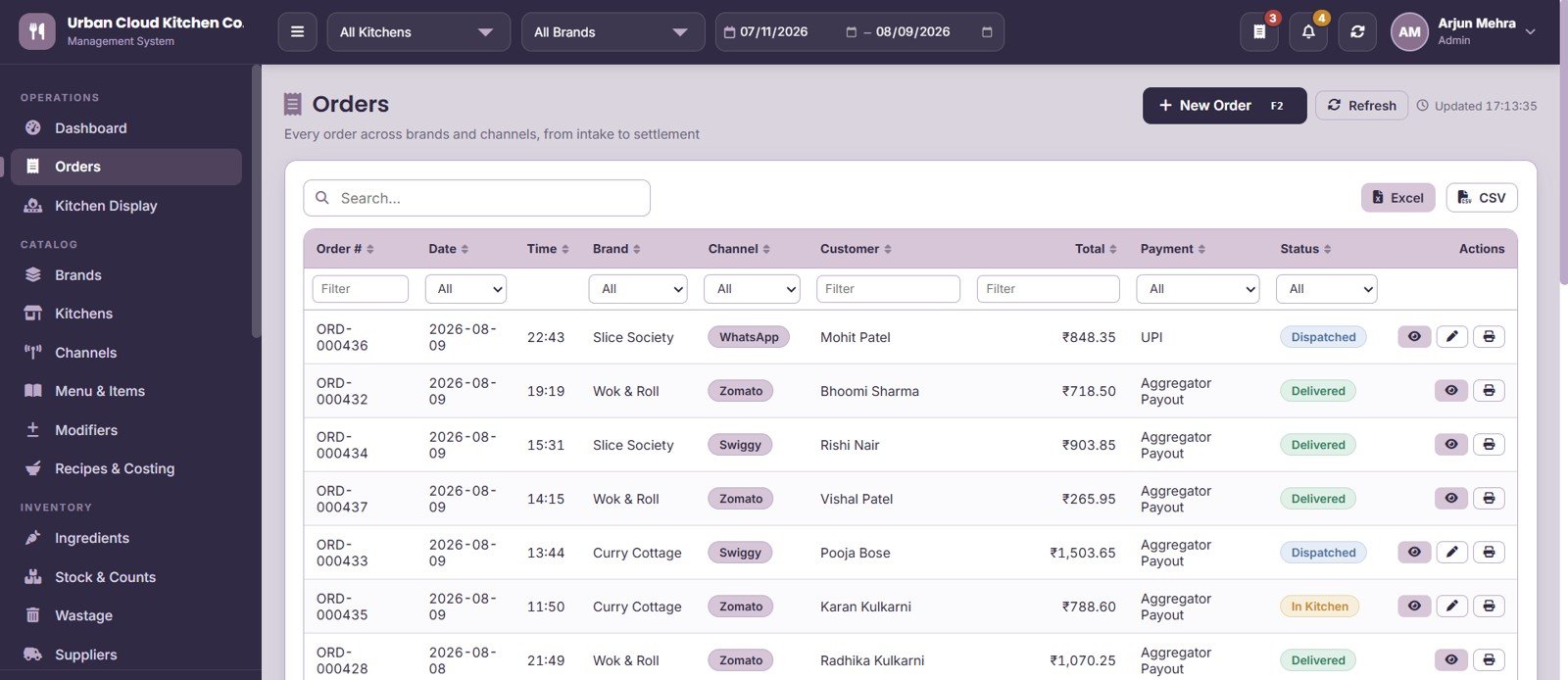
Column filters on Date, Brand, Channel, Customer, Total, Payment and Status isolate any slice of the order book instantly. Row actions cover View, Edit and Print, plus one-click moves to In Kitchen, Dispatched and Delivered.
Order Filters and Actions
5. Kitchen Display
A live KDS board with New, In Kitchen, Ready and Dispatched lanes on a 60-second auto refresh. Each ticket shows brand, channel, delivery label, elapsed time and item quantity, with Ready, Delivered and Print KOT buttons for the production team.
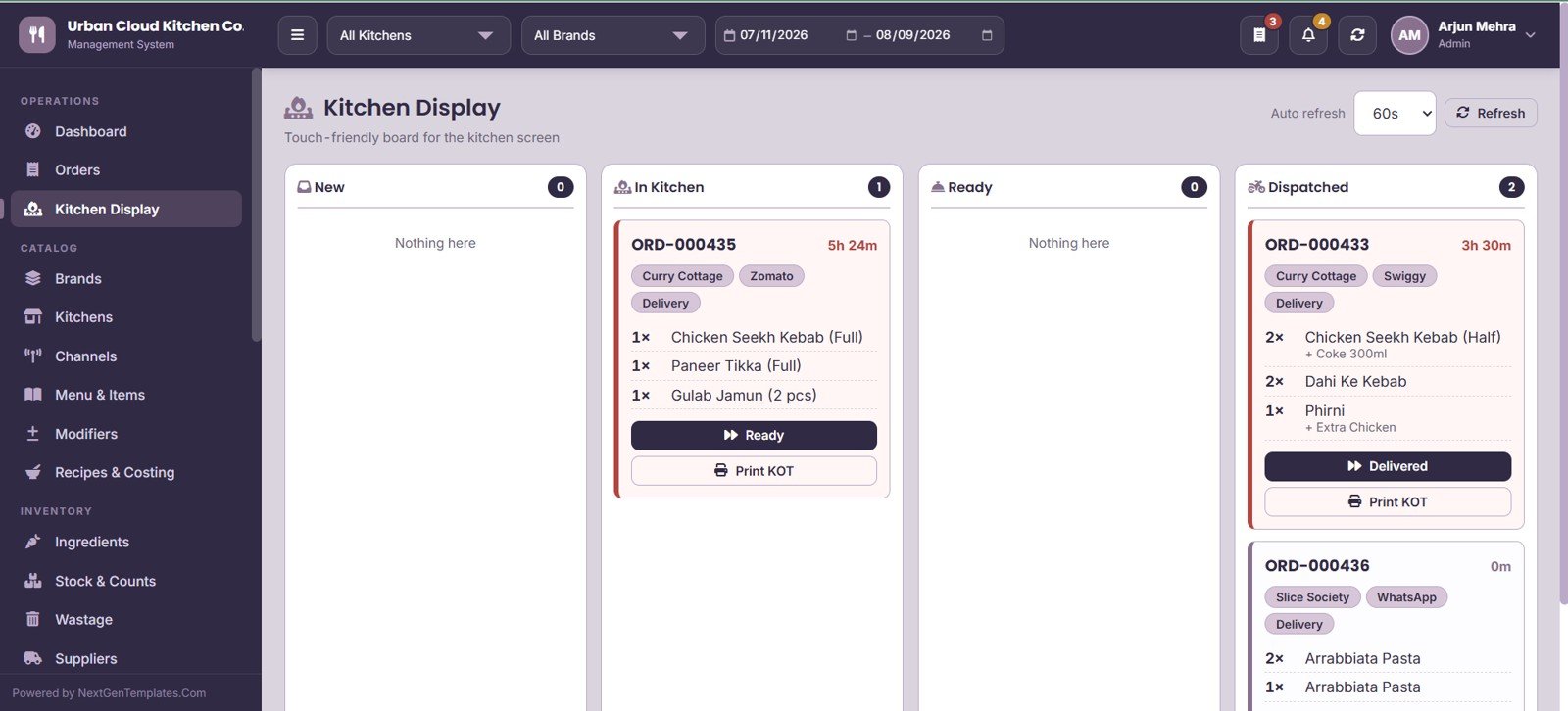
Kitchen Display
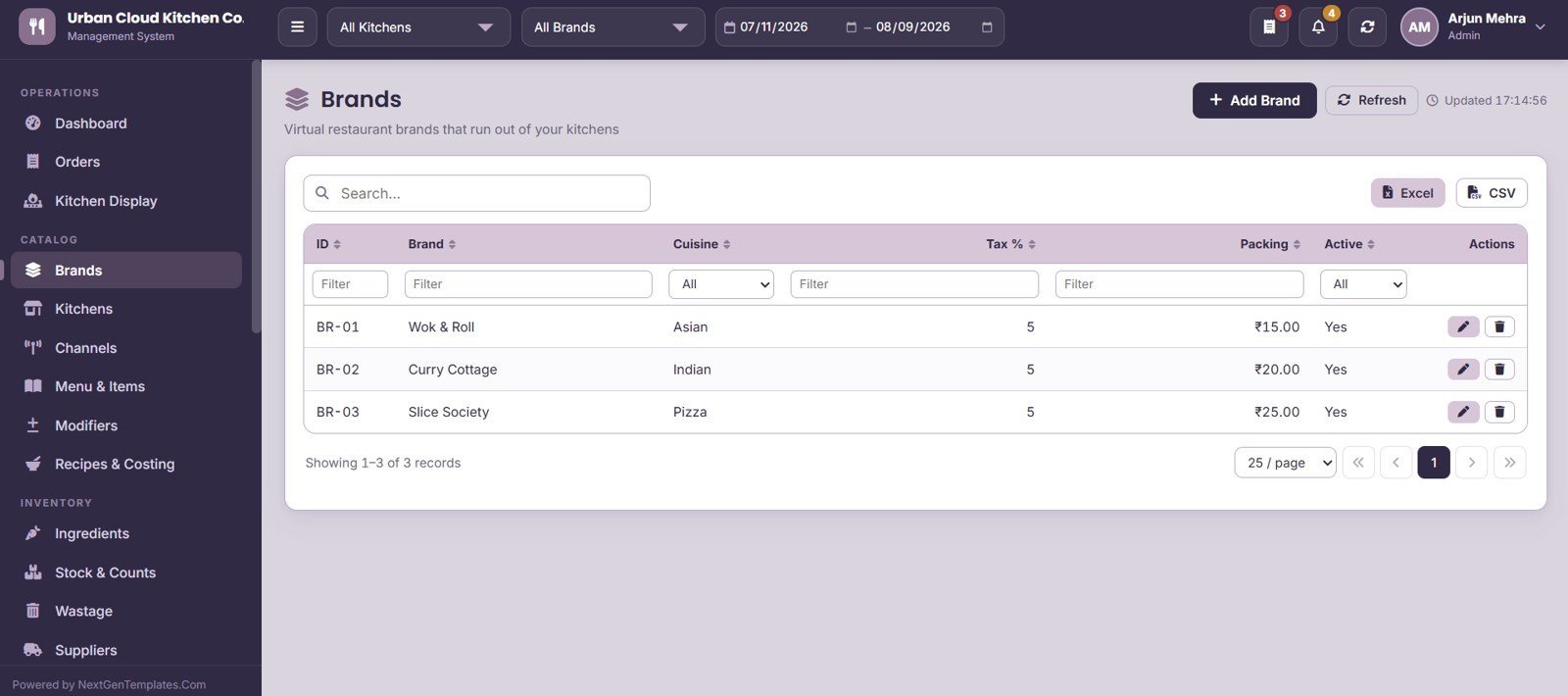
6. Brands
Manage every virtual brand running out of your kitchens – Wok & Roll, Curry Cottage, Slice Society and more – each with its own Cuisine, Tax %, Packing charge and Active flag so brand-level P&L stays clean.
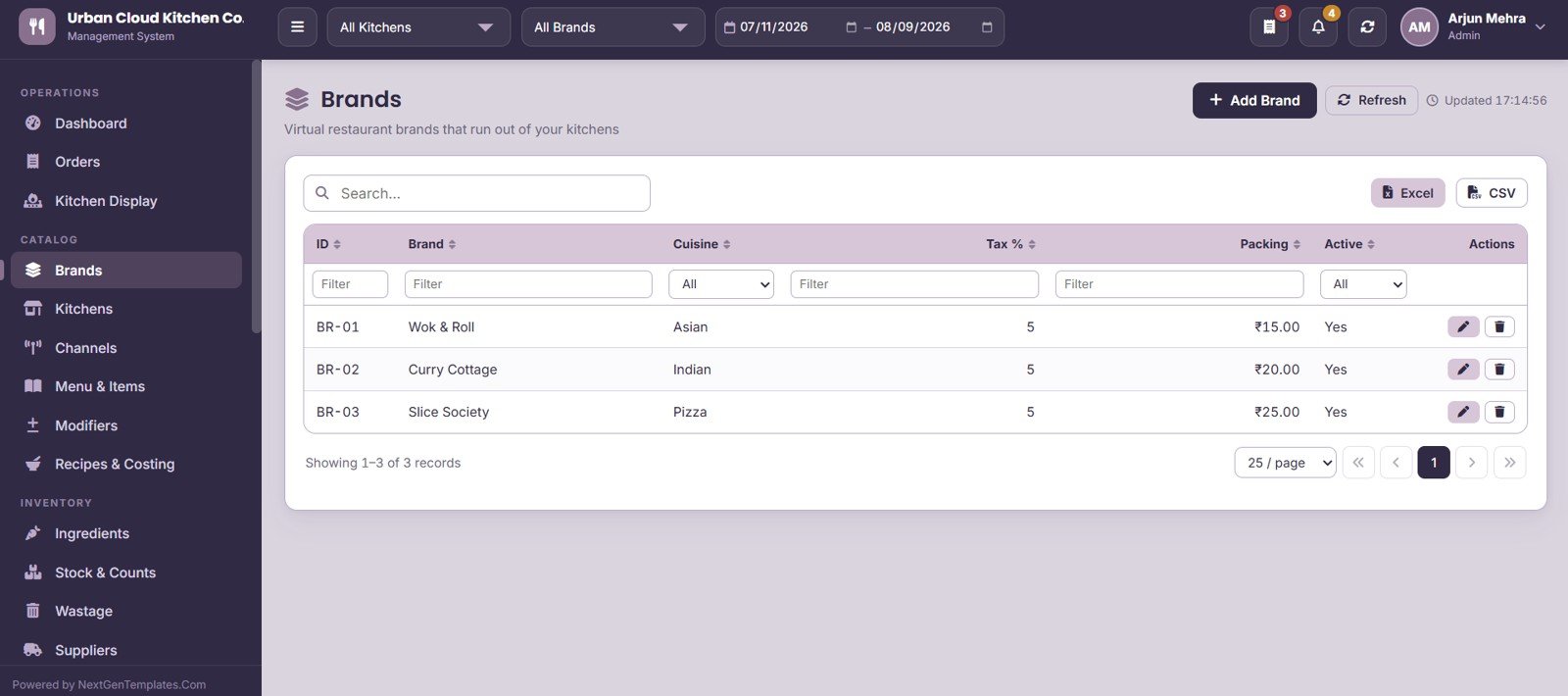
Brands
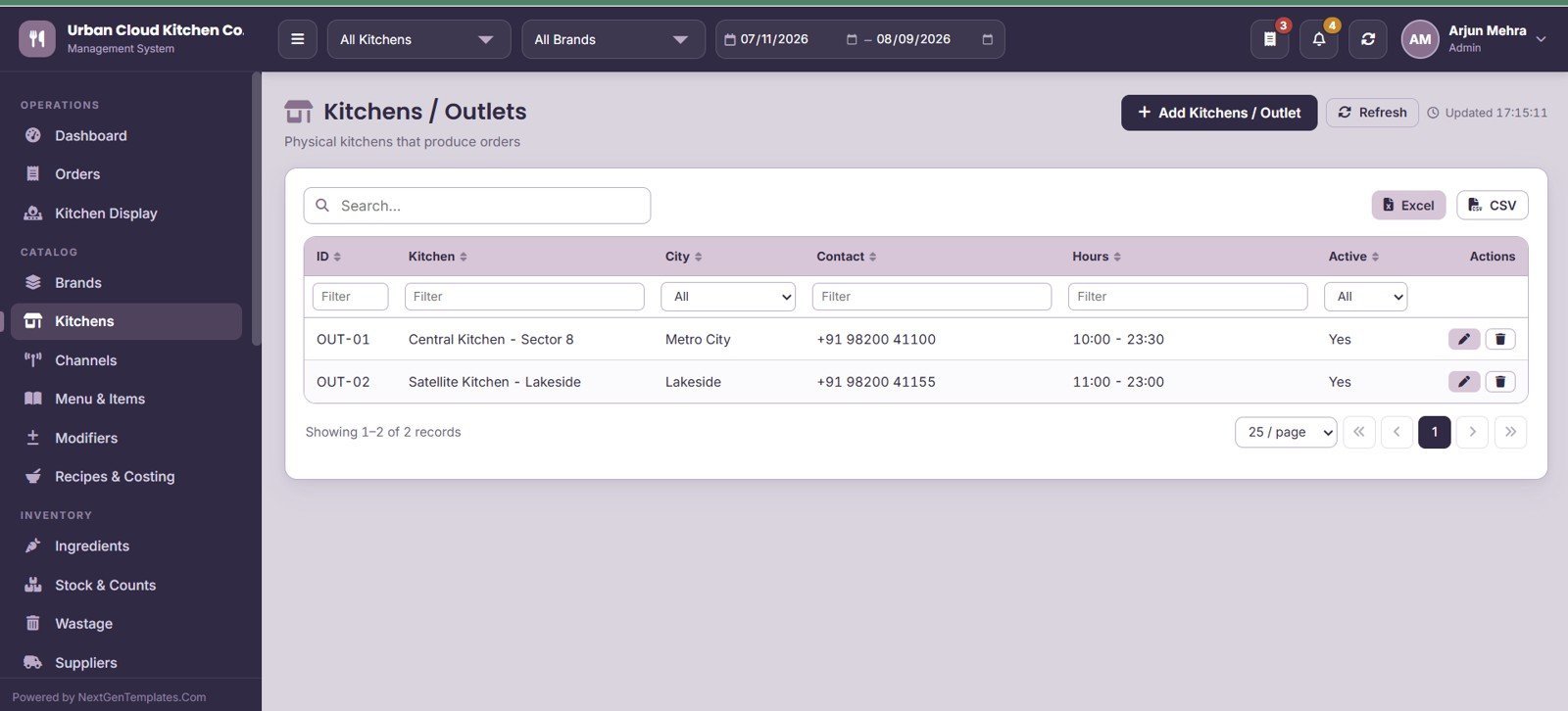
7. Kitchens / Outlets
The register of physical production units such as Central Kitchen Sector 8 and Satellite Kitchen Lakeside, with City, Contact, operating Hours and Active status. Every order and stock balance ties back to one of these kitchens.
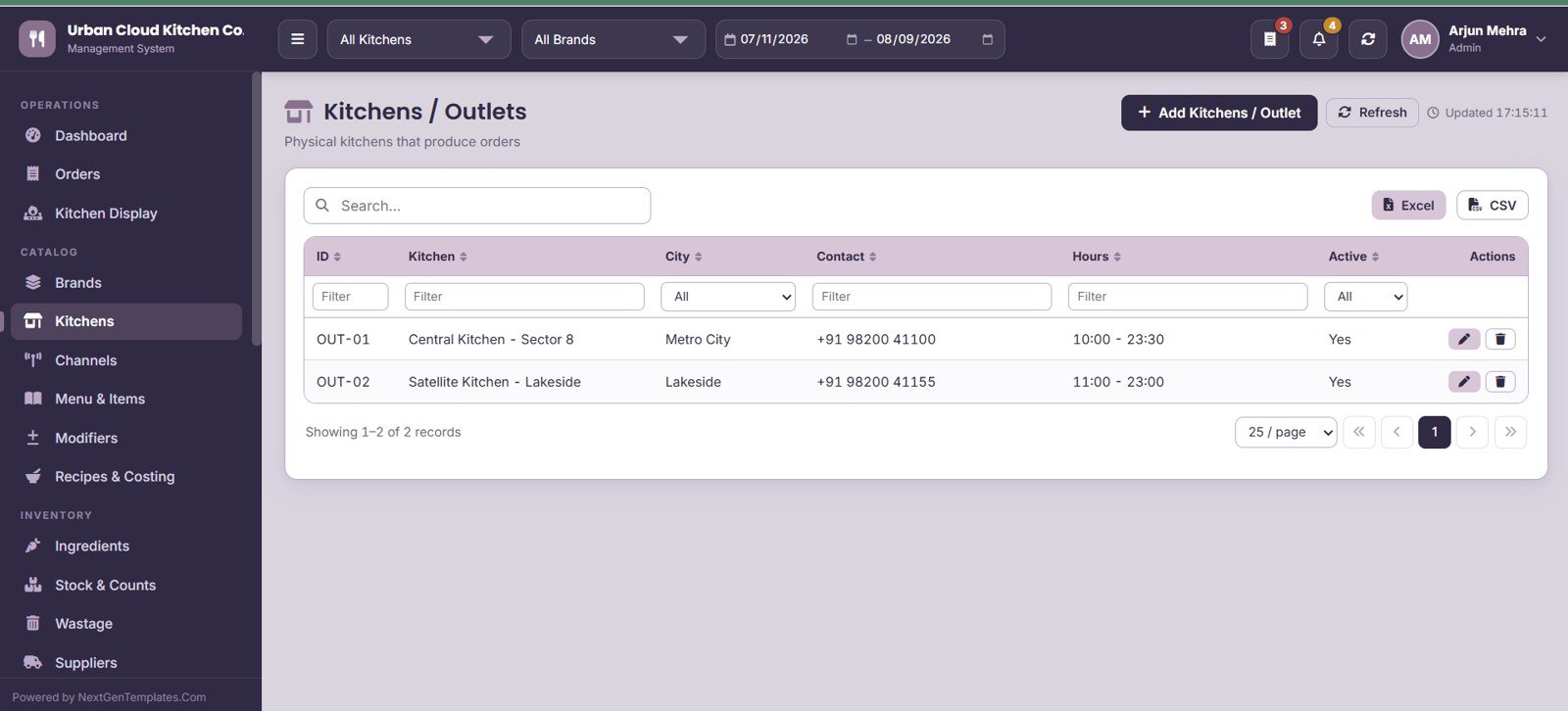
Kitchens / Outlets
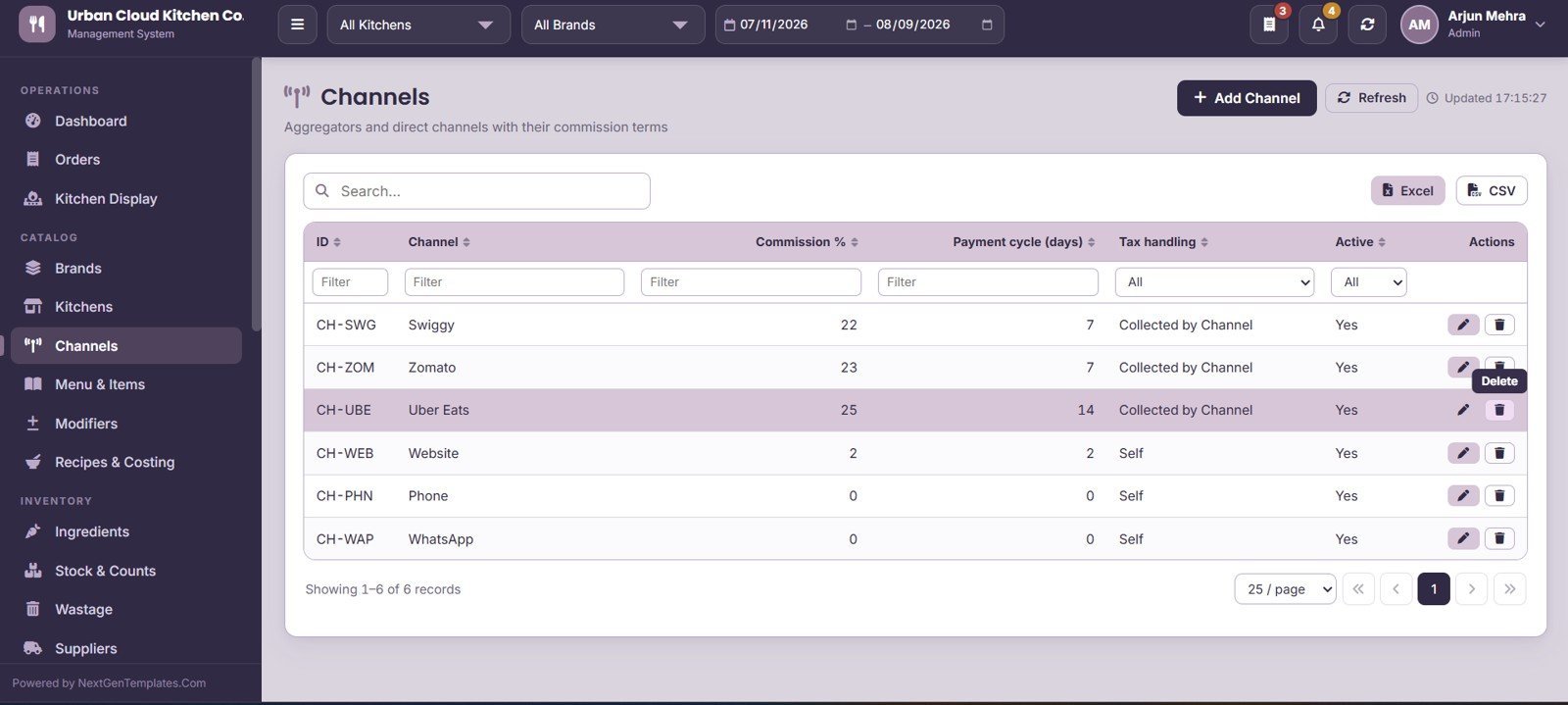
8. Channels
Maintain Swiggy, Zomato, Uber Eats, Website, Phone and WhatsApp as separate channels. Each stores Commission %, Payment cycle in days and Tax handling, which drives channel-wise profitability and settlement downstream.
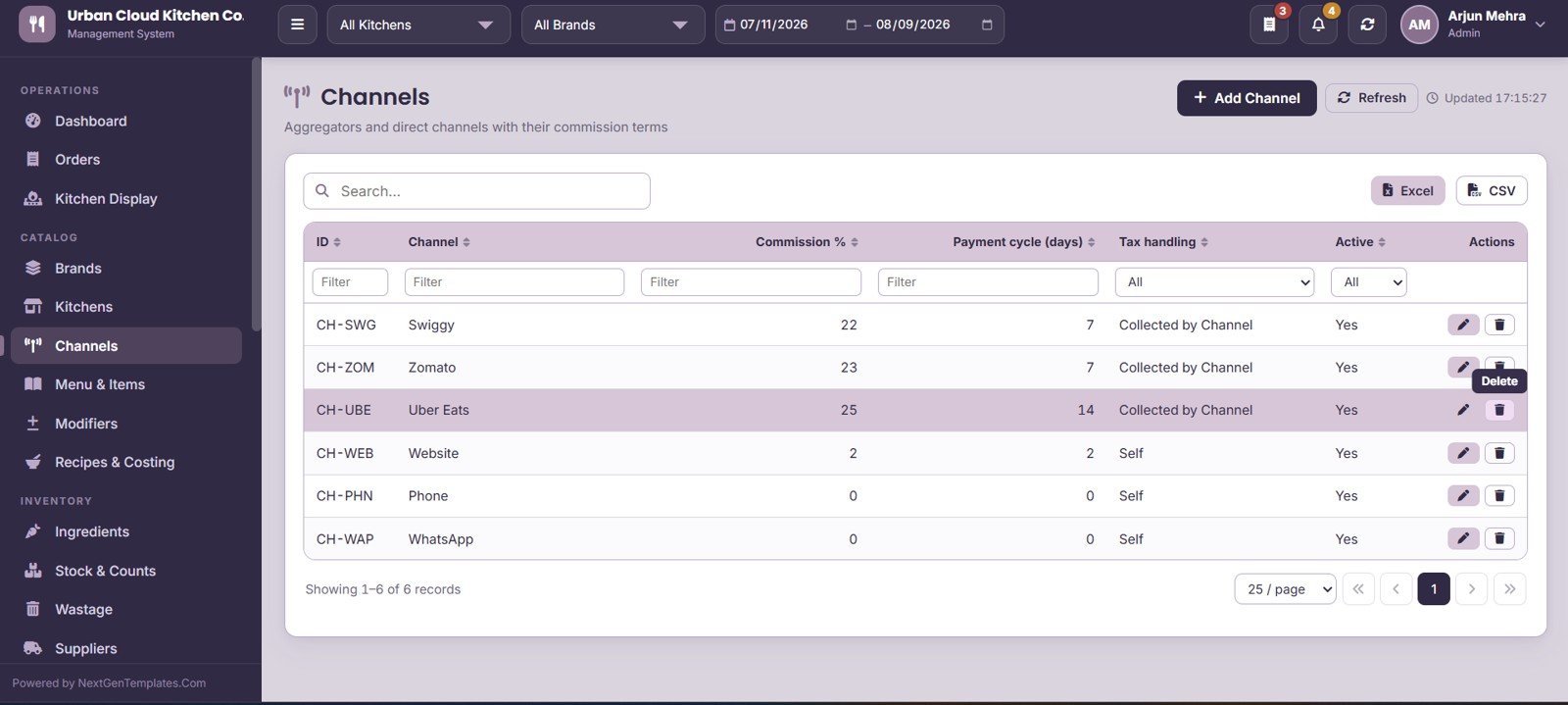
Channels
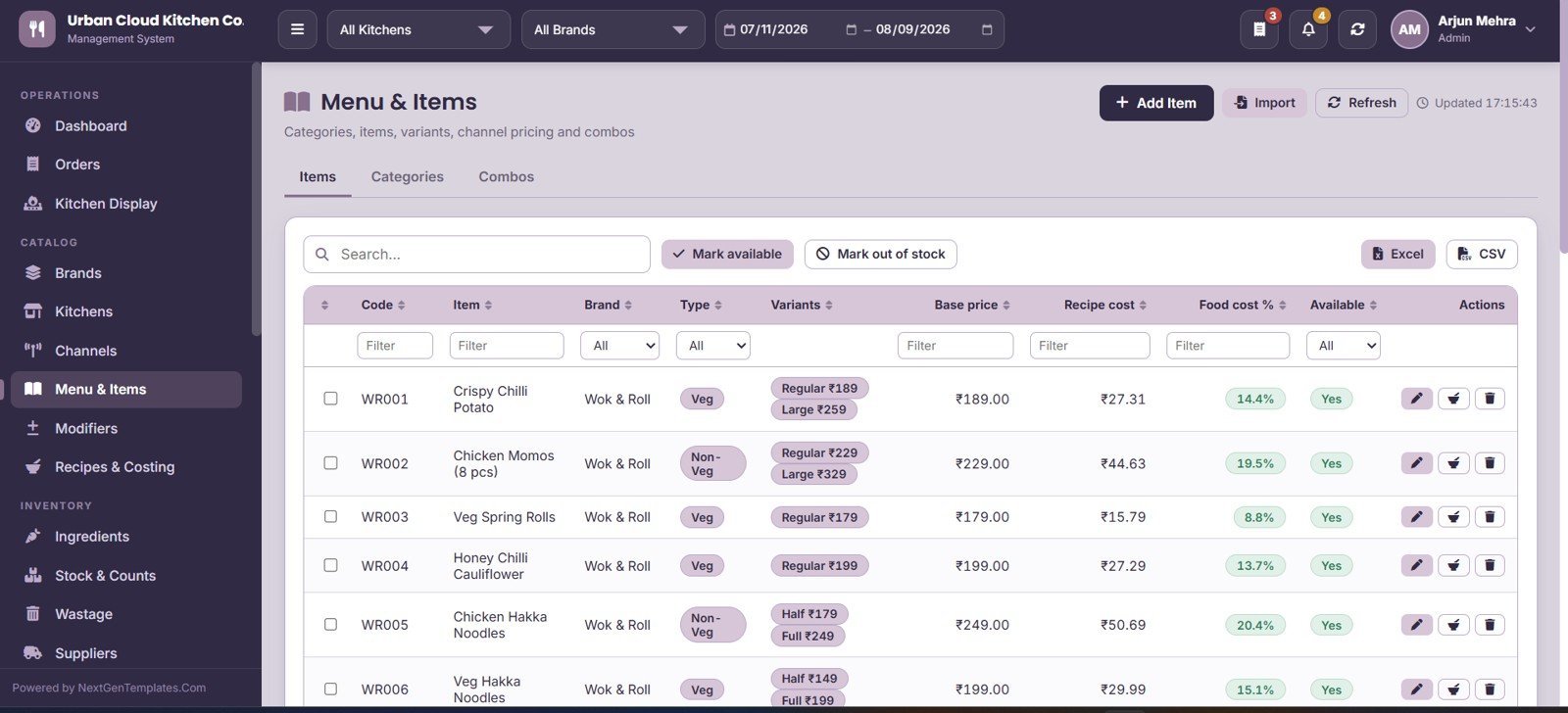
9. Menu & Items
Items, Categories and Combos tabs hold the full menu with Code, Brand, Type, Variants, Base price, Recipe cost, Food cost % and Availability. Bulk Mark Available and Mark Out of Stock kill an item across every channel the moment an ingredient runs out.
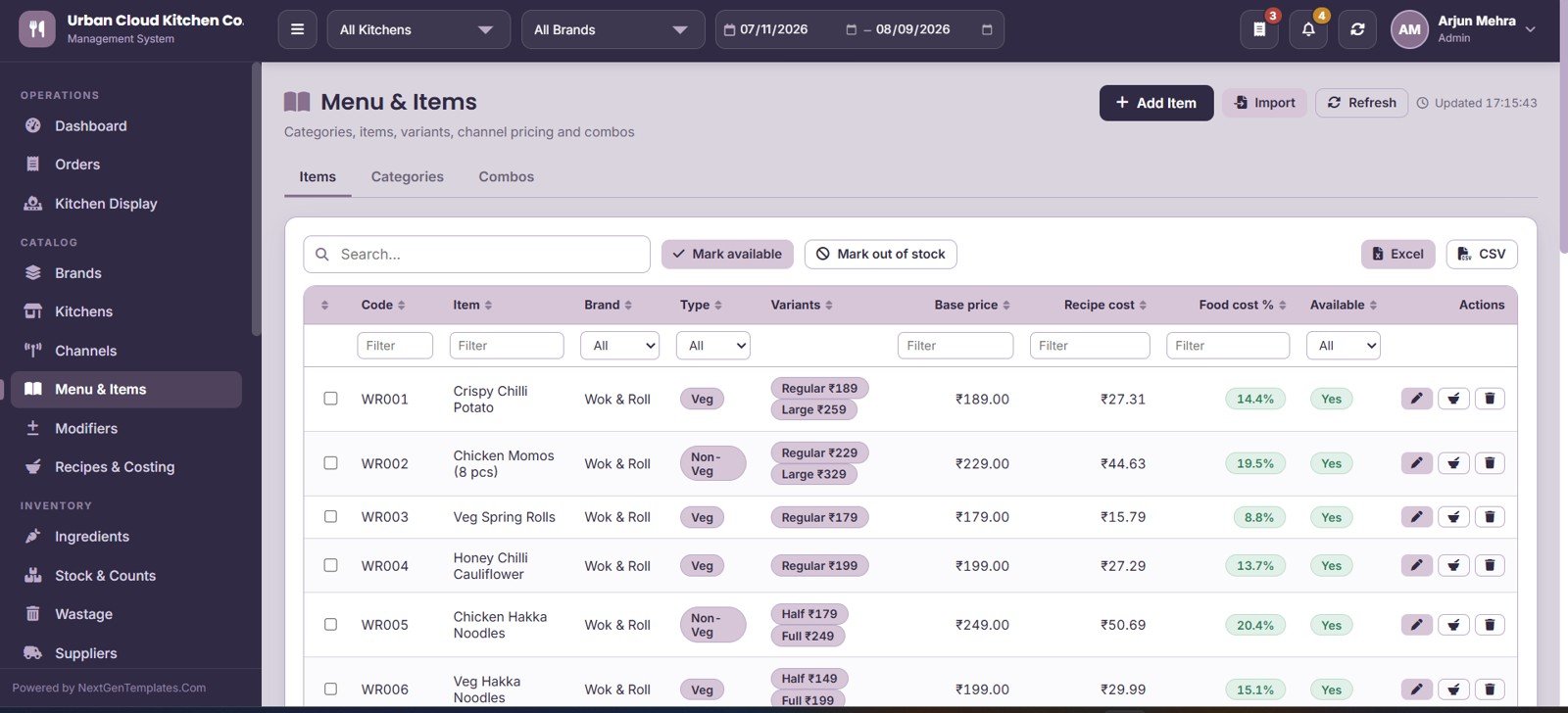
Menu & Items
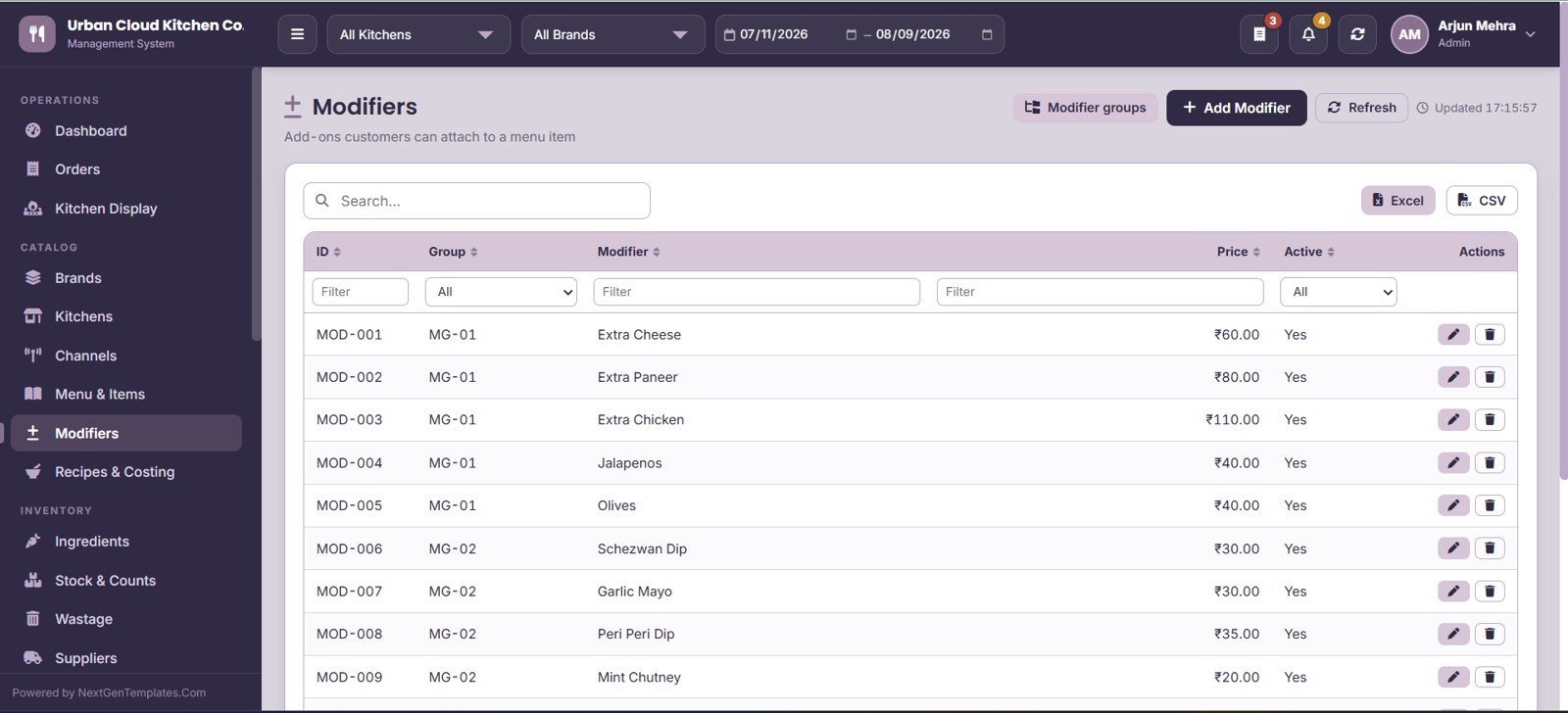
10. Modifiers
Add-ons customers attach to menu items – Extra Cheese, Extra Paneer, Extra Chicken, Jalapenos, Olives, Garlic Mayo – organised into modifier groups with individual pricing so upsell revenue is captured properly.
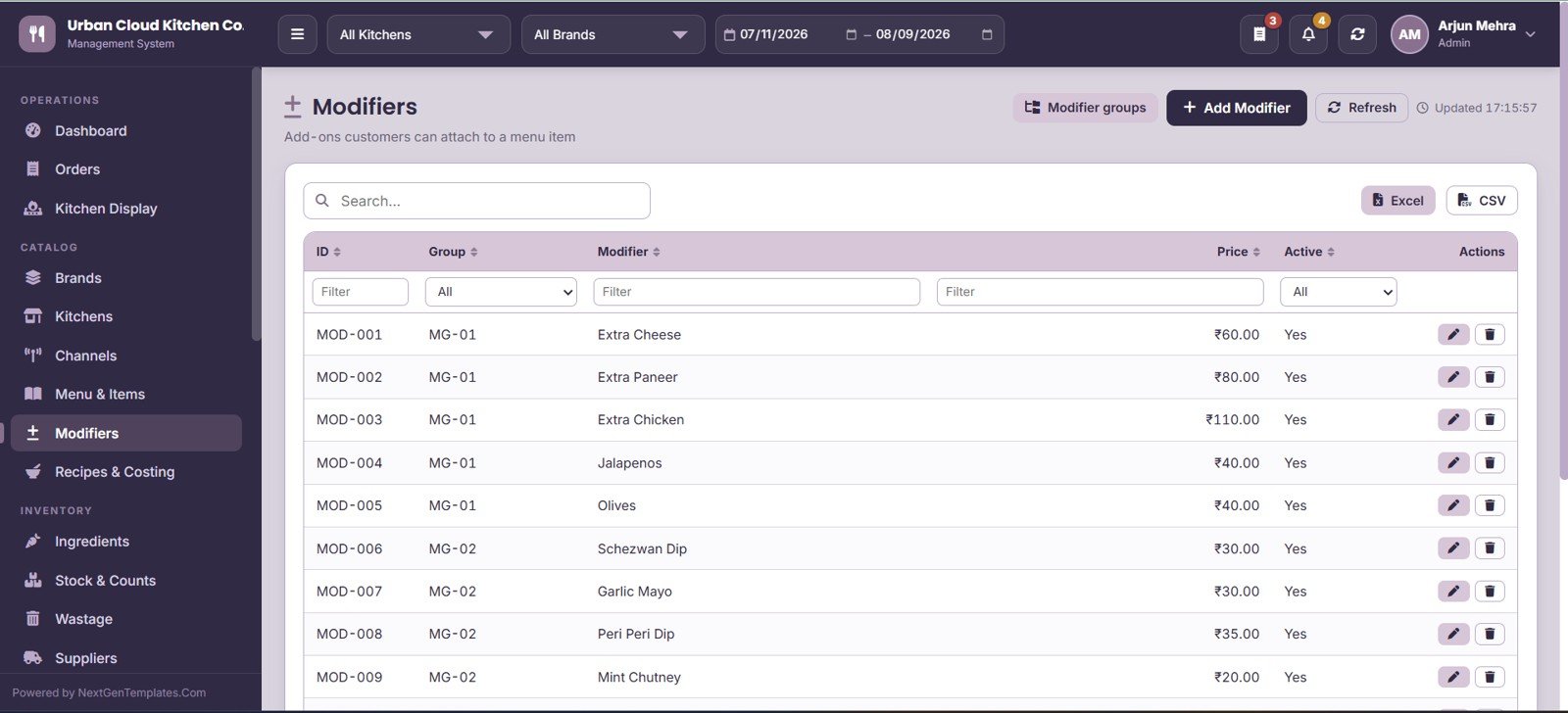
Modifiers
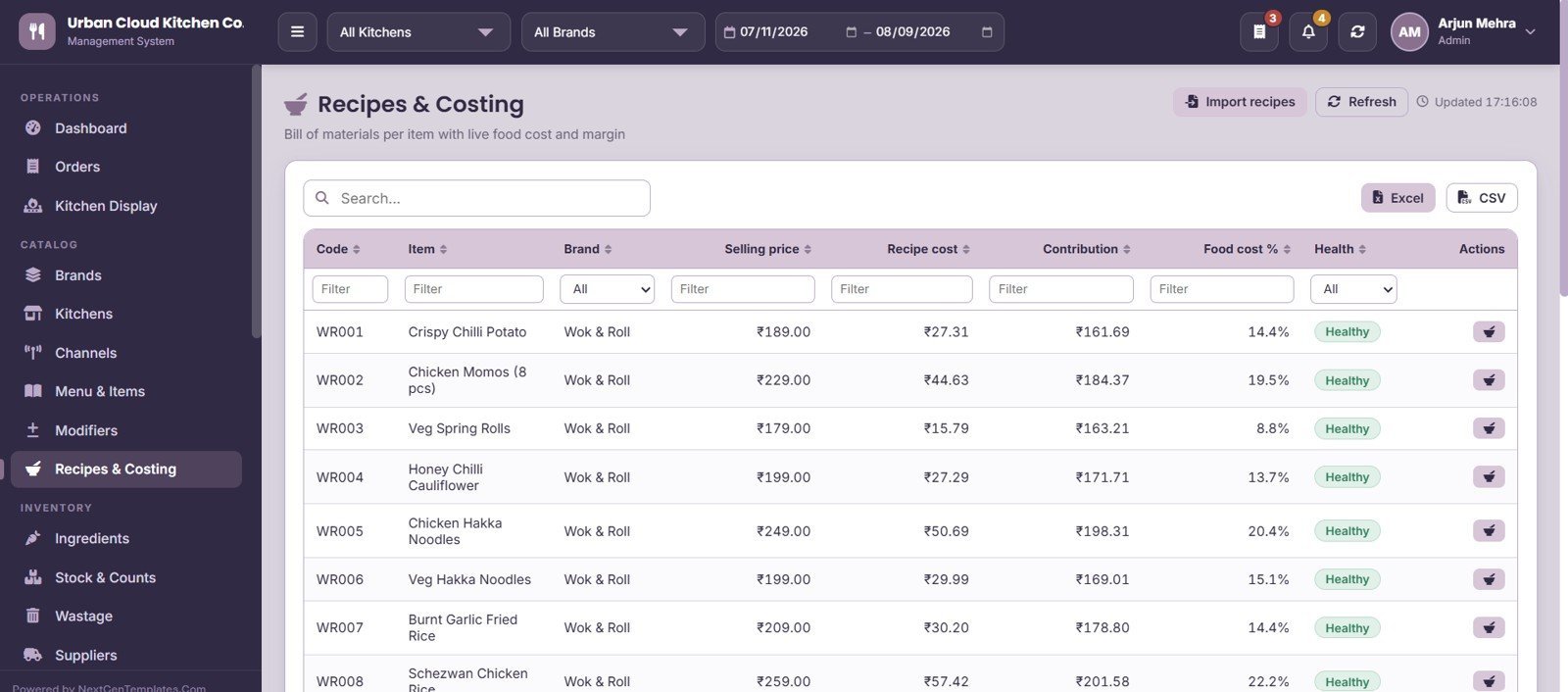
11. Recipes & Costing
Connects every menu item to its recipe cost, showing Selling price, Recipe cost, Contribution, Food cost % and a Health indicator side by side. This is the screen that reveals which dishes lose money on discount-heavy channels.
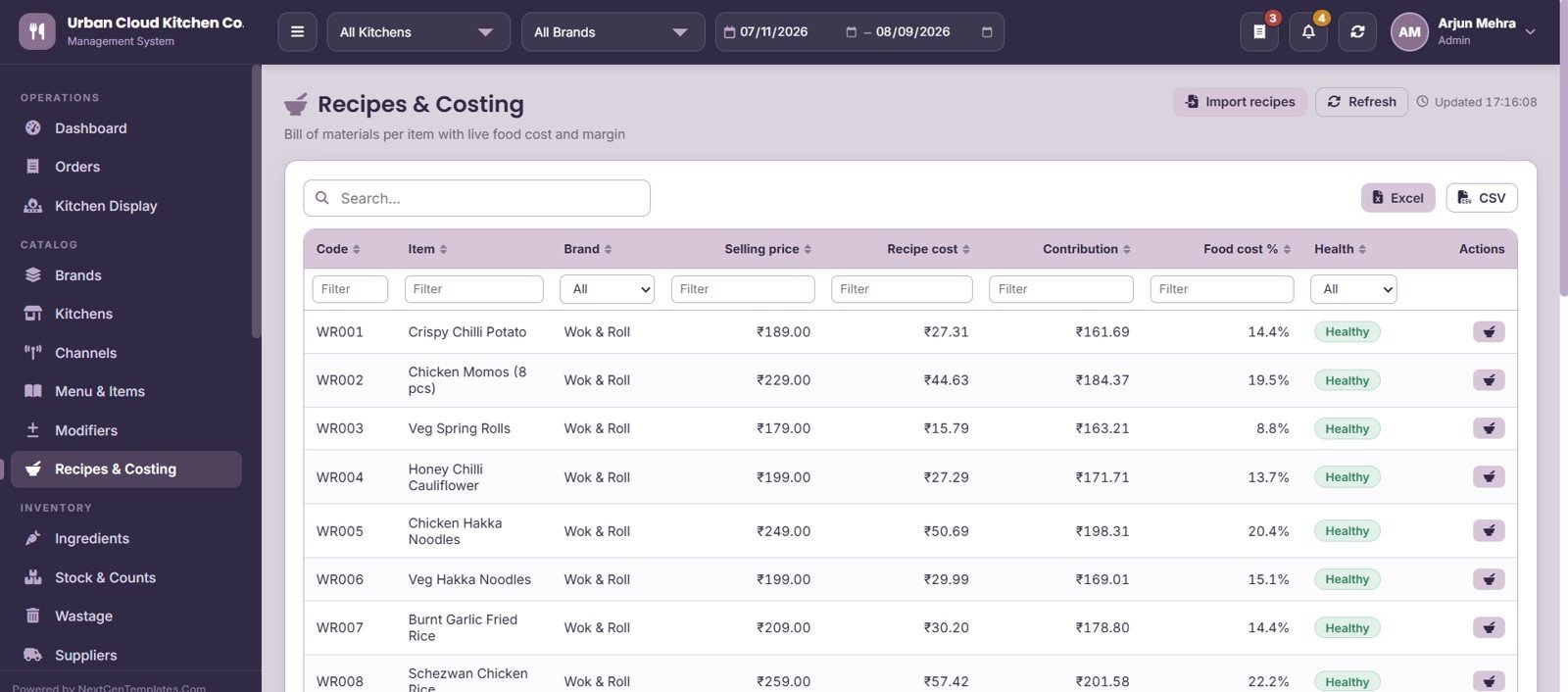
Recipes & Costing
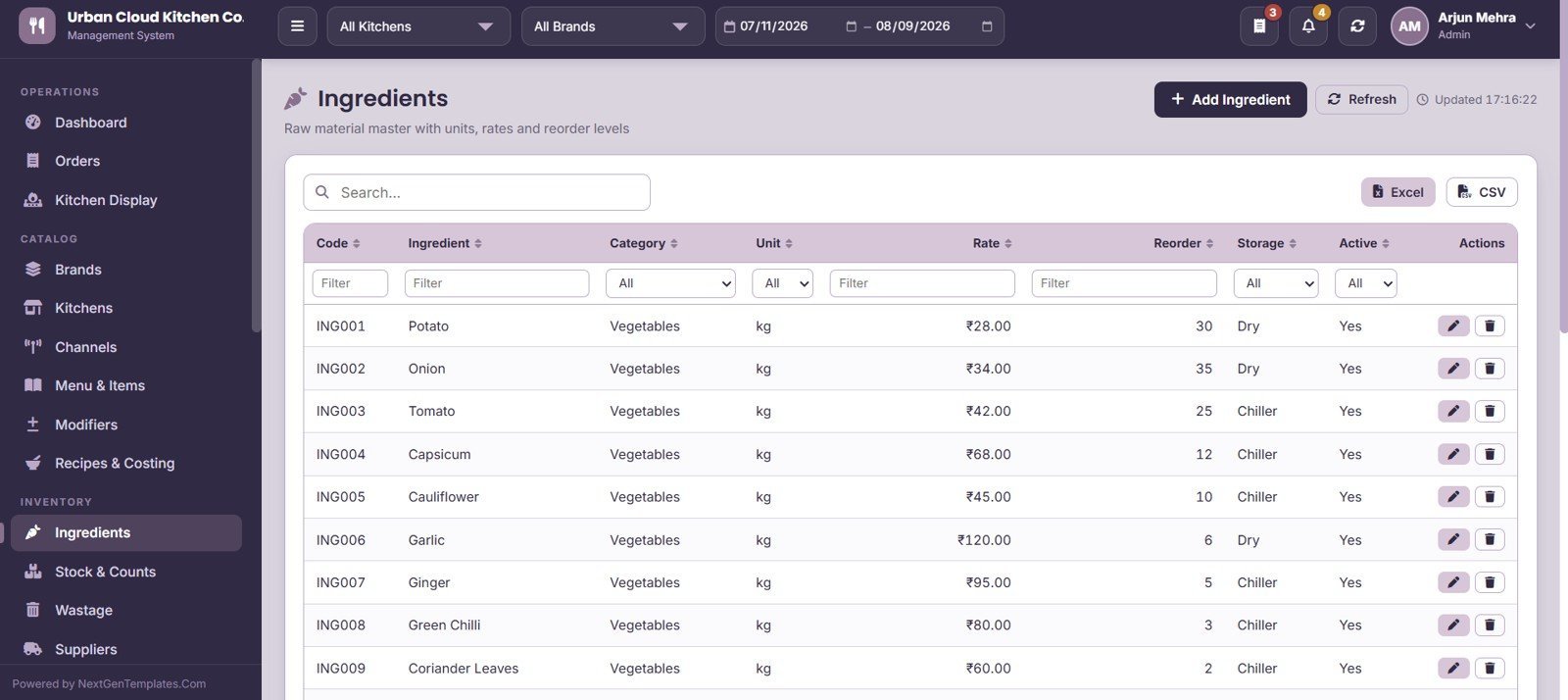
12. Ingredients
Raw material master data with Code, Ingredient, Category, Unit, Rate, Reorder level, Storage location and Active flag. Reorder levels set here drive the Low Stock Items count on the dashboard.
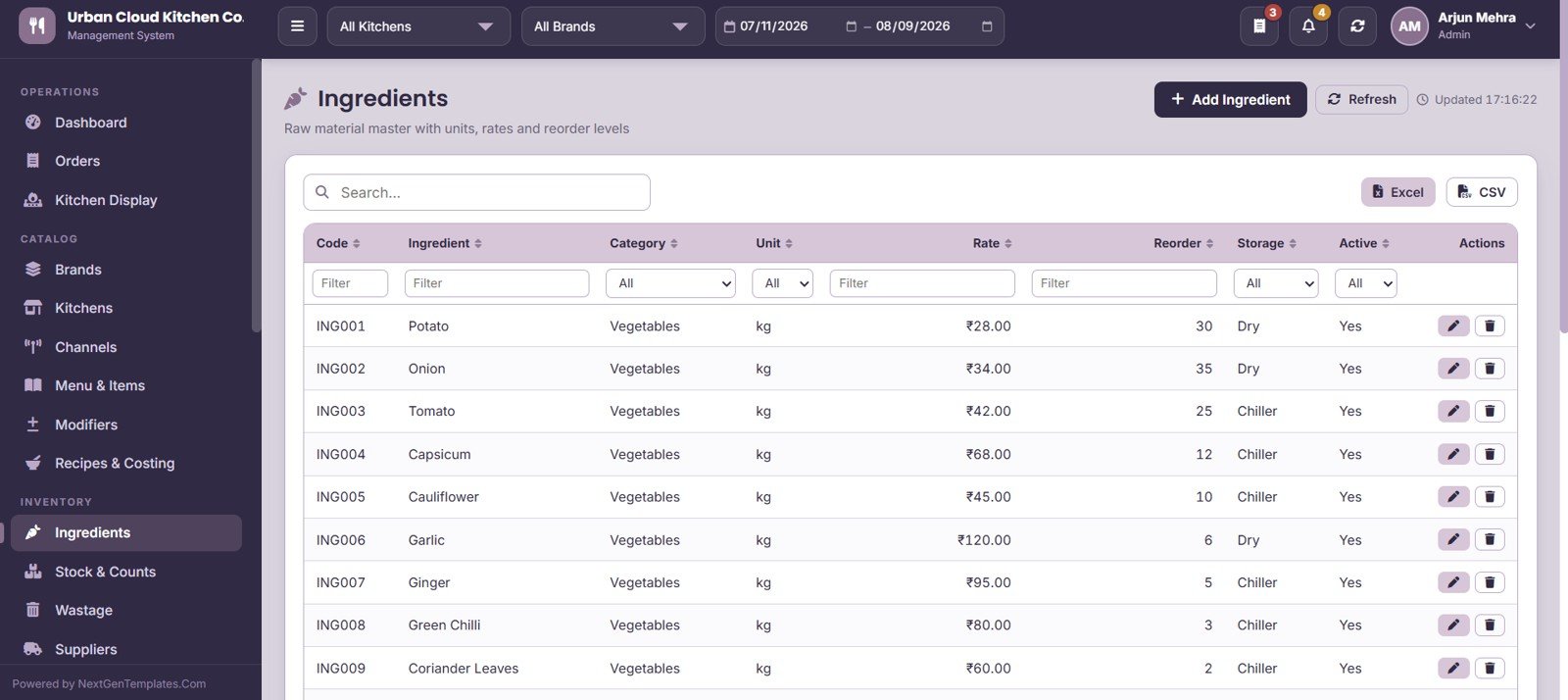
Ingredients
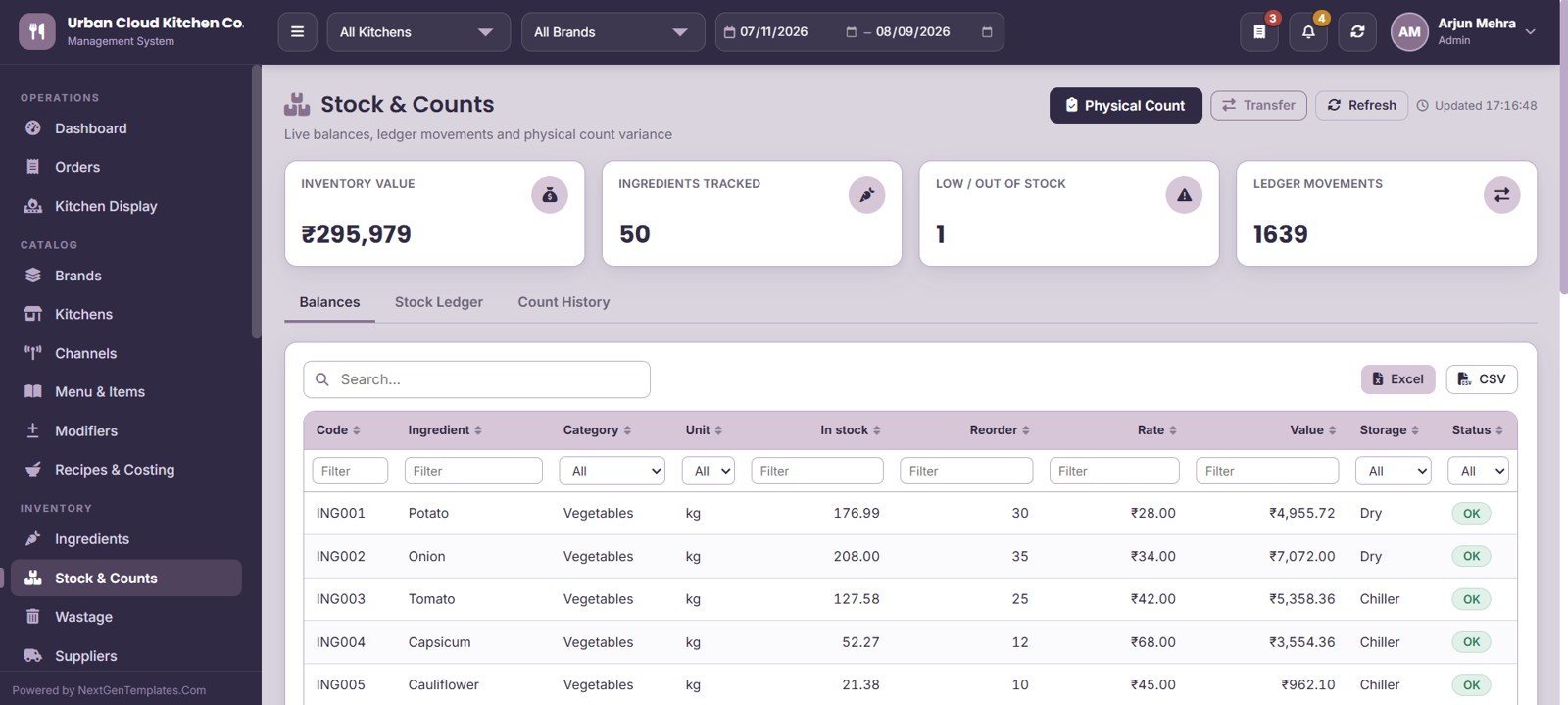
13. Stock & Counts
Inventory Value, Ingredients Tracked, Low / Out of Stock and Ledger Movements cards sit above Balances, Stock Ledger and Count History tabs. Physical Count and Transfer actions reconcile real shelf stock against system stock and record the variance.
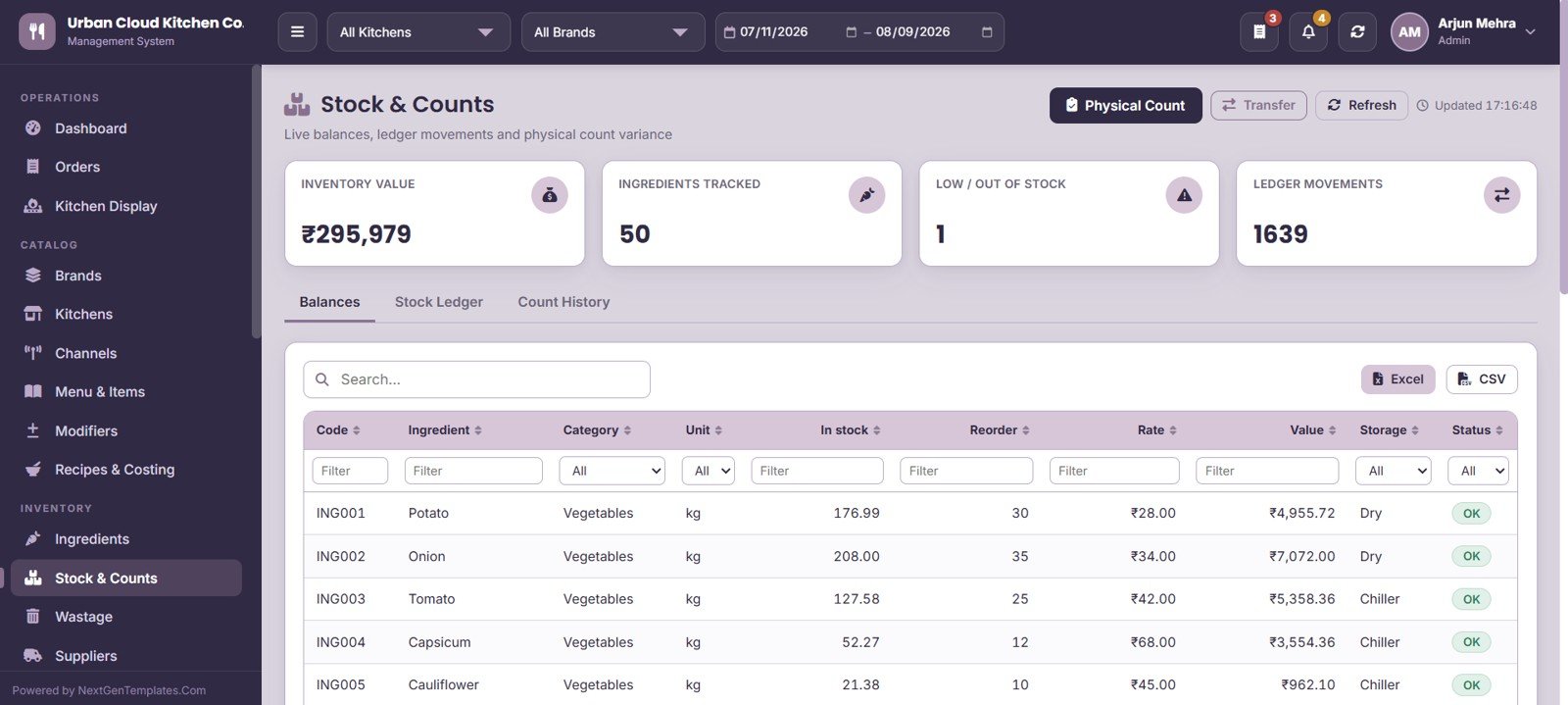
Stock & Counts
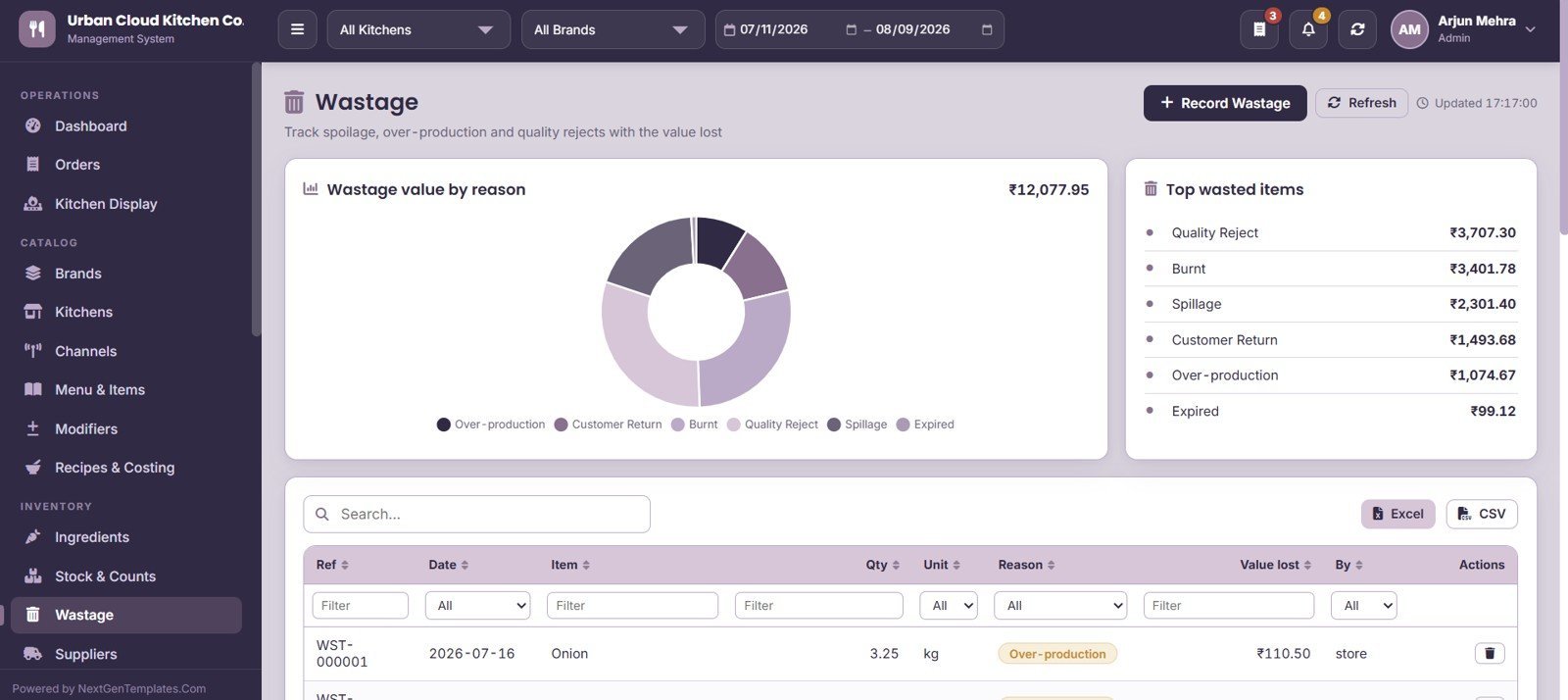
14. Wastage
Records spoilage, over-production and quality rejects against six reasons with value lost calculated per entry. Two panels chart Wastage value by reason and Top wasted items so the pattern is obvious.
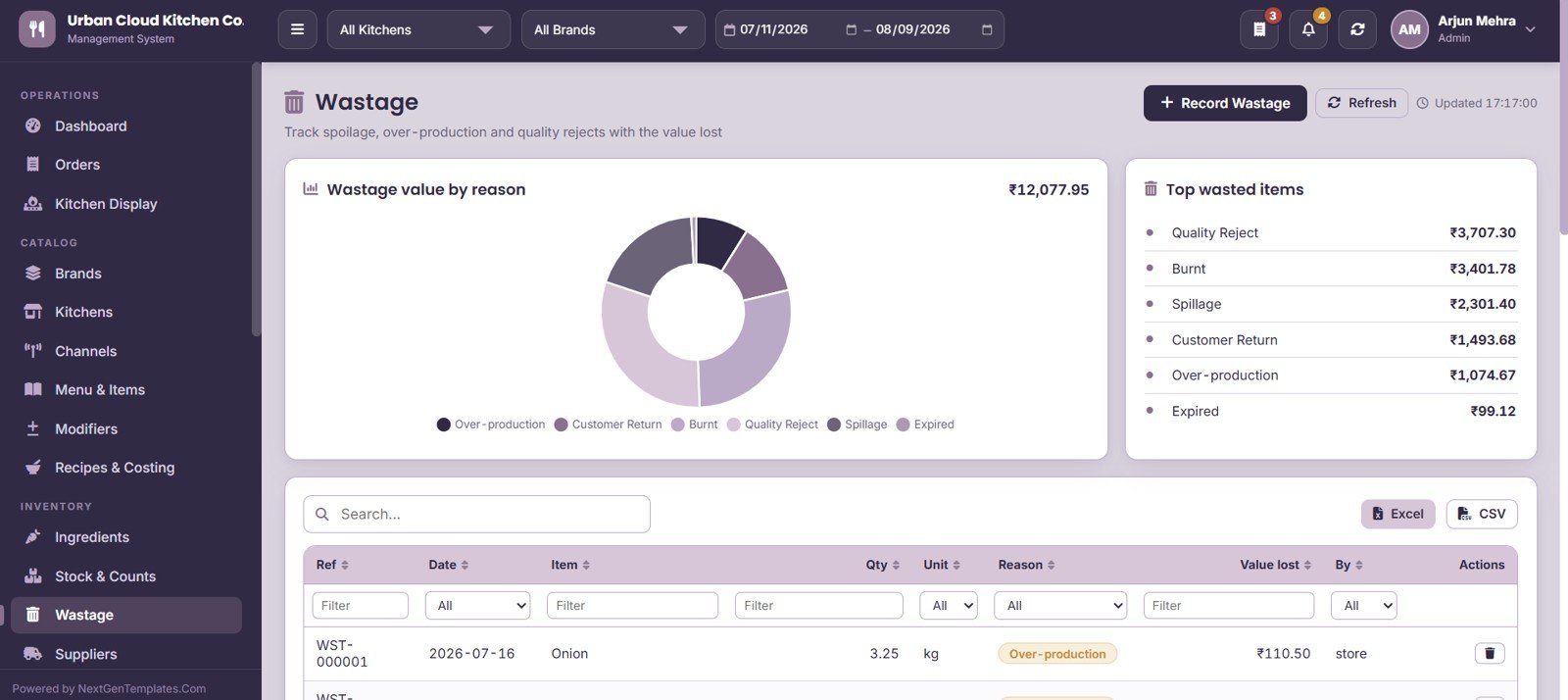
Wastage
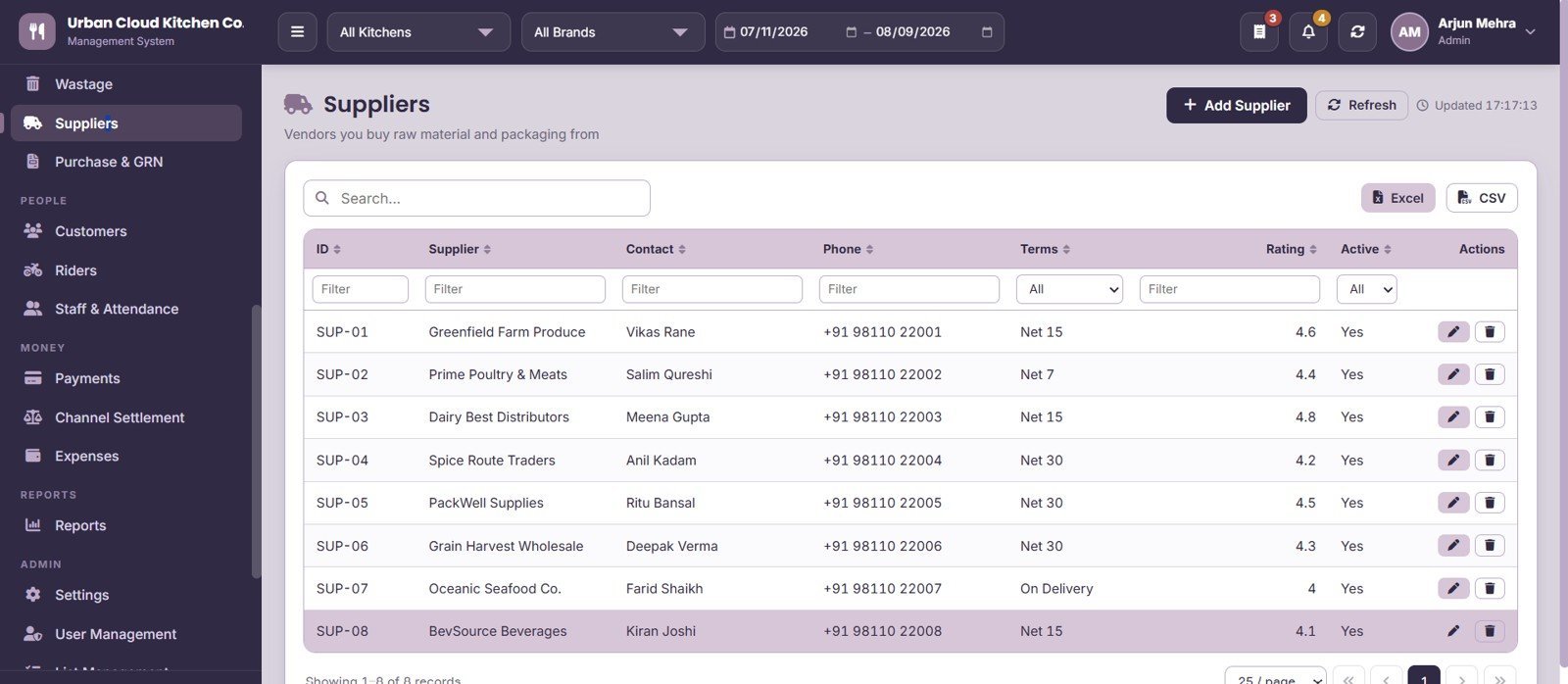
15. Suppliers
Vendor master for raw material and packaging suppliers with Contact, Phone, payment Terms, Rating and Active status. Ratings surface which vendors keep missing delivery windows.
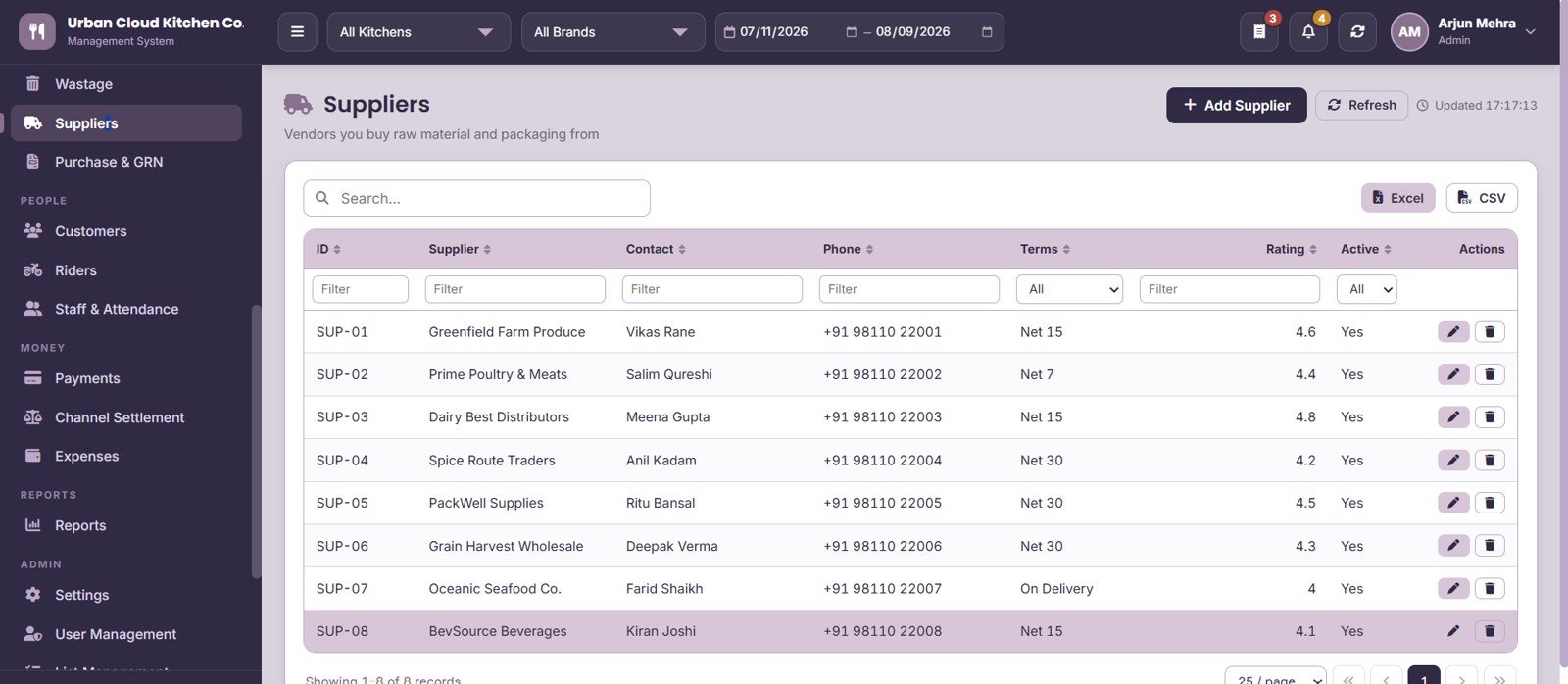
Suppliers
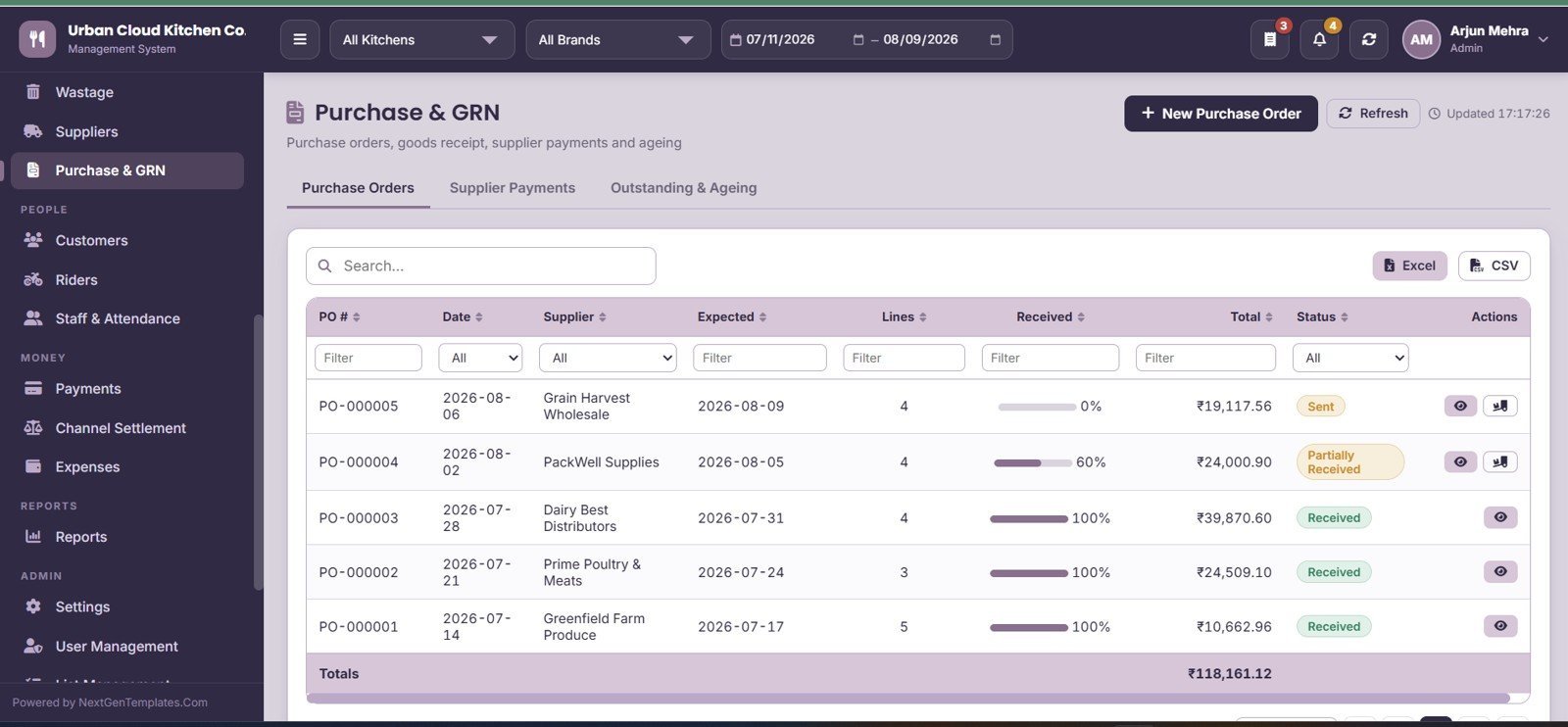
16. Purchase & GRN
Purchase Orders, Supplier Payments and Outstanding & Ageing tabs. Each PO tracks Date, Supplier, Expected date, Lines, Received quantity, Total and Status, keeping partial receipts and pending goods visible.
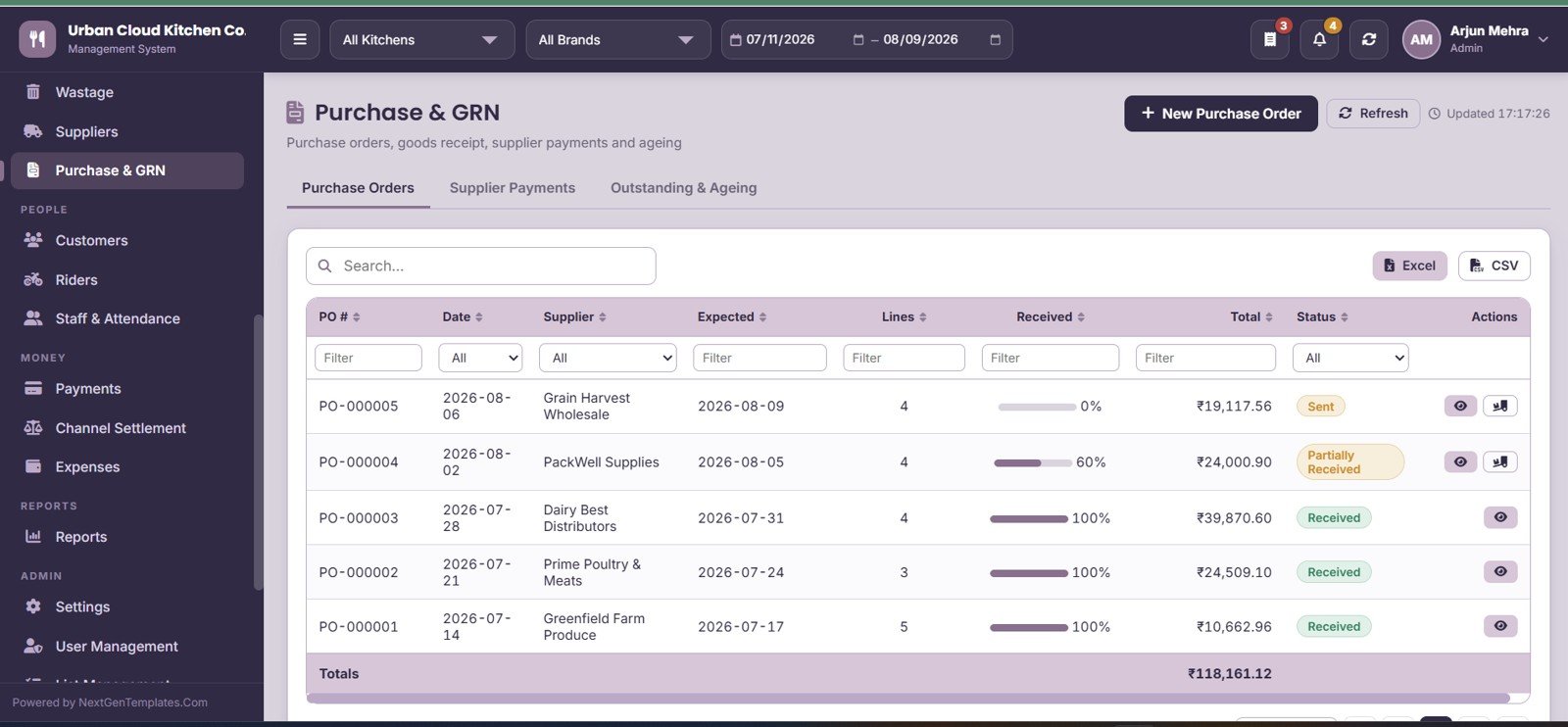
Purchase & GRN
17. Customers
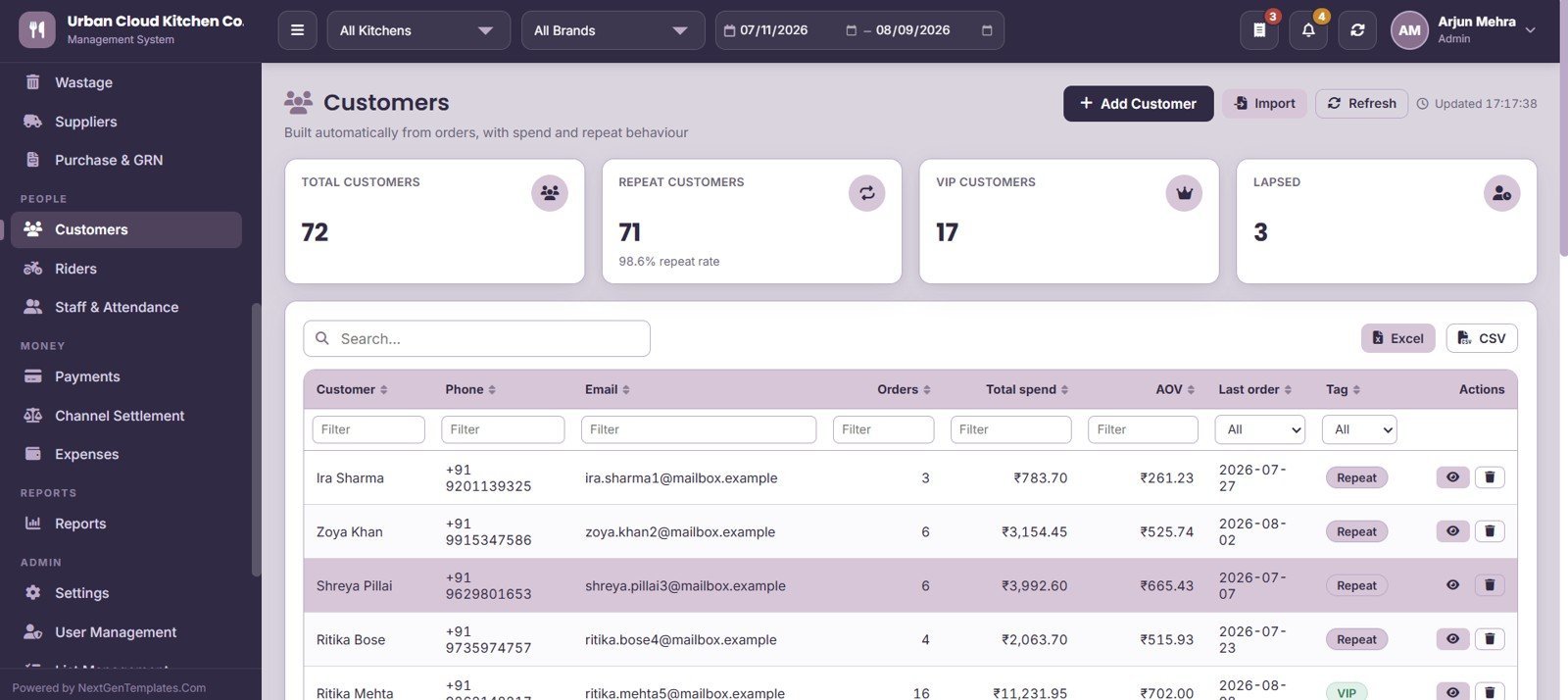
Customer records build themselves from orders, with Total Customers, Repeat Customers, VIP Customers and Lapsed cards. The grid shows Orders, Total spend, AOV, Last order and a Tag for segmentation.
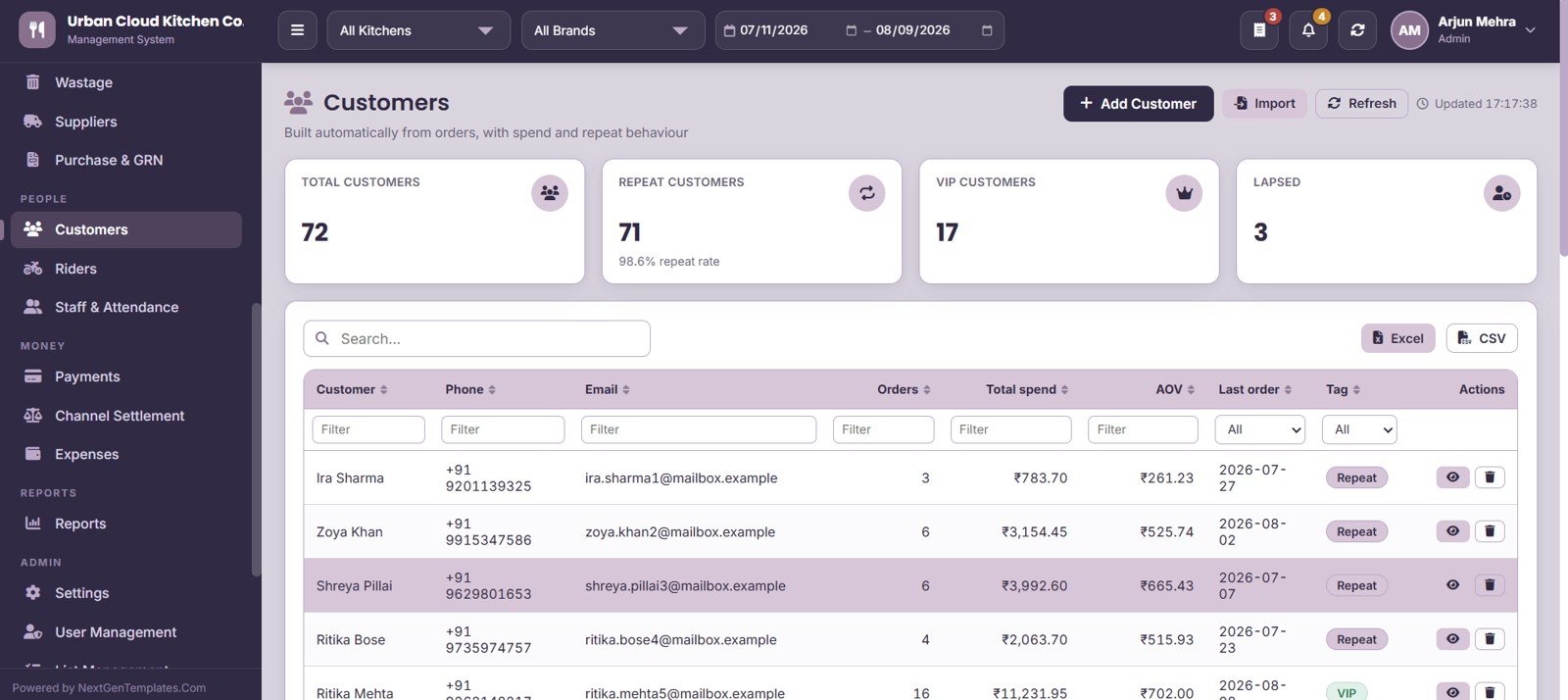
Customers
18. Riders
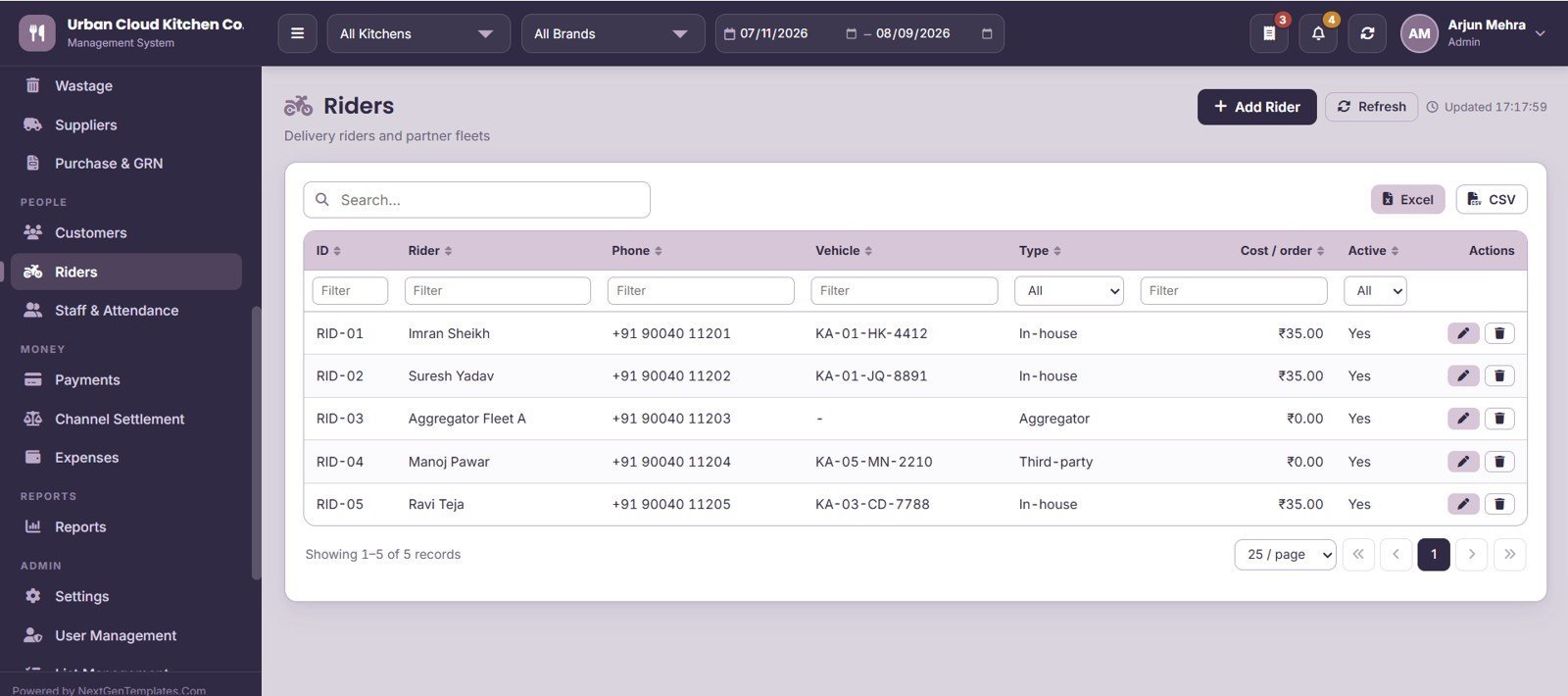
Manages your own riders and partner fleets with Phone, Vehicle, Type and Cost per order. Rider cost feeds the Rider Performance report and the true delivery cost of direct orders.
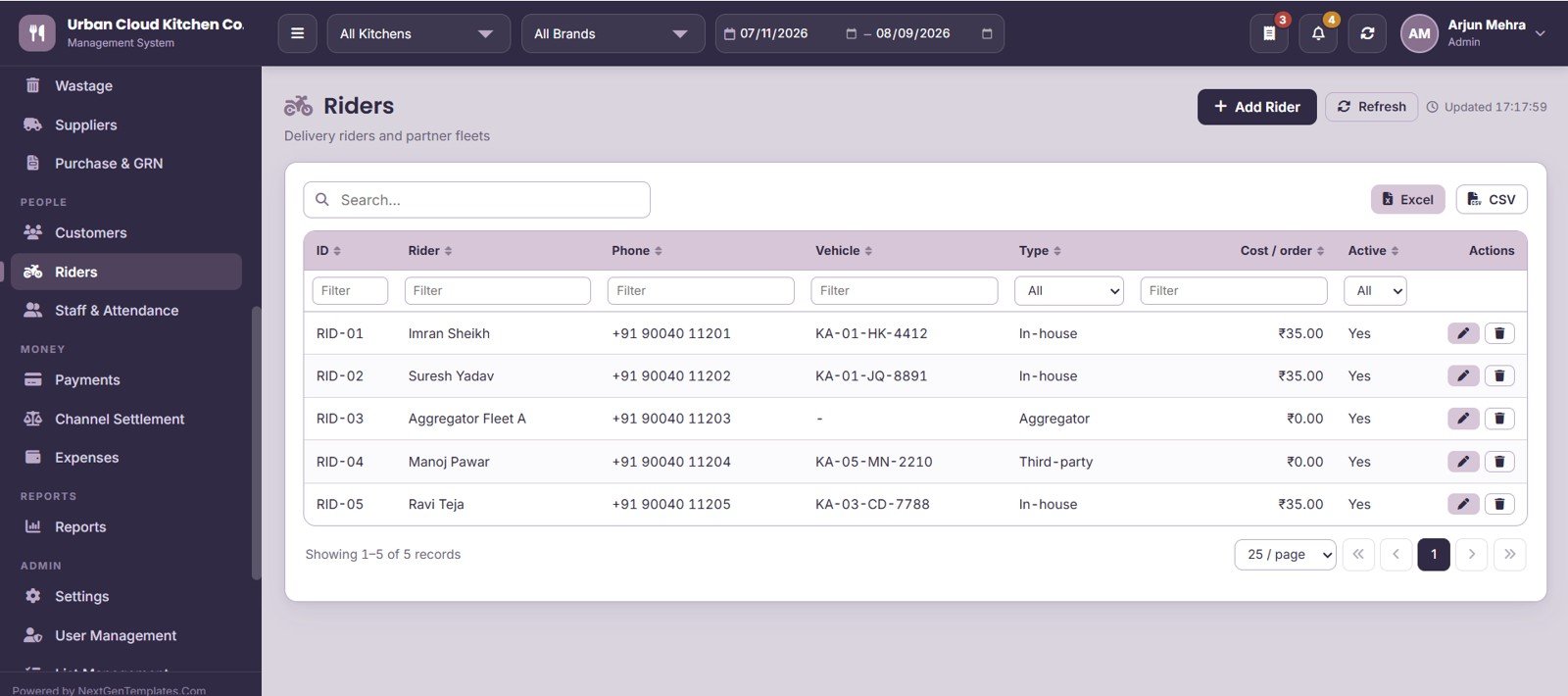
Riders
19. Staff & Attendance
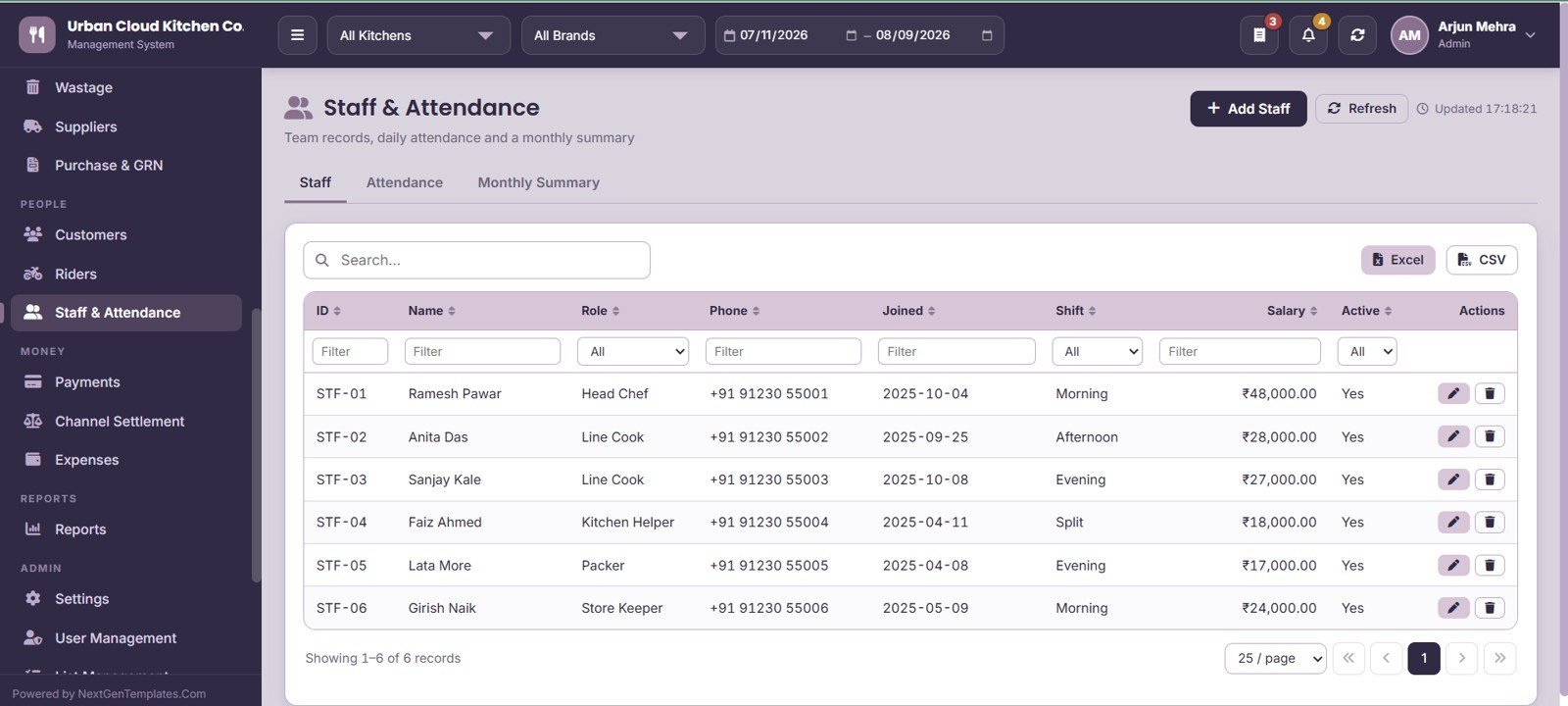
Staff, Attendance and Monthly Summary tabs hold Name, Role, Phone, Joined date, Shift, Salary and Active status. Daily attendance rolls into a monthly summary you can export for payroll.
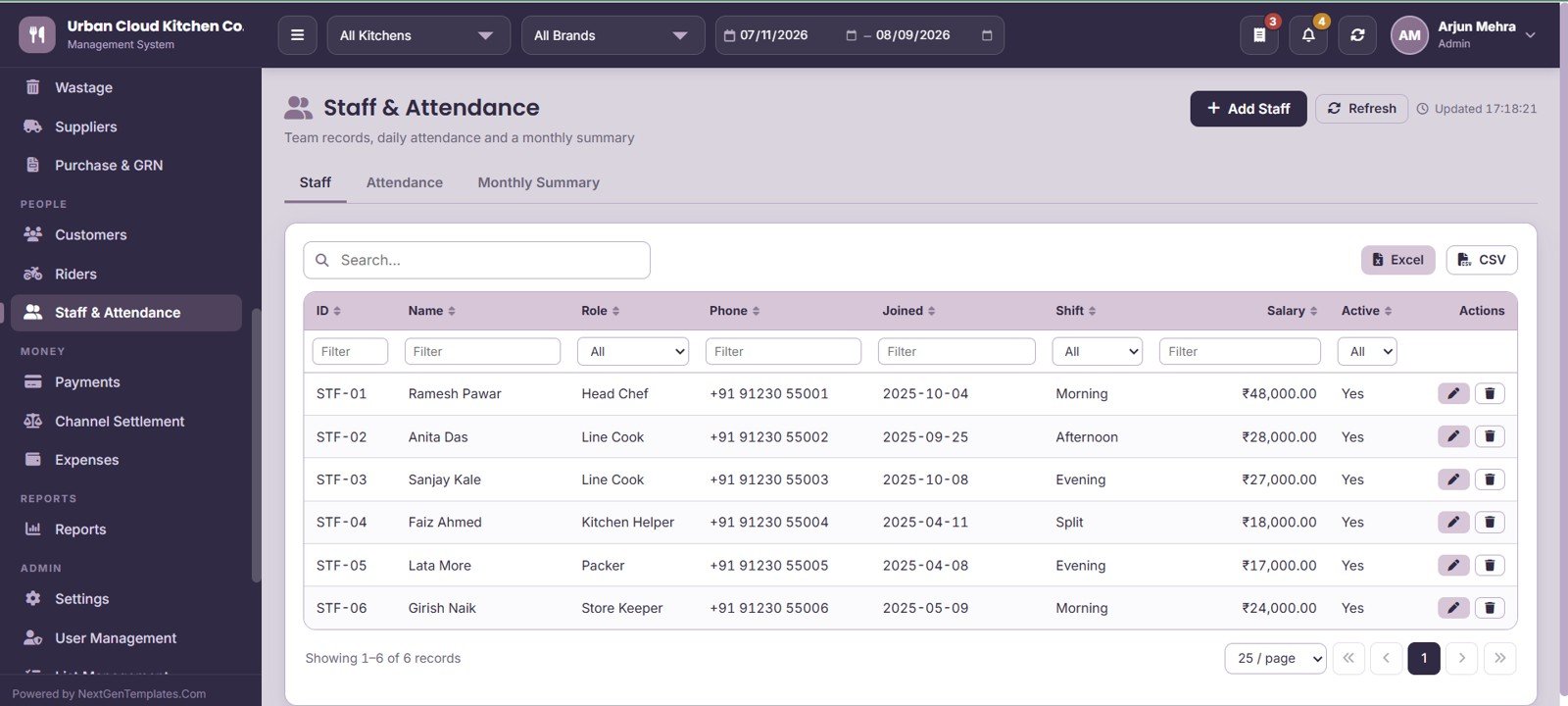
Staff & Attendance
20. Payments
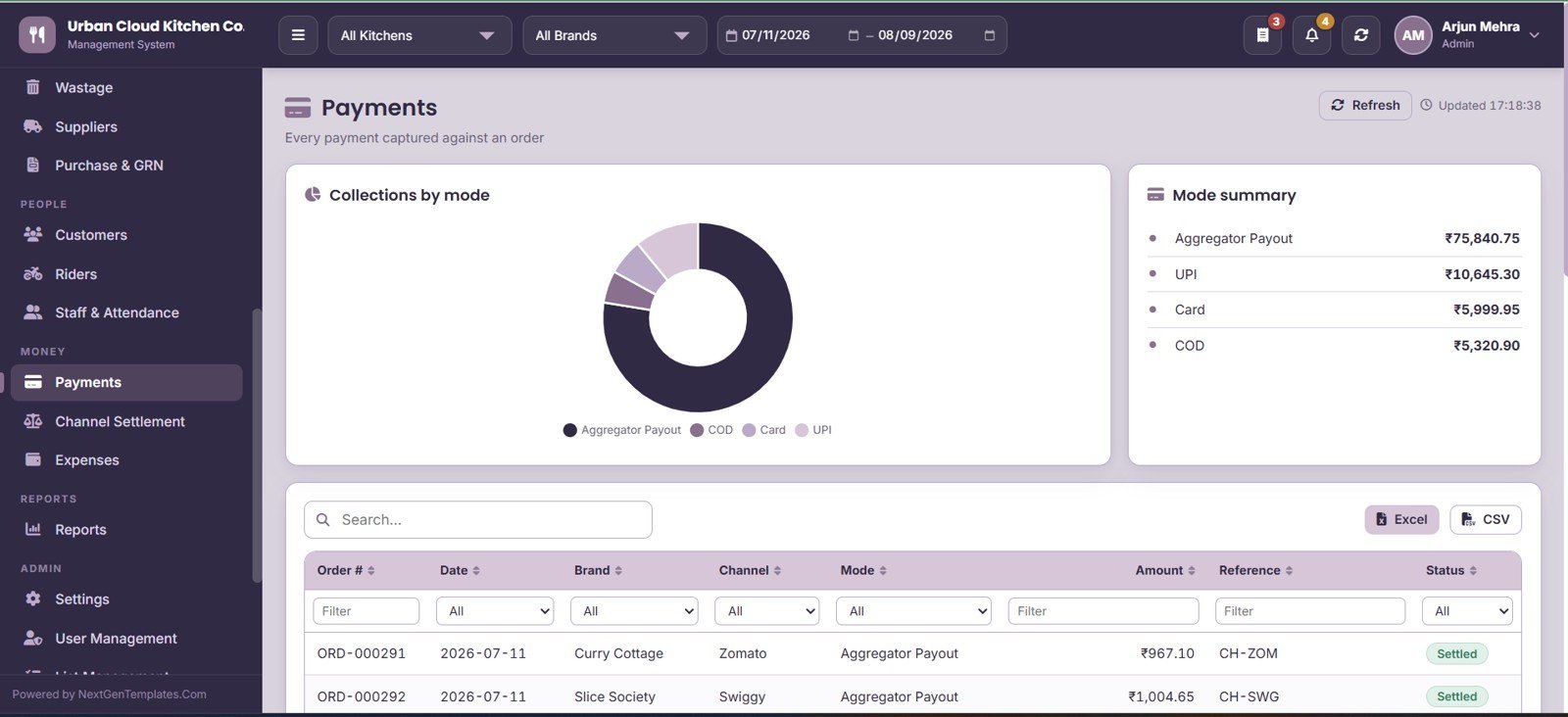
Captures every payment against an order with Order #, Date, Brand, Channel, Mode, Amount, Reference and Status. Collections by mode and a Mode summary show exactly how much arrived as cash, UPI, card or aggregator credit.
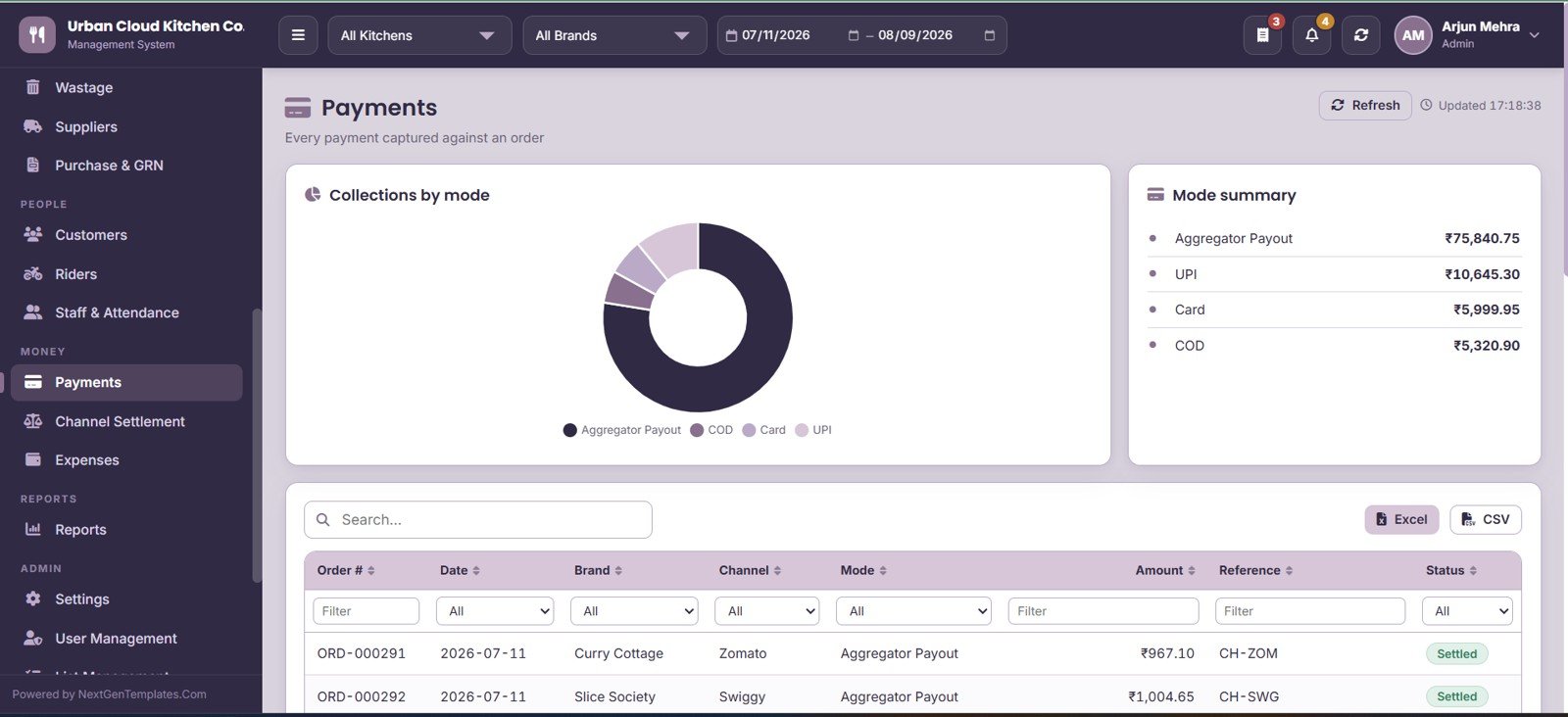
Payments
21. Channel Settlement
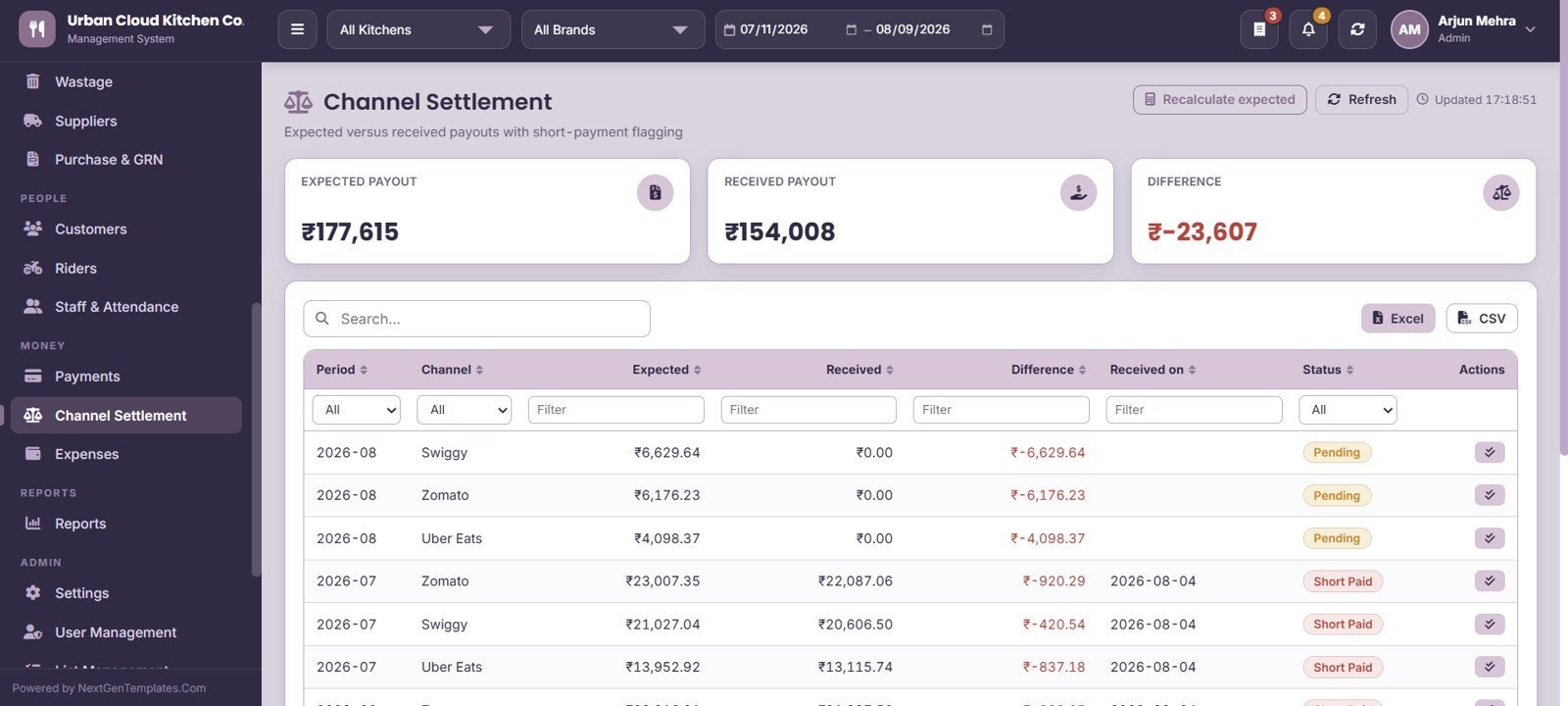
Compares Expected Payout against Received Payout per period and channel, flagging the Difference and recording the Received on date. Recalculate Expected rebuilds expected payouts from order value minus channel commission.
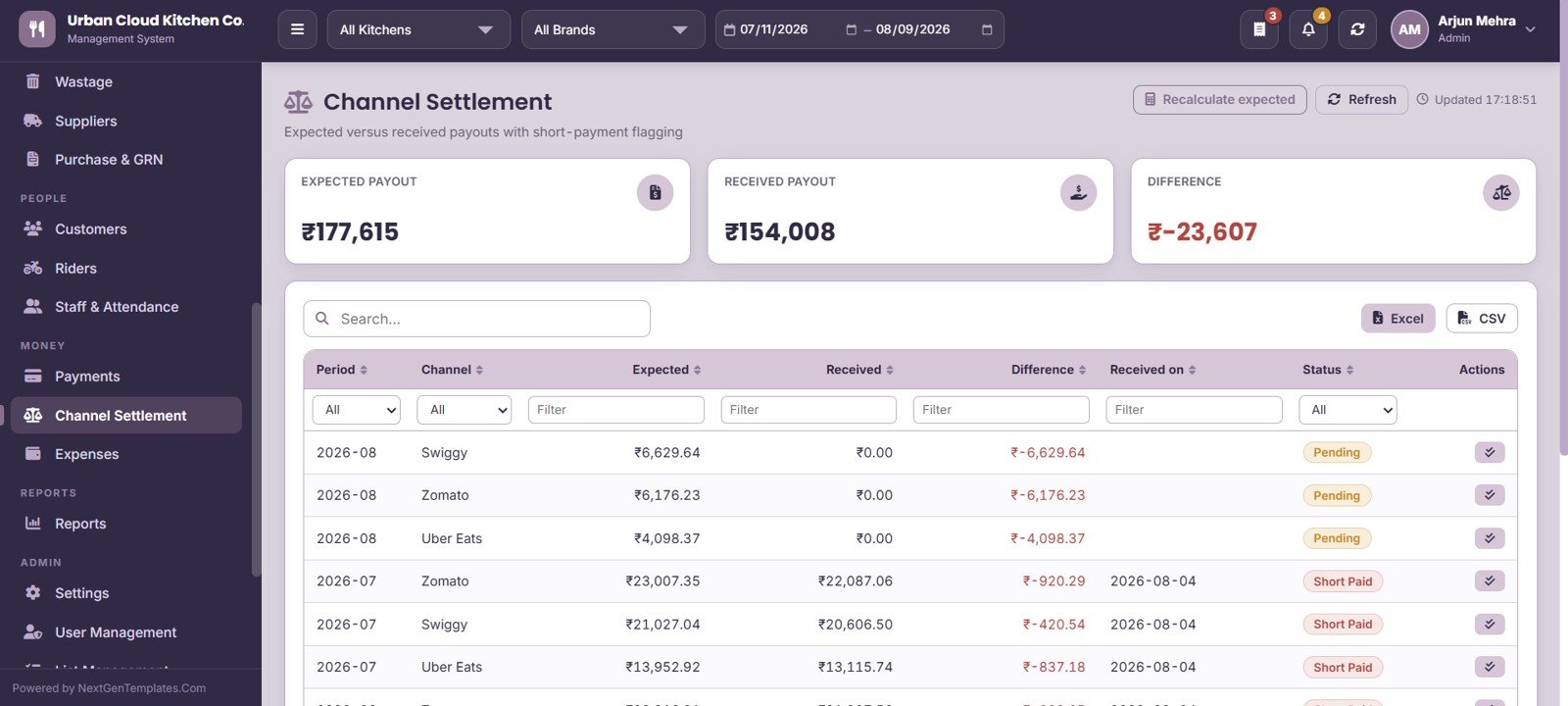
Channel Settlement
22. Expenses
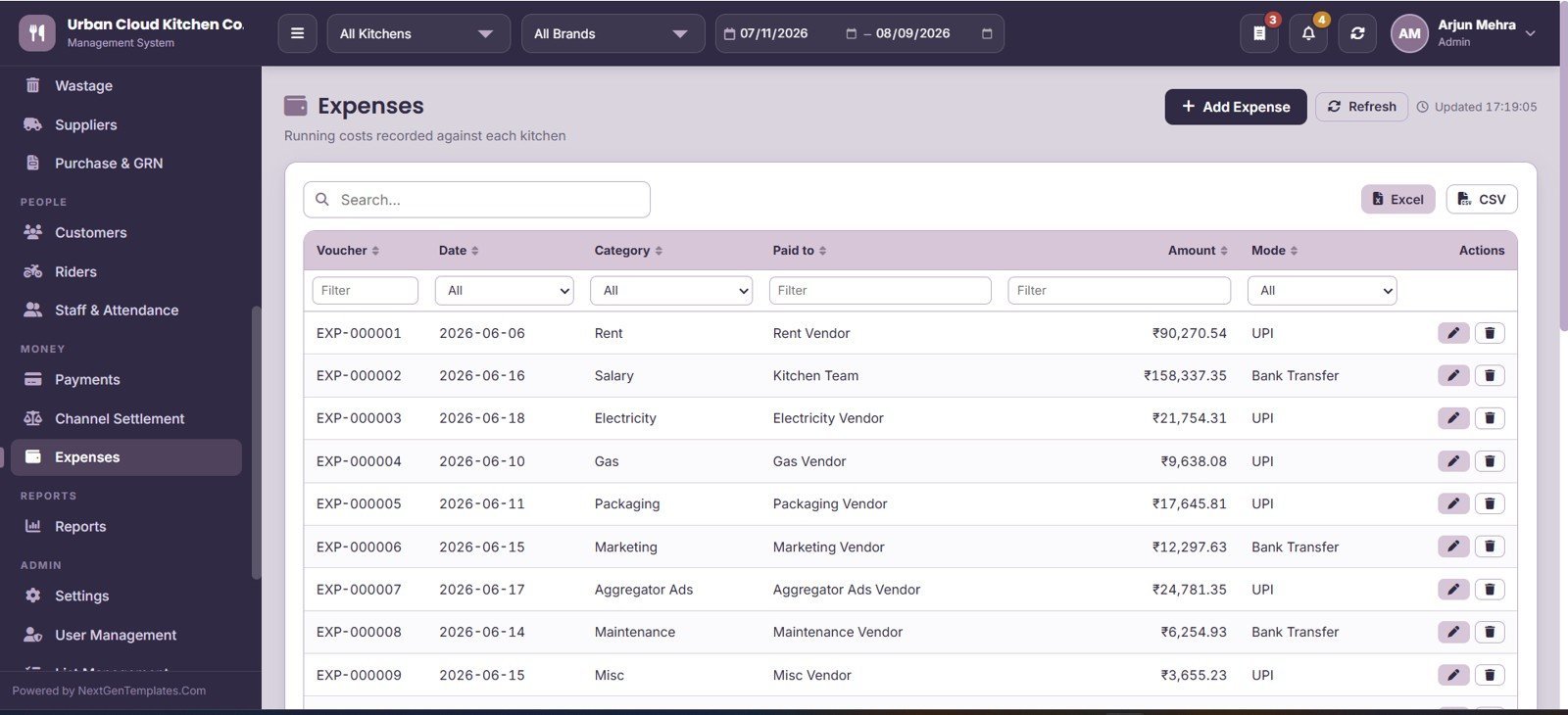
Records running costs against each kitchen with Voucher, Date, Category, Paid to, Amount and Mode. Expense categories are editable from List Management, so rent, gas, packaging and marketing report separately.
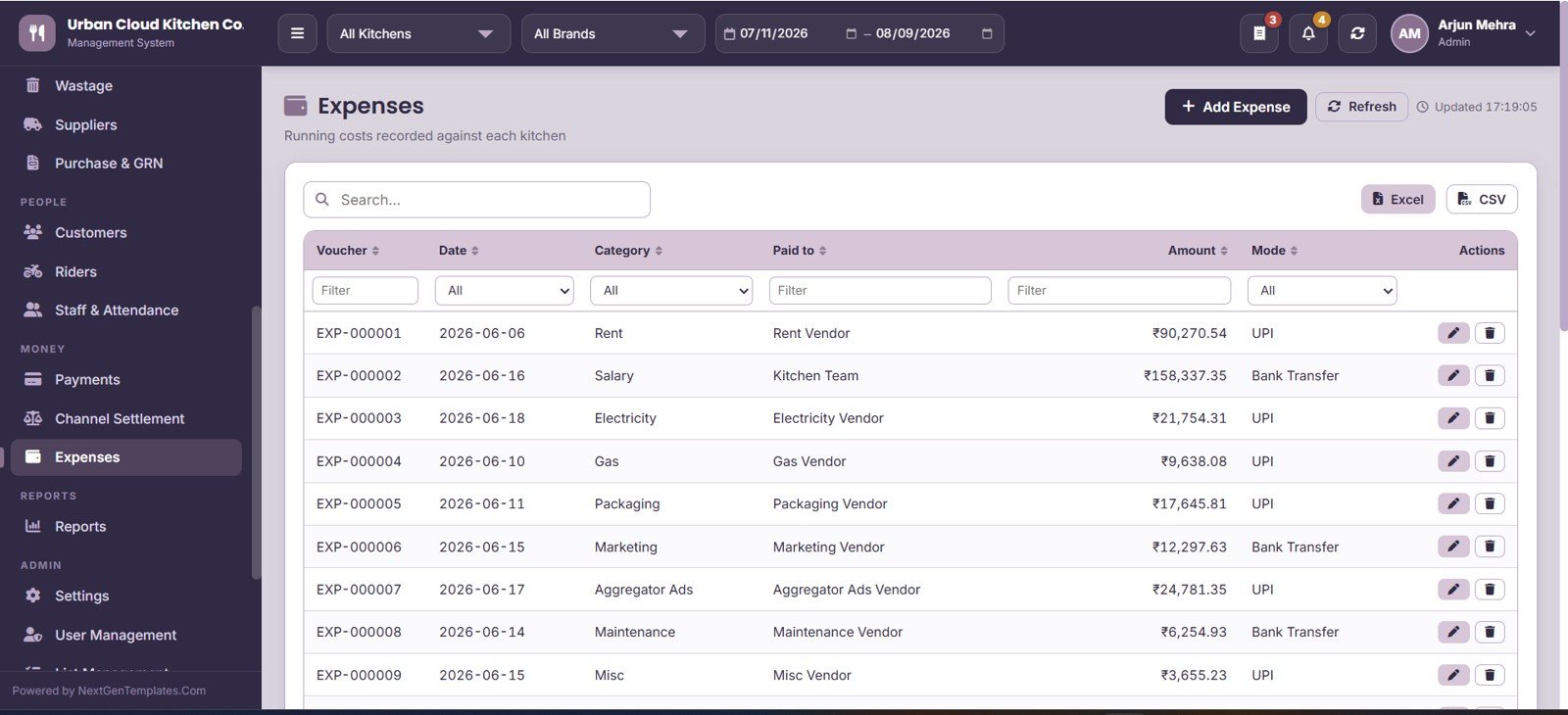
Expenses
23. Reports
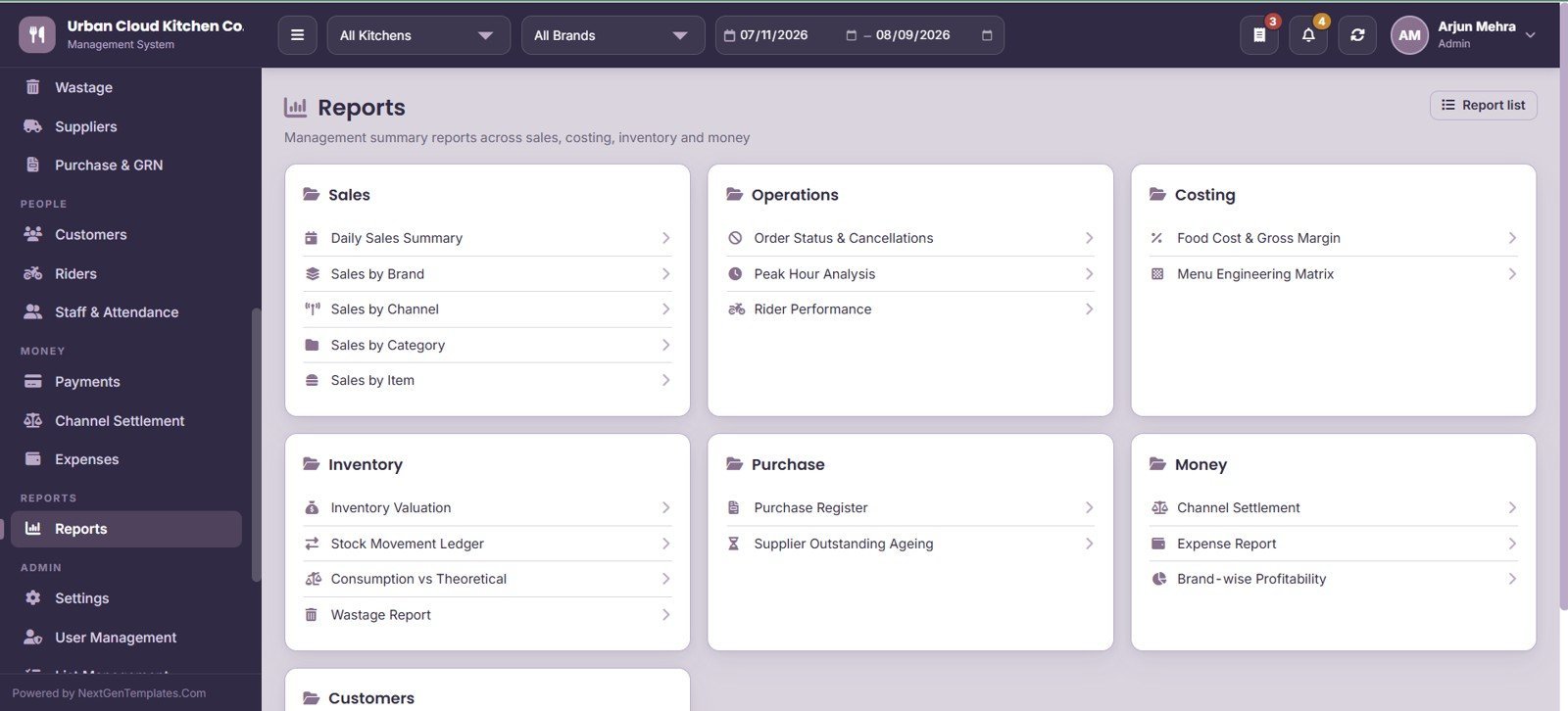
Nineteen reports in six families: Sales (Daily Sales Summary, Sales by Brand, Channel, Category, Item), Operations (Order Status & Cancellations, Peak Hour Analysis, Rider Performance), Costing (Food Cost & Gross Margin, Menu Engineering Matrix), Inventory (Valuation, Stock Movement Ledger, Consumption vs Theoretical, Wastage), Purchase (Register, Supplier Outstanding Ageing) and Money (Channel Settlement, Expense Report, Brand-wise Profitability).
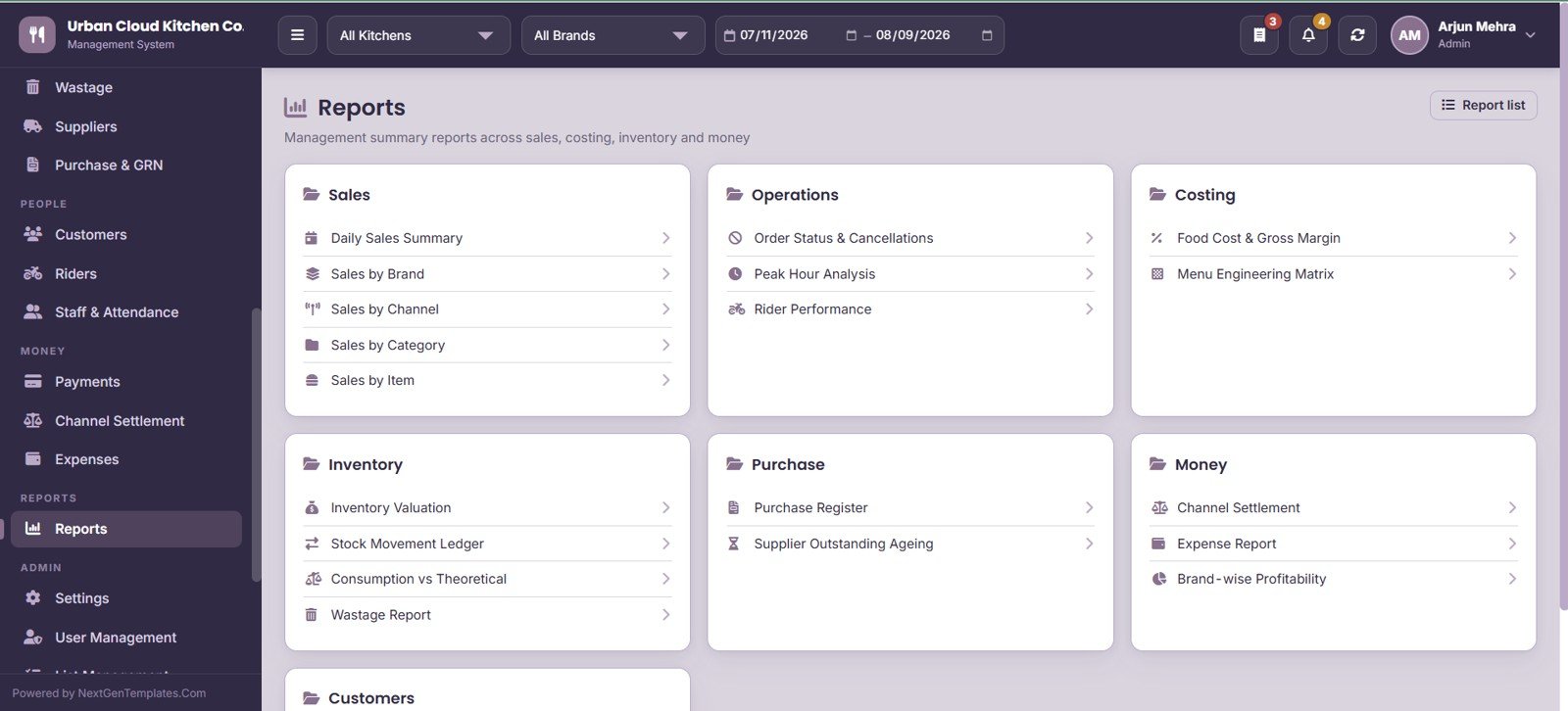
Reports
24. Settings
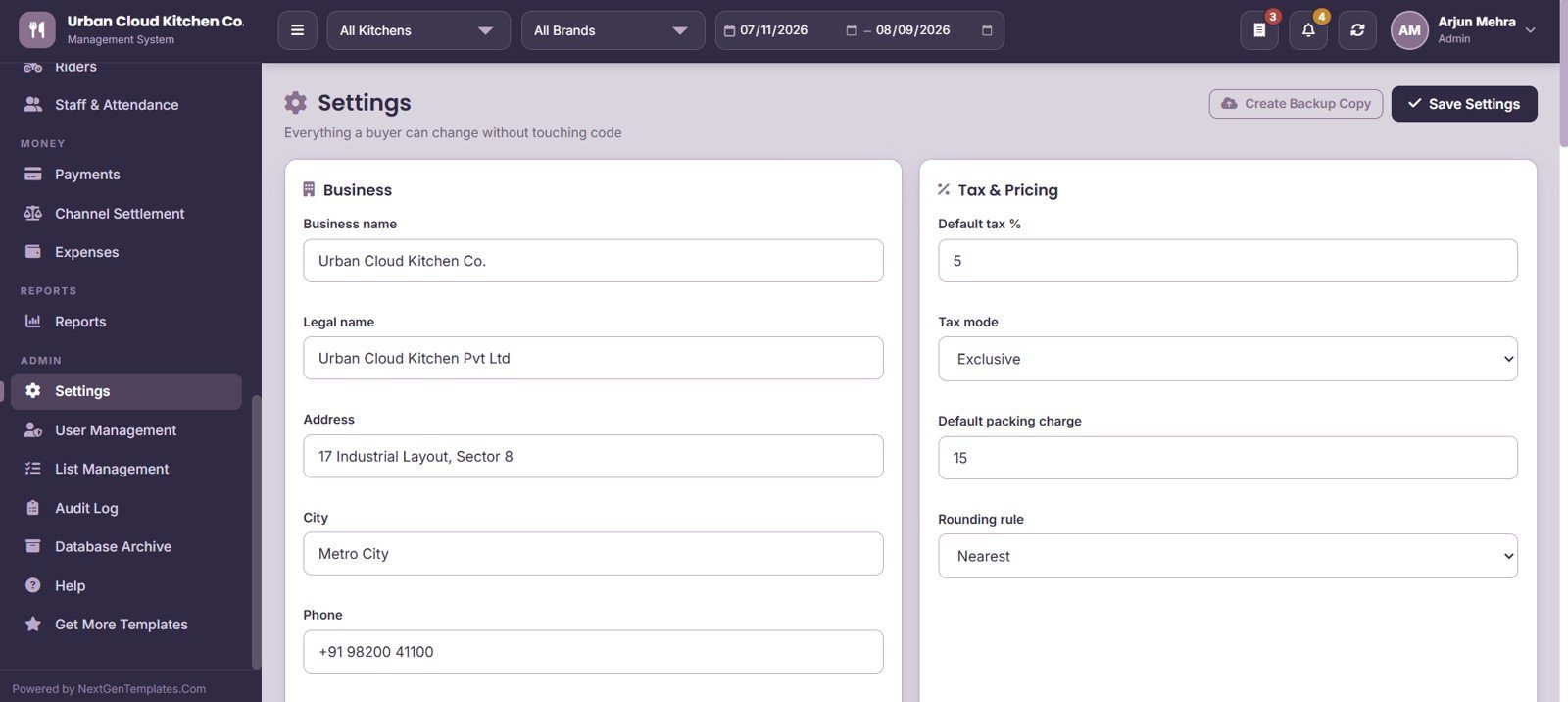
Business profile fields (Business name, Legal name, Address, City, Phone) alongside Tax & Pricing rules – Default tax %, Tax mode, Default packing charge and Rounding rule. Create Backup Copy snapshots the database before structural changes.
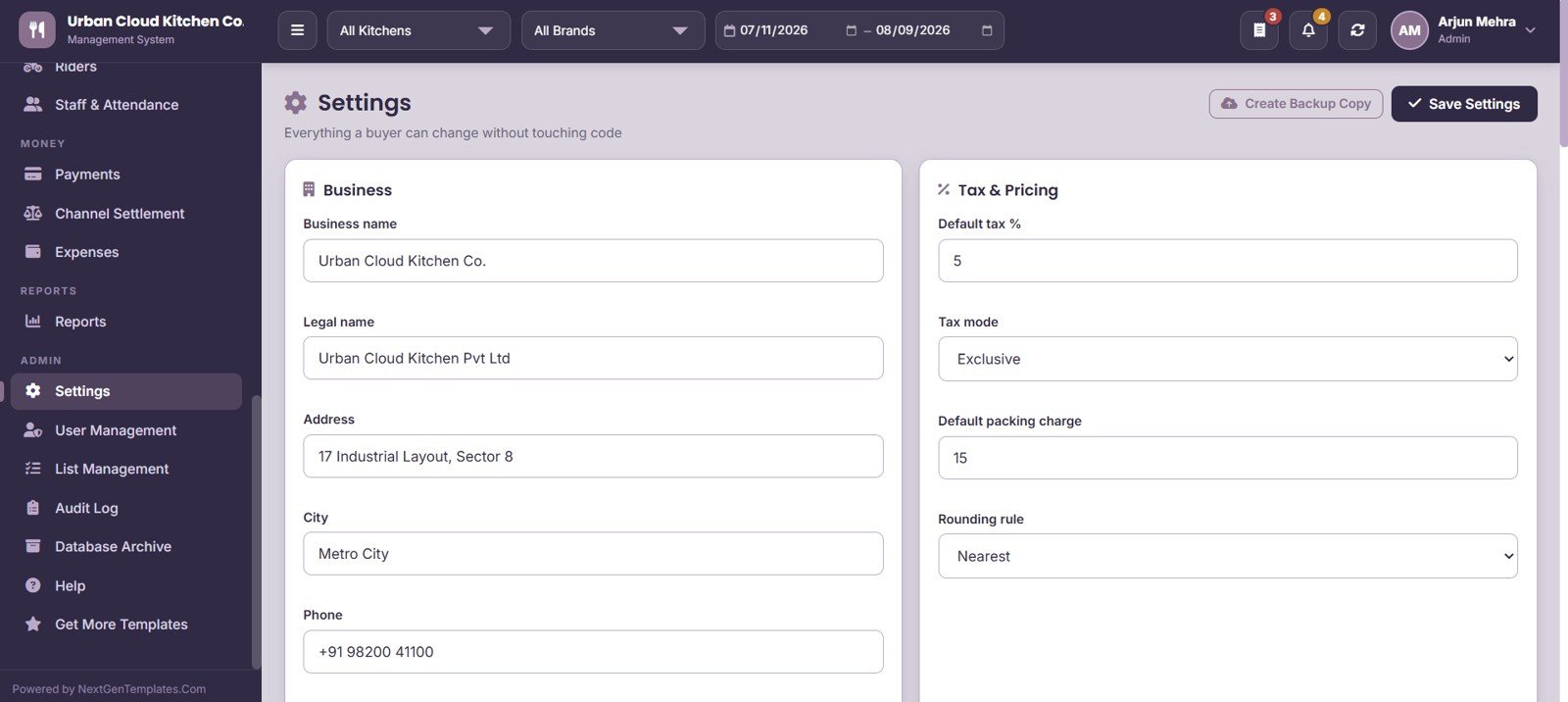
Settings
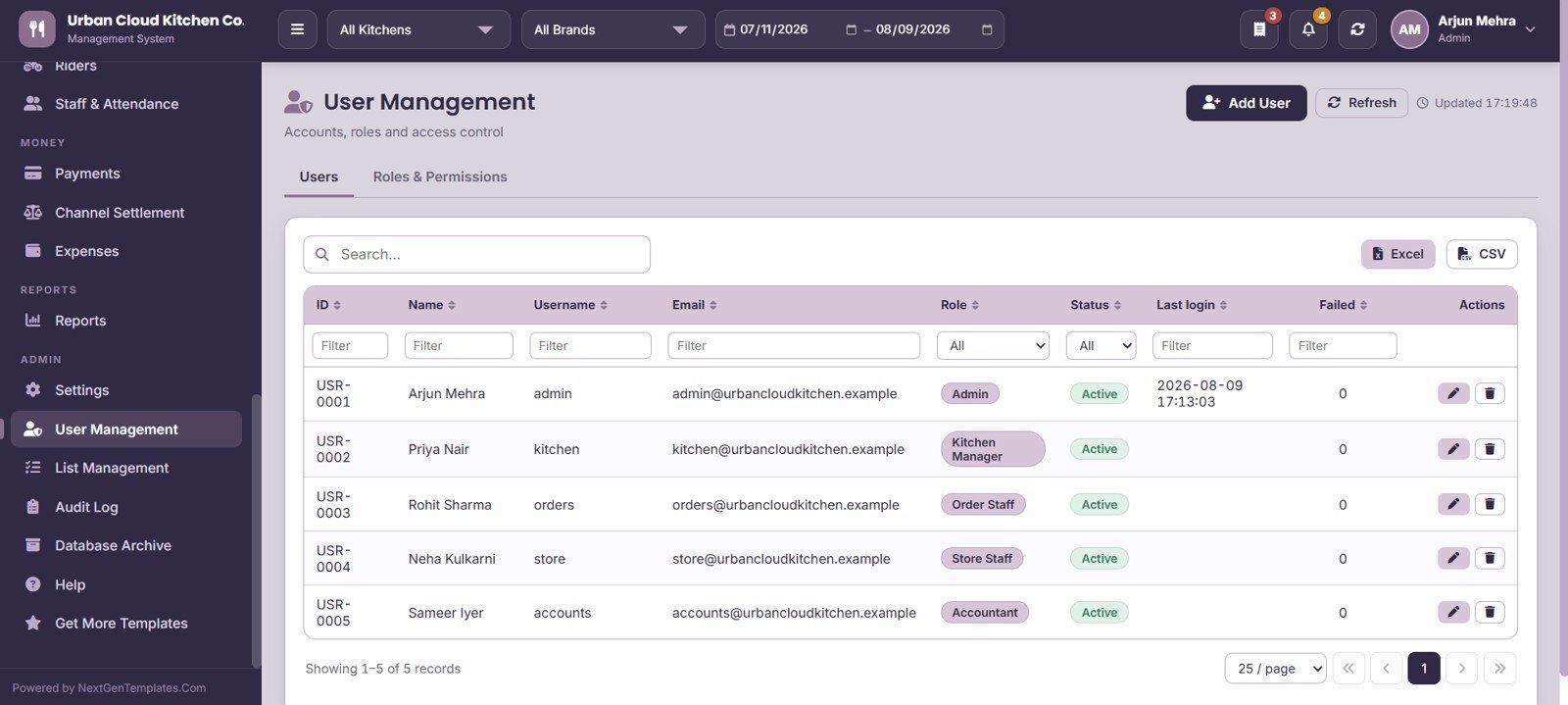
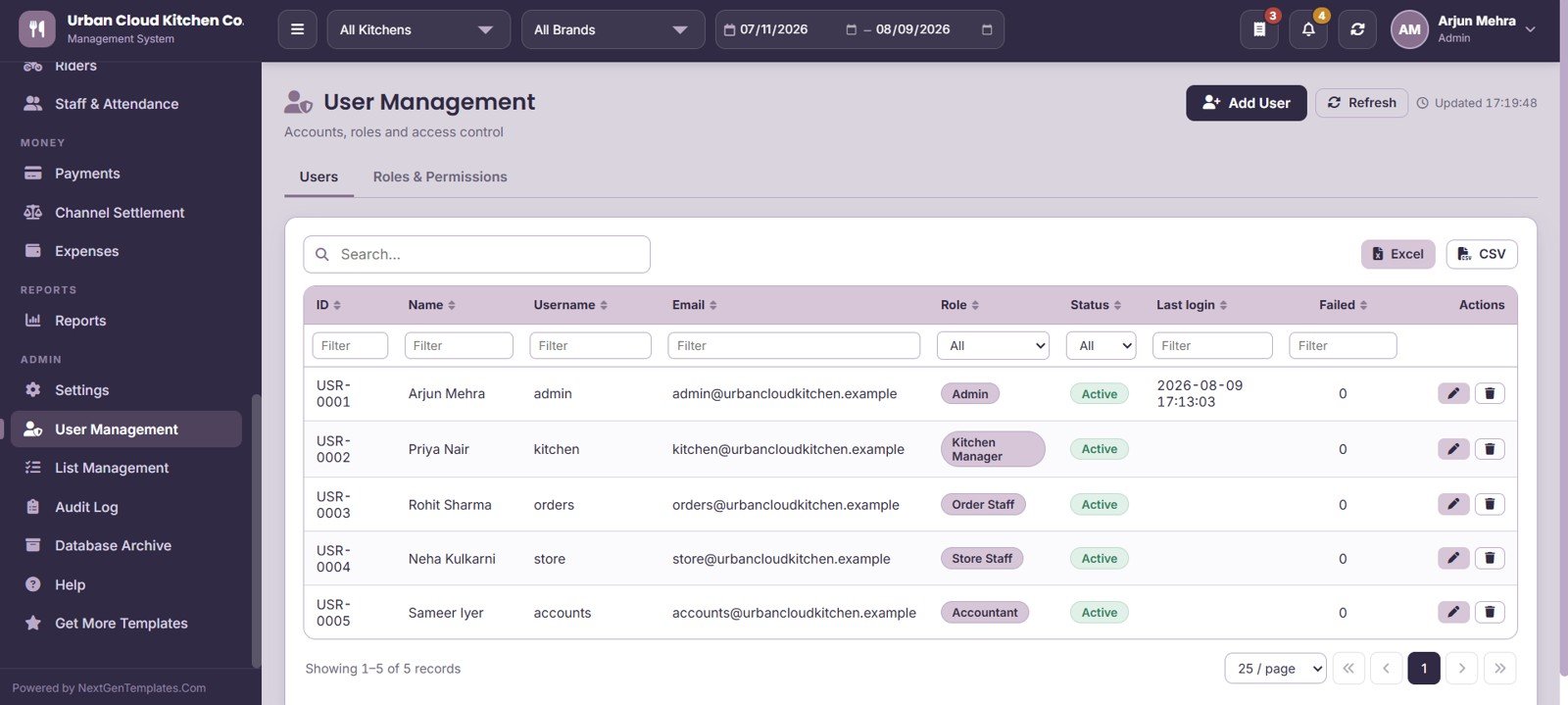
25. User Management
Users and Roles & Permissions tabs manage accounts with Name, Username, Email, Role, Status, Last login and Failed login count. Roles control which modules each team member can open, so a kitchen lead never sees settlement figures.
User Management
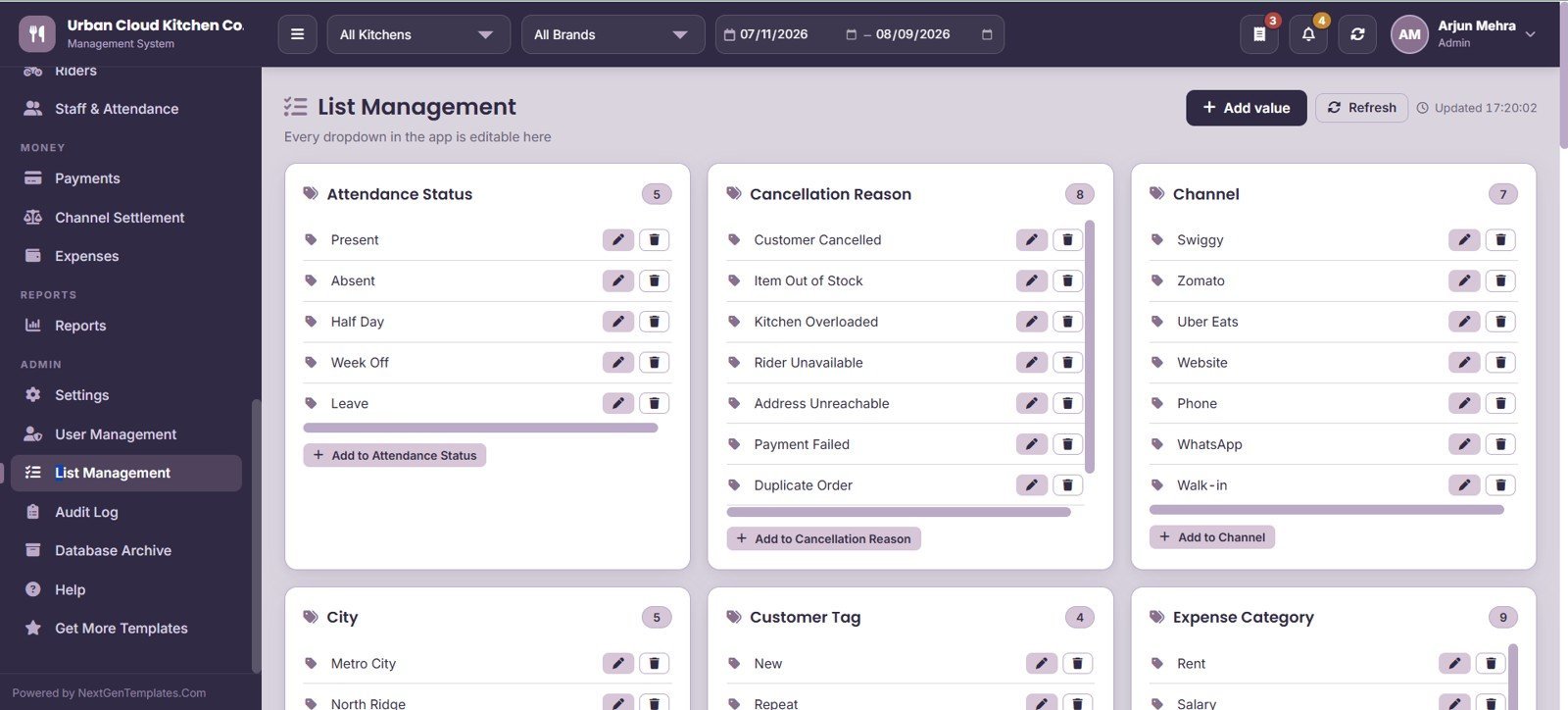
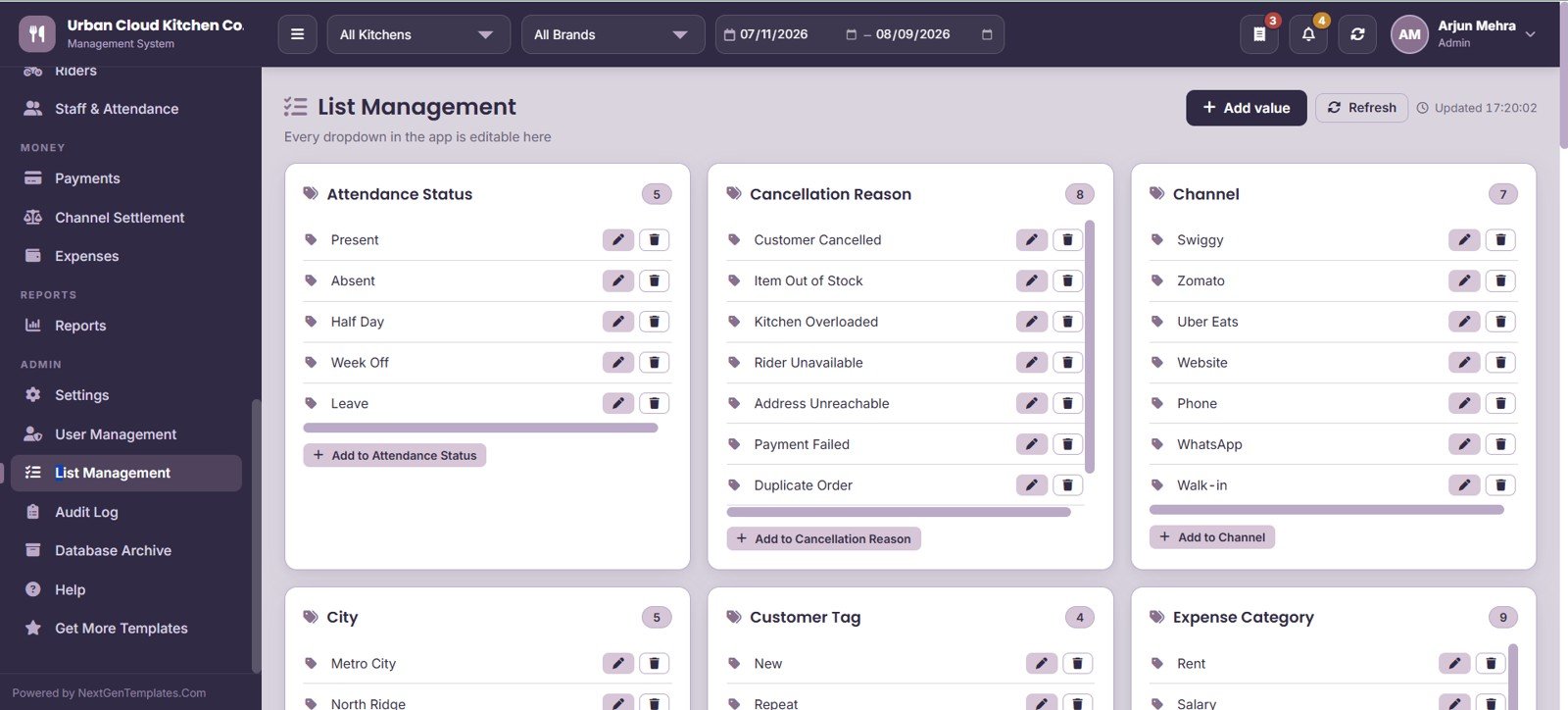
26. List Management
Every dropdown in the app is editable from one screen – Attendance Status, Cancellation Reason, Channel, City, Customer Tag and Expense Category. Adding a new aggregator takes seconds and needs no code change.
List Management
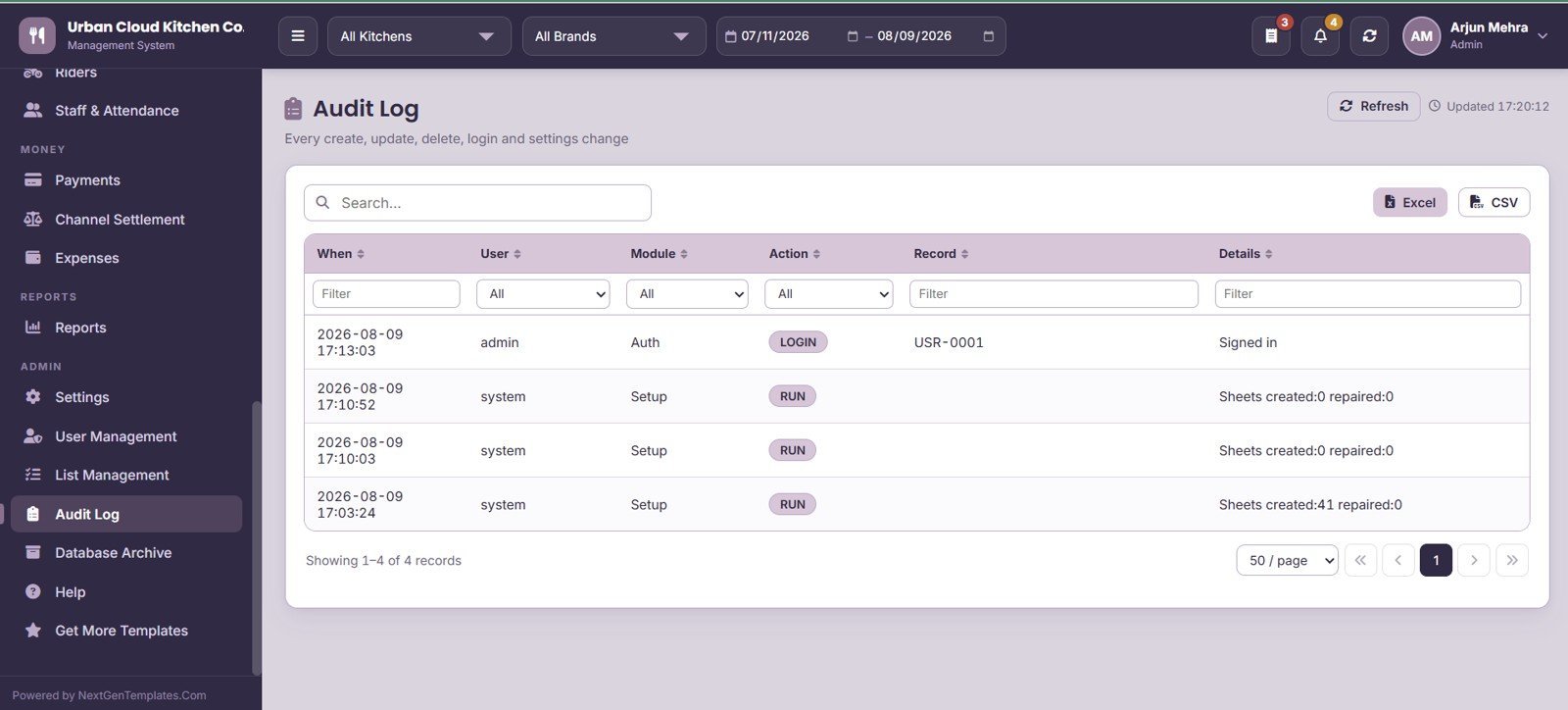
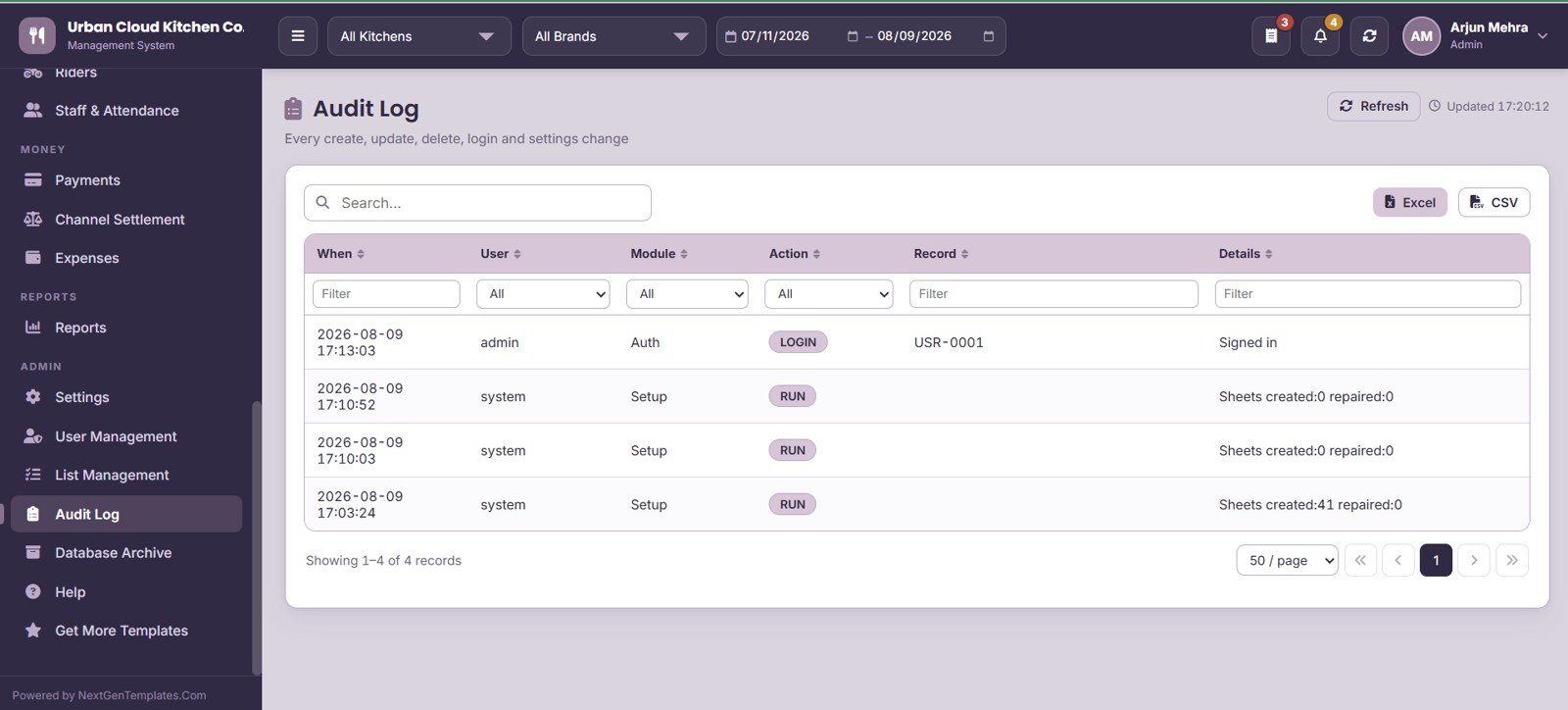
27. Audit Log
Tracks every create, update, delete, login and settings change with When, User, Module, Action, Record and Details – useful when an order total changes overnight and nobody remembers touching it.
Audit Log
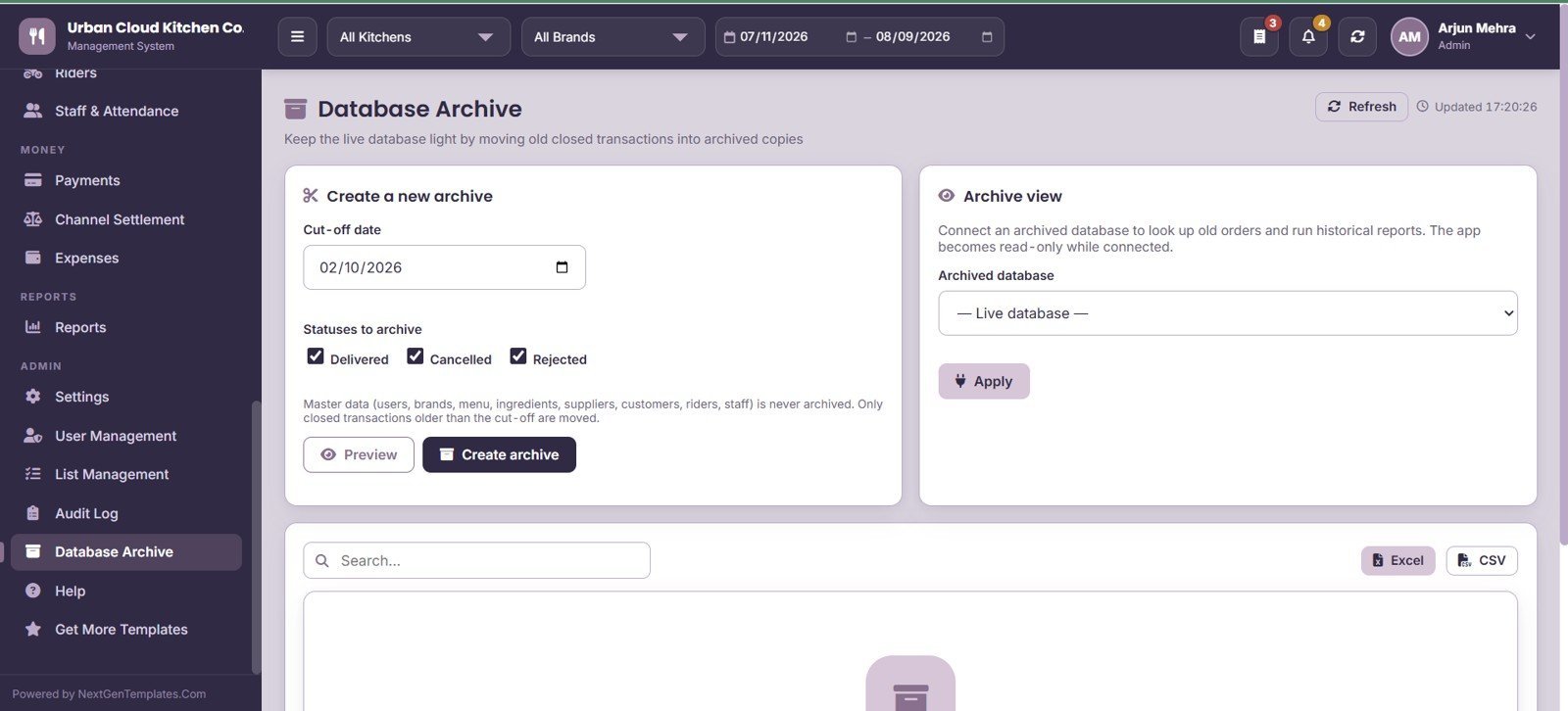
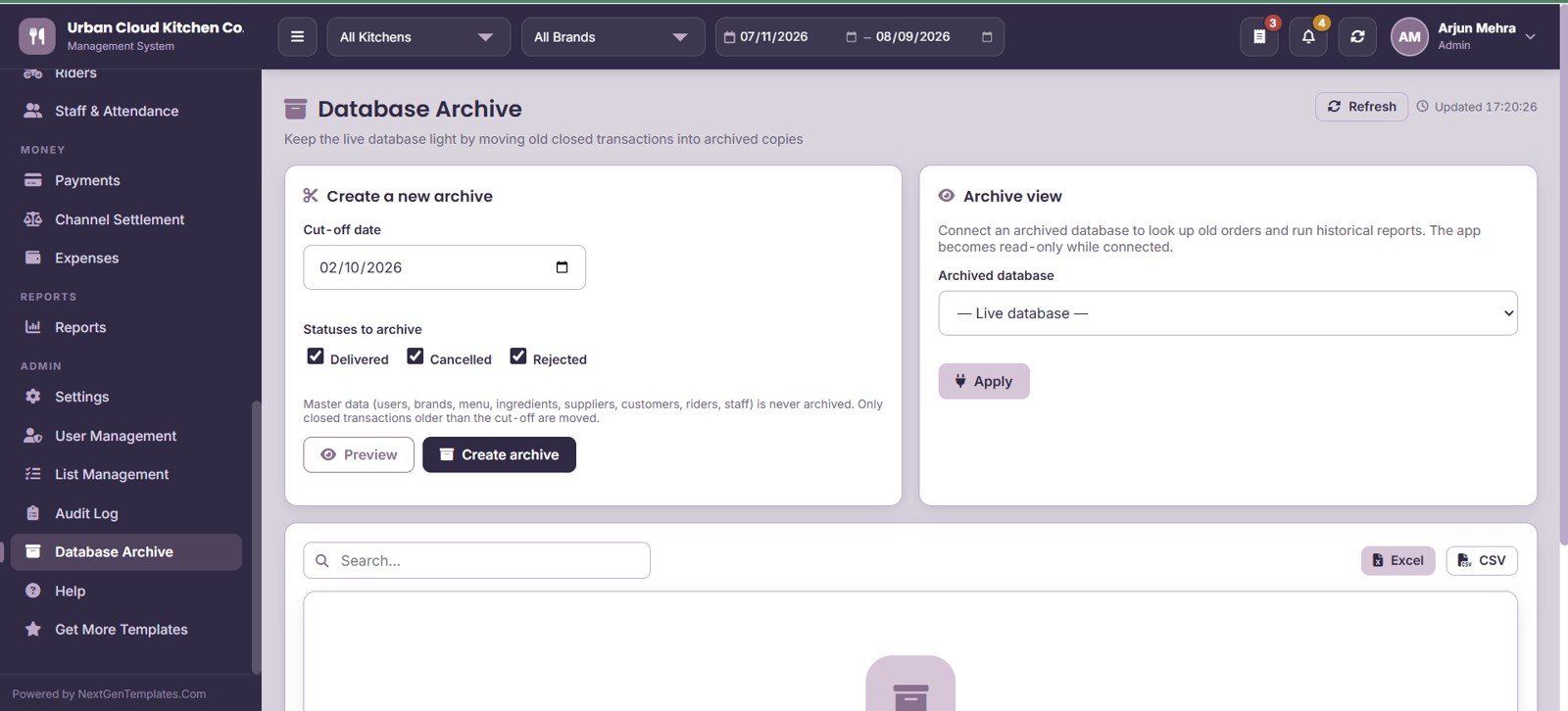
28. Database Archive
Keeps the live database light by moving old Delivered, Cancelled and Rejected transactions into archived copies by cut-off date. Preview before archiving, then toggle between Archived and Live database views any time.
Database Archive
📊 Cloud Kitchen Management System Web App vs. Excel VBA System vs. Paid Cloud Kitchen SaaS – Where This Fits
| Feature | Cloud Kitchen Management System Web App | Excel VBA Management System | Petpooja / Posist / UrbanPiper |
|---|---|---|---|
| Cost | $39.99 one-time ✅ | $30-60 one-time | $30-120 per outlet / month |
| Platform | Browser, any device ✅ | Windows desktop only | Browser and mobile app |
| Setup time | Under 15 minutes ✅ | 10 minutes | 3-10 days onboarding |
| Real-time team collaboration | Yes, unlimited multi-user login ✅ | No, single-file | Yes ✅ |
| Mobile access | Responsive browser access ✅ | No | Native app ✅ |
| Kitchen Display System | Built in, four lanes ✅ | Not available | Usually a paid add-on |
| Recipe-linked inventory | Included ✅ | Limited | Higher tier only |
| Channel settlement reconciliation | Included ✅ | Not available | Higher tier only |
| Data ownership | Your own Google Sheet ✅ | Your own file ✅ | Vendor-hosted |
| Year-1 cost at 5 users | $39.99 total ✅ | $30-60 total | $1,800-7,200 |
For cloud kitchen operators who want aggregator reconciliation and recipe costing without a per-outlet monthly bill, the Cloud Kitchen Management System Web App sits in the sweet spot.
👥 Who This Template Is For – and Who It’s Not For
✅ This template is built for:
- Cloud kitchen and virtual restaurant operators running 2-6 brands out of 1-3 production kitchens
- Delivery-only food businesses selling through Swiggy, Zomato, Uber Eats and their own website
- Central kitchen and commissary operations supplying satellite outlets
- Owner-operators who want brand-wise profitability without a per-outlet SaaS subscription
- Consultants building a working operations prototype for a food-service client
❌ This template is NOT for:
- Operators who need live API order sync from Swiggy or Zomato – orders are entered or imported here, not pulled automatically
- Dine-in restaurants needing table management and split billing – the Restaurant POS Web App fits better
- Chains of 20+ outlets requiring SOC 2, SSO and a support SLA
- Teams that need offline operation – this is a browser-based Apps Script application
⚙ How to Use the Cloud Kitchen Management System Web App
- Download the ZIP and open the included Code.gs, Index.html and deployment guide.
- Deploy the web app from your own Google account and sign in with the supplied admin credentials.
- Update Settings – business name, address, default tax %, tax mode, packing charge and rounding rule.
- Add your Brands, Kitchens and Channels first, with commission % and payment cycle per channel.
- Build the menu, modifiers, ingredients and recipes so food cost calculates correctly.
- Create users and roles, then run daily service from Orders and the Kitchen Display board.
- Review Reports, Channel Settlement and Wastage at the end of each day and each payout cycle.
💼 Real-World Use Cases
Rohit runs three virtual brands from one 600 sq ft kitchen in Pune. Wok & Roll, Curry Cottage and Slice Society share the same fryers and ingredient store. The Brand-wise Profitability report showed Slice Society carrying a 41% food cost against Curry Cottage’s 28%, and he repriced two pizzas on Zomato the same week.
Anjali manages a central kitchen supplying two satellite units in Bengaluru. She runs Physical Count every Sunday and compares it against Consumption vs Theoretical, which traced a 6 kg weekly paneer gap to over-portioning on one shift – visible only because the recipe module supplied a theoretical benchmark.
Faisal operates a delivery-only kitchen with four aggregator accounts. Every fortnight he opens Channel Settlement, hits Recalculate Expected and reconciles what each platform actually paid, catching a roughly 4% short payment on one channel that would otherwise have slipped through.
❓ Frequently Asked Questions
What does the Cloud Kitchen Management System Web App actually do?
The Cloud Kitchen Management System Web App runs order intake, a live kitchen display, menu and recipe costing, ingredient inventory, purchase and GRN, customers, riders, staff attendance, payments, channel settlement and 19 reports across 28 screens from one Google Apps Script application.
Can it handle multiple virtual brands in one kitchen?
Yes. The Cloud Kitchen Management System Web App tags every order with a Brand, Kitchen and Channel, so unlimited virtual brands can share one production kitchen while sales, food cost and profitability report separately for each brand.
Does it connect directly to Swiggy or Zomato?
No. The Cloud Kitchen Management System Web App does not pull orders through an aggregator API. Orders are entered manually or imported, while commission, payment cycle and settlement reconciliation run automatically once the order exists in the system.
How long does setup take?
Most operators have the Cloud Kitchen Management System Web App live in under 15 minutes – copy the file, deploy it as a web app from your own Google account, sign in, then enter your brands, kitchens and channels.
How does this compare to Petpooja or Posist?
Paid cloud kitchen platforms charge roughly $30-120 per outlet per month and host your data on their servers. The Cloud Kitchen Management System Web App is a one-time $39.99 purchase, keeps everything in your own Google Sheet, and includes KDS, recipe costing and settlement without tier upgrades.
Is the source code editable?
Yes. The Cloud Kitchen Management System Web App ships as editable Google Apps Script source, so you or your developer can add modules, rename fields or adjust reports. There is no obfuscation and no license server.
How many users can log in?
There is no user limit and no per-user fee. The Cloud Kitchen Management System Web App supports unlimited accounts under Admin and User roles, with failed-login tracking and a full audit trail of every change.
👤 About the Author
Built by PK – Microsoft Certified Professional with 15+ years of Excel, Google Sheets and Power BI experience. Founder of NextGenTemplates, reaching 300K+ subscribers across YouTube channels (@PK-AnExcelExpert, @NextGenTemplates, @NeoTechNavigators). Every template is hand-built and tested before release.
🔗 Explore Related Templates
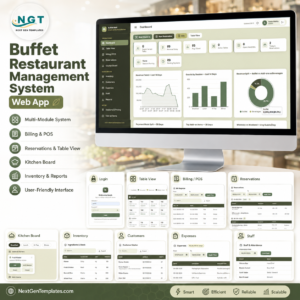
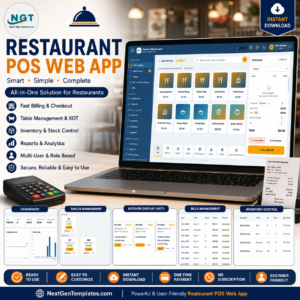
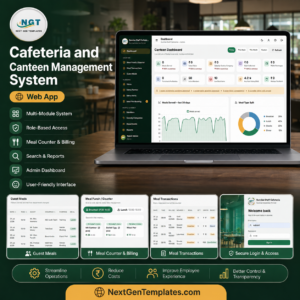
For dine-in and counter service, see the Restaurant POS Web App and the Buffet Restaurant Management System Web App. For event-driven food operations, compare the Catering Business Management System Web App, and for institutional food service the Cafeteria and Canteen Management System Web App. Lighter companions include the Inventory Tracker in Google Sheets and the Online Order Tracker Data Entry System in Excel.
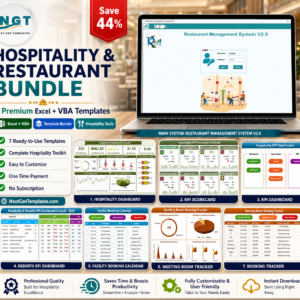
💎 Save 44% – get seven hospitality and restaurant templates together in the Hospitality & Restaurant Bundle.
📖 Click here to read the Detailed Blog Post
🎥 Visit our YouTube channel for step-by-step video tutorials
👉 YouTube.com/@NextGenTemplates
Watch the step-by-step video Demo:
📅 Last updated: August 2026





Reviews
There are no reviews yet.