

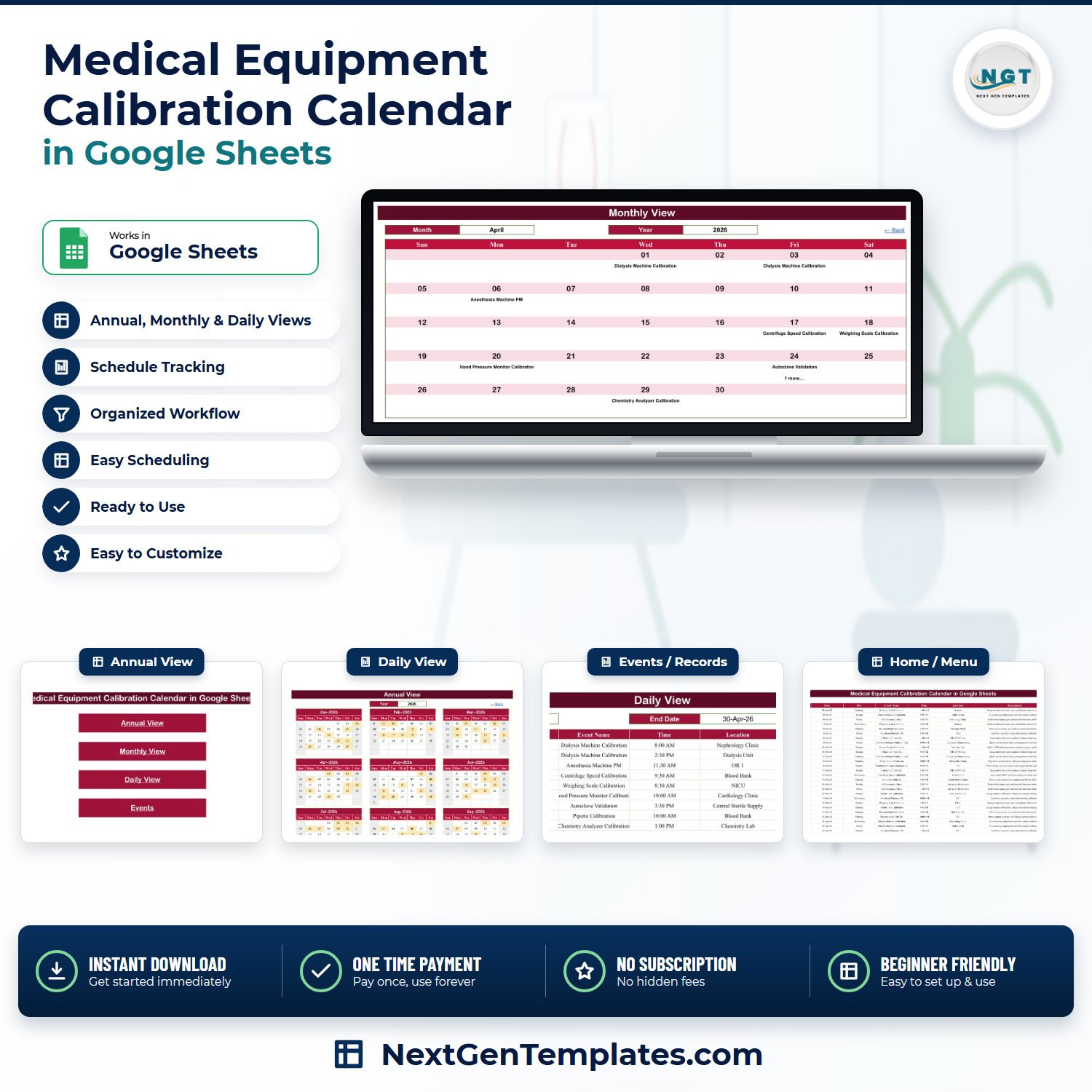
The Medical Equipment Calibration Calendar in Google Sheets is a ready-to-copy scheduling workbook with six tabs, three linked calendar views and 100 sample entries loaded across 2026, covering 19 calibration, verification and preventive-maintenance task labels in 34 named wards, theatres, labs and clinics. Buy it once at $4.99, open the PDF in your download, click the copy link, and the calendar lands in your own Google Drive in about two minutes. No subscription and no per-user licence. Built and tested by NextGenTemplates, reaching 300K+ subscribers across our YouTube channels. If the file does not open or copy correctly, contact us for a replacement or a refund.
Please read this before you buy. This is a spreadsheet that holds dates, times, task names and room labels. It is not a calibration-management system, not a CMMS, not a quality system of record, not a medical device, and not a metrology or asset-management tool. It records no measurement, no result and no certificate, it does not calculate when anything is next due, and it carries no FDA, ISO 13485, ISO 17025, IEC 62353, IEC 60601, Joint Commission, CQC, NABH, MHRA, CE or any other regulatory, metrology or accreditation claim. Calibration certificates, traceability, device fitness-for-use and patient safety remain entirely your responsibility.
Key Features of Medical Equipment Calibration Calendar in Google Sheets
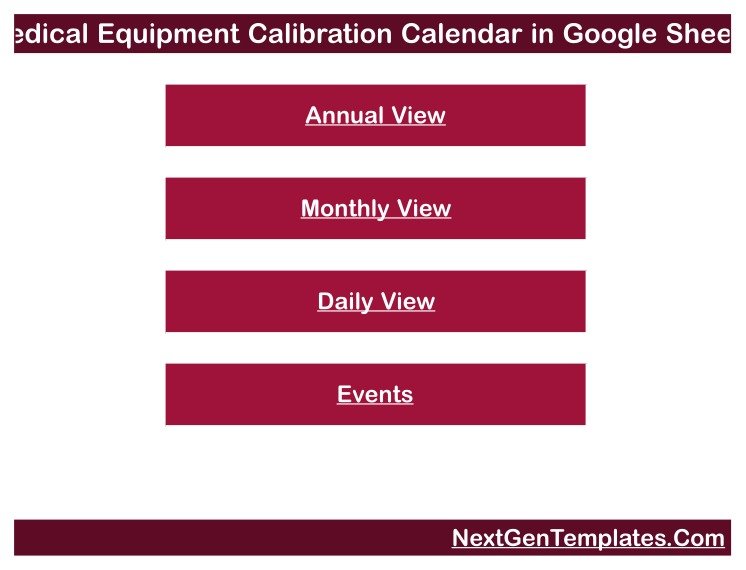
- Six tabs, five visible – Home, Annual View, Monthly View, Daily View and Events, plus one hidden List tab that feeds the Month and Year dropdowns.
- Four navigation buttons on Home jump straight to each view, and every view carries a “Back” link home.
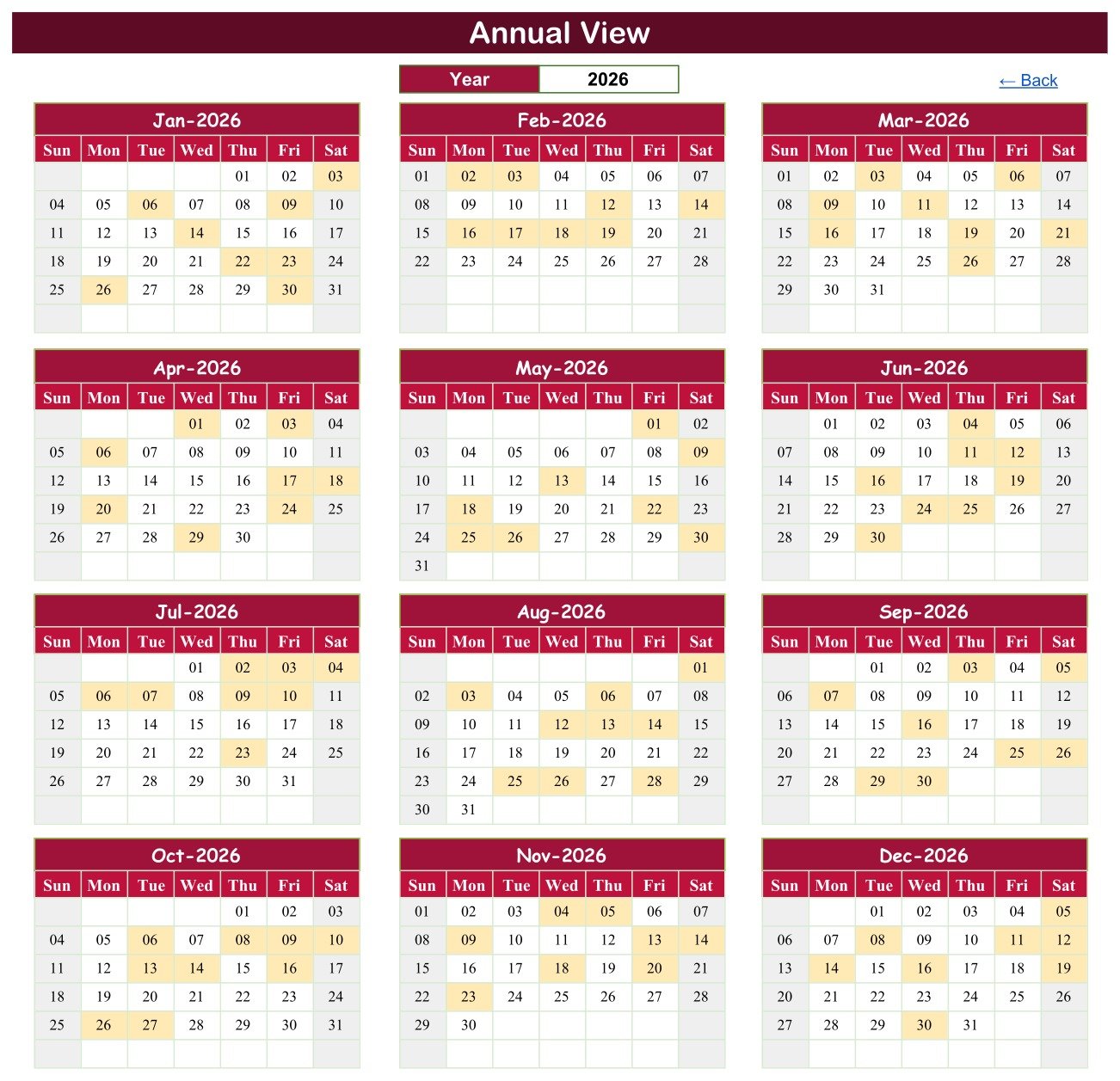
- Annual View driven by one cell – type a year into the Year box and all twelve month grids rebuild, three across and four down, with every scheduled day shaded. In the sample data, January 2026 shades the 3rd, 6th, 9th, 14th, 22nd, 23rd, 26th and 30th.
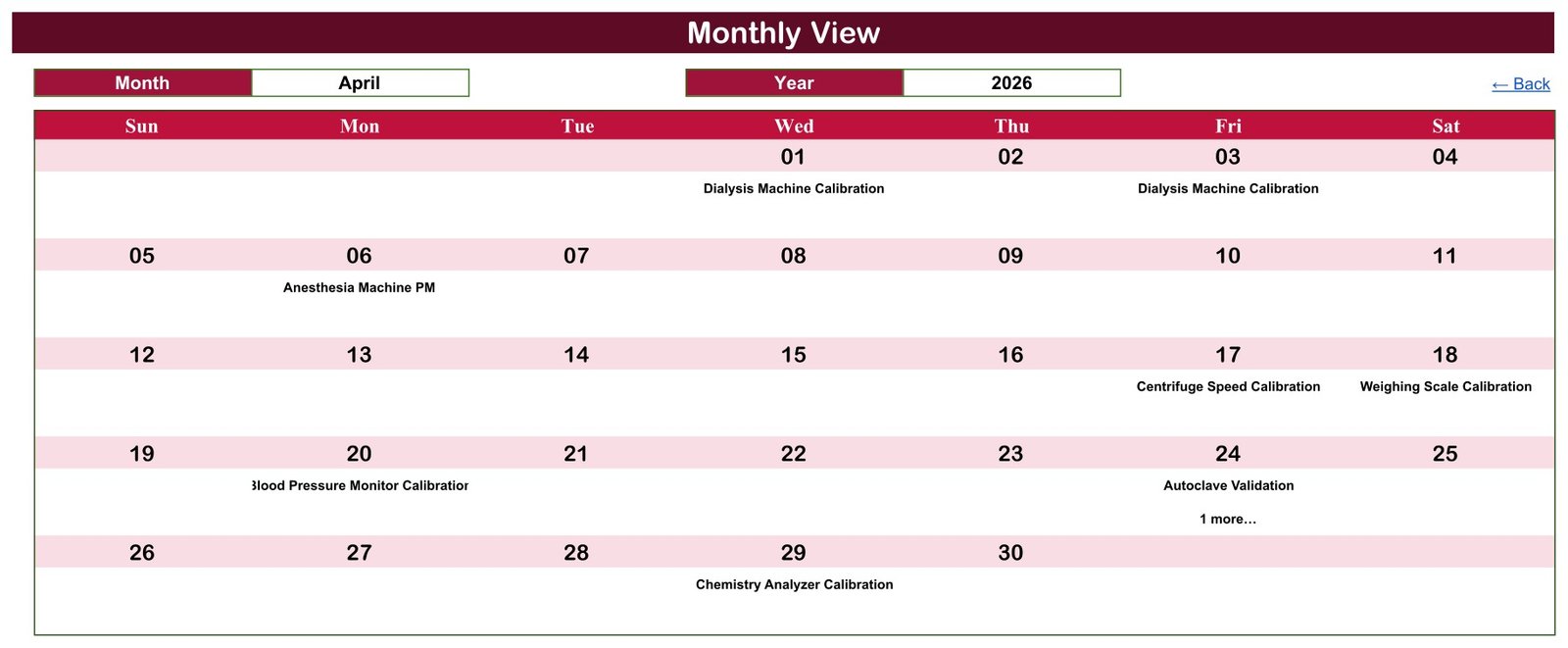
- Monthly View with Month and Year dropdowns – pick April and 2026 and the Sun-to-Sat grid fills with that month’s tasks by date: Dialysis Machine Calibration on the 1st and the 3rd, Anesthesia Machine PM on the 6th, Centrifuge Speed Calibration on the 17th, Weighing Scale Calibration on the 18th, Blood Pressure Monitor Calibration on the 20th, Autoclave Validation on the 24th and Chemistry Analyzer Calibration on the 29th.
- A “more” counter on busy days – the month grid prints the first task on a date, and a
COUNTIFunderneath adds a “1 more…” note when that date carries another one, so a stacked day never looks empty. In the sample year that happens twice: 24-Apr-2026 and 25-Jun-2026. - Daily View date range – set a Start Date and an End Date and a
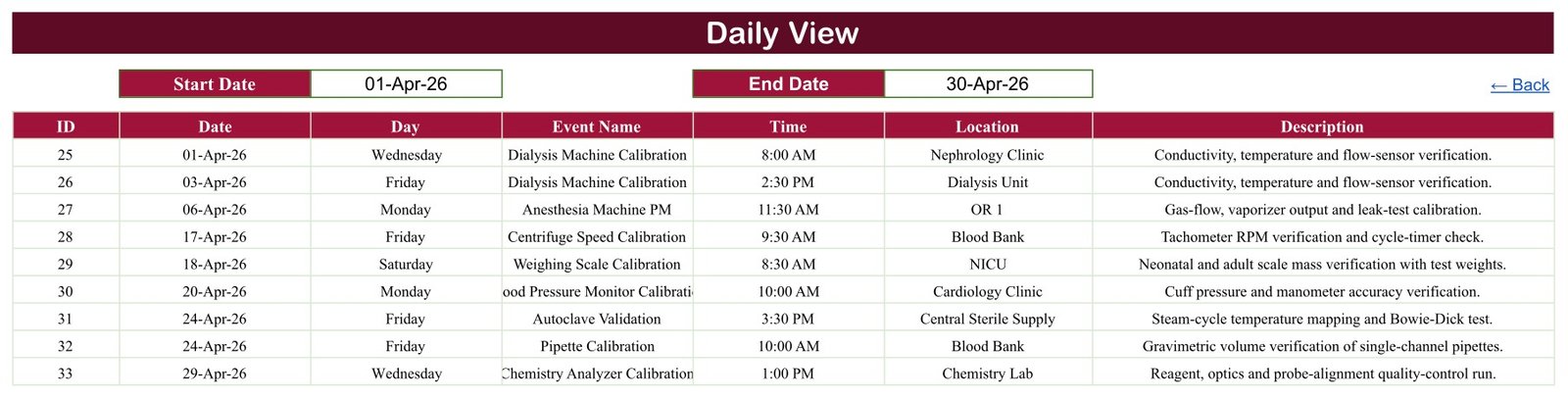
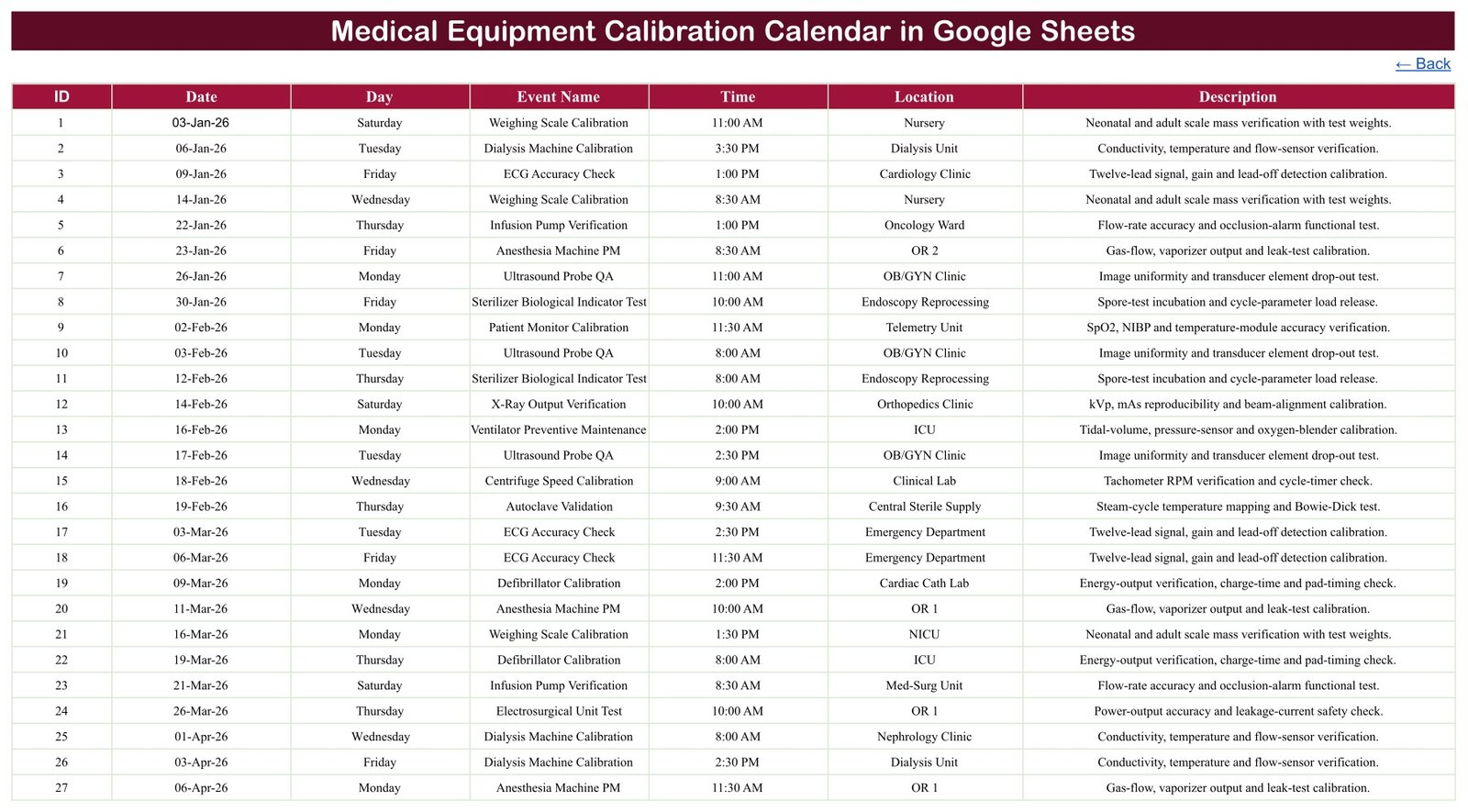
FILTERformula returns every task between them across all seven columns, in date order. Set it to 01-Apr-26 and 30-Apr-26 and you get April’s nine jobs on one screen. - 100 sample entries on the Events tab, numbered 1 to 100 and dated 03-Jan-2026 to 30-Dec-2026, eight or nine a month for all twelve months – and room for roughly 896 more rows before you touch a formula.
- Seven columns and nothing else – ID, Date, Day, Event Name, Time, Location and Description. There is no patient name, patient ID, hospital number, date of birth, diagnosis, clinical value or notes column anywhere in the workbook. That omission is deliberate; see the section below.
- 19 sample task labels covering the rhythm of a biomedical engineering department: Anesthesia Machine PM, Pipette Calibration, Weighing Scale Calibration, ECG Accuracy Check, Ultrasound Probe QA, Chemistry Analyzer Calibration, Autoclave Validation, Blood Pressure Monitor Calibration, Vaccine Fridge Logger Check, Dialysis Machine Calibration, Infusion Pump Verification, X-Ray Output Verification, Electrosurgical Unit Test, Sterilizer Biological Indicator Test, Centrifuge Speed Calibration, Patient Monitor Calibration, Ventilator Preventive Maintenance, Defibrillator Calibration and Infant Incubator Inspection.
- 34 named locations – OR 1, OR 2, OR 3, PACU, ICU, NICU, Nursery, Dialysis Unit, Emergency Department, Cardiac Cath Lab, Telemetry Unit, Med-Surg Unit, Oncology Ward, Pediatrics Ward, Labor & Delivery, Central Sterile Supply, Endoscopy Reprocessing, Endoscopy Suite, Blood Bank, Clinical Lab, Chemistry Lab, Microbiology Lab, Pathology Lab, Radiology, Vascular Lab, Vaccine Cold Room, Pharmacy, Respiratory Therapy, Anesthesia Workroom and the cardiology, nephrology, orthopedics, OB/GYN and outpatient clinics.
- 14 working start times from 8:00 AM to 3:30 PM on the half hour, so the sample year reads like a real weekday workload rather than filler.
- Weekday column that matches the calendar – all 100 sample rows carry the correct day name for their date, so the Daily View print-out reads properly straight out of the box.
- Native formulas only –
FILTER,VLOOKUP,COUNTIF,DATEandTEXT. No Apps Script, no macros, no add-on and no permissions prompt. - A hidden List tab with a 36-year range – the Year dropdown runs 2021 to 2056, so the workbook does not date itself out.
It Schedules Machines, Not People
Open the Events tab and count the columns. There are seven: ID, Date, Day, Event Name, Time, Location and Description. There is no patient name, no patient ID, no hospital or NHS number, no date of birth, no contact detail, no diagnosis and no clinical value – not hidden, not optional, simply absent. Across all 100 sample rows the word “patient” appears only inside the name of a device, Patient Monitor Calibration, because a patient monitor is a bedside vital-signs machine; “Nursery” and “NICU” are rooms. Nobody’s identity is anywhere in this file.
For a calibration diary that is not a gap – it is the point. The thing being scheduled is an instrument in a room: the autoclave in Central Sterile Supply, the scales in the Nursery, the pipettes in Microbiology. A biomedical department’s planner has no business holding clinical identities, and a shared Google Sheet is emphatically the wrong place to keep them. A Google Sheet has no access control worth the name once the link is shared, no encryption you control, no audit trail and no retention policy. So schedule the work here, and keep patient records where your organisation has decided they belong.
There is also no staff name, technician, engineer or vendor column, and no signature field. If you need to record who did a job and who signed it off, that belongs in your quality system, not in this planner.
What It Does Not Do – Read This Twice
A calibration calendar that does not manage calibration surprises people, so here is the list in plain words.
- It does not calculate the next due date. There is no interval field, no frequency field and no formula that reads “last done plus twelve months”. Every date on the Events tab is a date you typed. If you delete the 2026 samples and enter nothing, the calendar is empty. This is the single most important thing to understand before buying.
- It does not record a result. There is no pass/fail, no as-found or as-left reading, no tolerance, no uncertainty, no deviation and no corrective-action field. It says a job is scheduled; it never says what happened.
- It holds no certificates and no traceability. No certificate number, no issuing lab, no standard reference, no expiry. Your certificates and your traceability chain live wherever they live now.
- It has no asset register. There is no serial number, asset tag, model, manufacturer, purchase date or location-history column. It schedules a task type in a named room. If you own four infusion pumps in the Oncology Ward, this file cannot tell them apart – you would write that into the Description cell yourself.
- It does not stop a clash. Nothing prevents two jobs being written for the same room at the same time. There is no validation, no warning and no colour change.
- It does not show every task on a stacked day in the month grid. Monthly View uses
VLOOKUP, which returns the first match, then prints “1 more…” underneath. Use the Daily View for the full picture of a busy date. - It has no duration or end-time field, so downtime and technician hours cannot be calculated from it.
- It sends nothing. No reminders, no email, no SMS, no notifications, no escalation when something is overdue – because it has no concept of overdue.
- It makes no compliance claim of any kind. Naming a standard here is not a claim to meet it: this template is not certified, validated, audited or approved under FDA regulation, ISO 13485, ISO 17025, ISO 9001, IEC 62353, IEC 60601, Joint Commission, CQC, NABH, MHRA, CE marking or any national metrology scheme. If an auditor asks for a calibration management system, this is not it.
What it is is a clear, shareable, twelve-month picture of when the work is meant to happen – which for a lot of small departments is the thing that is currently missing.
What’s Inside the Medical Equipment Calibration Calendar in Google Sheets
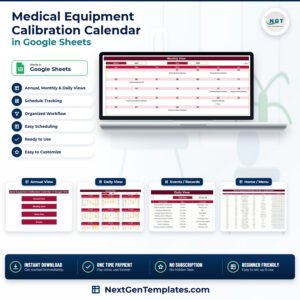
- Home – a title banner and four buttons: Annual View, Monthly View, Daily View and Events.
- Annual View – one Year cell and twelve month grids, three across and four down, every scheduled day shaded. A “Back” link returns to Home.
- Monthly View – Month and Year dropdowns, a Sun-to-Sat grid, the first task printed on each date and an “N more…” counter under any date carrying more.
- Daily View – Start Date and End Date boxes over a
FILTERthat returns every matching row with its ID, Date, Day, Event Name, Time, Location and Description. - Events – the single source table. 100 sample rows in rows 4 to 103, formulas written to row 999.
- List (hidden) – twelve month names and the 2021-2056 year range that feed the dropdowns.
- The download itself – a PDF containing a “Make a copy” link. Click it and Google creates your own private copy in your own Drive. Nothing is shared with us, and the original stays untouched.
Medical Equipment Calibration Calendar in Google Sheets vs. the Excel Edition vs. CMMS / Calibration Software – Where This Fits
| What you need | This Google Sheets calendar | The Excel edition | CMMS / calibration software |
|---|---|---|---|
| See a year, a month and a date range of scheduled calibration and PM work | Yes – three linked views off one table | Yes – plus a This Month summary page | Yes |
| Share with biomedical, nursing and lab staff and edit together, live | Yes – it is a Google Sheet, share the link | No – a file you email or put on a drive | Yes, with accounts and licences |
| Works on a phone or a tablet on the ward round | Yes – browser or the Sheets app | Desktop Excel for Windows, macros enabled | Usually yes |
| Generate the next due date from a calibration interval | No – you type every date yourself | No – you type every date yourself | Yes, that is the core of it |
| Record results, as-found/as-left readings, tolerances or certificates | No | No | Yes |
| Asset register with serial numbers and service history | No – task type and room only | No – task type and room only | Yes |
| Store patient identities or any clinical value | No – and deliberately so | No – and deliberately so | No, and it should not either |
| Flag an overdue item, warn on a clash, enforce a rule | No – it validates nothing | No – it validates nothing | Yes |
| Send reminders, texts or emails to anyone | No | No | Usually yes |
| Audit trail, access control, retention, e-signature, validation | No | No | Yes, that is the difference |
| Cost | $4.99 once | $4.99 once | Recurring, per seat or per asset |
The honest summary: if your hospital already runs a validated CMMS or calibration-management platform, this is a shared wall-planner you can put on a screen in the workshop, not a replacement for it. If your department currently runs on a paper diary, a whiteboard and a group chat, this is a large step up for the price of a coffee – and it still is not a quality system of record, so keep the certificates and the results where they belong.
Who This Template Is For – and Who It’s Not For
It is for the person who keeps the department’s diary: a biomedical or clinical engineering technician planning the year’s preventive maintenance; a small hospital or nursing-home manager with no CMMS at all; a laboratory supervisor who needs pipette, centrifuge and analyser checks visible to the whole bench; a Central Sterile Supply lead tracking autoclave validations and biological indicator tests; a dental, veterinary, diagnostic-imaging or dialysis practice owner with a handful of instruments and no software budget; a facilities coordinator who wants vaccine fridge logger checks and cold-room work on the same calendar as everything else; and a service company that wants to show a client the coming quarter’s visits on one shareable page.
It is not for anyone who needs the calendar to drive compliance. If you need next-due dates generated from intervals, results captured against tolerances, certificates stored and traceable, assets tracked by serial number, escalation when something runs overdue, an audit trail, e-signatures or a validated system that will stand up to an inspection, buy calibration-management software. This is a diary. It is very good at being a diary and it is not pretending to be anything else.
How to Use the Medical Equipment Calibration Calendar in Google Sheets
- Open the PDF in your download and click the “Make a copy” link. Google creates your own copy in your own Drive. You need a Google account; nothing is installed.
- Look around the sample year first. Set Monthly View to April 2026 and Daily View to 01-Apr-26 / 30-Apr-26 – the same nine jobs seen two ways. That is the whole mechanism.
- Clear the samples when you are ready. Select Events rows 4 to 103 and delete the contents – not the rows, and not row 3, which holds the headers. Leave the formulas on the other tabs alone.
- Enter your own schedule. Give each job an ID, a Date, the Day name, an Event Name, a Time, a Location and a one-line Description. Work out your own due dates from your own intervals and certificates; the sheet will not do that for you.
- Keep the Day column honest. It is typed text, not a formula, so if you move a date, change the day name too – or replace the column with
=TEXT(B4,"dddd")and fill it down. - Check the busy dates in Daily View. Any date showing “1 more…” in Monthly View has another job hiding behind it.
- Share it read-only with the ward and lab staff and editable with the one or two people who own the schedule. That single decision is the closest thing this file has to access control.
- Put it on a screen. Monthly View printed or cast to a workshop monitor is where most of the value shows up.
Real-World Use Cases
- A 40-bed private hospital with one biomedical technician maps the whole year’s ventilator, defibrillator, infusion pump and anaesthesia machine work in January, then shares Monthly View with the ward managers so nobody is surprised when a machine is taken away.
- A clinical laboratory puts pipette, centrifuge, analyser and weighing-scale checks on one calendar and prints the month for the bench noticeboard.
- A Central Sterile Supply department schedules autoclave validations and sterilizer biological indicator tests, and uses Daily View to hand the week’s list to the technician on shift.
- A vaccination programme tracks fridge data-logger checks and cold-room work alongside everything else, so the cold chain is not managed on a separate scrap of paper.
- A third-party service company shares a read-only link with each client showing the coming quarter’s planned visits, instead of emailing a spreadsheet nobody opens.
- An imaging department keeps X-ray output verification and ultrasound probe QA visible next to the rest of the department’s diary rather than in a vendor portal only two people can log into.
Frequently Asked Questions
Is this a calibration management system, a CMMS or a quality system of record?
No. It is a Google Sheets calendar. It shows scheduled dates in three views and stores nothing else. A calibration management system records results, certificates, intervals, asset histories and approvals under access control and an audit trail; a Google Sheet does none of that, and this one does not pretend to.
Does it work out when each device is next due?
No, and this is the question worth reading twice. There is no interval field and no due-date formula anywhere in the workbook. You decide when each job is due, from your own intervals, manufacturer guidance and certificates, and you type that date into the Events tab. The calendar then shows you what you typed, on a year view, a month view and a date-range view.
Does it store measurements, results or calibration certificates?
No. There is no pass/fail, as-found, as-left, tolerance, uncertainty, deviation or certificate-number field. The Description column is a one-line note about what the job involves – it is not a results field, and it should not be used as one.
Can I track individual machines by serial number?
Not as it stands. There are seven columns and none of them is an asset tag, serial number, model or manufacturer. It schedules a task type in a named room. You can of course add your own column – it is your copy of a spreadsheet – but nothing in the three views will use it.
Is it certified, validated, compliant or approved for regulated use?
No. It carries no FDA, ISO 13485, ISO 17025, ISO 9001, IEC 62353, IEC 60601, Joint Commission, CQC, NABH, MHRA, CE or national metrology claim of any kind. Naming those here is a statement that it does not meet them. It is also not a medical device and has no role in deciding whether a device is fit for clinical use.
Are there patient details in it?
None. The Events tab has seven columns and not one of them holds a name, patient ID, hospital number, date of birth, diagnosis or clinical value. The word “patient” appears in the file only inside the device name “Patient Monitor Calibration”. Please do not add clinical identities to a shared Google Sheet.
Will it warn me if something is overdue, or if two jobs clash?
No. It has no concept of overdue, and nothing stops you writing two jobs into the same room at the same time. There is no validation, no conditional warning and no escalation.
Why does Monthly View show only one task on some days?
Monthly View uses VLOOKUP against the Events tab, and VLOOKUP returns the first match. A COUNTIF underneath adds “1 more…” so you can see something is hidden. Open Daily View and set the range to that date to see everything on it. In the sample year this happens on 24-Apr-2026 and 25-Jun-2026.
Does it send reminders, texts or emails?
No. It sends nothing to anyone. It is a spreadsheet you look at.
What exactly is in the download?
One PDF. Inside it is a “Make a copy” link to the Google Sheet. Click it and Google puts an editable copy in your own Drive. There is no .xlsx, no .zip and no software to install.
Can I change the task names, times and locations?
Yes – all of it. The 19 task labels and 34 locations are plain typed text in the Events tab, not a fixed list. Overwrite them with your own equipment, your own rooms and your own wording.
Do I need Apps Script, macros or an add-on?
No. The workbook uses native Google Sheets formulas only – FILTER, VLOOKUP, COUNTIF, DATE and TEXT. Nothing asks for permissions and nothing runs in the background.
The sample data is 2026 – does it expire?
No. The 100 entries are demonstration data for you to overwrite. The workbook itself does not expire: the hidden List tab carries a 36-year range from 2021 to 2056, so the Year dropdown keeps working for decades.
How many entries can it hold?
The view formulas are written against Events rows 4 to 999, so roughly 996 rows in total – about 896 free once you have cleared the 100 samples. That is several years of a small department’s planned work.
About the Author
Built by PK – Microsoft Certified Professional with 15+ years of Excel, Google Sheets, and Power BI experience. Founder of NextGenTemplates, reaching 300K+ subscribers across YouTube channels. Every template is hand-built and tested before release.
Explore Related Templates
If you would rather have a desktop workbook than a browser sheet, the Medical Equipment Calibration Calendar in Excel is the same idea built as a macro-enabled Excel file, with Annual, Monthly, Daily and This Month views. Its sample data is its own, so the two editions are companions rather than copies.
For the rest of the hospital diary, the Operation Theatre Booking Calendar in Google Sheets and the Radiology Slot Booking Calendar in Google Sheets use exactly this layout for theatre lists and imaging rooms, and the Pharmacy Stock Expiry Calendar in Google Sheets covers the other thing a department has to keep an eye on by date.
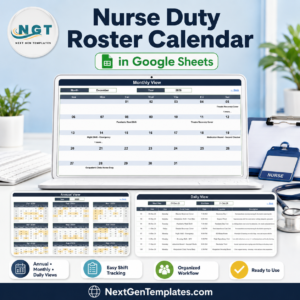
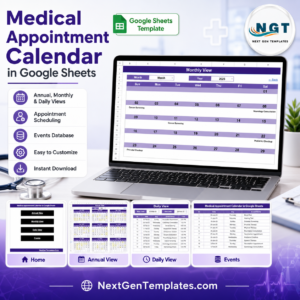
If the staffing side is your problem rather than the machines, look at the Nurse Duty Roster Calendar in Google Sheets and the Doctor On-Call Calendar in Google Sheets. For a general clinic diary there is the Medical Appointment Calendar in Google Sheets, and for treatment scheduling around the machines there is the Patient Follow-Up Visit Calendar in Google Sheets.
And when a calendar stops being enough – when you need records, roles, logins and reports rather than a shared diary – the Hospital Management System Web App is the step up.
Watch the step-by-step video Demo:
Visit youtube.com/@PKAnExcelExpert for walkthroughs of our Google Sheets calendars and trackers.











Reviews
There are no reviews yet.