

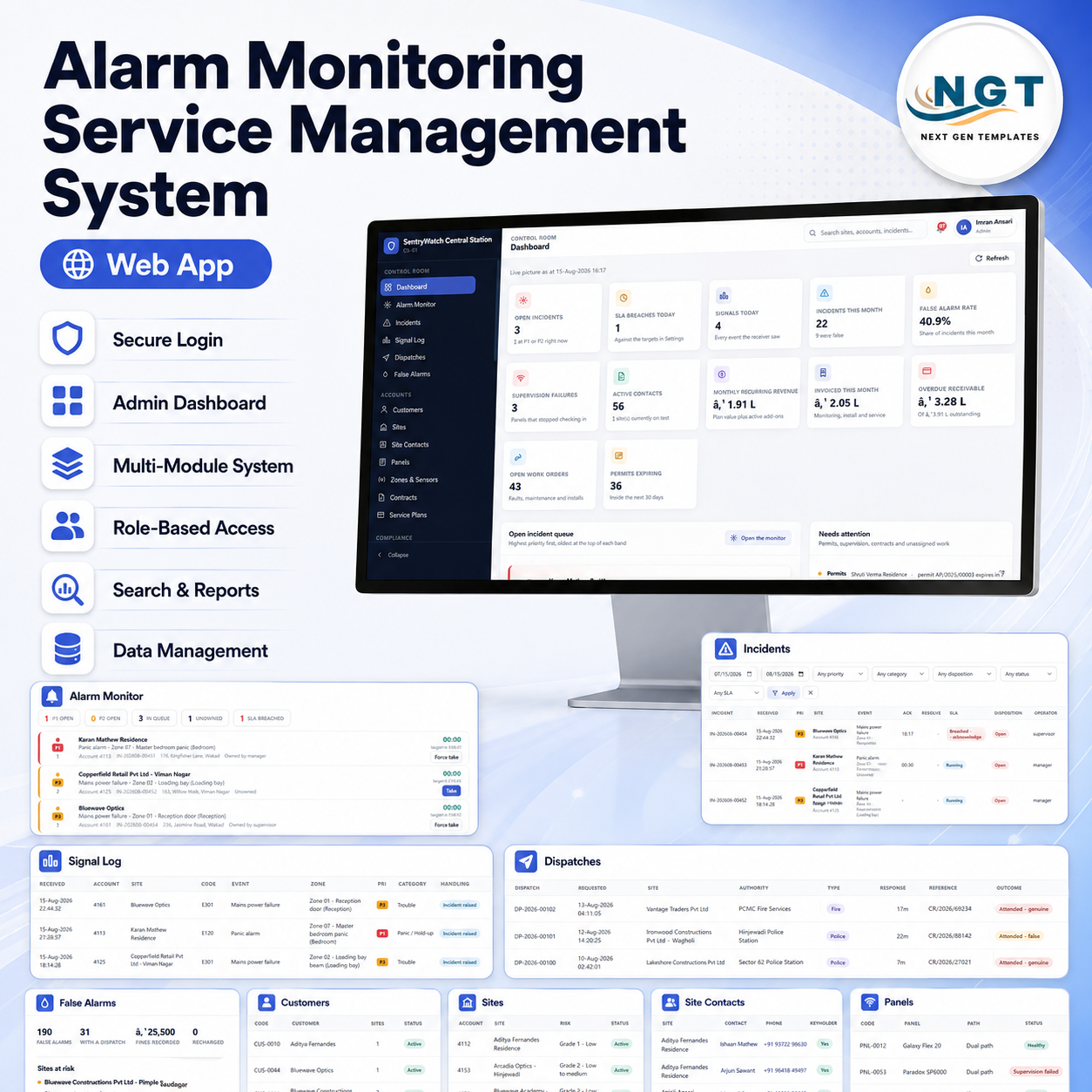
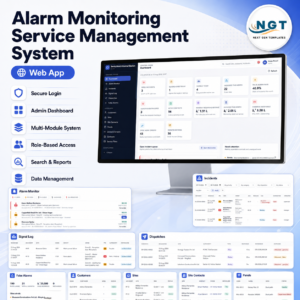
The Alarm Monitoring Service Management System Web App runs a central station and the alarm company around it from one browser tab: a live alarm monitor with an SLA countdown on every open incident, keyholder calls, authority dispatch, a false alarm register with municipal fines, monitoring contracts with recurring revenue, and a one-pass monthly billing run. It arrives seeded with a working business – 60 customers, 85 protected sites, 85 control panels, 697 zones and sensors, 85 contracts, 12 response authorities, 10 technicians and six months of signals, incidents and invoices – so nothing is a blank screen. It is a Google Apps Script app with a Google Sheets database, so it runs in your Google account with no per-seat SaaS bill. You get the full source, a 30-page user manual, and a live demo you can sign into right now before spending anything.
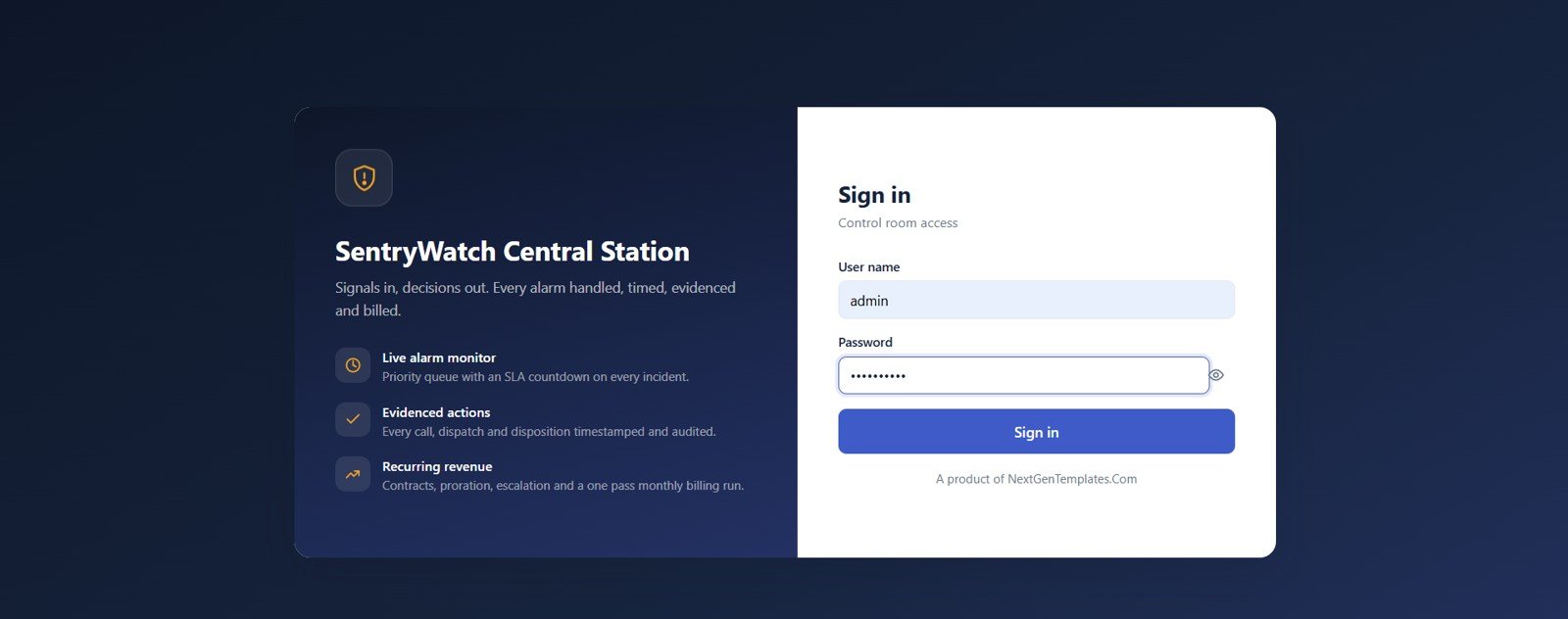
🚀 Try the Live Demo Before You Buy
We have deployed this web app in our own Google account so you can test every page, every role and every report – with real sample data – before purchasing. No signup, no email required.
🔑 Test Login Credentials
Sign in as admin to see the whole system including users, settings and the archive tool, or as operator1 to see how little a monitoring operator is allowed to touch – no invoices, no contracts, no billing. That contrast is the product. Try tech too: a technician sees only their own work orders and the panel they are working on.
💡 These credentials are public on purpose – they are the seeded logins of a shared demo instance that resets, not of anyone’s live system. Please treat the demo as a sandbox. What you get after purchase: the full source (Code.gs + Index.html) plus a step-by-step deployment guide, so you can run your own private instance in your own Google account in under 15 minutes.
Key Features of the Alarm Monitoring Service Management System Web App
- A monitor that ranks the queue for you. P1 first, oldest at the top of each band, with a live countdown against the acknowledge and resolve targets you set per priority. Press 1-9 to take the nth incident.
- Ownership is explicit. Every incident is owned by a named operator or shows as Unowned, with a Force take for supervisors.
- The full handling chain. Signal → incident → contact calls with an outcome (answered, no answer, voicemail, cancelled by passcode) → authority dispatch → close with a disposition. Each step is timestamped.
- Verbal passcodes on the contact list, in call order, with keyholder and can-cancel flags on each contact.
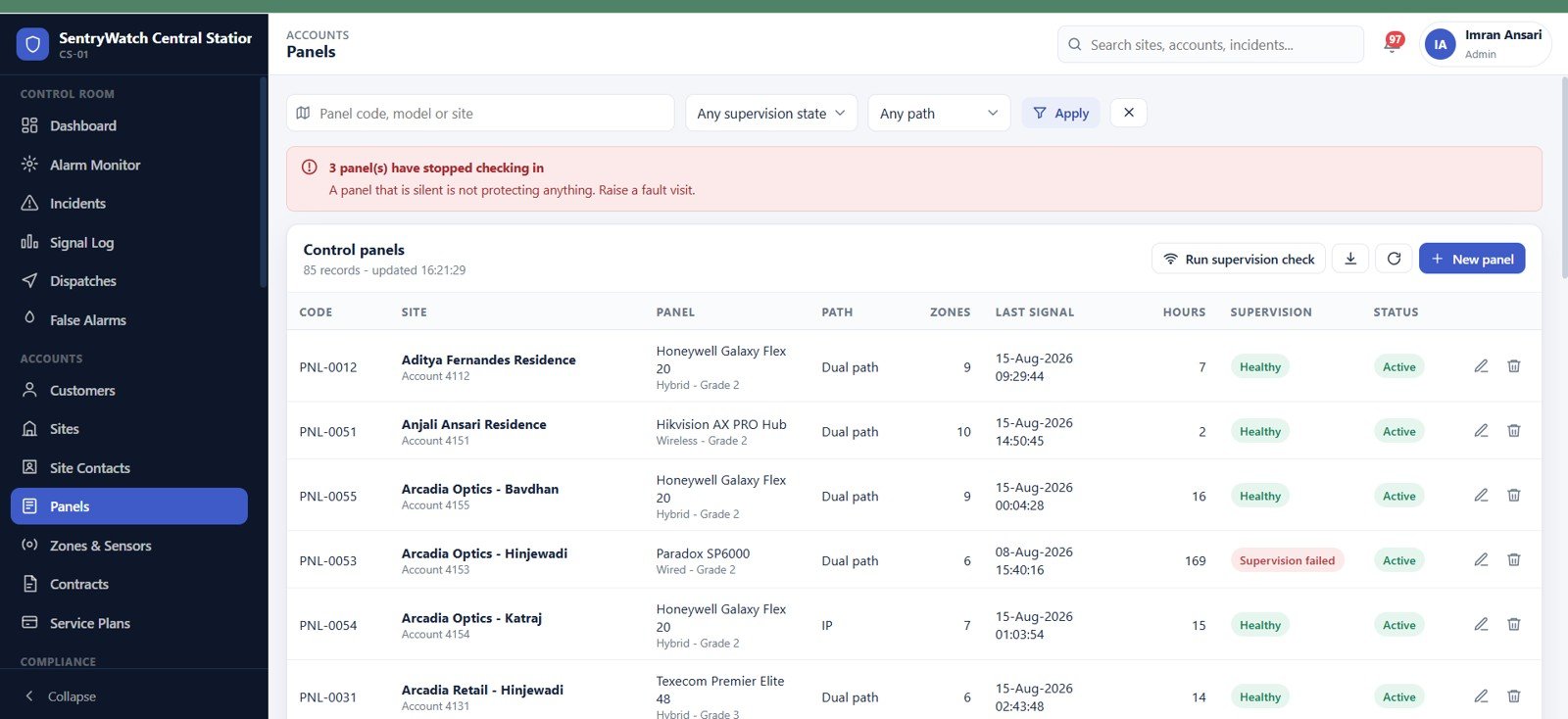
- Supervision watch. A panel that has stopped checking in is flagged with hours since last signal, and a Run supervision check button re-tests on demand.
- False alarm register that bites. A rolling window per site, a tiered fine schedule, recharge tracking, and automatic response suspension once a site passes the occurrence limit.
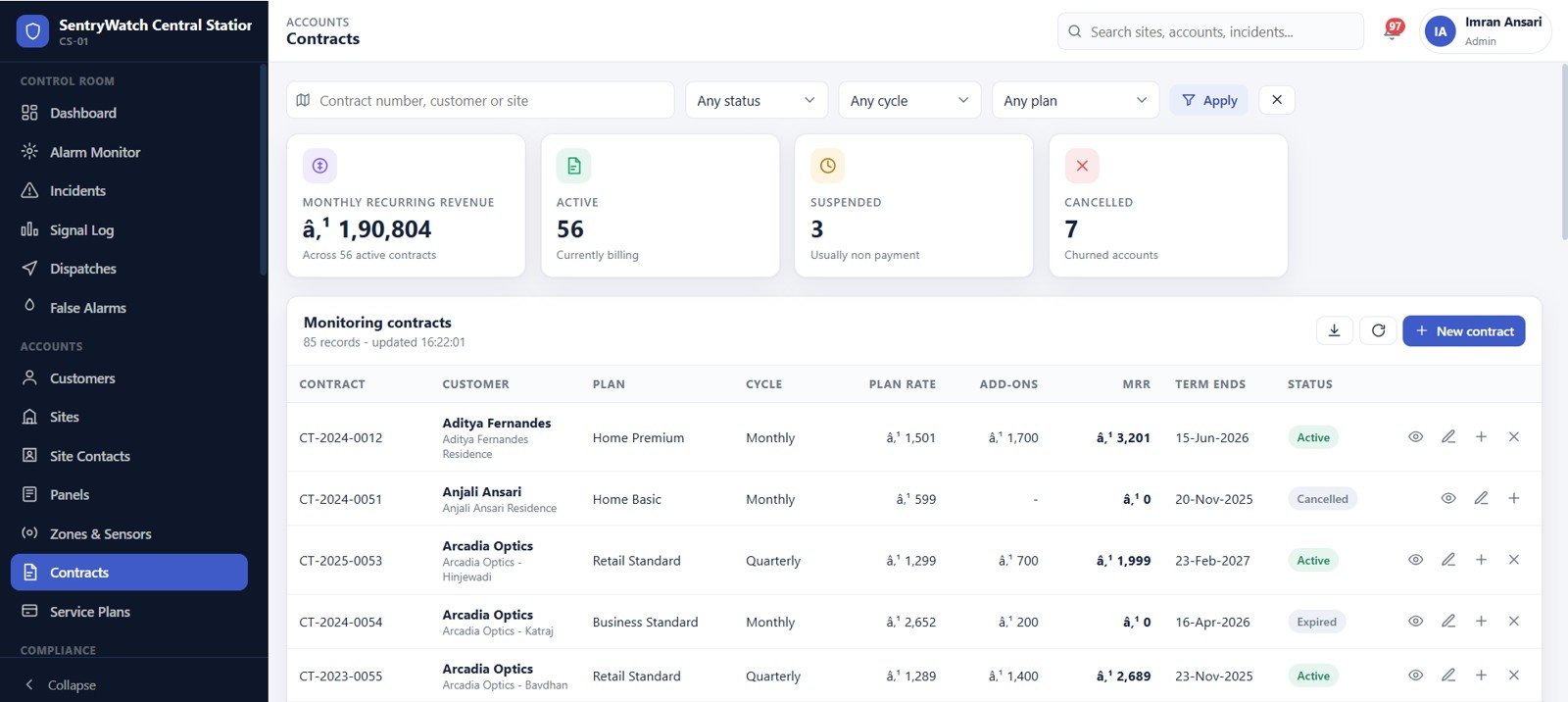
- Contracts, plans and recurring revenue. Eight-plan catalogue, monthly or quarterly cycles, add-on services, plan rate plus add-ons rolled into MRR, and term end dates.
- One-pass monthly billing. Preview the run, see prorated and escalated lines, then commit – invoice numbering, tax and terms come from Settings.
- The service business too. Work orders, installations, inspections with certificate numbers, technicians with certification expiry, and device stock with reorder points.
- Server-side permissions. The role map drives the menu and the server guard – hiding a button is treated as a convenience, and every call is re-checked before data is touched.
- Every dropdown is editable from Master Lists, and every threshold from Settings – no code edits to change how your control room behaves.
What’s Inside the Alarm Monitoring Service Management System Web App
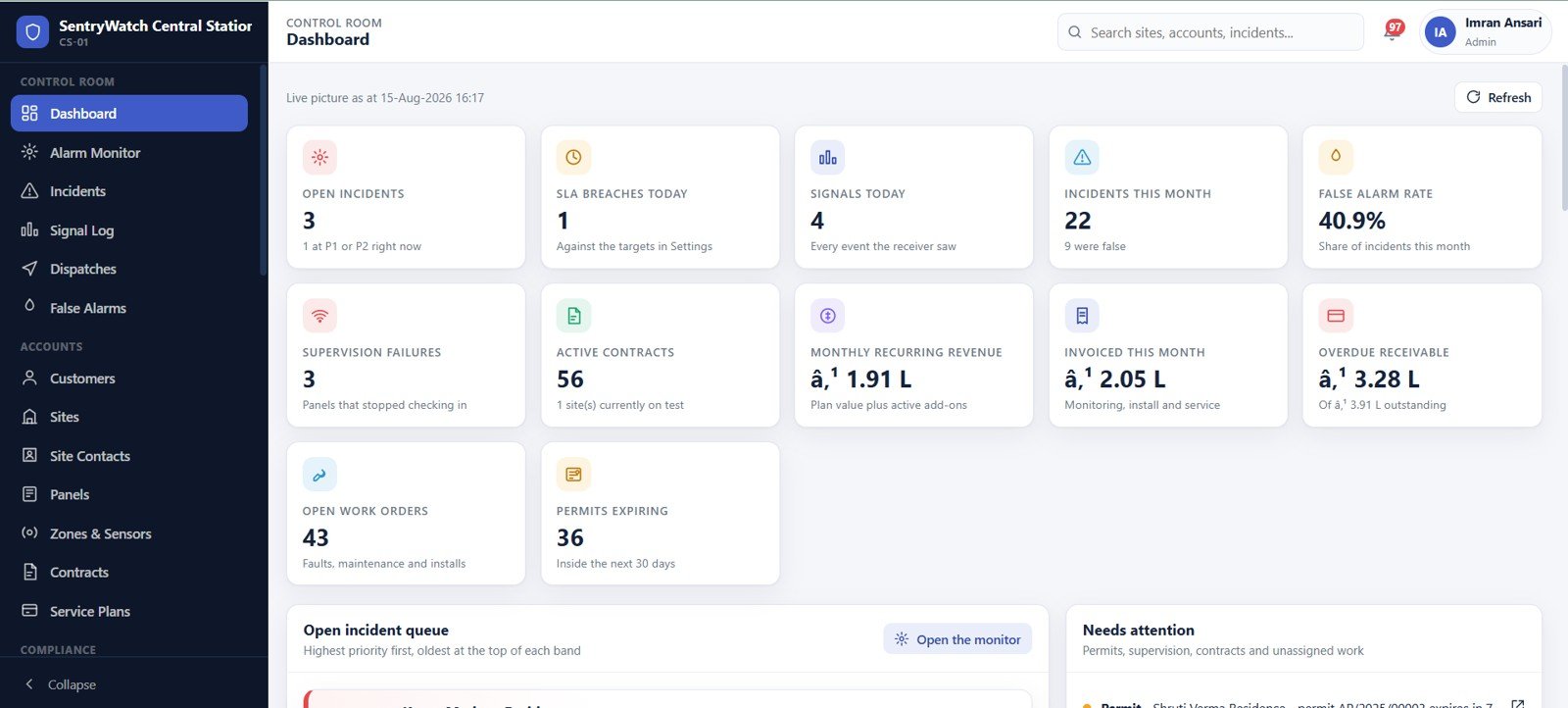
Control Room Dashboard
Twelve cards for the live picture: open incidents (and how many are P1/P2 right now), SLA breaches today, signals today, incidents this month, false alarm rate, supervision failures, active contracts, monthly recurring revenue, invoiced this month, overdue receivable, open work orders and permits expiring inside 30 days. Below them sit the open incident queue and a Needs attention list covering permits, supervision, contracts and unassigned work.
Alarm Monitor
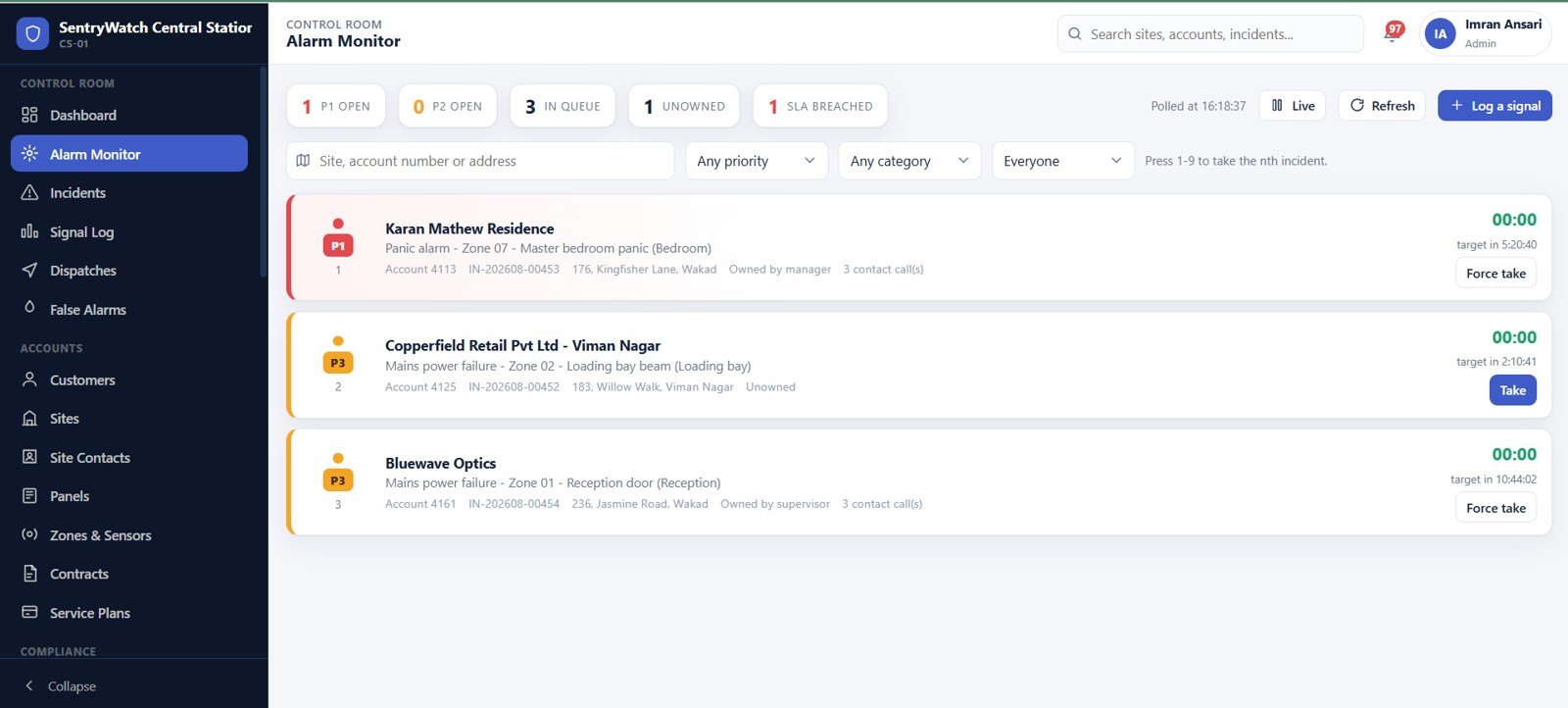
The operator’s screen. Counters across the top (P1 open, P2 open, in queue, unowned, SLA breached), filters for site, priority, category and owner, then priority-coloured cards showing the site, the event and zone, the account number, how many contact calls have been made and the time left on target.
Incidents
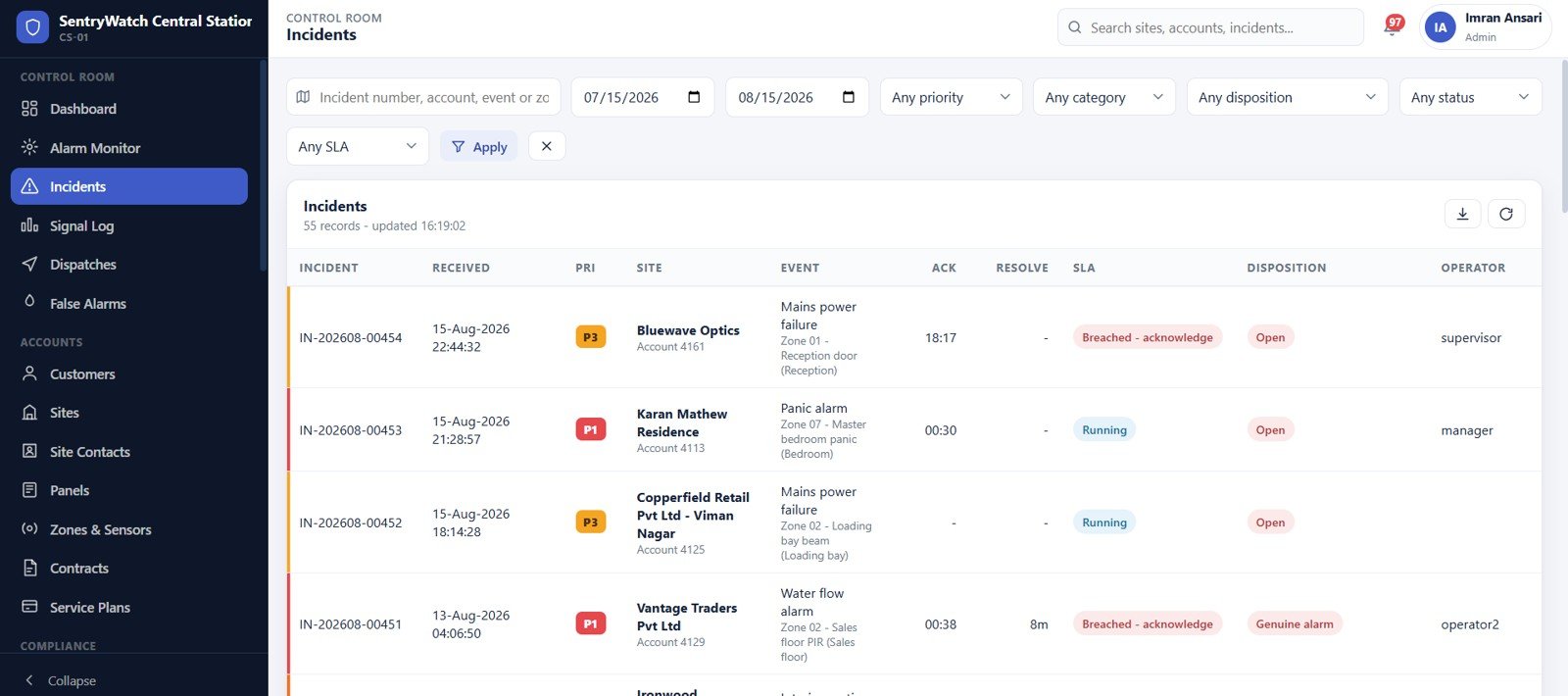
The permanent register behind the monitor – filter by date range, priority, category, disposition, status and SLA state, and read acknowledge and resolve times, the disposition (genuine alarm, false, open) and the operator who handled it. Exports to CSV.
Signal Log
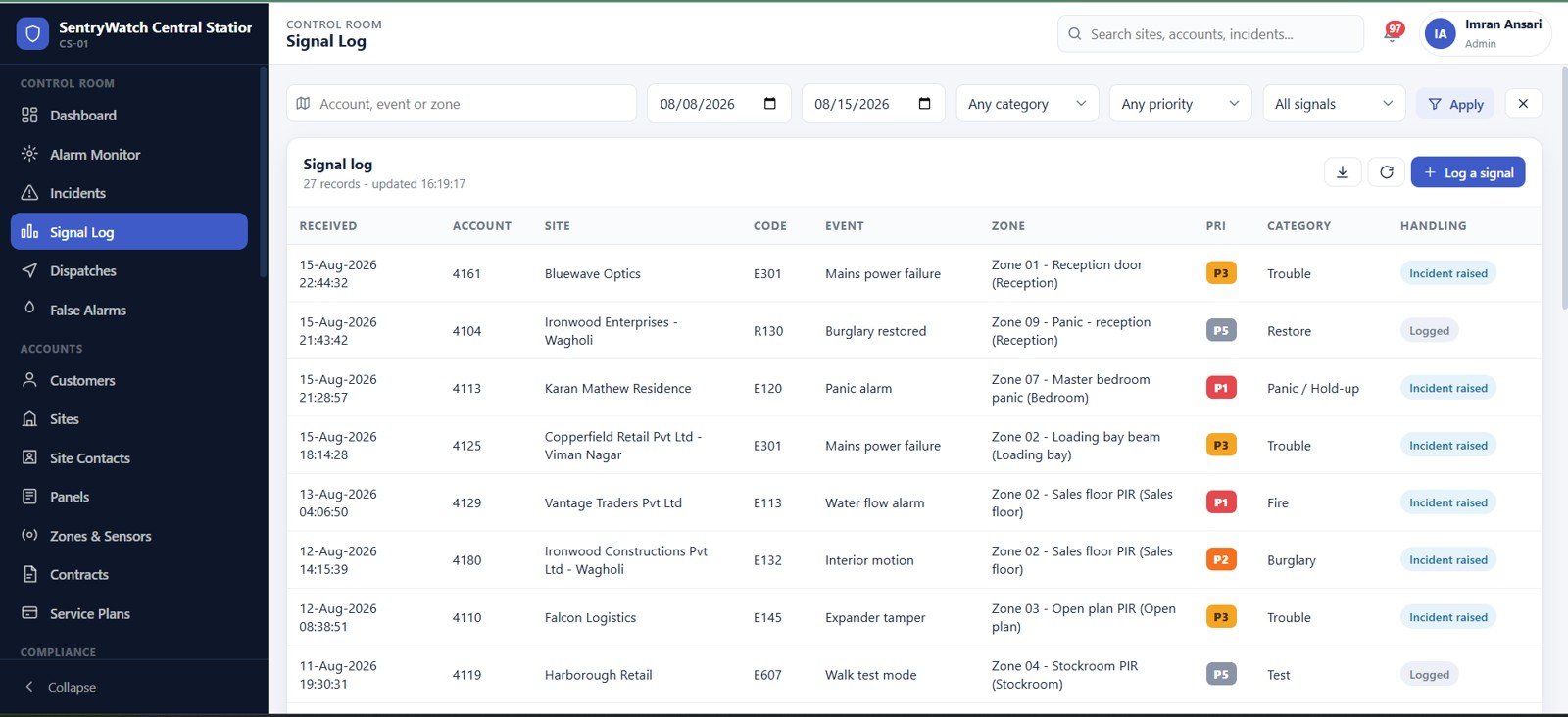
Every event the receiver saw, whether or not it became an incident: 59 Contact ID codes such as E120 Panic alarm, E301 Mains power failure and R130 Burglary restored, mapped to a zone, a category and a priority, and marked either Incident raised or Logged.
Dispatches
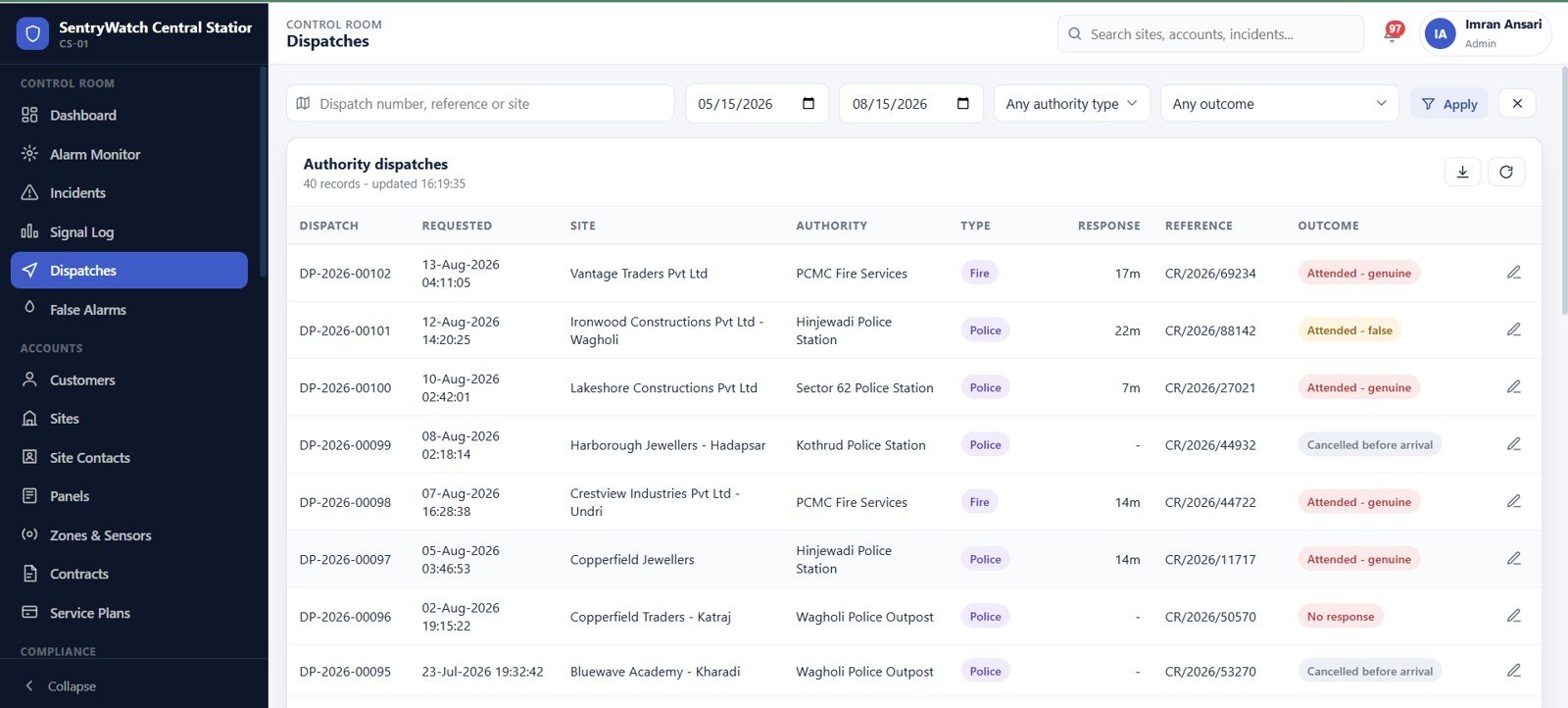
Every authority dispatch with the police, fire or medical unit sent, the response time, the authority’s own reference number, and the outcome – attended genuine, attended false, cancelled before arrival or no response. This is the page that answers a customer arguing about a call-out.
False Alarms
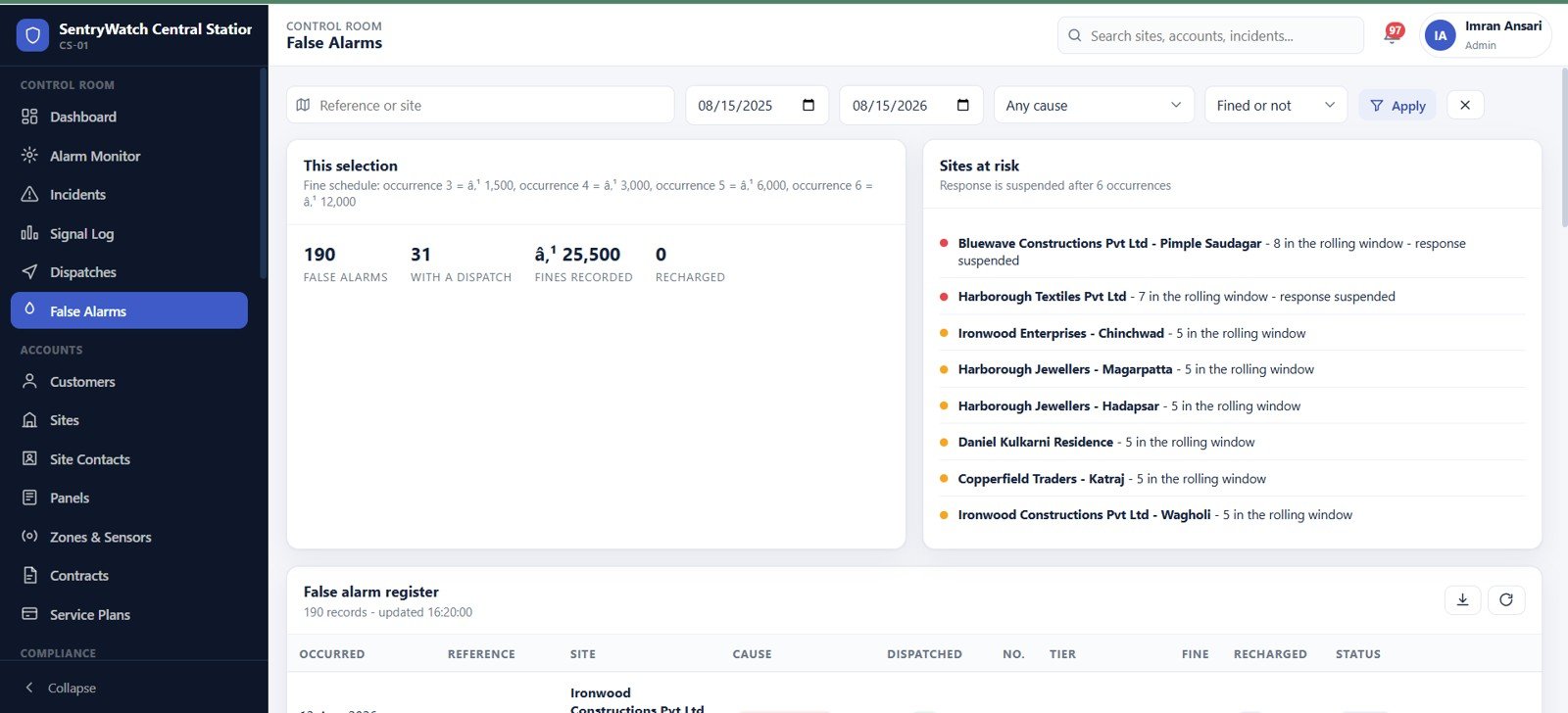
The register, the fine schedule (occurrence 3, 4, 5 and 6 each carry their own amount), how many were dispatched, how much was fined and how much was recharged – plus a Sites at risk panel that names the accounts approaching or past the suspension limit.
Sites, Panels, Zones and Contacts
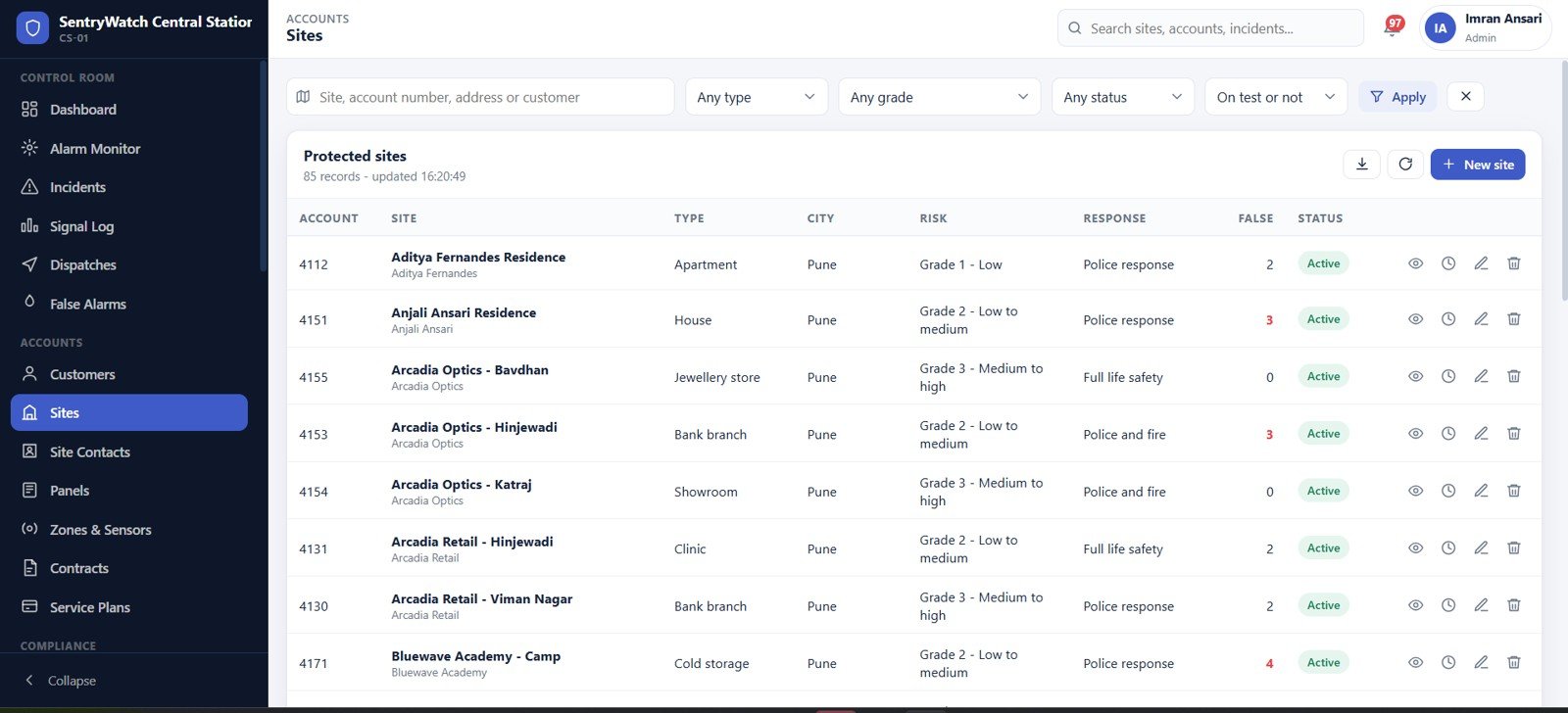
Sites carry a type, a risk grade, the agreed response (police response, police and fire, full life safety) and a false alarm count. Panels record make and model, signalling path, zone count, last signal and supervision state. Zones list device type, zone type and serial. Site Contacts hold the call order, keyholder and can-cancel flags and the verbal passcode.
Contracts and Service Plans
Contracts show plan, cycle, plan rate, add-ons, MRR, term end and status, headed by MRR, active, suspended and cancelled counts. The plan catalogue behind them sets monthly rate, setup fee, included service visits, term length and what is monitored.
Invoices, Receipts, Billing Runs and Expenses
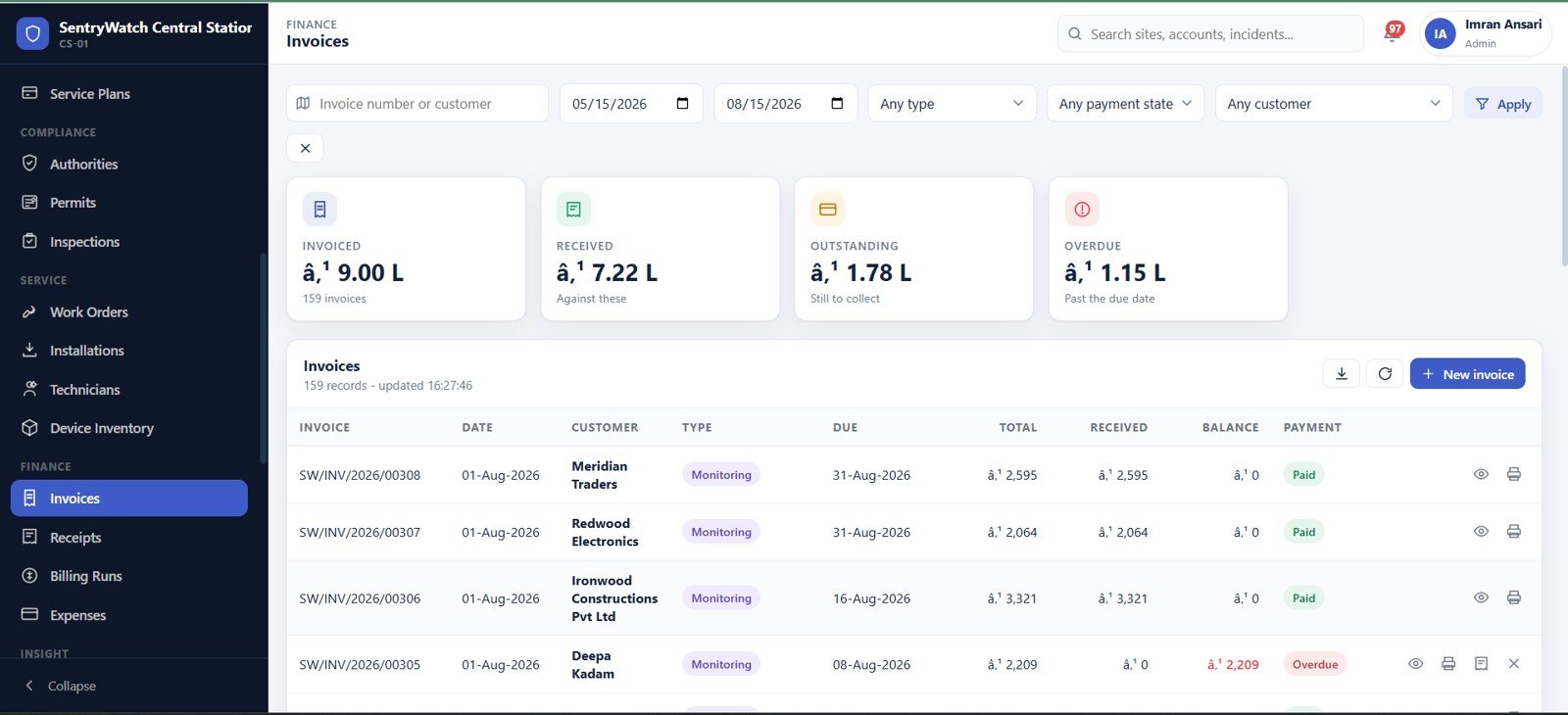
Invoiced, received, outstanding and overdue on one strip; invoices typed as monitoring, install or service; receipts matched against an invoice with a payment mode and reference; billing run history showing contracts, invoices produced, prorated and escalated counts per month; and an operating expense ledger with an approval state.
Reports
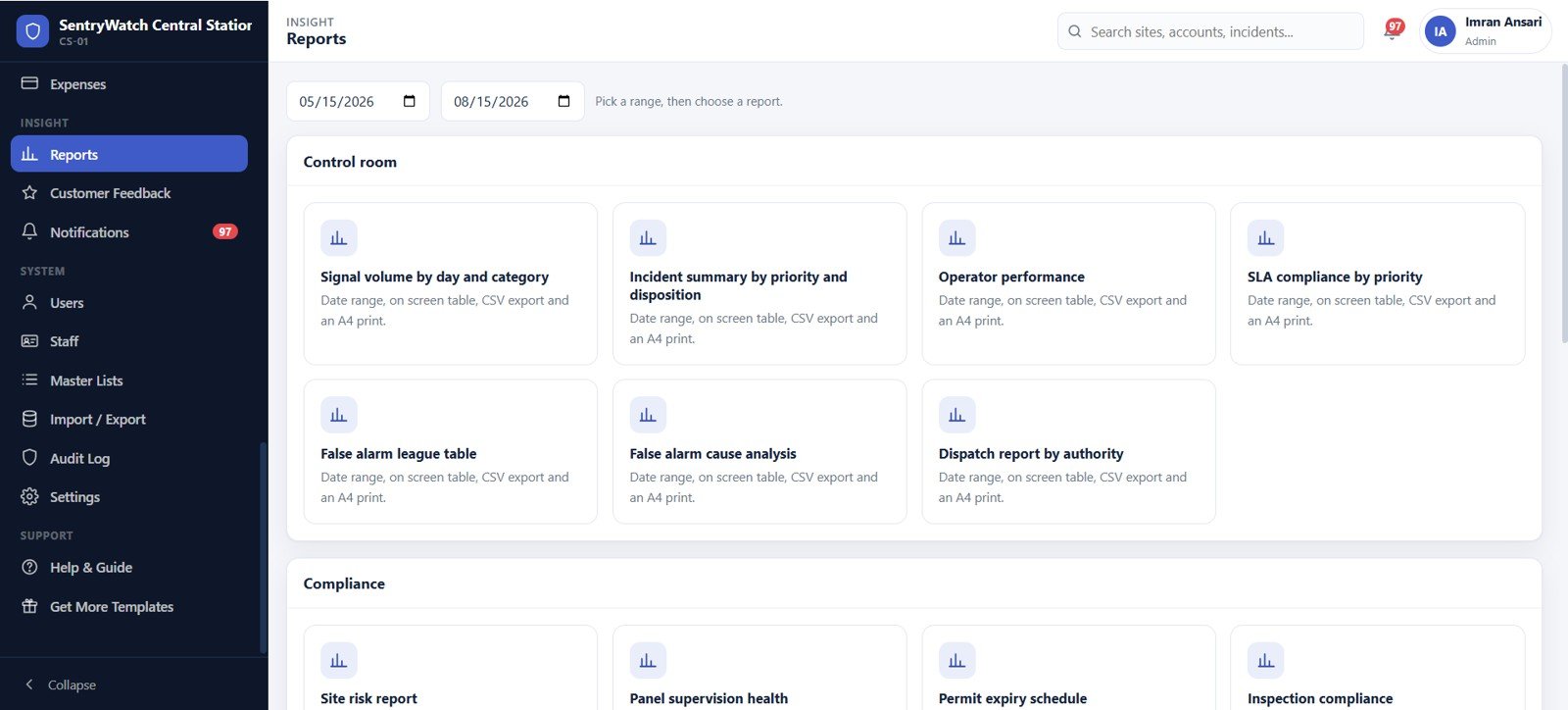
Pick a date range, then a report. Control room: signal volume by day and category, incident summary by priority and disposition, operator performance, SLA compliance by priority, false alarm league table, false alarm cause analysis, dispatch report by authority. Compliance: site risk, panel supervision health, permit expiry schedule, inspection compliance. Service and finance groups follow. Each one gives an on-screen table, a CSV export and an A4 print.
Settings, Users and Master Lists
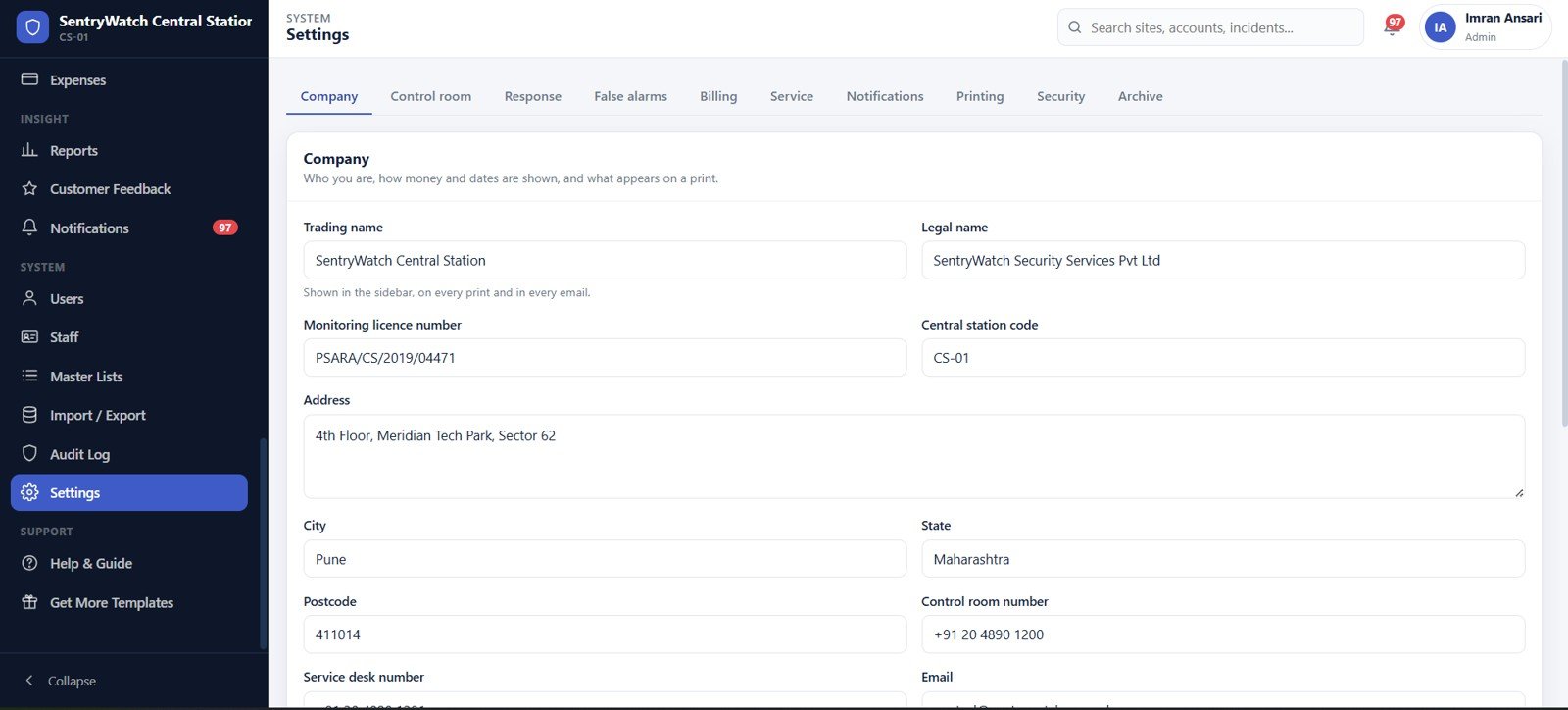
Ten settings tabs – company, control room, response, false alarms, billing, service, notifications, printing, security and archive – decide the SLA targets, how many contacts to try before dispatch, the fine schedule, the invoice prefix and tax, the labour and travel rates, session length and password rules. Users manages the accounts and roles; Master Lists holds every dropdown in the product; Audit Log records who did what.
Also included and not pictured here: Customers, Authorities, Permits (with a warning banner for active sites that have no permit where one is required), Inspections, Work Orders, Installations, Technicians, Device Inventory with stock movements, Customer Feedback, Notifications, Staff, Import / Export and a Help & Guide page.
Alarm Monitoring Service Management System Web App vs. Spreadsheets vs. Paid Central-Station Software
| This web app | Spreadsheets + WhatsApp | Paid automation software | |
|---|---|---|---|
| Cost | One payment, $39.99 | Free, plus the errors | Typically per-account or per-operator, monthly |
| Platform | Google Apps Script + Google Sheets, in your own account | Excel or Sheets files | Vendor cloud or on-premise server |
| Setup time | About 15 minutes, then one click to seed | Already there | Weeks, usually with paid onboarding |
| Live SLA countdown per incident | Yes | No | Yes |
| Role-based access re-checked server-side | Yes, seven roles | No – file access is all or nothing | Yes |
| False alarm fines and suspension logic | Yes, configurable schedule | Manual | Usually yes |
| Monthly billing run with proration | Yes, preview then commit | Manual | Yes |
| Automatic signal capture from a receiver | No – signals are logged in-app or imported | No | Yes, this is what you pay for |
| Year-1 cost, small company | $39.99 | $0 and a lot of rework | Four figures and up |
Who This Template Is For – and Who It’s Not For
A good fit: a small or mid-size alarm installation and monitoring company that already has a receiver or an app-based platform but runs the business around it on spreadsheets; a facilities or in-house security team keeping an evidenced log of alarms, calls and dispatches across several buildings; a security integrator that wants contracts, service visits and billing in the same place as the incident history; and anyone teaching or demonstrating how central-station workflow, SLAs and false alarm management actually fit together.
Not a good fit – stated plainly: this is business-management software, not a signal receiver. It does not connect to alarm receivers or communicator paths, does not ingest Contact ID automatically, and does not send anything to a PSAP. It is not UL-listed, not SIA CP-01 certified, carries no regulatory approval of any kind, and is not offered as a monitoring service or an emergency response service. Nothing here dispatches police for you – the app records that you did. If you need automated signal receipt and verified alarm transmission, buy purpose-built listed software; use this alongside it for the customers, contracts, compliance and money. Google Sheets is also a practical, not an unlimited, database – it is comfortable for a few dozen to a few hundred accounts, not for tens of thousands of signals a day.
How to Use the Alarm Monitoring Service Management System Web App
- Try the demo first. Open the live demo above, sign in as
admin, then sign out and come back asoperator1. If the role split matches how your control room works, the rest is deployment. - Deploy it. Create an Apps Script project, paste
Code.cs.txtintoCode.gsandIndex.txtinto an HTML file named exactlyIndex, then Deploy → New deployment → Web app, Execute as Me. - Press Run setup now. The first visit builds every sheet, seeds the working dataset and creates the Drive folder tree. It takes about a minute.
- Set your own rules in Settings – company details and currency, acknowledge and resolve targets per priority, how many contacts to try before dispatch, the false alarm window and fine schedule, invoice prefix and tax, labour and travel rates.
- Create your users and delete the seeded ones. Change every default password on first sign-in; the built-in admin account cannot be deleted.
- Load your accounts – customers, sites, panels, zones and contacts – by hand or through Import / Export, then attach a contract and a plan to each site.
- Install the daily triggers from the SentryWatch menu in the bound spreadsheet. That schedules the supervision check, the permit and invoice ageing sweep and the morning digest.
- Run the month. Work the monitor daily, raise work orders from faults, then on the 1st preview and commit the billing run.
Real-World Use Cases
Rakesh runs a 220-account alarm company. His operators handled alarms on a whiteboard and billed from a spreadsheet, so nobody could say how long a P1 actually took to acknowledge. Two weeks after switching, the SLA compliance report gave him a number to argue with – and the false alarm league table found four sites generating a third of his call-outs.
Meera manages security for a nine-building campus. She does not sell monitoring; she needs a defensible record. Every alarm, every call to a keyholder, every police dispatch and every disposition is timestamped and exportable, which is exactly what her insurer asks for at renewal.
Arjun is a service coordinator at an integrator. He lives in Work Orders, Installations, Inspections and Device Inventory, and cannot see a single invoice – his role simply does not include them. When a panel goes into supervision failure, the fault visit is raised against the same site record the monitoring team is looking at.
Frequently Asked Questions
Can I try it before buying?
Yes. The live demo above is a fully deployed instance with the seeded dataset. Nine logins across seven roles are published in the box – sign in as any of them. That demo is shared and resets periodically, so treat it as a sandbox, not storage.
Does it receive alarm signals from panels automatically?
No. Signals are logged in the app with the Log a signal button or brought in through Import / Export. Automatic receipt from a receiver or communicator path is not part of this product, and no claim of a listing or certification is made for it.
Do I need a Google Workspace account?
No. A normal Gmail account is enough. Apps Script, Sheets and Drive are all included, and the app runs entirely inside your account.
How many users can sign in?
As many as you create – the seeded nine are only a starting point. Accounts are managed in Users, and each is bound to one of the seven roles.
The demo shows amounts with an odd currency symbol – what is that?
An encoding slip in the shipped seed data: the currency symbol was written with mis-encoded bytes, so it renders as stray characters instead of the intended sign. The numbers themselves are correct. Fix it in five seconds in Settings → Company → Currency symbol – type your own symbol and it applies everywhere. Two other seeded-data quirks we would rather you heard from us: the Work Orders scheduled column can show a 1899 placeholder date on time-only values, and the Installations margin figures are calculated against full device cost so they read negative. Neither affects invoicing, receipts or the billing run.
Can I change the fields, the fine schedule or the dropdowns?
The thresholds, rates and fine tiers are all in Settings, and every dropdown in the product is editable in Master Lists – no code needed. For structural changes you have the complete source and can edit it yourself, or ask us for a customisation.
What exactly is in the download?
A zip containing Code.cs.txt (the Apps Script backend), Index.txt (the whole frontend) and a detailed user manual PDF covering every module, the role matrix, deployment and first-run setup.
About the Author
Built by PK – Microsoft Certified Professional with 15+ years of Excel, Google Sheets, and Power BI experience. Founder of NextGenTemplates, reaching 300K+ subscribers across YouTube channels. Every template is hand-built and tested before release.
Explore Related Templates
- Access Control and ID Card Management System Web App – the natural companion: passes, credentials and door access alongside your alarm accounts.
- Airport Transfer Management System Web App – the same dispatch-and-SLA pattern applied to vehicle jobs.
- Hospital Management System Web App – our largest multi-role Apps Script system if you want to see how far the pattern scales.
- Amusement Park Ticketing Management System Web App – ticketing, staffing and daily operations in the same build style.
- Browse every system in the Web Apps category.
- Read the full walkthrough on our blog: Alarm Monitoring Service Management System Web App.
Open the demo, sign in as an operator, and see whether the queue behaves the way your control room does. If it does, the download gives you the whole thing – source, manual and seed data – to run privately in your own Google account for a single payment.
Last updated: 18 August 2026.


Reviews
There are no reviews yet.