

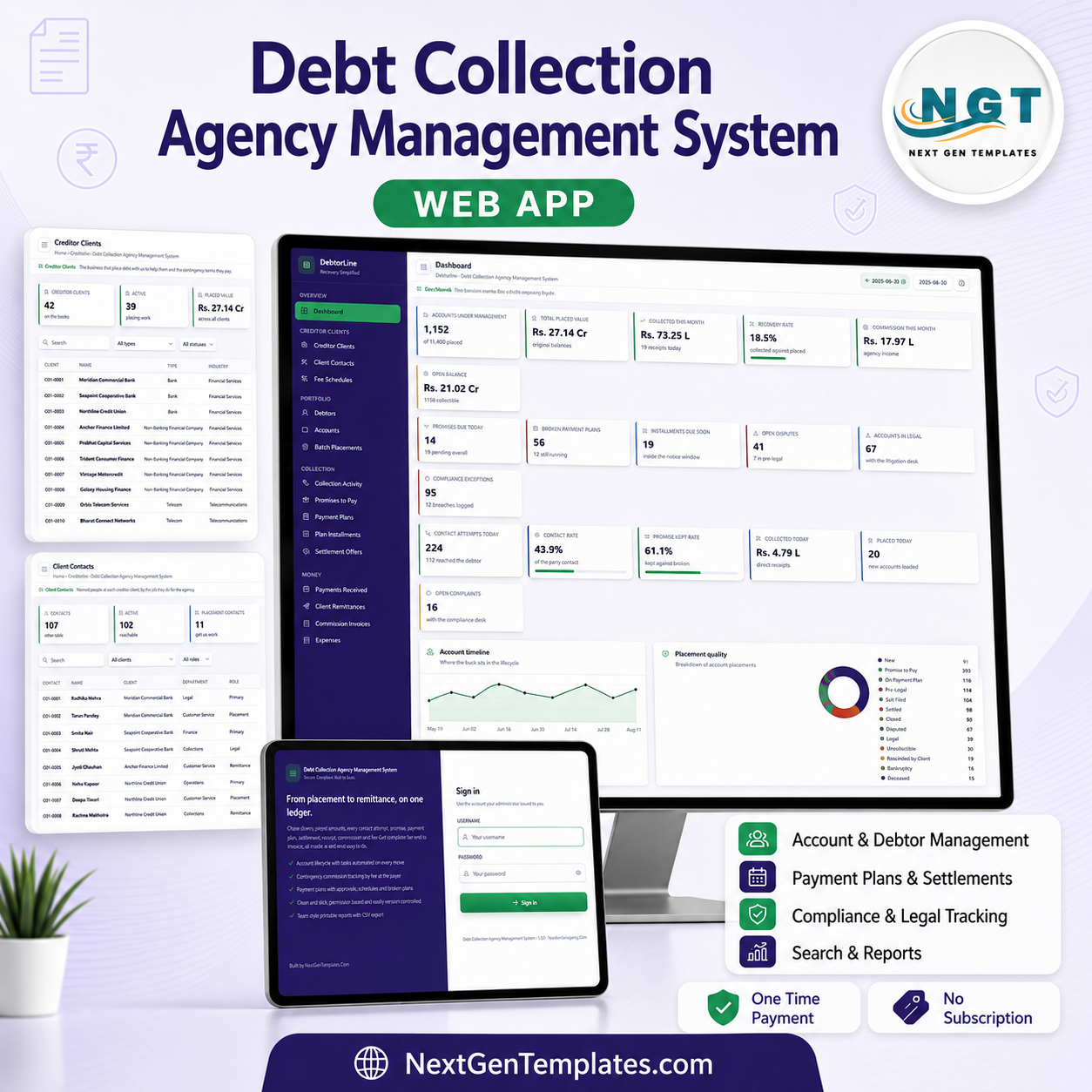
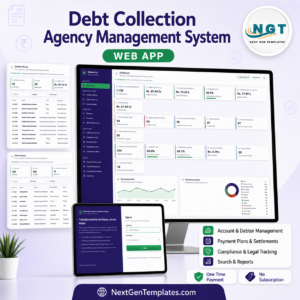
The Debt Collection Agency Management System Web App is a complete recovery back office on one screen: 38 working screens, 8 server-enforced roles, 36 database tables and 28 printable reports, running inside your own Google account as a single Google Apps Script web app. It carries a placed account from the day a creditor hands it over to the day the client statement is signed off – creditor clients, fee schedules, batch placements, debtors, accounts, every contact attempt, promises, payment plans, settlements, receipts, commission, remittances, disputes, complaints, legal action and judgments – all on one ledger, with balances recomputed on the server on every receipt. The demo instance ships with a seeded book of 1,400 placed accounts across 42 creditor clients, 900 debtors, 3,800 logged contact attempts, 1,540 receipts and roughly 14,750 rows in total, so every screen and every report is populated the moment you sign in. You pay once, you get the source code (Code.gs + Index.html), and there is no per-seat fee, no per-account fee and nothing to cancel.
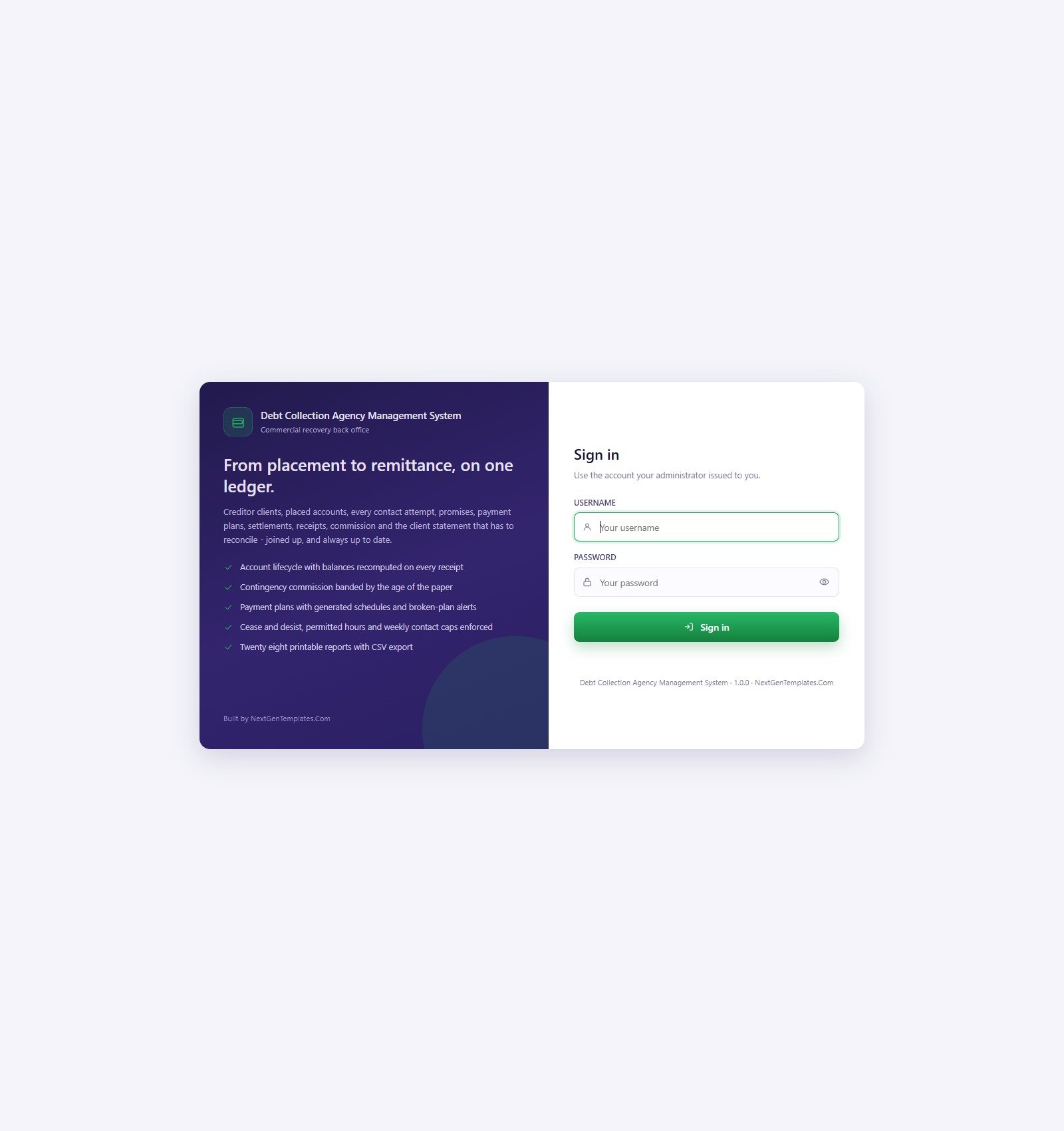
🚀 Try the Live Demo Before You Buy
We have deployed this web app in our own Google account so you can test every page, every role and every report – with a full seeded recovery book – before purchasing. No signup, no email required.
🔑 Test Login Credentials
Sign in as admin to see everything including Users, Roles & Permissions, Settings, the Audit Log and the Database Archive. Then sign out and sign in as collector1 – a collector works allocated accounts and records contact, promises and plans, but every balance, commission and remittance figure is blanked on the server before the page is sent. That role separation is the product, so it is worth signing in twice. All 14 seeded accounts are listed below.
These credentials are public on purpose. They belong to a shared demonstration instance that is periodically reset, not to a customer deployment. When you install your own copy you get your own database, your own users and your own passwords – and the first thing the manual asks you to do is change the admin password and delete the seeded accounts.
Key Features of the Debt Collection Agency Management System Web App
- One ledger from placement to remittance – creditor clients, fee schedules, batch placements, debtors, accounts, activity, promises, plans, settlements, receipts, commission, remittances and expenses are joined, not scattered across spreadsheets.
- Balances the server recomputes, not you – current balance = original balance + interest accrued + fees added − payments received − settlement adjustment, recalculated on every receipt and every reversal. When it reaches zero the account closes itself as Paid in Full, or Settled where a discount applied.
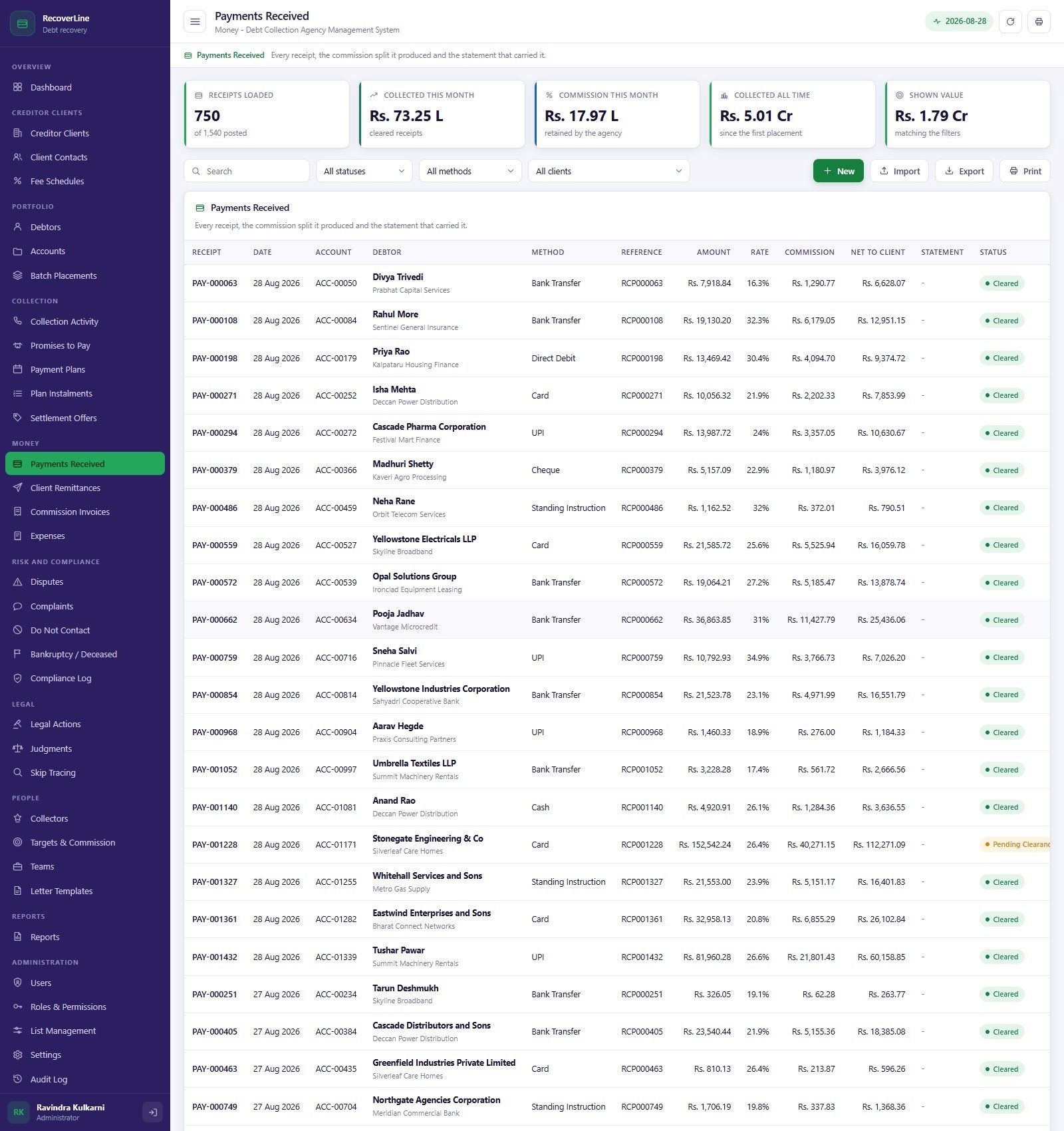
- Contingency commission banded by the age of the paper – 252 seeded fee bands across six tiers (Fresh, Early, Standard, Aged, Late, Legacy) with a per-client contingency rate, legal rate and minimum fee. Commission on a receipt is the receipt times the band rate; the balance is the net owed to the client.
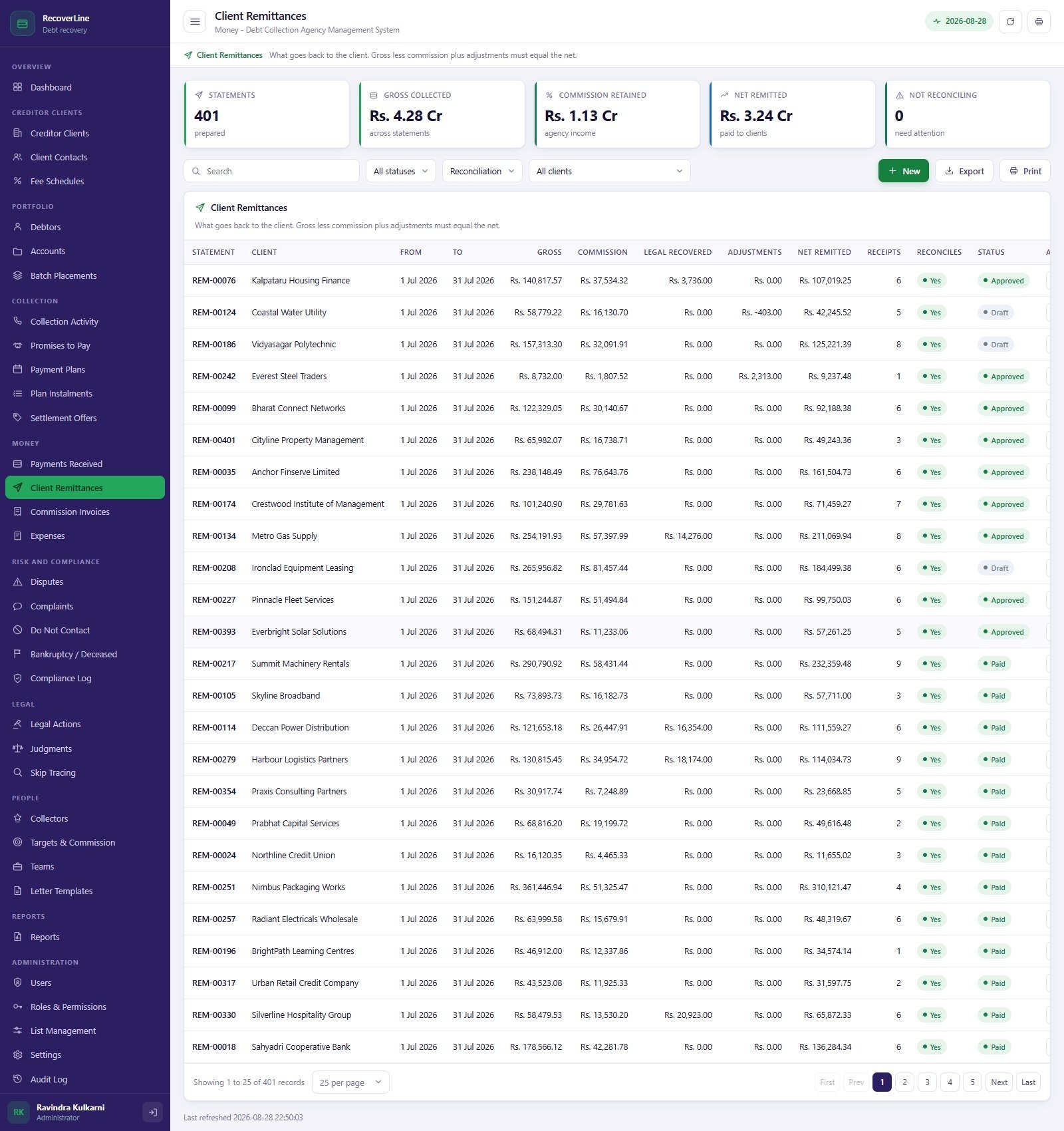
- Remittance statements that must reconcile – a statement is refused unless gross − commission + legal recovered + adjustments = net remitted. The Client Remittances screen carries a “Not reconciling” counter that should always read zero.
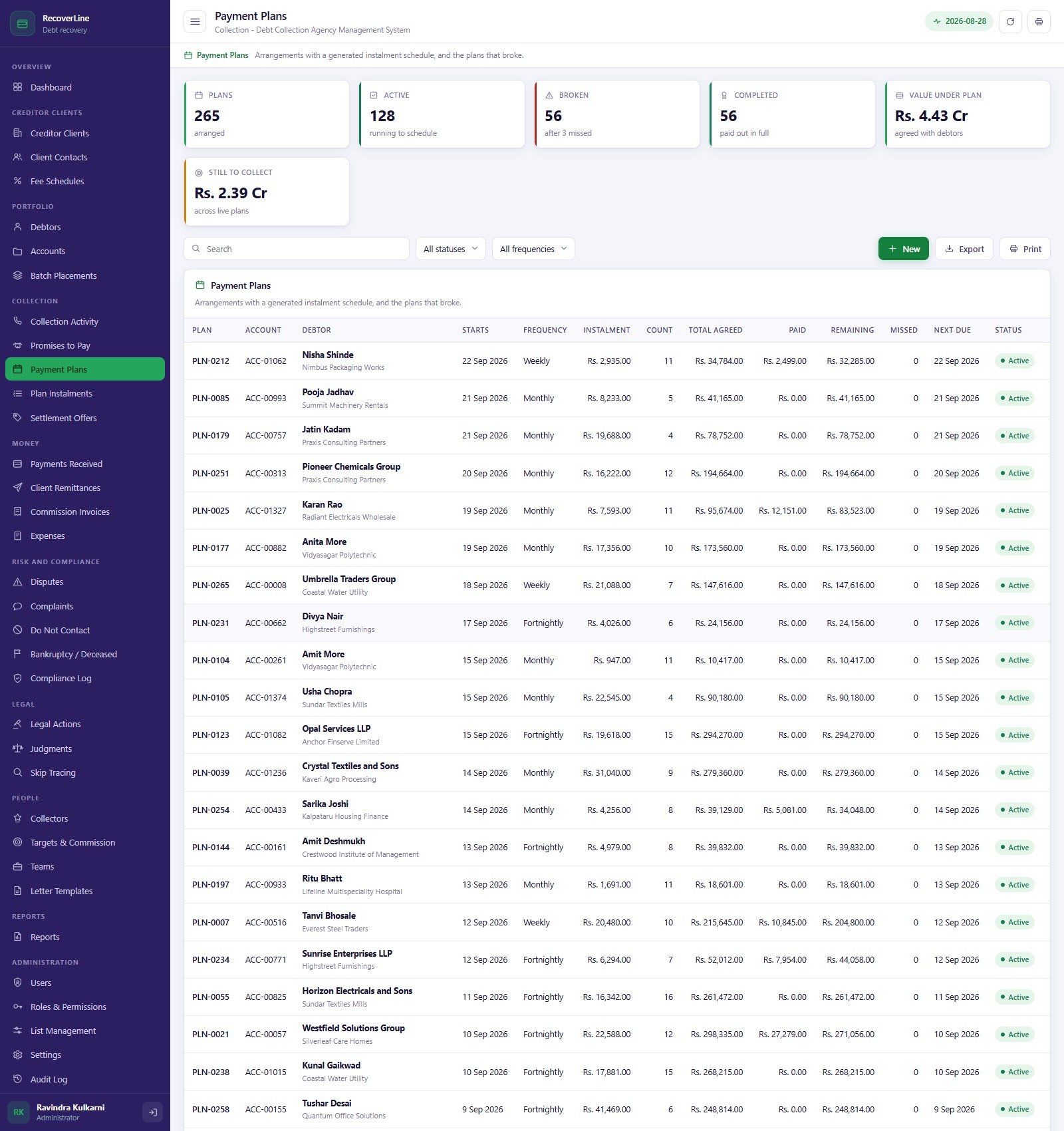
- Payment plans with generated schedules – the instalment schedule is built on the server. An instalment whose due date passes unpaid becomes Missed, and once the missed count hits the Settings threshold (3 by default) the plan breaks and the account returns to the working pool.
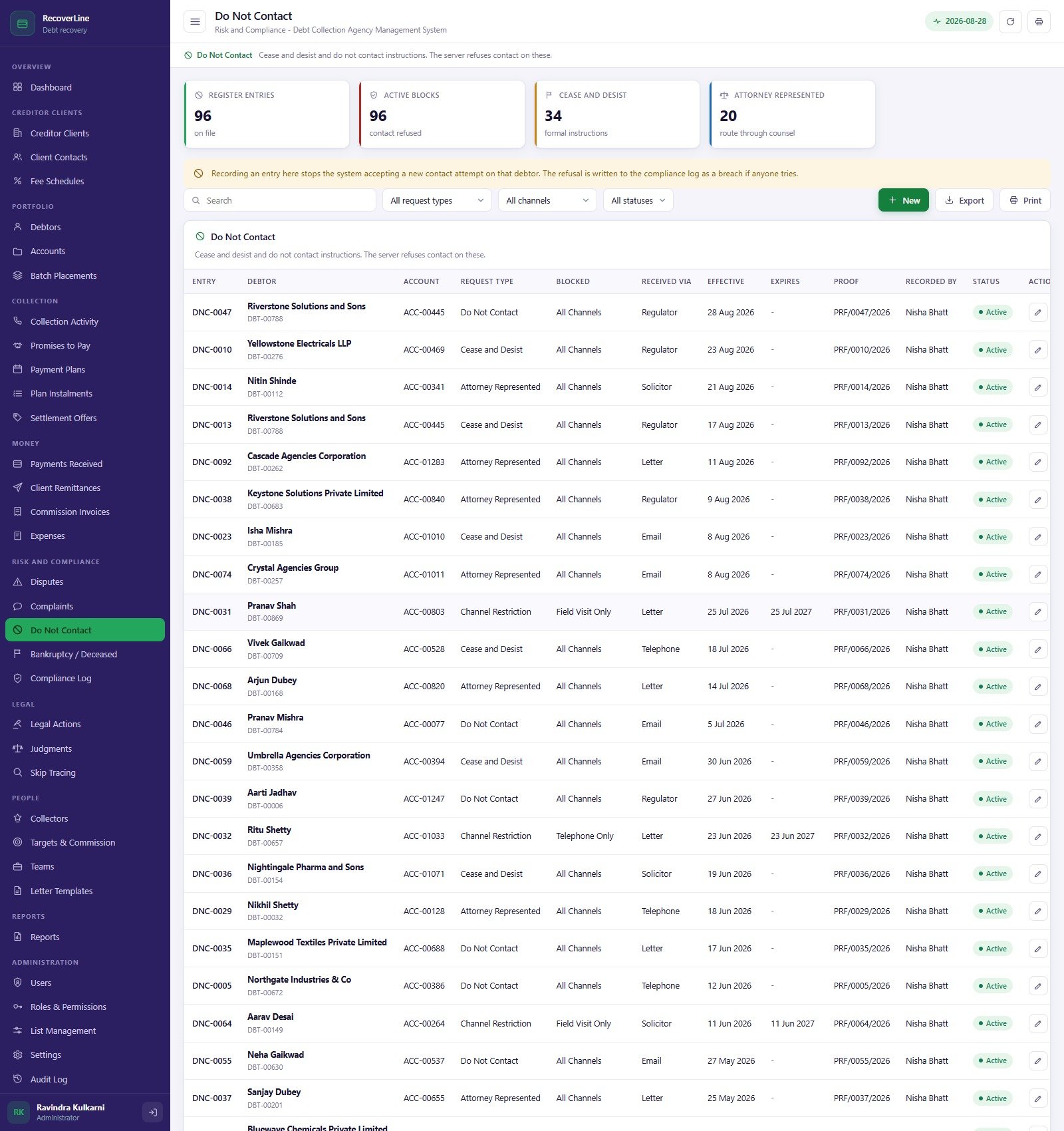
- A do not contact register the server actually honours – a contact attempt against a debtor on the Do Not Contact or Cease and Desist register is refused outright and written to the compliance log as a breach, and so is an attempt against a debtor flagged deceased or bankrupt.
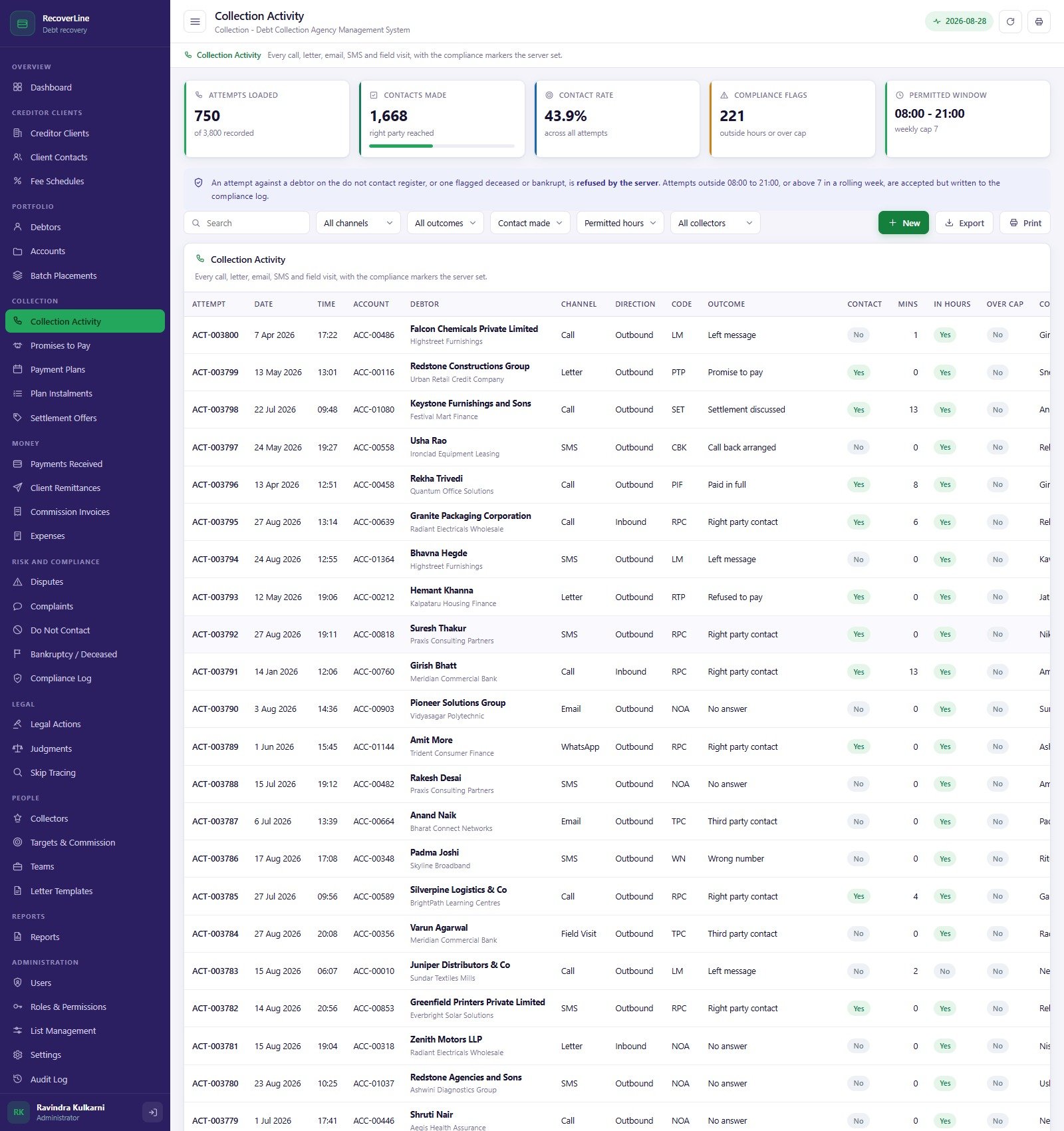
- Contact-window and frequency rules you configure – attempts outside the permitted window (08:00 to 21:00 by default) or above the weekly cap (7 per account) are accepted but flagged and logged, so a supervisor can see them on the Compliance Log rather than discovering them later.
- A collector who cannot see money – for the Collector role every balance, commission and remittance column is blanked on the server before the payload leaves. It is not a hidden column in the browser.
- The legal desk, tracked end to end – letter before action, claim filed, charging orders, attachment of earnings and enforcement, with court fees and solicitor fees per action, then judgments with costs, amounts paid and the enforcement step in flight.
- Skip tracing with a hit rate – 310 seeded trace requests across address, telephone and employment traces, per-provider cost and a confirmed-hit percentage, so you can see which tracing provider is worth paying.
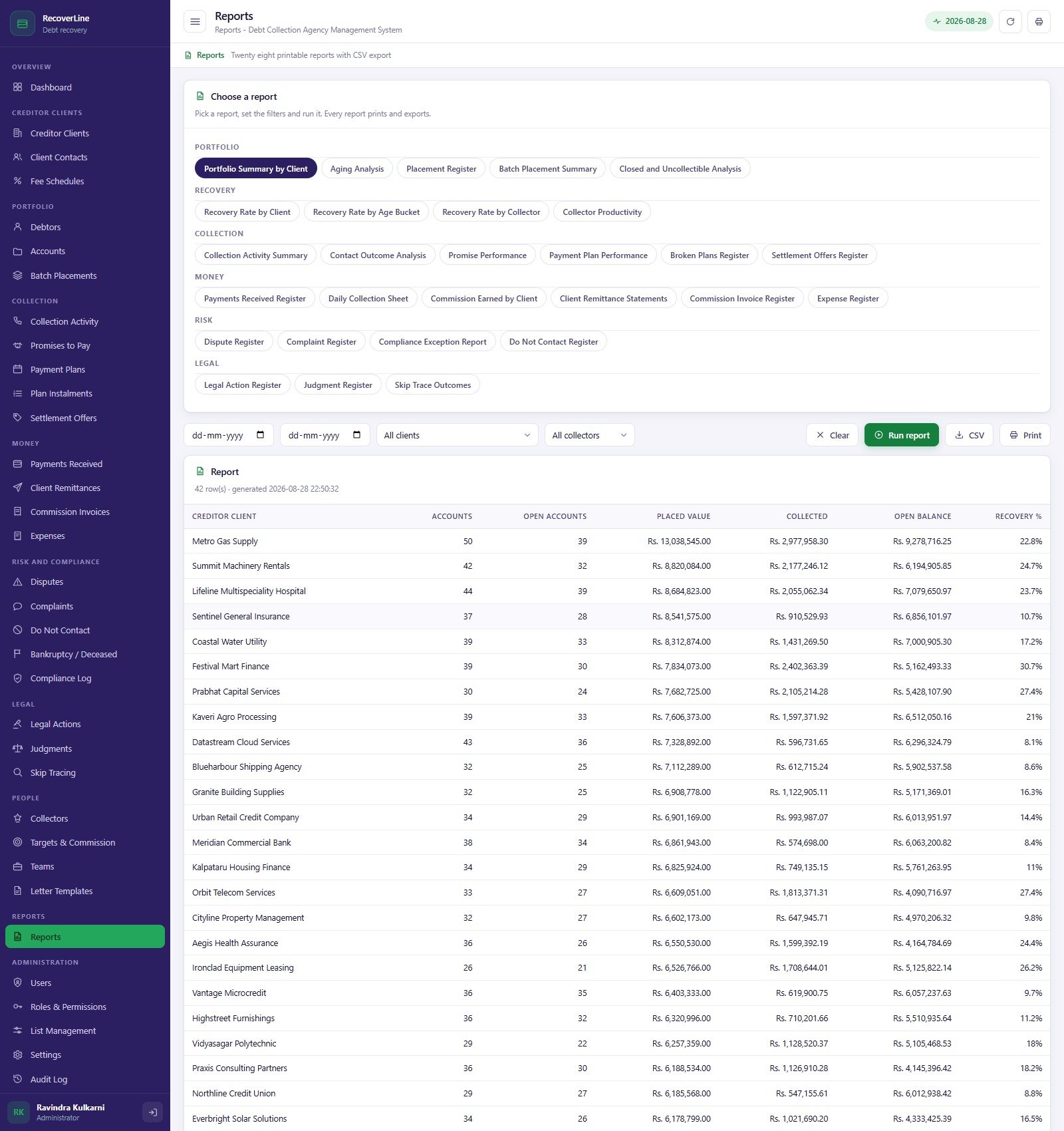
- 28 printable reports with CSV export – grouped as Portfolio, Recovery, Collection, Money, Risk and Legal, each with a date range plus client and collector filters.
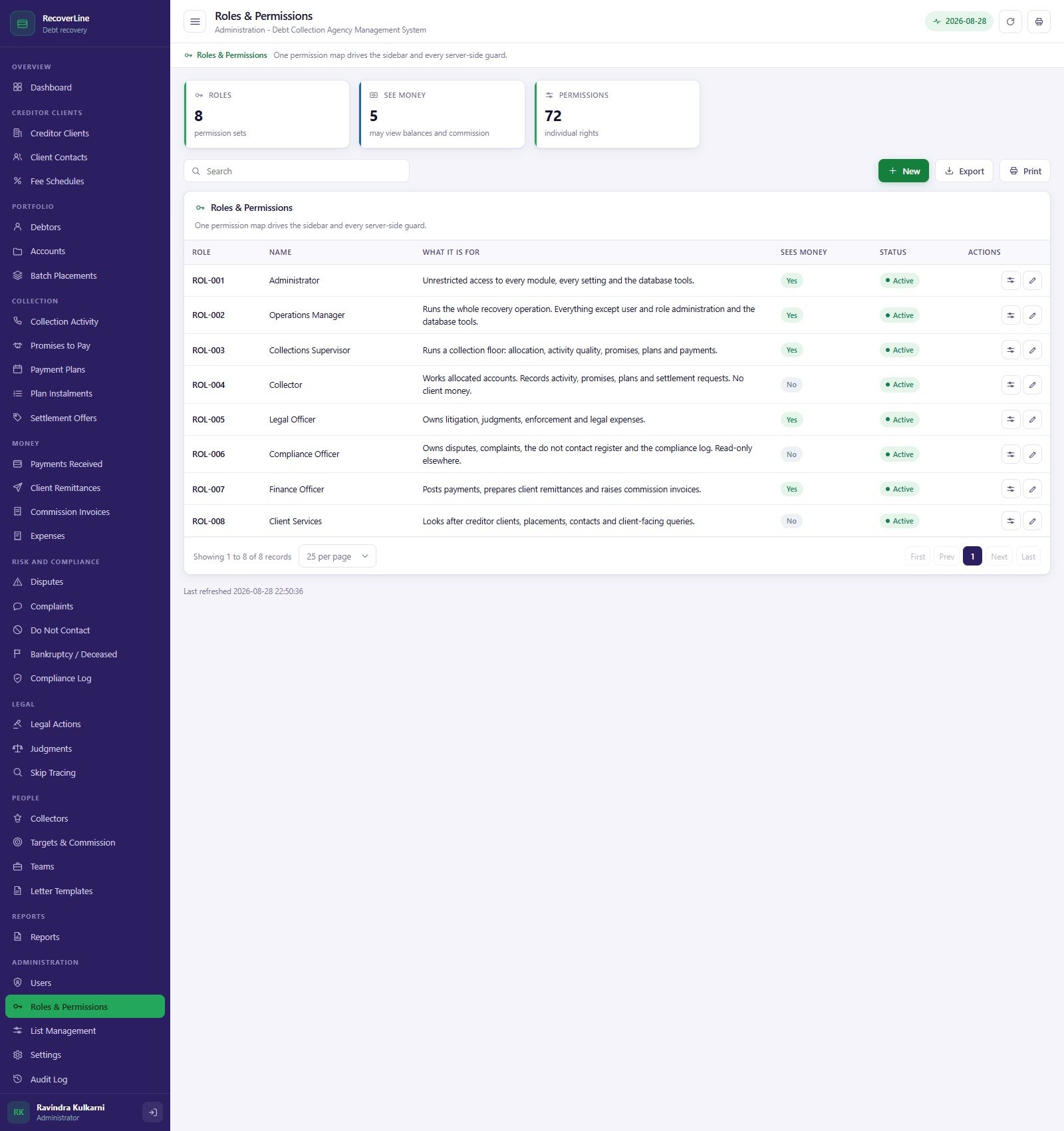
- 8 roles and 72 individual permissions – the same permission map drives the sidebar and the guard on every server entry point, so hiding a page also blocks the underlying call.
- Backups and a database archive – a dated copy of the whole database into your Drive on demand, and an archive that moves closed transactions before a cutoff out of the live sheet. The copy is taken first; nothing is removed until it exists.
- Runs in your own Google account – one-off price, full source code, no subscription, no per-collector licence and no data leaving your Workspace.
What’s Inside the Debt Collection Agency Management System Web App
Thirty-eight working screens, grouped exactly as the sidebar groups them.
Overview
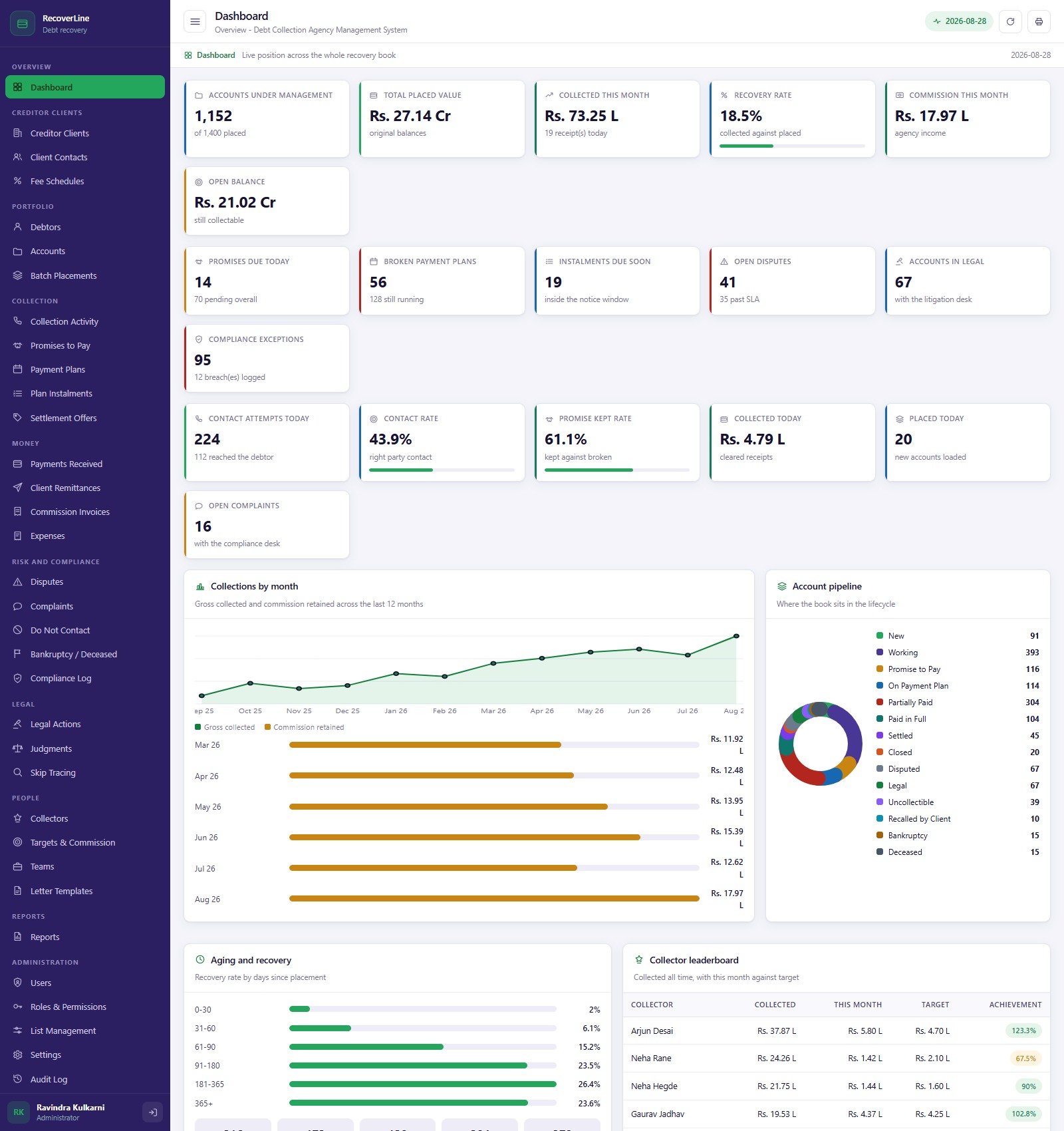
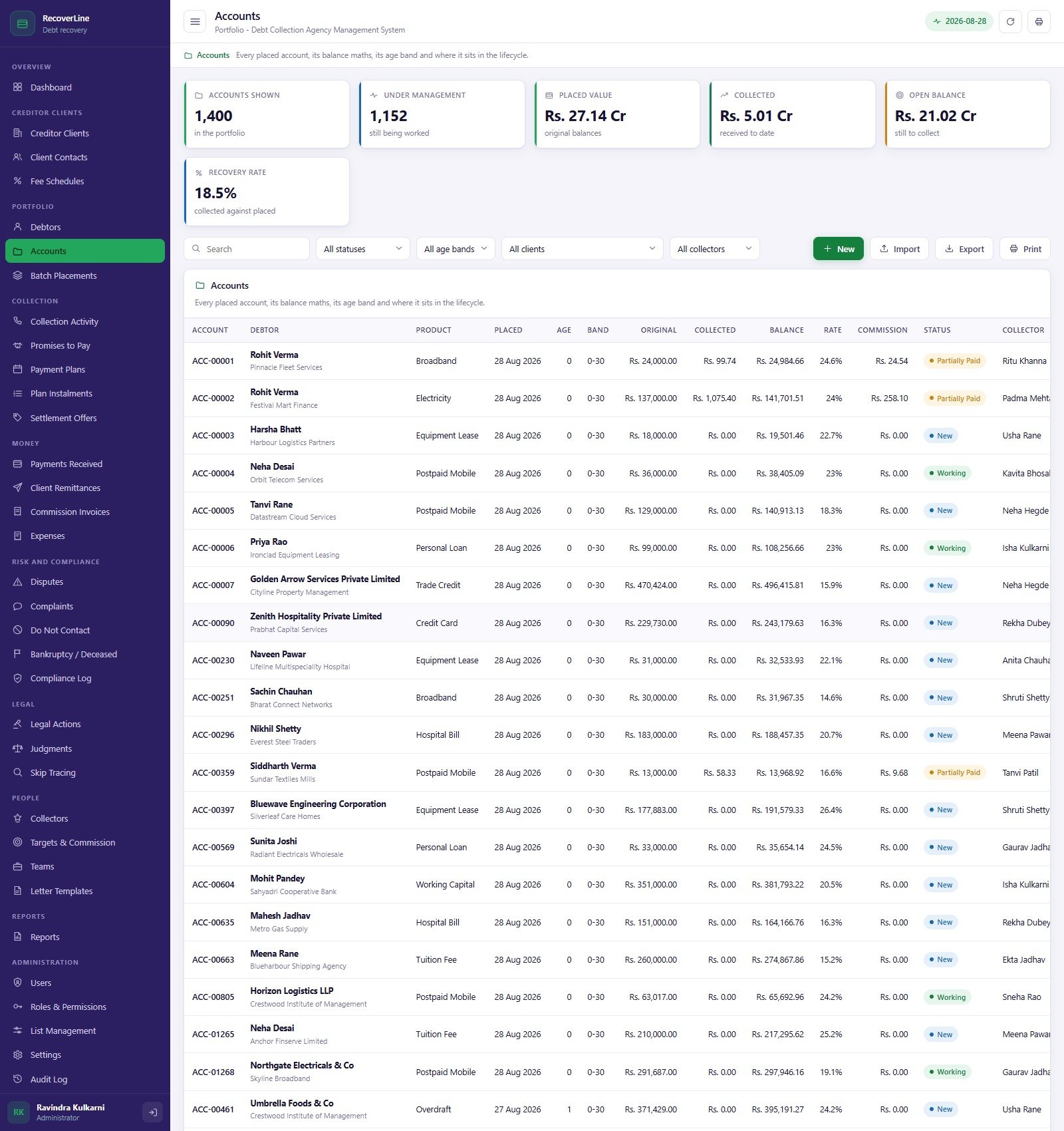
- Dashboard – eighteen live counters across the whole recovery book: Accounts Under Management (1,152 of 1,400 placed), Total Placed Value, Collected This Month, Recovery Rate, Commission This Month, Open Balance, Promises Due Today, Broken Payment Plans, Instalments Due Soon, Open Disputes, Accounts in Legal, Compliance Exceptions, Contact Attempts Today, Contact Rate, Promise Kept Rate, Collected Today, Placed Today and Open Complaints. Below them sit Collections by month, the Account pipeline across all fourteen lifecycle statuses, Aging and recovery by days since placement, and a Collector leaderboard of collected against target.
Creditor clients
- Creditor Clients – the businesses that place debt with the agency and the contingency terms they pay: type, industry, city, fee model, base rate, remittance cycle, accounts, placed value and collected.
- Client Contacts – named people at each client with department, role (Primary, Placement, Remittance, Legal, Escalation), preferred channel and status.
- Fee Schedules – the contingency percentage each client pays, banded by how old the account is, with the legal rate, minimum fee and effective date per band.
Portfolio
- Debtors – the people and businesses that owe, with a contactability score, a risk band from A – Contactable to E – Protected, and the DNC, deceased and bankrupt flags on the row.
- Accounts – every placed account: product, placement date, age and age band, original balance, collected, current balance, commission rate, commission, lifecycle status and the collector holding it.
- Batch Placements – each file a client handed over, its reference, the accounts and value it carried, the source file name and who loaded it.
Collection
- Collection Activity – every call, letter, email, SMS, WhatsApp and field visit, with direction, outcome code (RPC, TPC, LM, NOA, PTP, RTP, CBK, SET, PIF, WN), talk minutes and the in-hours and over-cap markers the server sets.
- Promises to Pay – what the debtor said they would pay, when it was due, whether it arrived, and the kept-against-broken split.
- Payment Plans – arrangements with a generated instalment schedule: frequency, instalment amount, count, total agreed, paid, remaining, missed count and next due date.
- Plan Instalments – the generated schedule behind every plan, each row Scheduled, Paid, Missed or Waived.
- Settlement Offers – reduced offers with the discount given away, the expiry date, and whether client approval was required because the collector went past the 25% limit.
Money
- Payments Received – every receipt with method (bank transfer, direct debit, card, UPI, cheque, cash, standing instruction), the commission split it produced, the net to client and the statement that carried it.
- Client Remittances – what goes back to the client: gross, commission retained, legal recovered, adjustments, net remitted, receipt count and a reconciles flag on every row.
- Commission Invoices – what the agency bills its clients for the commission it retained, with tax, total, paid and due date.
- Expenses – court fees, process serving, tracing, telephony, postage, data purchase and legal costs, marked recoverable or not, with what was actually recovered.
Risk and compliance
- Disputes – every challenge to a balance by type (Not My Debt, Amount Disputed, Already Paid, Goods Not Received, Fraud, Identity Theft, Statute Barred, Contract Terminated), how it arrived, the SLA clock and whether collection is on hold.
- Complaints – conduct and process complaints with severity, channel, SLA due date and whether a regulator was told.
- Do Not Contact – cease and desist, do not contact, attorney represented and channel restriction entries, with the proof reference and effective and expiry dates.
- Bankruptcy / Deceased – insolvency and bereavement flags with the case number, court or registry, trustee or executor, verification date and the action taken on the account.
- Compliance Log – every automated and manual check, what it found, who reviewed it and what was done about it.
Legal
- Legal Actions – letter before action through claim filed, charging order, attachment of earnings and enforcement, with the court, case number, claim value, court fees and solicitor fees.
- Judgments – judgments entered with costs, paid against, outstanding and the enforcement step being used.
- Skip Tracing – address, telephone and employment traces by provider, with result, any new detail found and the cost.
People
- Collectors – the floor: grade, team, licence expiry, monthly target, accounts held, portfolio value and what each collector actually recovered.
- Targets & Commission – one row per collector per month with target, collected, achievement, accounts, contacts, promises, kept promises and commission earned.
- Teams – eight desks by focus area (Early Stage, Mid Stage, Late Stage, Commercial, Legal, Consumer), each with a leader, member count, monthly target and portfolio held.
- Letter Templates – 27 compliance-approved templates across Notice, Demand, Settlement, Client, Legal and Compliance categories, each versioned, with an approval date, approver and a usage count.
Reports
- Reports – 28 printable reports with CSV export: Portfolio (Portfolio Summary by Client, Aging Analysis, Placement Register, Batch Placement Summary, Closed and Uncollectible Analysis), Recovery (Recovery Rate by Client, by Age Bucket, by Collector, Collector Productivity), Collection (Collection Activity Summary, Contact Outcome Analysis, Promise Performance, Payment Plan Performance, Broken Plans Register, Settlement Offers Register), Money (Payments Received Register, Daily Collection Sheet, Commission Earned by Client, Client Remittance Statements, Commission Invoice Register, Expense Register), Risk (Dispute Register, Complaint Register, Compliance Exception Report, Do Not Contact Register) and Legal (Legal Action Register, Judgment Register, Skip Trace Outcomes).
Administration
- Users – who can sign in, the role they hold, the team they belong to and when they last signed in.
- Roles & Permissions – eight permission sets over 72 individual rights, with a plain “sees money” yes or no on each role.
- List Management – 328 values across 53 lists feeding every dropdown in the system, so you can rename a status or add an outcome code without touching the code.
- Settings – agency identity, permitted contact hours, weekly contact cap, dormancy days, promise follow-up days, plan break threshold, minimum instalment, maximum plan length, collector discount limit, settlement validity, default contingency rate and the remittance cycle. These are read by the server, not merely displayed.
- Audit Log – every create, change, status move, approval, remittance and password reset.
- Database Archive – move closed transactions dated before a cutoff into an archived copy, choosing which closed statuses are eligible.
- Backup – a dated copy of all 36 tabs into your Drive.
- Help – thirteen answered questions about how the system models the recovery process, plus the version and build information.
Debt Collection Agency Management System vs. Spreadsheets vs. Collections SaaS – Where This Fits
| What you need | Spreadsheets and shared folders | This web app (one-off 59.99) | Subscription collections platform |
|---|---|---|---|
| Cost after two years | Free, plus the hours | Paid once | Per collector, per month, forever |
| Balance recalculated on every receipt | A formula somebody breaks | Server-side, every time | Yes |
| Commission banded by account age | VLOOKUP that goes stale | 252 fee bands, six tiers | Yes |
| Remittance statement that must reconcile | Checked by eye | Refused unless it balances | Yes |
| Collector cannot see client money | Hidden column, easily unhidden | Blanked on the server | Usually |
| Do not contact honoured, not just recorded | A tab nobody reads | Attempt refused and logged | Yes |
| Legal desk and judgments | A separate file | Built in, with costs | Often an add-on module |
| Your data stays in your account | Yes | Yes – your Google Drive | No – the vendor’s cloud |
| Source code you can change | n/a | Yes – Code.gs + Index.html | No |
| Dialler, payment gateway, credit bureau feed | No | No – see the honest list below | Usually yes |
Who This Template Is For – and Who It’s Not For
A good fit if you are:
- A first-party or third-party collection agency running 5 to 60 collectors that has outgrown spreadsheets but does not want a per-seat subscription.
- A recovery desk inside an NBFC, cooperative bank, credit union or microfinance lender that needs placement, activity, promise and settlement records in one place.
- A commercial recovery or receivables firm that bills contingency commission and has to produce a reconciling client statement every cycle.
- A legal recovery practice tracking letters before action, claims, judgments and enforcement alongside the money.
- An agency owner who wants the source code, one price, and the whole database sitting in their own Google account.
Not the right fit if you need:
- A predictive or preview dialler, IVR, call recording or telephony integration – this records the outcome of a contact, it does not place the call.
- A payment gateway, card processing, auto-debit or e-mandate execution – it records receipts, it does not take money.
- A live credit bureau, bank or utility data feed for skip tracing – trace requests and results are recorded by hand or imported.
- A debtor-facing self-service portal or payment page.
- A guarantee that your collection practice is lawful. This is a record-keeping and workflow tool – see the note below.
A Plain Note on Collection Law
Debt collection is a regulated activity in most countries – the FDCPA and state licensing rules in the United States, the FCA’s CONC rules in the United Kingdom, RBI directions on recovery agents in India, and their equivalents elsewhere. This template does not make you compliant with any of them, and it does not certify, enforce or guarantee lawful collection practice. What it does is record what your people did and let you configure the operating rules you have decided to follow: a permitted contact window, a weekly attempt cap per account, a do not contact and cease-and-desist register the server refuses attempts against, deceased and bankruptcy flags, a dispute and complaint register with SLA clocks, versioned letter wording, and an audit log. Those settings ship with defaults; you must set them to whatever your own regulator, licence and client contracts require, and you remain solely responsible for complying with the collection laws that apply to you and to each account you work. Nothing in this listing or in the product is legal advice.
How to Use the Debt Collection Agency Management System Web App
- Try the live demo first. Open the demo above, sign in as
admin, then sign out and sign in ascollector1. Ten minutes there will tell you more than any feature list. - Deploy your own copy. Unzip the download. In a new Google Apps Script project, paste
Code.cs.txtintoCode.gs, add an HTML file named exactlyIndex(Apps Script adds the extension itself) and pasteIndex.txtinto it. - Deploy as a web app. Deploy > New deployment > Web app, Execute as Me, Who has access Anyone. Accept the Google permission prompt – the system creates its own spreadsheet database, stores documents in Drive and sends statements by email.
- Build the database once. Open the deployment URL and press “Build the database now” on the sign-in card, or run
setupfrom the editor. Setup is staged and resumable, so Google’s six-minute script limit cannot break it. - Sign in and lock it down. Sign in as the seeded administrator, change that password immediately, create real accounts for your team under Users and disable every seeded account.
- Set your operating rules. In Settings, put in your agency name, recovery licence number, address, tax registration and currency symbol, then set the permitted contact hours, the weekly attempt cap, the dormancy and follow-up days, the plan break threshold, the collector discount limit, the settlement validity and your default contingency rate.
- Load your own book. Add your creditor clients and their fee schedules first, then import debtors and accounts, then record the batch placement each file came from. Balances and commission fall out of the fee bands automatically.
- Work it, then report on it. Allocate accounts to collectors, record activity, promises, plans and settlements, post receipts, prepare the remittance statements, and print the 28 reports at the end of each cycle. Take a backup before any archive or bulk import.
Real-World Use Cases
- Month-end client statement. The Finance Officer prepares remittances for the cycle; a statement that does not satisfy gross − commission + legal recovered + adjustments = net remitted is refused, so the “Not reconciling” counter stays at zero and the commission invoice can be raised the same day.
- The plan that quietly broke. Three instalments pass unpaid, the plan flips to Broken, the account returns to the working pool and appears on the Broken Payment Plans counter on the dashboard instead of being forgotten for a quarter.
- A cease and desist arrives. Compliance records it on the Do Not Contact register with the proof reference. The next collector who tries that account is refused by the server and the attempt is written to the compliance log as a breach.
- A collector calls at 22:43. The attempt is accepted but flagged as outside the permitted window, lands on the Compliance Log, and the supervisor coaches the agent rather than finding out from a complaint.
- Deciding which tracing provider to keep. Skip Tracing shows the hit rate per provider against what each one costs, so the contract that never confirms an address does not get renewed.
- Pricing a new client. Fee Schedules shows what every existing client pays by age band, and Recovery Rate by Age Bucket shows what is actually recoverable at that age, so the contingency quote is grounded in the book rather than a guess.
Frequently Asked Questions
Can I try it before buying?
Yes. The green box above is a live deployment with a full seeded recovery book, and all fourteen seeded logins across eight roles are listed. Sign in as admin and again as collector1 to see the money blanking for yourself. Nothing you do in the demo affects your own copy.
Where is my data stored?
In your own Google account. On first run the system creates its own Google Sheets database – 36 tabs – in your Drive, and the web app reads and writes only that. Nothing is sent to us and there is no third-party server in the path.
Does it dial numbers, take card payments or run auto-debit?
No. It records the outcome of a contact attempt and it records a receipt; it does not place calls and it does not move money. There is no dialler, no payment gateway and no e-mandate execution.
Does it make my agency compliant with collection law?
No, and it does not claim to. It is a record-keeping and workflow tool. It lets you set a permitted contact window, a weekly cap, a do not contact register, deceased and bankruptcy flags, dispute and complaint SLAs and versioned letter wording – and it logs what happened – but you remain responsible for complying with the collection laws, licensing rules and client contracts that apply to you.
How many people can use it at once?
It is a normal Apps Script web app, so a floor of collectors can work in it concurrently within Google’s own quotas for your account type. Each user signs in with their own account and the server checks their permissions on every call.
Will the Google Sheets database get too big?
That is what the Database Archive is for. It takes a full copy into your Drive first, then moves closed transactions dated before your cutoff out of the live sheet, keeping master tables and every open account behind. The Backup screen shows the row count in each of the 36 tabs so you can see it coming.
Can I change the code?
Yes. You get Code.cs.txt and Index.txt in full – it is your project in your account, so you can add a field, rename a status, change the letter wording or bolt on your own report. Dropdown values, statuses and outcome codes can be changed from List Management without touching the code at all.
Does it work in currencies other than rupees?
Yes. The currency symbol is a Settings field used everywhere money is shown. The seeded demonstration data is in rupees because that is what the sample book was built with; your own data can be in any currency.
What is in the download?
A single ZIP containing Code.cs.txt, Index.txt and the Debt Collection Agency Management System user manual as a PDF, which covers every module, the roles, deployment and the housekeeping tools.
About the Author
Built by NextGenTemplates.Com, which has been building Excel, Google Sheets, Power BI and Google Apps Script business tools for over a decade. Every system we ship is deployed and used before it is listed, which is why there is a live demo on this page rather than a set of mockups. Questions, or want a module added? Write to [email protected].
Explore Related Templates
- Credit Recovery Agencies Dashboard in Power BI – the analytics layer over a recovery book, if you want board-level reporting alongside the operating system.
- Credit Recovery Agencies Dashboard in Excel – the same analysis in a workbook, for teams that live in Excel.
- Credit Recovery Agencies KPI Dashboard in Excel – an MTD/YTD scorecard for recovery KPIs with traffic lights.
- Loan Recovery Services Dashboard in Power BI – for lenders running recovery in house.
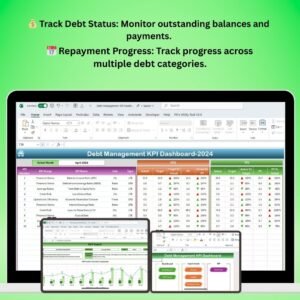
- Debt Management KPI Dashboard in Excel – the creditor-side view of the same problem.
- Accounts Receivable KPI Dashboard in Google Sheets – catch it before it becomes a placement.
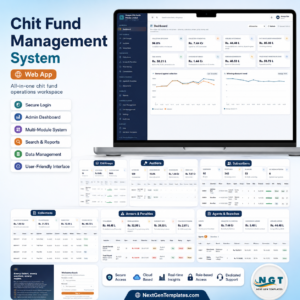
- Chit Fund Management System Web App – another finance web app built the same way, if you like this architecture.
- Payroll and Salary Management System Web App – pay the floor you are tracking targets and commission for.
Try the live demo above, sign in twice, and see the whole recovery book working before you spend anything. When you are ready, the download gives you the source code, the user manual and a database you build once in your own Google account.
Compatibility and Requirements
- Runs as a Google Apps Script web app in your own Google account. You need a Google account and a web browser.
- The system creates its own Google Sheets database and stores documents in Drive. Google explains the account side in Get started with Google Sheets.
More Questions About This Template
Does it place calls or take card payments?
No. It records the outcome of a contact attempt and it records a receipt. There is no dialler, no payment gateway and no e-mandate execution.
Can a collector see balances or commission?
No. For the Collector role every balance, commission and remittance column is blanked on the server before the page is sent.
What happens when a payment plan is missed?
An instalment that passes its due date unpaid becomes Missed. Once the missed count reaches the Settings threshold (3 by default) the plan breaks and the account returns to the working pool.
What is in the download?
One ZIP with Code.cs.txt, Index.txt and the user manual as a PDF.
Is there an Excel or Power BI version for recovery reporting?
Not of this system, but the Credit Recovery Agencies Dashboard in Power BI and the Credit Recovery Agencies Dashboard in Excel cover the analysis side.
Related Debt and Recovery Templates
- Debt Management KPI Dashboard in Excel: the creditor-side view of the same problem
- Debt Management KPI Dashboard in Power BI: the Power BI edition
- Debt Management KPI Dashboard in Google Sheets: the same KPIs in Google Sheets
- Debt Management KPI Scorecard in Excel: a scorecard view of debt metrics
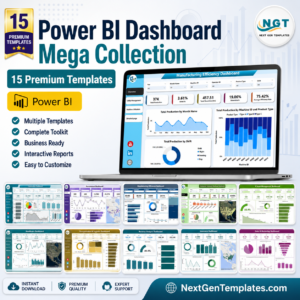
- Power BI Dashboard Mega Collection: 15 Power BI dashboards in one download
Browse all Web Apps.














Reviews
There are no reviews yet.