
Maintaining accurate financial records is essential for every business. However, many organizations still manage financial statements across multiple spreadsheets and manual reports. This scattered approach often leads to confusion, calculation errors, and delayed financial insights. As a result, business owners and finance teams struggle to understand the true financial health of the company.
That’s exactly where the Balance Sheet Template in Google Sheets becomes an essential financial management tool 📊💼.
This ready-to-use template provides a structured and automated system for recording financial data, calculating totals, and monitoring monthly balances. Instead of building complex financial statements from scratch, businesses can easily track assets, liabilities, and shareholders’ equity within a single organized spreadsheet.
Built entirely in Google Sheets, this template follows the standard accounting principle:
Assets = Liabilities + Shareholders’ Equity
Because the template automatically validates this equation, it helps maintain financial accuracy and ensures reliable reporting.
Whether you run a small business, manage financial accounts, or analyze company performance, this template simplifies balance sheet preparation and financial monitoring.
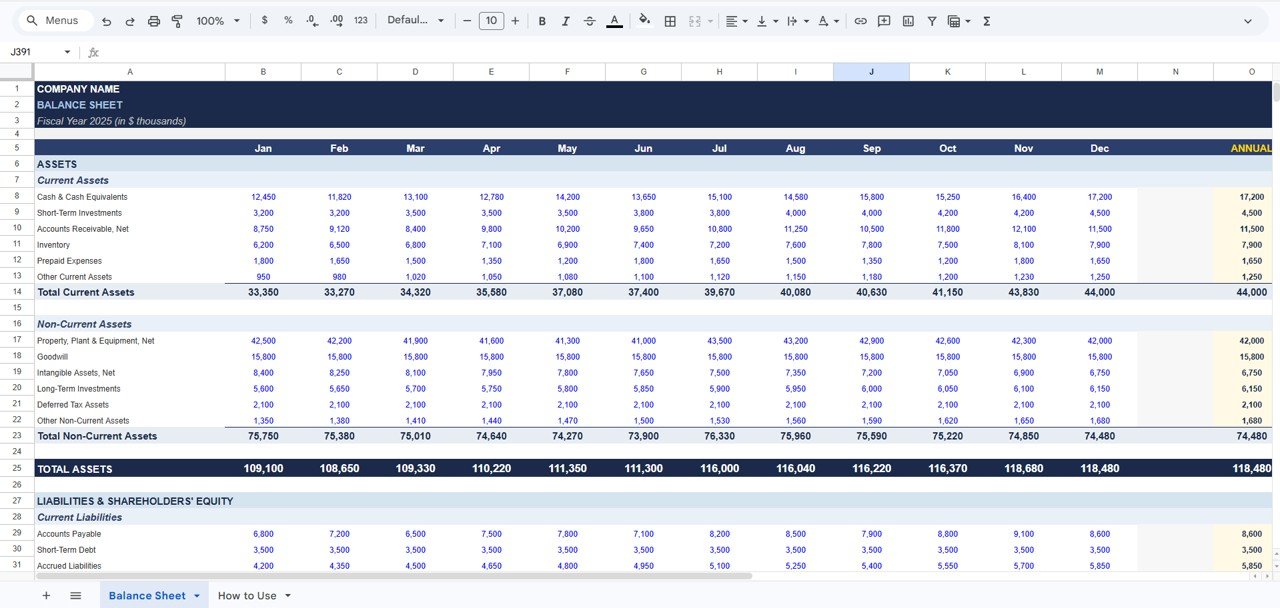
🚀 Key Feature of Balance Sheet Template in Google Sheets
📊 Structured Financial Reporting System – Organize assets, liabilities, and equity in a professional balance sheet format.
📅 Monthly Financial Tracking (Jan–Dec) – Record financial data across the entire year with an annual summary column.
🧮 Automatic Calculations – Built-in formulas instantly calculate totals for assets, liabilities, and equity.
⚖️ Balance Verification Formula – Automatically confirms that Assets = Liabilities + Shareholders’ Equity.
🏦 Complete Asset Management – Track both current assets and long-term investments clearly.
💳 Liability Monitoring System – Monitor short-term and long-term financial obligations.
📈 Financial Trend Analysis – Review monthly financial balances to evaluate performance trends.
☁️ Cloud-Based Accessibility – Access the template from anywhere using Google Sheets.
These features make financial reporting more efficient and reduce the risk of accounting errors.
📦 What’s Inside the Balance Sheet Template in Google Sheets?
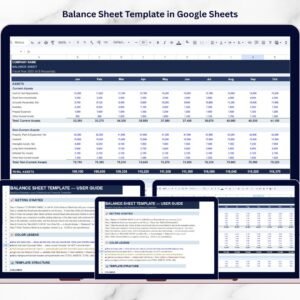
This template includes two well-structured worksheets designed to simplify financial reporting.
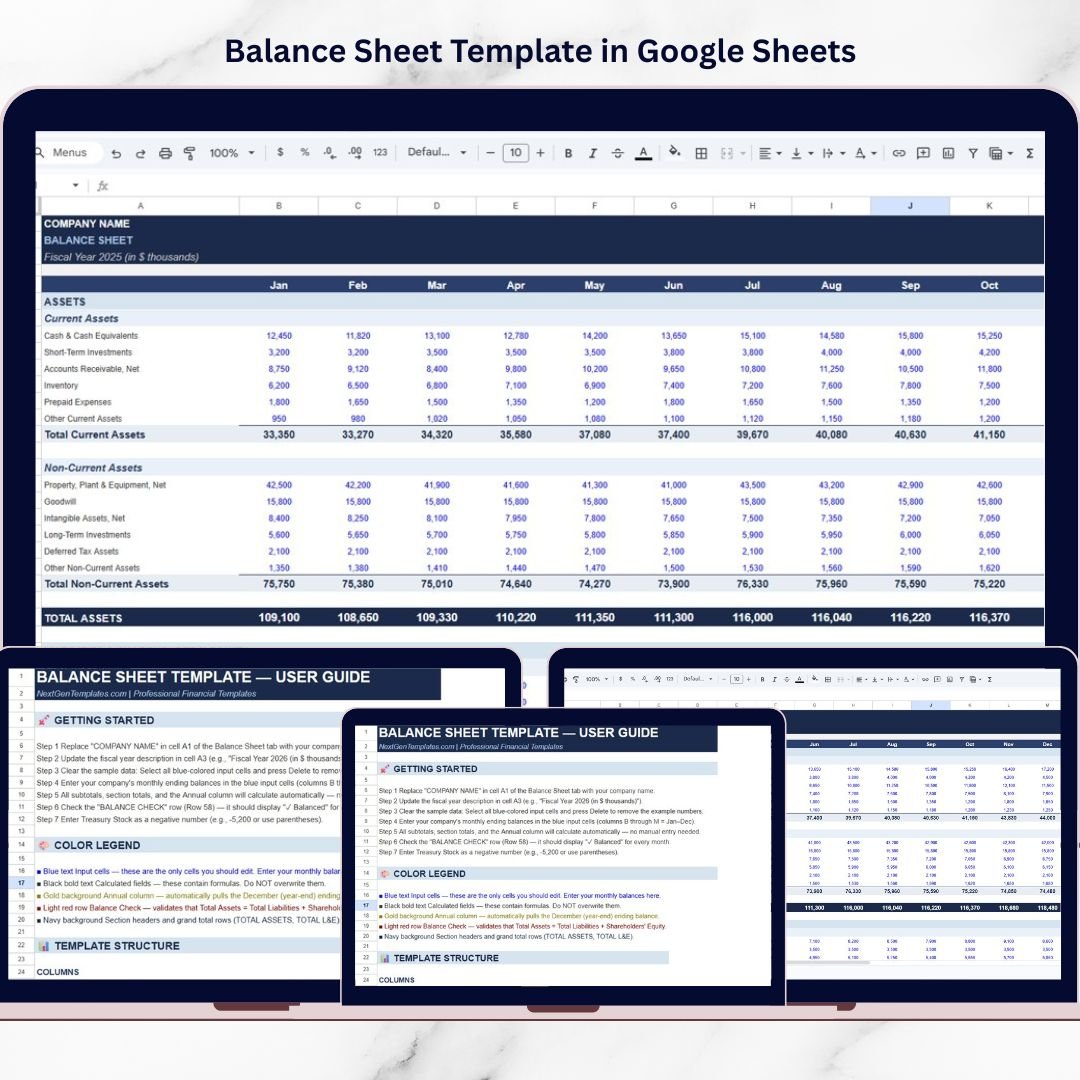
1️⃣ Balance Sheet Worksheet – Main Financial Statement
The Balance Sheet sheet tab is the core reporting page of the template.
At the top of the sheet, users can enter:
• Company Name
• Fiscal Year
Below the header, the template organizes financial data across monthly columns from January to December, along with an Annual summary column.
Assets Section
The asset section lists everything the business owns.
Current Assets
These represent short-term financial resources.
Examples include:
• Cash & Cash Equivalents
• Short-Term Investments
• Accounts Receivable
• Inventory
• Prepaid Expenses
• Other Current Assets
The template automatically calculates:
Total Current Assets
Non-Current Assets
These represent long-term business investments.
Examples include:
• Property, Plant & Equipment
• Goodwill
• Intangible Assets
• Long-Term Investments
• Deferred Tax Assets
• Other Non-Current Assets
The template automatically calculates:
Total Non-Current Assets
Finally, both sections combine to generate:
Total Assets
Liabilities & Shareholders’ Equity Section
Below the asset section, the template records financial obligations and ownership value.
Current Liabilities
These represent obligations due within one year.
Examples include:
• Accounts Payable
• Short-Term Debt
• Accrued Liabilities
• Deferred Revenue
• Current Portion of Long-Term Debt
The template automatically calculates:
Total Current Liabilities
Long-Term Liabilities
These represent financial obligations beyond one year.
Examples include:
• Long-Term Loans
• Bonds Payable
• Lease Liabilities
The template calculates:
Total Liabilities
Shareholders’ Equity
This section reflects the owners’ stake in the company.
Common entries include:
• Share Capital
• Retained Earnings
• Treasury Stock
The template automatically calculates:
Total Shareholders’ Equity
Balance Validation
One of the most valuable features of this template is the Balance Check row.
This formula verifies the accounting equation:
Total Assets = Total Liabilities + Shareholders’ Equity
If the values match, the balance sheet confirms accuracy automatically.
This feature helps prevent accounting mistakes and ensures financial consistency.
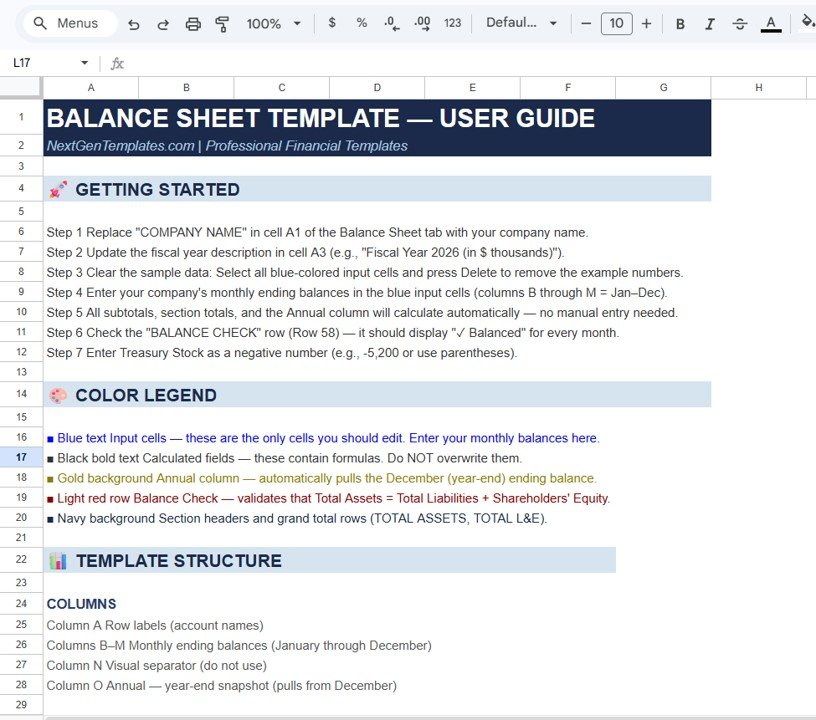
⚙️ How to Use the Balance Sheet Template in Google Sheets
Using this template is simple and efficient.
1️⃣ Enter company information at the top of the sheet
2️⃣ Record monthly financial values for each account
3️⃣ Allow formulas to calculate totals automatically
4️⃣ Verify the balance check row
5️⃣ Analyze financial trends across months
Because calculations are automated, finance teams save time and reduce errors.
👥 Who Can Benefit from This Balance Sheet Template?
This template is useful for many professionals and organizations.
✔ Small Business Owners
✔ Accountants & Bookkeepers
✔ Finance Managers
✔ Startup Founders
✔ Financial Analysts
✔ Business Consultants
Any organization that needs a structured financial reporting system can benefit from this template.
This balance sheet template also helps answer critical financial questions:
• Does the company have enough liquidity?
• What is the current debt level?
• Is the business financially stable?
• Are assets growing over time?
By reviewing these insights regularly, businesses can make smarter financial decisions.
Moreover, because the template is built in Google Sheets, teams can collaborate easily and update financial data from anywhere.
If you want a simple, accurate, and cloud-based financial reporting system, the Balance Sheet Template in Google Sheets provides the perfect solution.
Click hare to read the Detailed blog post
Watch the step-by-step video tutorial: