

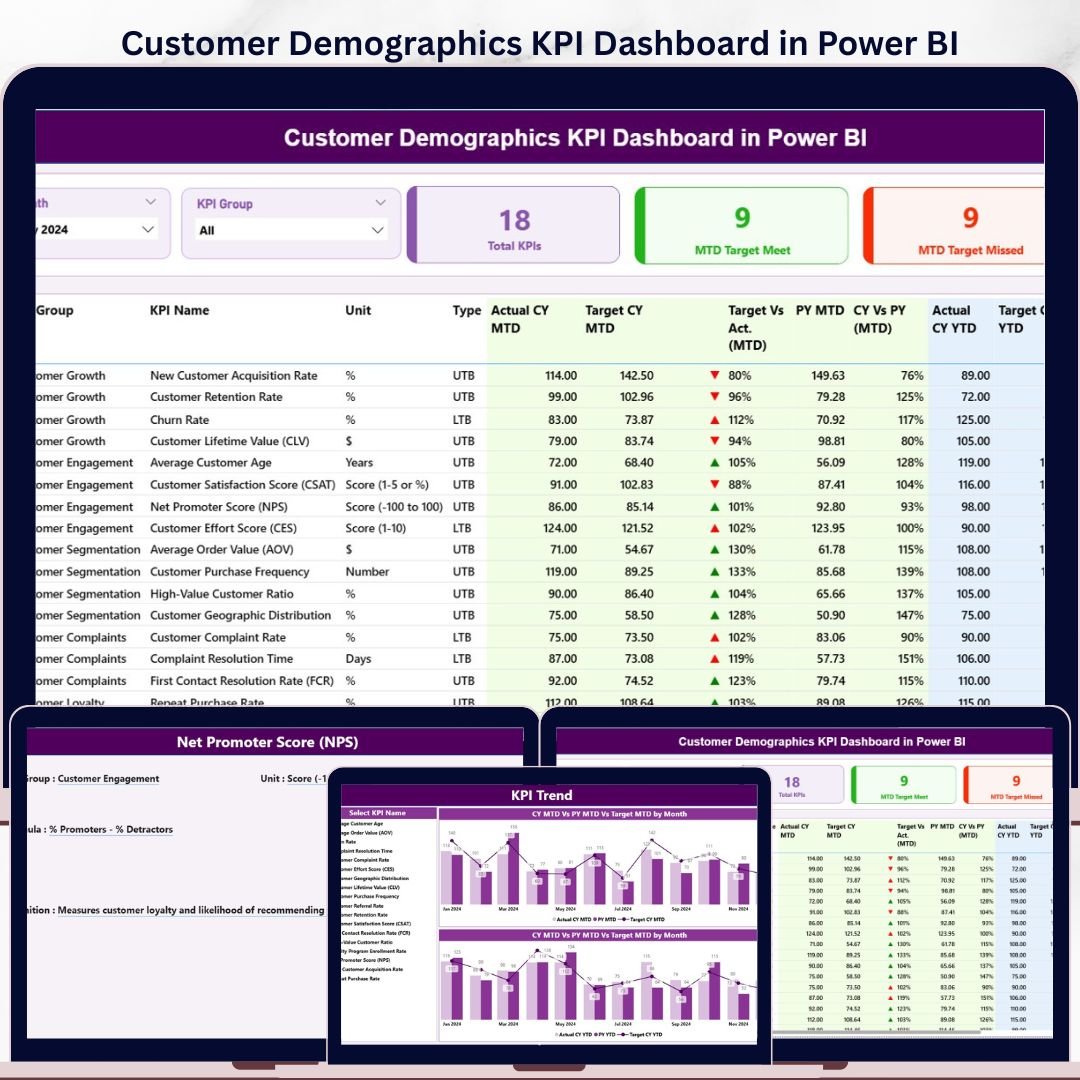
The Customer Demographics KPI Dashboard in Power BI tracks key customer metrics across 3 connected pages, with MTD and YTD comparisons against targets and prior-year actuals, plus a built-in drill-through to KPI definitions. Setup takes under 10 minutes — drop your numbers into the Excel data source and every visual refreshes automatically.
🌍 Join 8,400+ teams in 40+ countries using NextGenTemplates to replace paid SaaS tools with one-time-purchase Excel, Google Sheets, Power BI, and HTML templates.
✅ Instant download · One-time payment · No subscription · No per-user fees · Lifetime access
🔑 Key Features of the Customer Demographics KPI Dashboard in Power BI
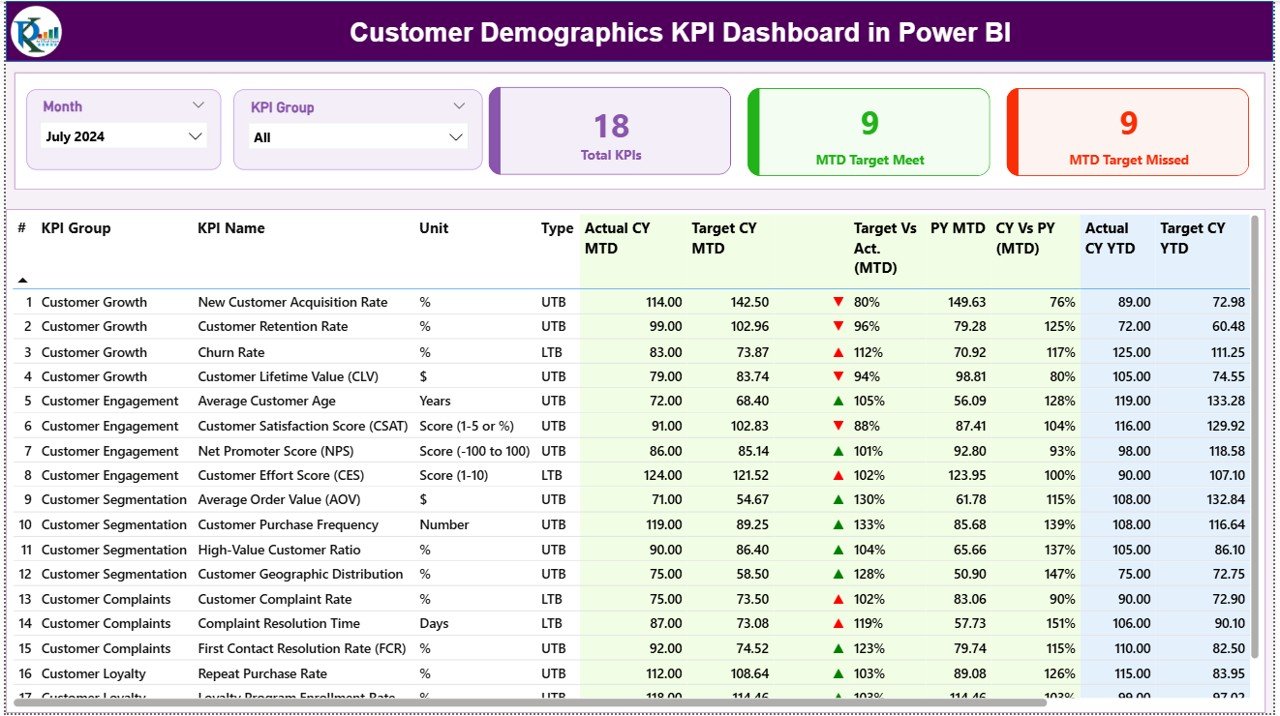
🎯 Month and KPI Group slicers — every page is driven by two slicers at the top of the Summary page, so you can filter to any month or any KPI category (acquisition, retention, demographic breakdown, etc.) in one click without writing a single DAX measure.
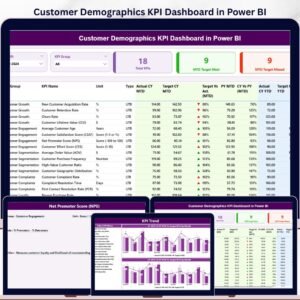
📊 Three live KPI cards on the Summary page — Total KPIs count, MTD Target Met count, and MTD Target Missed count refresh the moment slicer values change, so managers see the headline scorecard in under three seconds.
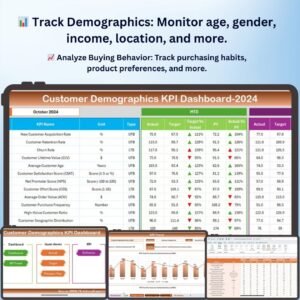
📋 Detailed KPI table with 15 columns — each KPI row shows KPI Number, KPI Group, KPI Name, Unit, Type (LTB / UTB), Actual CY MTD, Target CY MTD, MTD Icon (▼/▲ in red/green), Target Vs Actual MTD %, PY MTD, CY Vs PY MTD %, Actual CY YTD, Target CY YTD, YTD Icon, Target Vs Actual YTD %, PY YTD, and CY Vs PY YTD %. This is the complete monthly + yearly scorecard most paid CRM tools charge $25+ per user per month to deliver.
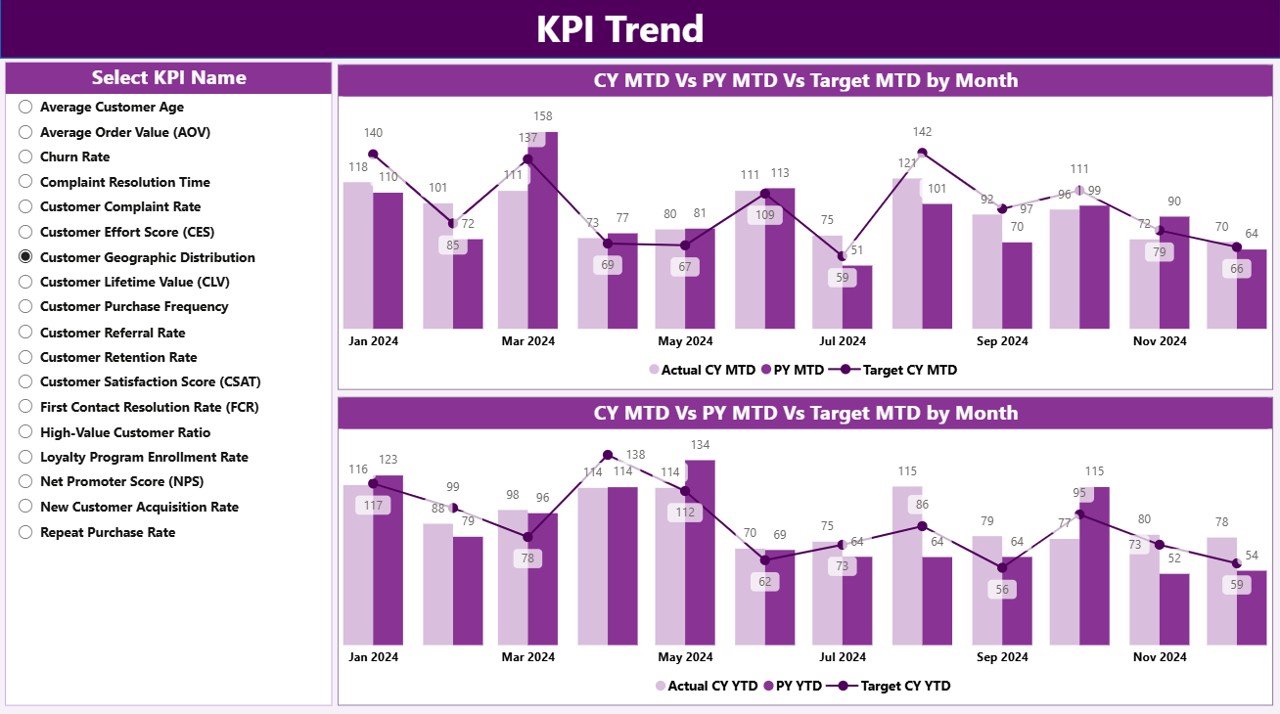
📈 Trend page with two combo charts — selectable per-KPI views show Current Year Actual, Previous Year Actual, and Target lines side-by-side for both MTD and YTD, so you can spot whether a metric is improving or regressing against last year at a glance.
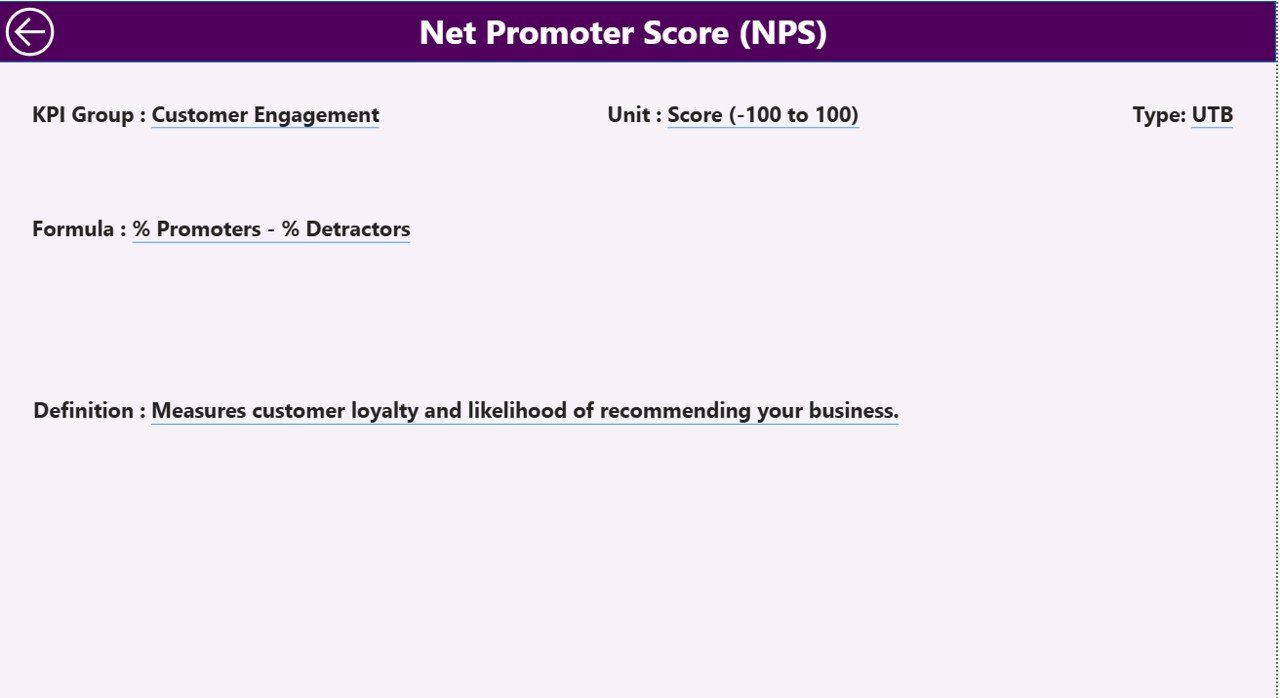
📖 Hidden KPI Definition drill-through page — right-click any row in the Summary table and drill through to see the KPI’s formula and definition. A back button on the top-left corner returns you to the main page. No more guessing what “Repeat Customer Rate” or “Customer Lifetime Value” actually means.
📂 Three-sheet Excel data source — the dashboard reads from Input_Actual (KPI Name + Month-start + MTD/YTD numbers), Input_Target (same structure, target values), and KPI Definition (KPI Number, Group, Name, Unit, Formula, Definition, Type LTB/UTB). Three sheets is all that stands between you and a fully refreshed dashboard.
🔁 Lower-the-Better and Upper-the-Better logic — the MTD and YTD status icons flip automatically based on the Type column. Metrics where higher is better (Customer Retention Rate, NPS, Lifetime Value) get green ▲ when Actual ≥ Target; metrics where lower is better (Customer Acquisition Cost, Churn Rate, Time-to-Resolution) get green ▲ when Actual ≤ Target.
💡 Built for marketers who don’t write DAX — every measure is pre-built. You don’t need Power BI training, you don’t need Power Query knowledge, and you don’t need a BI consultant. Open the .pbix file in Power BI Desktop (free from Microsoft) and start tracking.
📦 What’s Inside the Customer Demographics KPI Dashboard in Power BI
Page 1: Summary Page
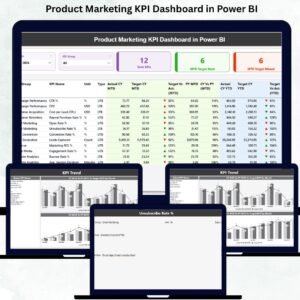
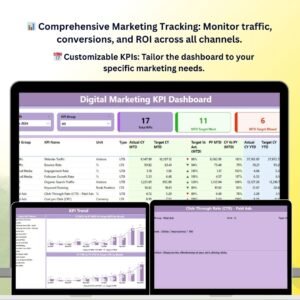
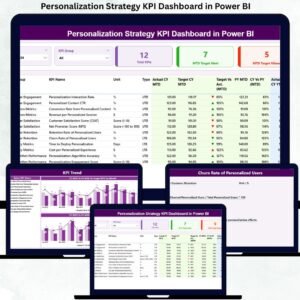
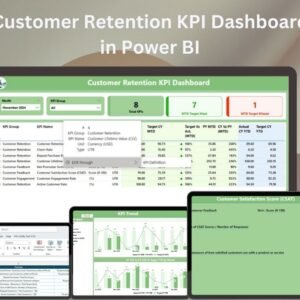
This is the main page of the dashboard. At the top sit two slicers — Month and KPI Group — that filter every visual on the page. Below the slicers, three KPI cards show Total KPIs count, MTD Target Met count, and MTD Target Missed count. The detailed KPI table beneath the cards lists every demographic metric with KPI Number, KPI Group, KPI Name, Unit, Type, Actual CY MTD, Target CY MTD, MTD Icon (▼/▲ red/green), Target Vs Actual MTD %, PY MTD, CY Vs PY MTD %, Actual CY YTD, Target CY YTD, YTD Icon, Target Vs Actual YTD %, PY YTD, and CY Vs PY YTD %.
Page 2: KPI Trend Page
This page shows two combo charts — one for MTD and one for YTD — each plotting Current Year Actual, Previous Year Actual, and Target for the selected KPI. A slicer on the left lets you pick which demographic metric to drill into (Customer Acquisition by Age Band, Repeat Purchase Rate by Region, New vs Returning Customer Split, and so on), so you can compare a single KPI’s performance across time periods without leaving the page.
Page 3: KPI Definition Page (Hidden Drill-Through)
This is a hidden drill-through page that surfaces the Formula and Definition of any KPI you right-click on from the Summary table. It removes the ambiguity around metric naming — your team always knows exactly how Customer Lifetime Value, Average Order Frequency, or Customer Demographic Index is calculated. A back button on the top-left corner returns you to the Summary page.
📊 Customer Demographics KPI Dashboard in Power BI vs. Tableau / Qlik vs. HubSpot / Salesforce — Where This Fits
| Feature | Customer Demographics KPI Dashboard in Power BI | Tableau / Qlik equivalent | HubSpot / Salesforce |
|---|---|---|---|
| Cost | $11.99 one-time ✅ | $70-75 / user / month | $50-150 / user / month |
| Platform | Power BI Desktop (free) ✅ | Tableau Desktop / Qlik Sense (paid) | Cloud-only SaaS |
| Setup time | Under 10 minutes ✅ | 2-4 hours (data modelling) | 4-8 hours (CRM mapping + admin) |
| MTD + YTD vs Target + Prior Year built-in | ✅ Yes, pre-built | ❌ Must be built from scratch | ❌ Custom report builder required |
| Drill-through to KPI definitions | ✅ Yes | Possible (advanced setup) | Limited |
| LTB / UTB icon logic | ✅ Auto-flipping ▲/▼ | ❌ Manual calculated fields | ❌ Not native |
| Customizable fields | ✅ Full Power BI freedom | ✅ Full | Limited to CRM schema |
| Year-1 cost at 5 users | $11.99 ✅ | ~$4,200 | ~$3,000-$9,000 |
| Lifetime access | ✅ Yes | ❌ Subscription only | ❌ Subscription only |
For teams that want enterprise-grade customer demographic reporting without the $3,000+ annual seat fees, the Customer Demographics KPI Dashboard in Power BI sits in the sweet spot.
👥 Who This Template Is For — and Who It’s Not For
✅ This template is built for:
- Marketing managers at 10-500-person companies who need monthly demographic scorecards but can’t justify a $30K/year Tableau license
- E-commerce store owners on Shopify, WooCommerce, or Etsy tracking buyer age, region, gender, and repeat-purchase patterns
- Customer analysts and CRM analysts who already work in Excel and want to step up to Power BI without learning DAX
- Agency strategists building demographic deep-dives for retainer clients
- Founders running quarterly board meetings who need a clean MTD vs YTD vs target view
❌ This template is NOT for:
- Enterprise teams that need SOC 2, SSO, and row-level security at the platform layer (use Power BI Premium with custom RLS instead)
- Real-time streaming dashboards — this is built on a refreshable Excel source, not a live SQL connection
- Teams without access to Power BI Desktop (Mac users — Power BI Desktop runs on Windows only)
⚙️ How to Use the Customer Demographics KPI Dashboard in Power BI
- Download and open — unzip the package and open the .pbix file in Power BI Desktop (free download from Microsoft).
- Edit the Excel data source — open the included Excel file and fill in three sheets: Input_Actual, Input_Target, and KPI Definition.
- Input_Actual sheet — for each row, enter KPI Name, Month (always the first date of the month), MTD number, and YTD number.
- Input_Target sheet — same structure as Input_Actual, but for your target values (also keyed by KPI Name and first-of-month date).
- KPI Definition sheet — fill in KPI Number, KPI Group, KPI Name, Unit, Formula, Definition, and Type (LTB or UTB).
- Refresh the dashboard — in Power BI Desktop, click Home → Refresh. The Summary, KPI Trend, and KPI Definition pages all update instantly.
- Slice and analyze — use the Month and KPI Group slicers on the Summary page to filter, and right-click any KPI row to drill through to its definition.
💼 Real-World Use Cases
Priya leads marketing at a 45-person DTC skincare brand. She uses the Customer Demographics KPI Dashboard in Power BI to track Repeat Purchase Rate by age band, Customer Acquisition Cost by channel, and First-Order AOV by region every month. The MTD-vs-YTD-vs-target view replaces the three separate Excel files she used to send her CEO before each Monday standup.
Marcus is the founder of a B2B SaaS startup. His five-person team didn’t have budget for HubSpot Marketing Hub Pro, so they bought this Power BI template and plugged in their Stripe customer export. The KPI Definition drill-through means new hires understand “Trial-to-Paid Conversion” and “Average Contract Value” on day one — no Slack thread required.
Aisha runs analytics consulting for retail clients. She white-labels the dashboard for each engagement, swaps in the client’s KPI list and data, and delivers a Power BI report in two days instead of two weeks. Clients keep the .pbix file for ongoing use — no monthly seat fees, no lock-in.
❓ Frequently Asked Questions
What KPIs does the Customer Demographics KPI Dashboard in Power BI track?
The Customer Demographics KPI Dashboard in Power BI tracks any customer-demographic KPI you load into the Input_Actual sheet — examples include Customer Acquisition Cost, Repeat Purchase Rate, Customer Lifetime Value, New vs Returning Customer Split, Average Order Value by age band, and Customer Retention Rate by region. The KPI Group slicer lets you organize metrics into categories like Acquisition, Retention, and Demographic Breakdown.
How long does setup take?
Setup for the Customer Demographics KPI Dashboard in Power BI takes under 10 minutes. Open the .pbix file in Power BI Desktop, edit the three Excel sheets (Input_Actual, Input_Target, KPI Definition), hit Refresh, and every visual — including all three pages — updates automatically. No DAX, no Power Query editing required.
Do I need a Power BI Pro license to use this?
No. The Customer Demographics KPI Dashboard in Power BI runs entirely in Power BI Desktop, which is a free download from Microsoft. A Power BI Pro license is only needed if you want to publish the report to the Power BI Service for cloud sharing with non-desktop users. For local use, no subscription is required.
How does this compare to HubSpot or Salesforce?
HubSpot Marketing Hub Pro starts at $890/month and Salesforce Marketing Cloud starts at $1,250/month — both with annual contracts and per-user fees. The Customer Demographics KPI Dashboard in Power BI is a one-time $11.99 purchase with lifetime access, no per-user fees, and full control over your data file. It does not replace a CRM, but it replaces the demographic-reporting layer most teams pay extra for.
Can I add my own KPIs?
Yes. The Customer Demographics KPI Dashboard in Power BI is fully extensible. Add a new row to the KPI Definition sheet with the KPI Number, Group, Name, Unit, Formula, Definition, and Type (LTB or UTB), then add matching rows in Input_Actual and Input_Target. The Summary page table and KPI Trend slicer pick up the new KPI on the next refresh.
Is there an Excel version of this dashboard?
Yes. The Customer Demographics KPI Dashboard in Excel is the sibling template for teams that prefer to stay in Excel without Power BI Desktop. The Power BI version is faster, slicer-driven, and supports the drill-through KPI Definition page; the Excel version is more familiar for traditional spreadsheet users.
What if my numbers are confidential?
All data stays on your local machine. The Customer Demographics KPI Dashboard in Power BI is a downloadable .pbix file with a paired Excel data source — there is no cloud sync, no third-party service, and no telemetry. Power BI Desktop reads the Excel file directly from your hard drive.
👤 About the Author
Built by PK — Microsoft Certified Professional with 15+ years of Excel, Google Sheets, and Power BI experience. Founder of NextGenTemplates, reaching 300K+ subscribers across YouTube channels (@PK-AnExcelExpert, @NextGenTemplates, @NeoTechNavigators). Every template is hand-built and tested before release.
🔗 Explore Related Templates
📌 Also available as: The Customer Demographics KPI Dashboard in Excel — the Excel sibling with the same demographic-tracking logic for spreadsheet-first teams.
📌 Complementary Power BI dashboards from our Power BI Dashboards library:
- Customer Support SLA KPI Dashboard in Power BI — track first-response time, resolution rate, and SLA compliance alongside your demographic scorecard.
- Customer Churn KPI Dashboard in Google Sheets — pair demographic insights with churn-rate tracking by cohort.
- CRM Dashboard in HTML — a lightweight HTML version for embedding into internal portals.
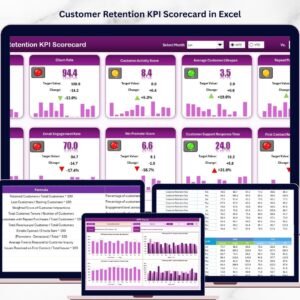
- Customer Retention KPI Scorecard in Excel — the retention companion to your demographic acquisition data.
Browse the full KPI Dashboard in Power BI collection for industry-specific scorecards.
📖 Click here to read the Detailed Blog Post
🎥 Visit our YouTube channel for step-by-step video tutorials









Reviews
There are no reviews yet.