

Managing ophthalmology services demands accuracy, speed, and continuous performance tracking. Eye hospitals and clinics handle large volumes of patients, surgeries, diagnostics, consultations, and resources daily. Yet, when this data lives in scattered spreadsheets, identifying performance gaps and improving service quality becomes difficult and time-consuming.
The Ophthalmology Services KPI Dashboard in Power BI solves this challenge by transforming raw clinical and operational data into clear, interactive, and insight-driven visuals. Ophthalmology Services KPI Dashboard in Power BI This ready-to-use dashboard allows healthcare leaders to monitor targets, actual performance, and trends from one unified platform. By combining Excel-based data input with Power BI analytics, the dashboard delivers flexibility, transparency, and analytical power without complexity.
With this dashboard, ophthalmology organizations move from reactive reporting to proactive, data-driven healthcare management—improving both patient care and operational efficiency.
🚀 Key Features of the Ophthalmology Services KPI Dashboard in Power BI
👁️ Centralized Ophthalmology KPI Tracking – Monitor all service KPIs in one dashboard
🎯 MTD & YTD Performance Monitoring – Track monthly and yearly service outcomes clearly
✅ Target Achievement Indicators – Instantly identify met and missed KPIs
📊 Actual vs Target vs Previous Year Comparison – Measure real performance objectively
🎛️ Interactive Month & KPI Group Slicers – Focus analysis instantly
📈 Trend Analysis Charts – Understand service performance over time
🔍 Drill-Through KPI Definitions – View KPI logic, formula, and meaning
⚡ Excel + Power BI Model – Simple updates with powerful analytics
📦 What’s Inside the Ophthalmology Services KPI Dashboard
This dashboard includes three carefully designed analytical pages, each serving a specific purpose:
🟢 Summary Page
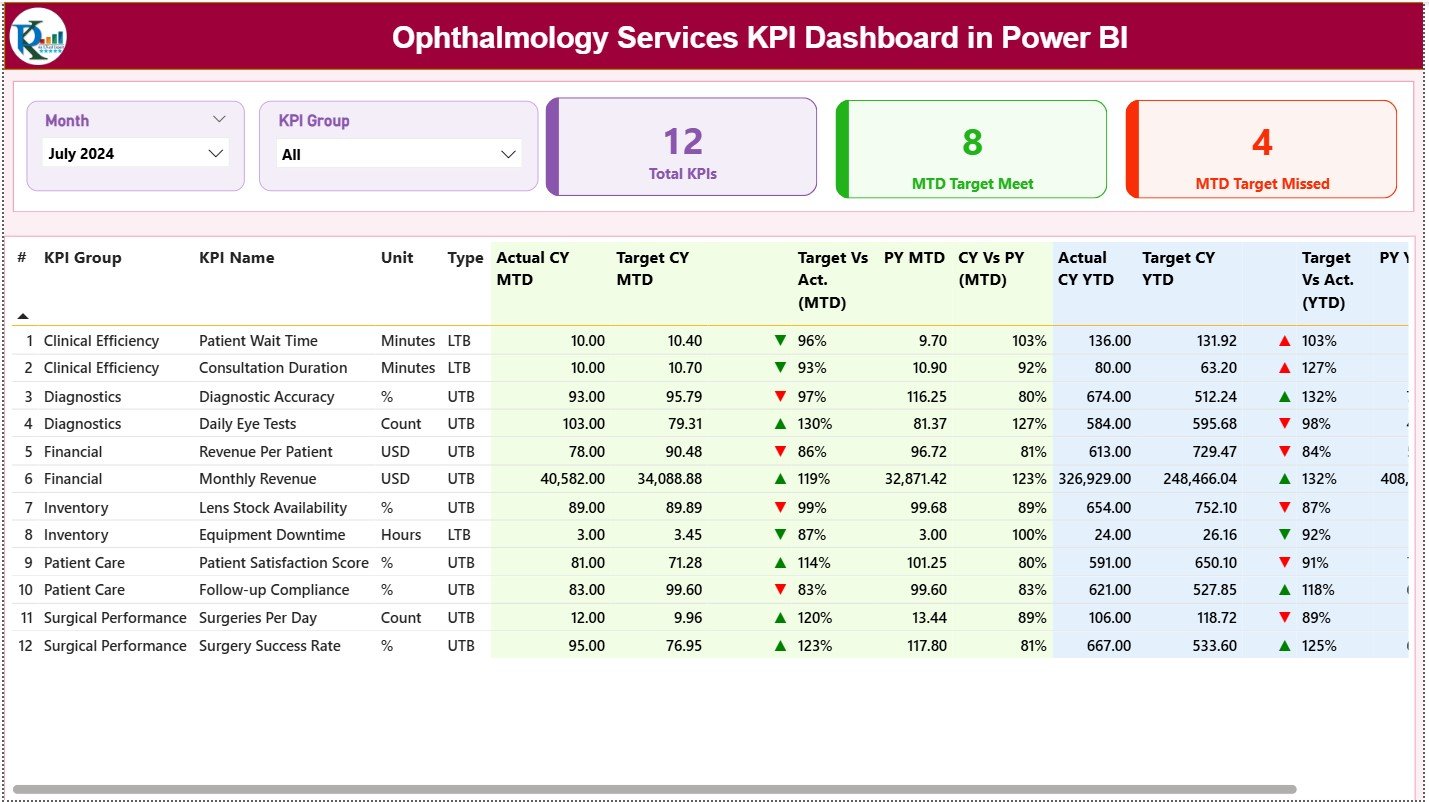
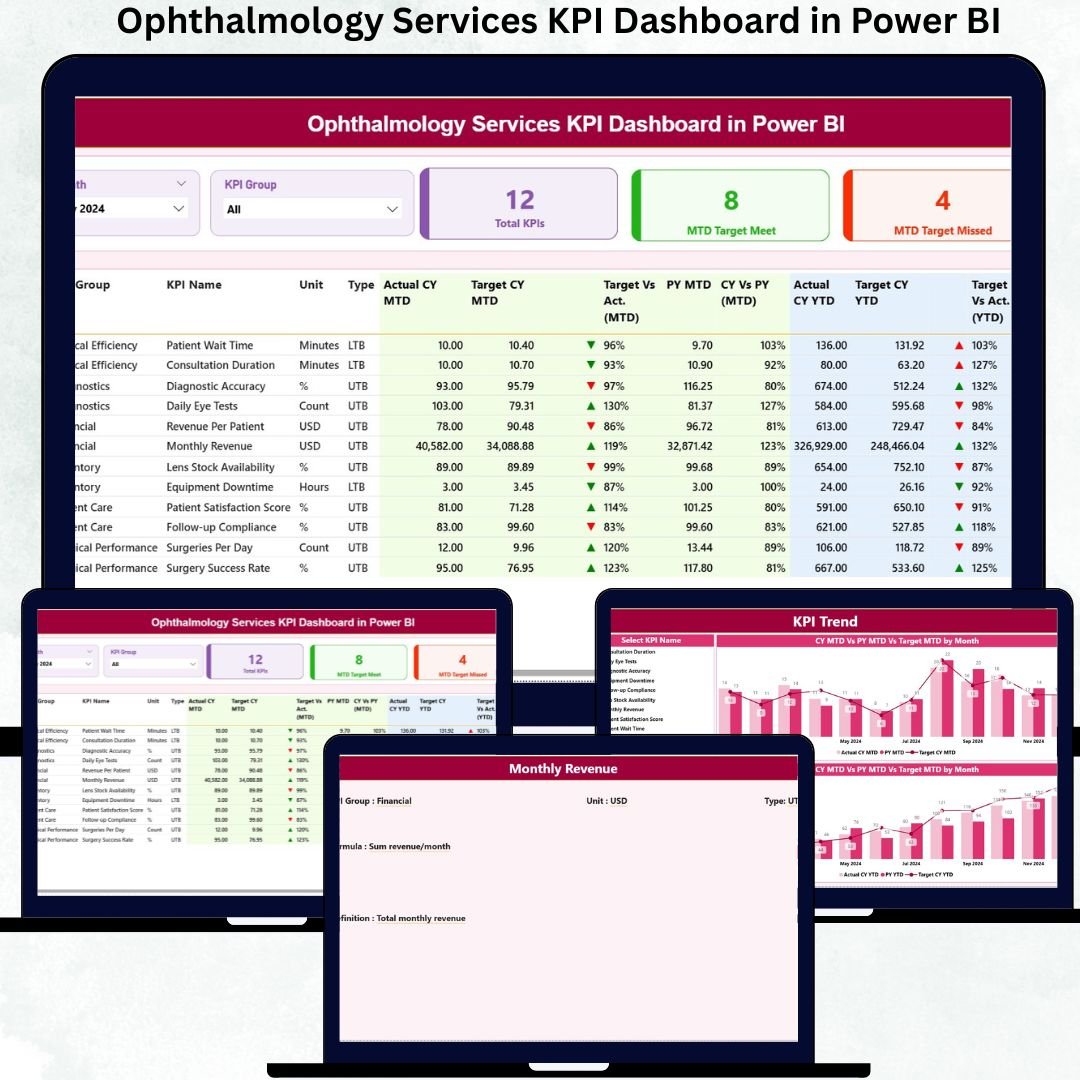
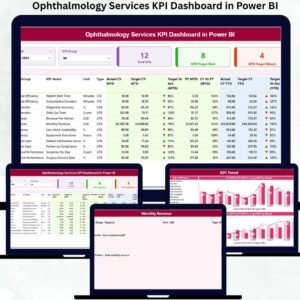
The main overview of ophthalmology service performance. It displays KPI cards for Total KPIs, MTD Target Met, and MTD Target Missed. A detailed performance table shows MTD and YTD Actuals, Targets, Previous Year values, and performance indicators—giving instant clarity on service efficiency and gaps.
📉 KPI Trend Page
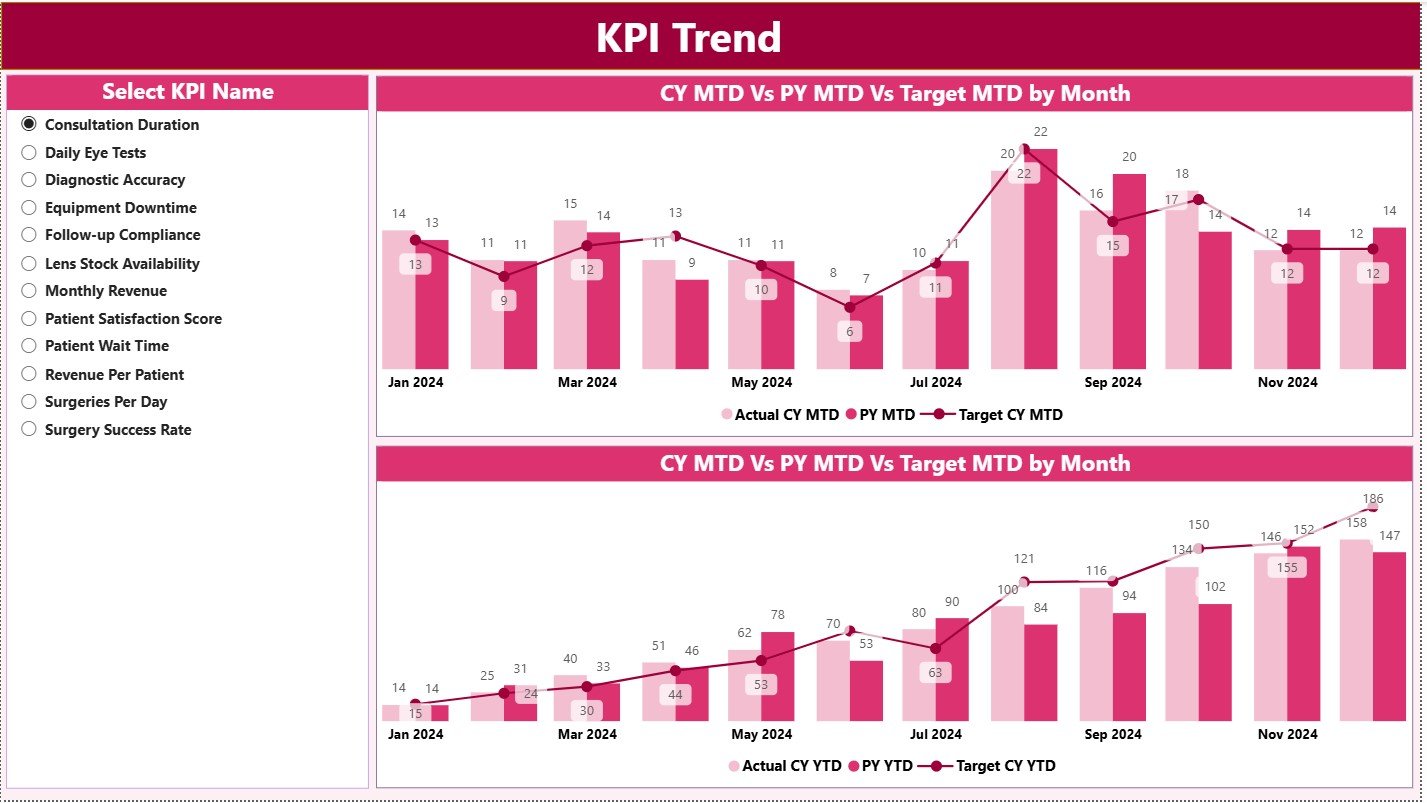
Designed for historical and trend-based analysis. Users select a specific KPI to instantly view MTD and YTD combo charts comparing Actual, Target, and Previous Year values. This page highlights improvement patterns, seasonality, and consistency.
📘 KPI Definition Page
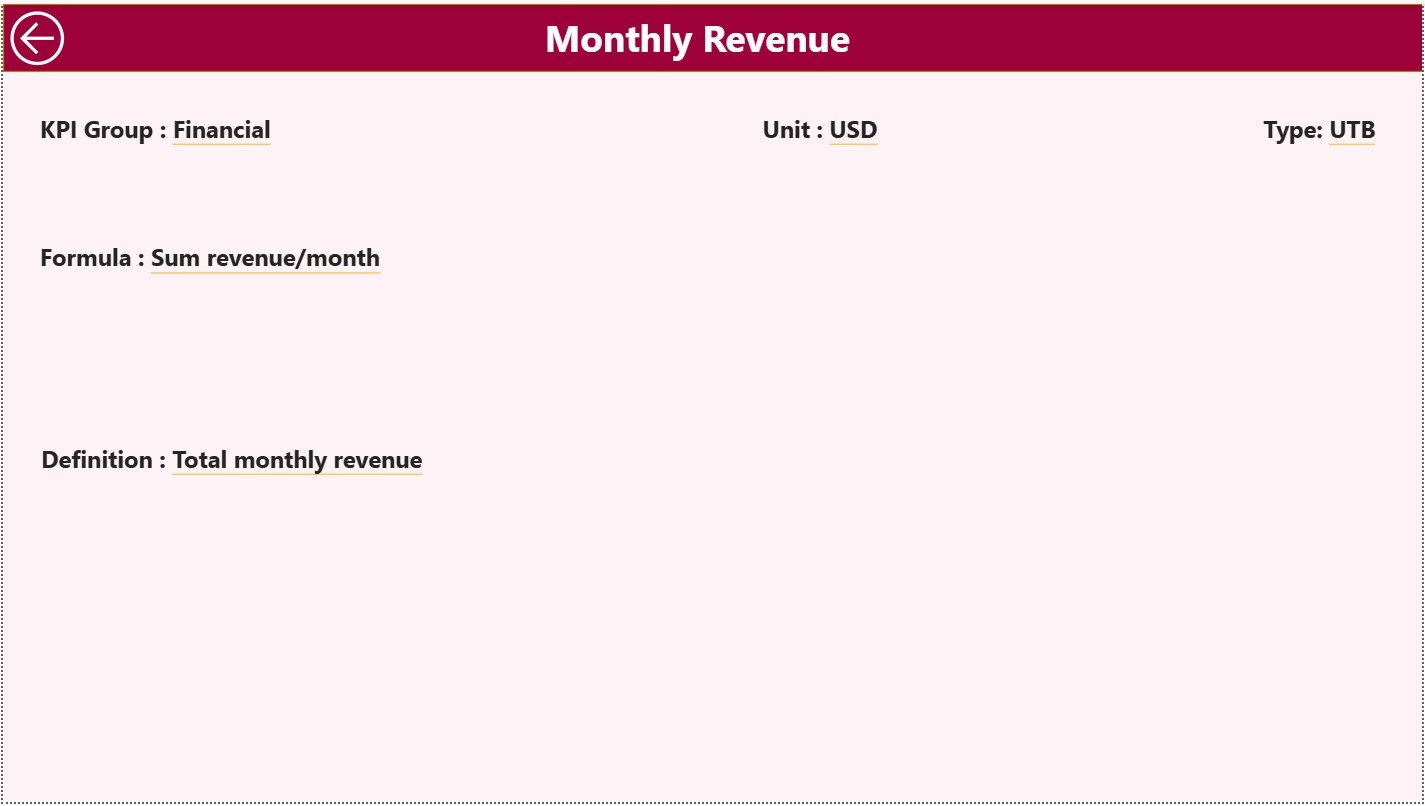
A drill-through transparency page that explains KPI logic. It displays KPI Formula, Definition, and Interpretation, ensuring alignment across clinical and administrative teams. A back button ensures smooth navigation.
The dashboard uses three structured Excel sheets:
Input Actual – MTD and YTD actual values
Input Target – Performance targets and benchmarks
KPI Definition – KPI structure, type (LTB/UTB), and logic
🛠️ How to Use the Ophthalmology Services KPI Dashboard
✅ Step 1: Enter actual performance values in the Input Actual Excel sheet
✅ Step 2: Maintain performance targets in the Input Target sheet
✅ Step 3: Define or update KPIs in the KPI Definition sheet
✅ Step 4: Refresh the Power BI dashboard
✅ Step 5: Analyze KPIs using slicers, tables, and trend charts
No advanced Power BI skills are required. The dashboard is plug-and-play and healthcare-friendly.
👥 Who Can Benefit from This Ophthalmology Dashboard?
🏥 Ophthalmology Clinic Managers
🏨 Hospital Administrators
👩⚕️ Clinical Operations Teams
✅ Quality & Compliance Teams
📊 Healthcare Analysts
👔 Senior Leadership & Management
Any eye-care organization seeking better visibility, quality control, and operational efficiency will gain immediate value.
🔗 Click here to read the Detailed blog post
🎥 Visit our YouTube channel to learn step-by-step video tutorials
Watch the step-by-step video tutorial:
Compatibility and Requirements
- Works in Power BI Desktop, which is free to download from Microsoft. Learn how to get Power BI Desktop.
- Data is entered in three Excel sheets: Input Actual, Input Target and KPI Definition. You need Excel to edit them, then refresh the dashboard in Power BI Desktop.
Frequently Asked Questions
Which pages does the dashboard include?
Three pages: Summary, KPI Trend and KPI Definition.
Where do I enter my data?
Enter actual values in the Input Actual sheet, targets in the Input Target sheet, and KPI names, type (LTB/UTB) and logic in the KPI Definition sheet. Then refresh the dashboard.
Does it show month-to-date and year-to-date results?
Yes. The Summary page shows MTD and YTD actuals, targets and previous year values, with indicators for target met and target missed.
How do I see the trend for one KPI?
Open the KPI Trend page and select a KPI. MTD and YTD combo charts compare actual, target and previous year values.
Is there an Excel version?
Yes. See the Ophthalmology Services KPI Dashboard in Excel.
Related Ophthalmology and Healthcare Templates
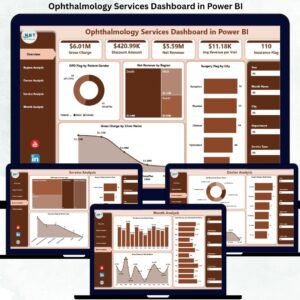
- Ophthalmology Services Dashboard in Power BI: another Power BI dashboard for ophthalmology services
- Ophthalmology Services KPI Dashboard in Excel: the same KPIs in Excel
- Ophthalmology Services Dashboard in Excel: an Excel dashboard for the same service area
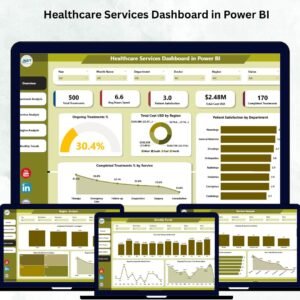
- Healthcare Services Dashboard in Power BI: a wider healthcare view in Power BI
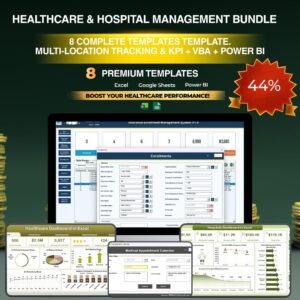
- Healthcare & Hospital Management Bundle: 8 healthcare templates in one download
Browse all Power BI KPI dashboards.

Reviews
There are no reviews yet.