


In a high-stakes, customer-driven world, your supply chain can’t afford delays, inaccuracies, or blind spots. That’s where the Supply Chain and Logistics Quality Assurance KPI Dashboard in Excel steps in — an interactive, visual, and easy-to-use Excel tool that empowers you to monitor key performance indicators, uncover inefficiencies, and make smarter decisions with real-time data.
Built specifically for quality assurance within logistics and supply chain management, this Excel dashboard provides an all-in-one view of MTD, YTD, and YoY performance across the KPIs that matter most.
✨ Key Features of the Dashboard
🏠 Home Sheet – One-Click Navigation Hub
Navigate between dashboard sections easily with six clickable buttons. No scrolling. Just click and go.
📊 Dashboard Sheet – Monthly Performance Snapshot

🔽 Drop-down Month Selector – Choose any month and the entire dashboard refreshes instantly
📈 KPI Cards for MTD & YTD – Track actual, target, and previous year values
⬆️⬇️ Arrows for Trend Analysis – Visual alerts using conditional formatting for under/overperformance
💡 Instantly spot delays, dips, or red flags
📉 KPI Trend Sheet – Month-by-Month Tracking
📋 Select any KPI using a drop-down
🧠 View key metadata (Unit, Group, Formula, LTB/UTB)
📈 Line charts for MTD & YTD trends across Actual, Target, and Previous Year
🧾 Actual Numbers Input Sheet – Simple Data Entry
📅 Set the first month in cell E1
✏️ Enter MTD & YTD actuals for all KPIs
🔄 Dashboard auto-updates — no manual linking needed
🎯 Target Sheet – Define Your Success Metrics
Input monthly MTD and YTD targets
Set expectations and benchmarks for every KPI
📆 Previous Year Sheet – YoY Performance Comparisons
Record previous year MTD & YTD values
Evaluate growth, decline, or stagnation
📚 KPI Definition Sheet – Team-Wide Clarity
KPI Name, Group, Formula, Unit
LTB/UTB Type explained for context
Ideal for onboarding and strategy alignment
🧠 Why This Dashboard Matters
Tracking KPIs like On-Time Delivery, Order Accuracy, and Supplier Defect Rate isn’t optional — it’s vital for:
Reducing costs
Preventing delays
Improving service quality
Meeting regulatory and customer expectations
By centralizing all your supply chain quality data into one automated system, you unlock proactive decision-making and strategic visibility.
🚀 Advantages of Using the Dashboard
🔎 Complete KPI Visibility – See performance at a glance
📈 Trend-Based Insights – Spot growth, seasonal patterns, or recurring bottlenecks
✅ Accurate Targeting – Set and measure progress toward strategic goals
📊 Actionable Visuals – Arrows and color cues draw attention instantly
⚙️ Fully Customizable – Modify KPI lists, formulas, visuals, or themes
🧾 Data-Driven Culture – Share performance across teams to align goals
🕒 Save Time Weekly – No need to rebuild reports from scratch
💰 No Subscription – One-time Excel template, reusable forever
👤 Who Should Use This Dashboard?
Ideal for professionals in:
🏭 Manufacturing & Production
🚚 Logistics & Distribution
🏬 Retail Supply Chains
📦 E-commerce Fulfillment
🏥 Healthcare Supply Operations
🔧 Automotive Supply Chains
If your work touches inventory, warehousing, delivery, or procurement — this dashboard is your new best friend.
🔧 Real-World Use Case
Let’s say you’re noticing late deliveries and unhappy customers. You open the dashboard and see that your Order Cycle Time has increased over the past 3 months. In the KPI Trend Sheet, you spot a dip in On-Time Delivery, aligning with a change in your primary supplier.
You use this insight to renegotiate delivery timelines — or find a better supplier. Result: improved delivery, reduced complaints, and optimized cost.
🧩 Best Practices for Dashboard Use
✔️ Update Monthly or Weekly – Fresh data = relevant insights
✔️ Use Conditional Formatting – Let color cues flag risks
✔️ Review as a Team – Discuss the dashboard in monthly meetings
✔️ Adjust Targets Annually – Reflect business priorities each year
✔️ Use Definitions Tab – Onboard teams faster and align expectations
🔁 Click here to read the Detailed blog post
📺 Visit our YouTube channel to learn step-by-step video tutorials
Watch the step-by-step video tutorial:
Compatibility and Requirements
- Works in Microsoft Excel desktop (Excel 2016 or later, or Microsoft 365).
- You pick the month and the KPI from dropdown lists. Microsoft explains them in Create a drop-down list.
Frequently Asked Questions
Which sheets are included?
Six sheets: Home, Dashboard, KPI Trend, Actual Numbers, Target, Previous Year and KPI Definition. The Home sheet has six clickable buttons that take you to the other sheets.
How do I update the dashboard?
Set the first month in cell E1 of the Actual Numbers sheet and enter your MTD and YTD actuals for each KPI. Add your goals on the Target sheet. The Dashboard updates by itself, with no manual linking.
Can I compare this year with last year?
Yes. Record last year’s MTD and YTD values on the Previous Year sheet. The Dashboard shows them next to your actuals and targets, so you can see growth, decline or no change.
How do I see the trend for one KPI?
Open the KPI Trend sheet and choose a KPI from the dropdown. It shows the unit, group, formula and type (LTB or UTB), plus line charts of MTD and YTD for Actual, Target and Previous Year.
Is there a Google Sheets or Power BI version?
The closest match is the Supply Chain Logistics KPI Dashboard in Google Sheets. A Power BI edition is also available: the Supply Chain Logistics KPI Dashboard in Power BI.
Related Supply Chain and Logistics Templates
- Supply Chain and Logistics Performance KPI Dashboard in Excel: overall logistics performance KPIs
- Supply Chain and Logistics Inventory Management KPI Dashboard in Excel: inventory-focused KPIs
- Supply Chain and Logistics Process Improvement KPI Dashboard in Excel: track process changes
- Quality Assurance Dashboard in Excel: a general quality assurance view
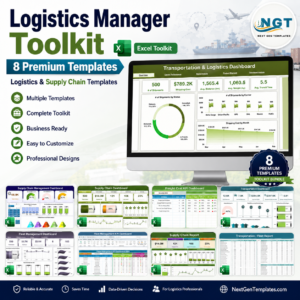
- Logistics Manager Toolkit: 8 Excel templates for logistics managers in one download
Browse all Excel KPI dashboards.





Reviews
There are no reviews yet.