

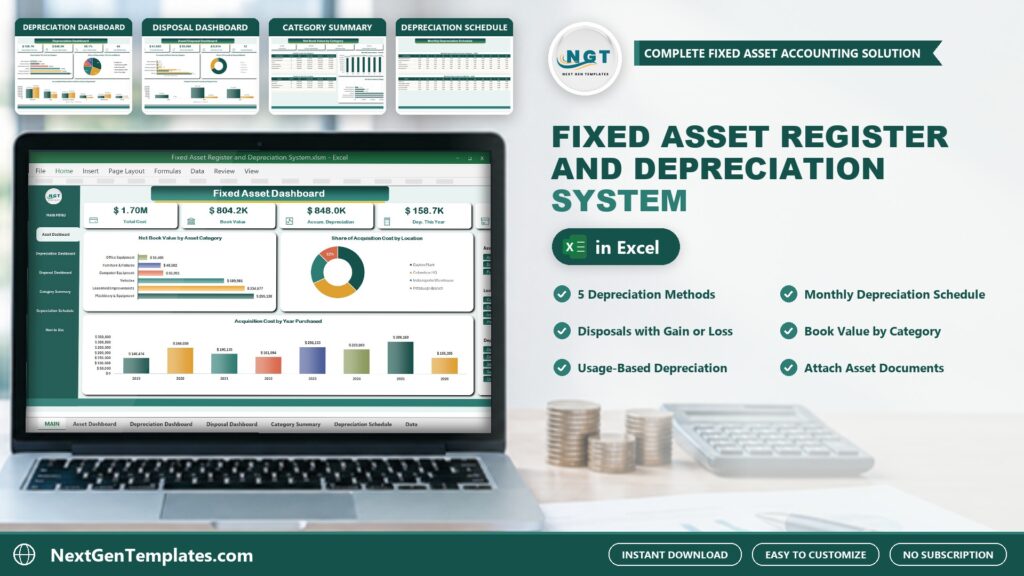
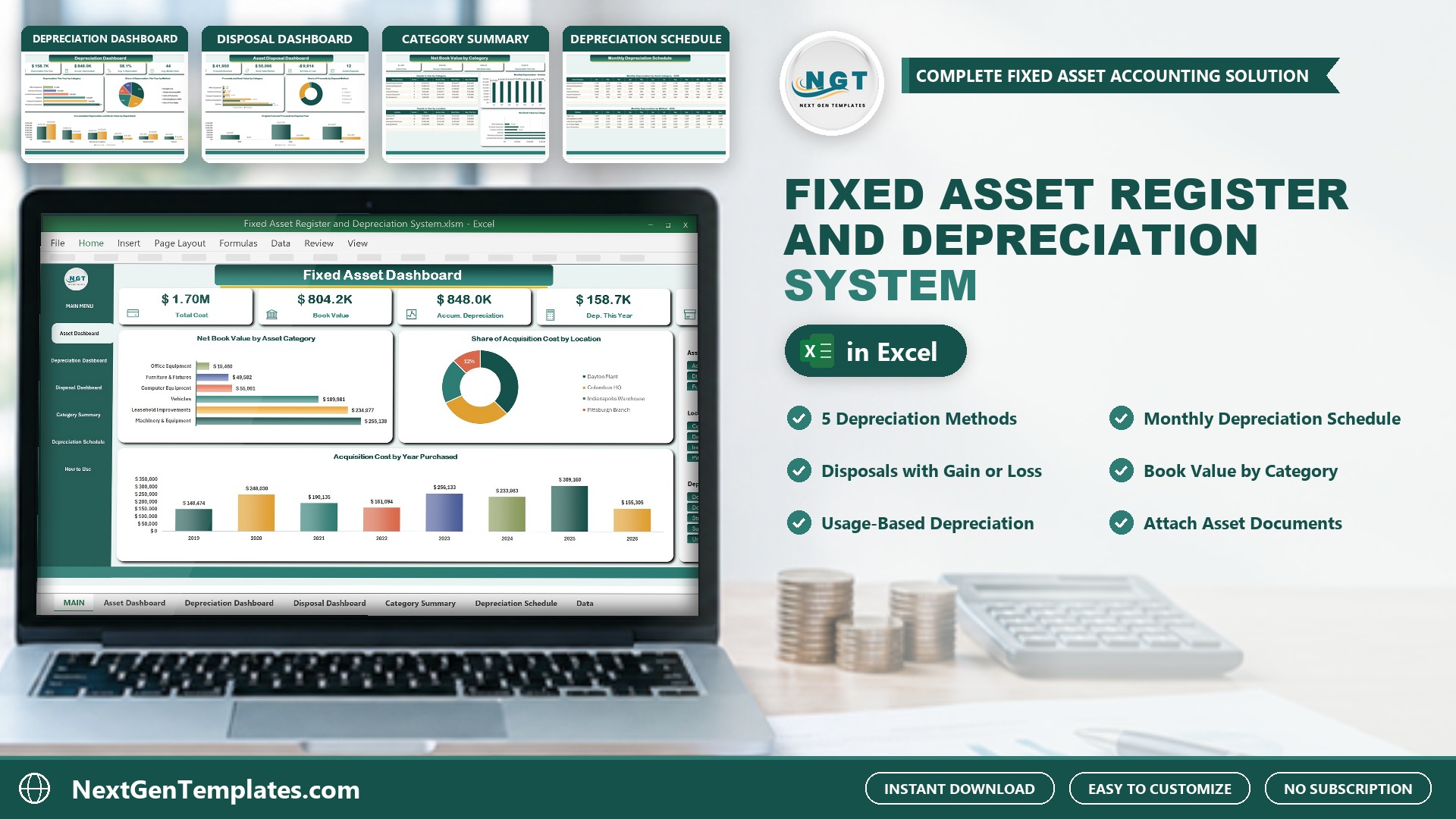
A fixed asset register is easy to start and hard to keep right. Costs sit in one file, depreciation in another, and nobody can say what the equipment is worth today. The Fixed Asset Register and Depreciation System V1.0 in Excel VBA puts the register, five depreciation methods, disposals, usage readings and three dashboards in one macro-enabled Excel workbook for Windows. This post walks through what is inside, who it suits and where it stops.
🌍 Join 10,000+ customers in 180+ countries using NextGenTemplates to replace paid SaaS tools with one-time-purchase Excel, Google Sheets, Power BI and HTML templates.
Watch the Fixed Asset Register and Depreciation System in Excel VBA: Five Methods, Disposals and Book Value walkthrough
 Launch offer
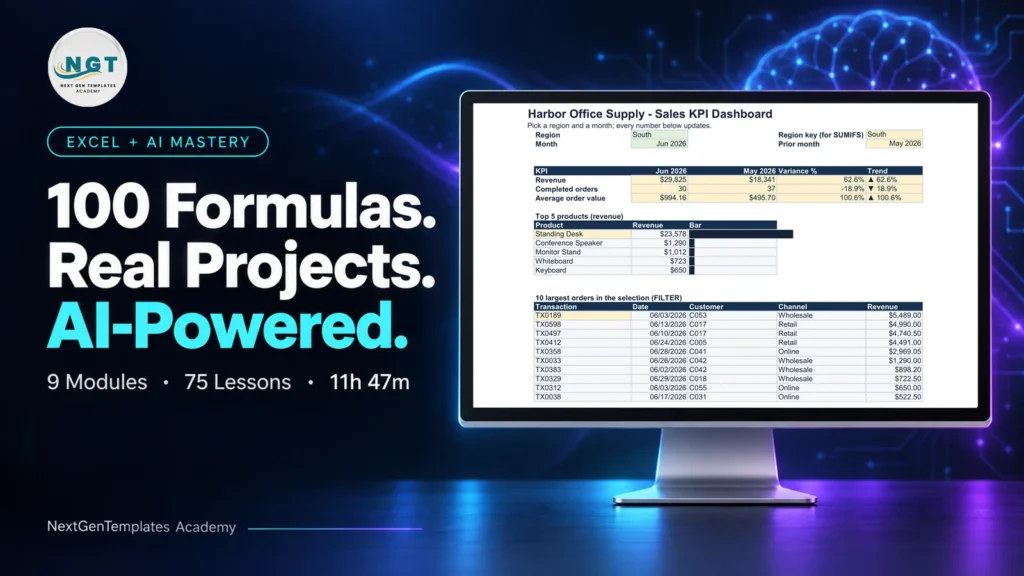
SUMIFS, XLOOKUP, FILTER, LAMBDA and checking AI-written formulas, with real business projects. 11h 47m of video by PK, with practice files, quizzes and a capstone.
What the Fixed Asset Register and Depreciation System does
- A complete asset register: category, location, department, vendor, invoice and serial number, purchase and in-service dates, cost, salvage value, useful life and method for every asset.
- Five depreciation methods: straight-line, declining balance 150%, double declining 200%, sum-of-the-years digits and units of production, mixed freely in one register.
- Live results: depreciable amount, months depreciated, accumulated depreciation, net book value, percent depreciated and status are formulas that update as you add assets.
- Disposals: sold, traded in, scrapped, donated or written off, with the net book value at disposal and the gain or loss.
- Usage Log: machine hours, miles, units produced or cycles for assets that depreciate by use.
- Three dashboards, a Category Summary and a Monthly Depreciation Schedule: filtered by slicers and refreshed with one button.
Sample data for a demo company is included: 54 assets, 12 disposals, 226 usage readings and 14 documents.
A look at the pages
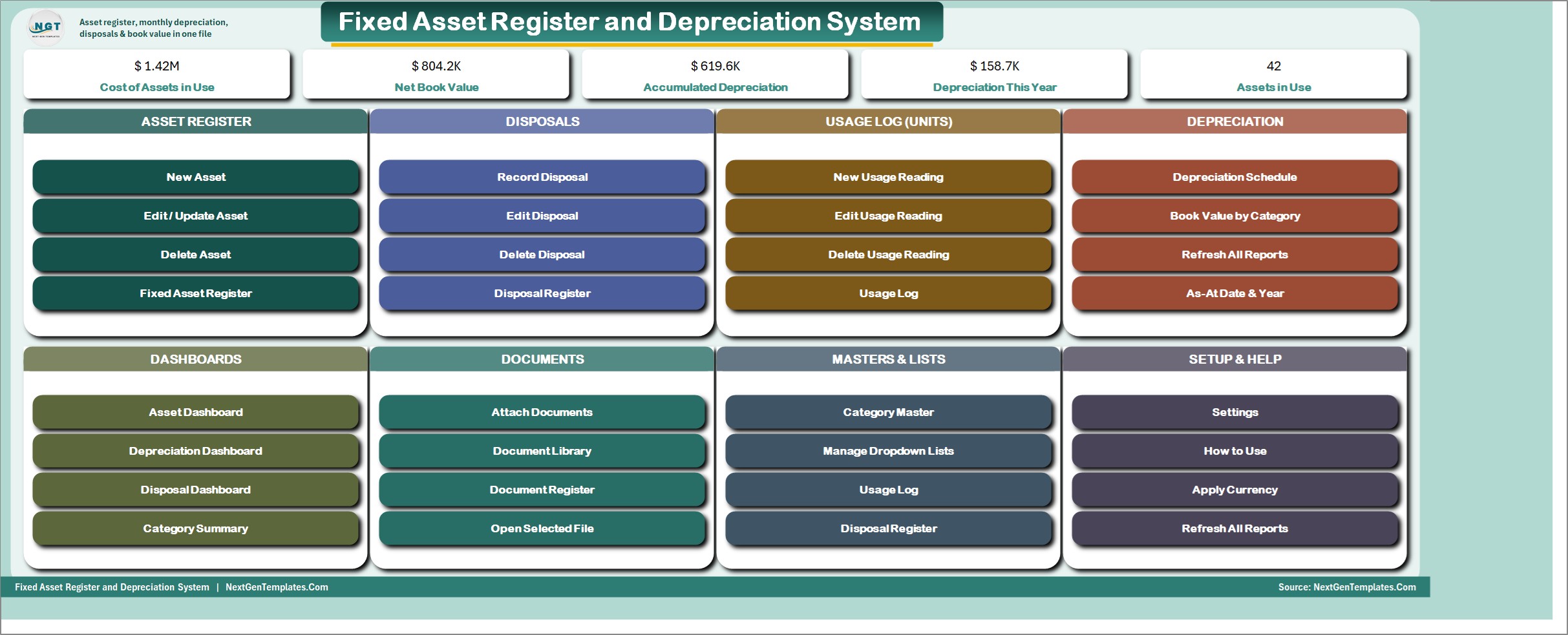
MAIN menu
The file opens here every time. Five live KPI chips (Cost of Assets in Use, Net Book Value, Accumulated Depreciation, Depreciation This Year and Assets in Use) sit above colour-coded cards for the Asset Register, Disposals, Usage Log, Depreciation, Dashboards, Documents, Masters and Lists, and Setup and Help. Every job starts from one of its buttons.
Fixed Asset Dashboard
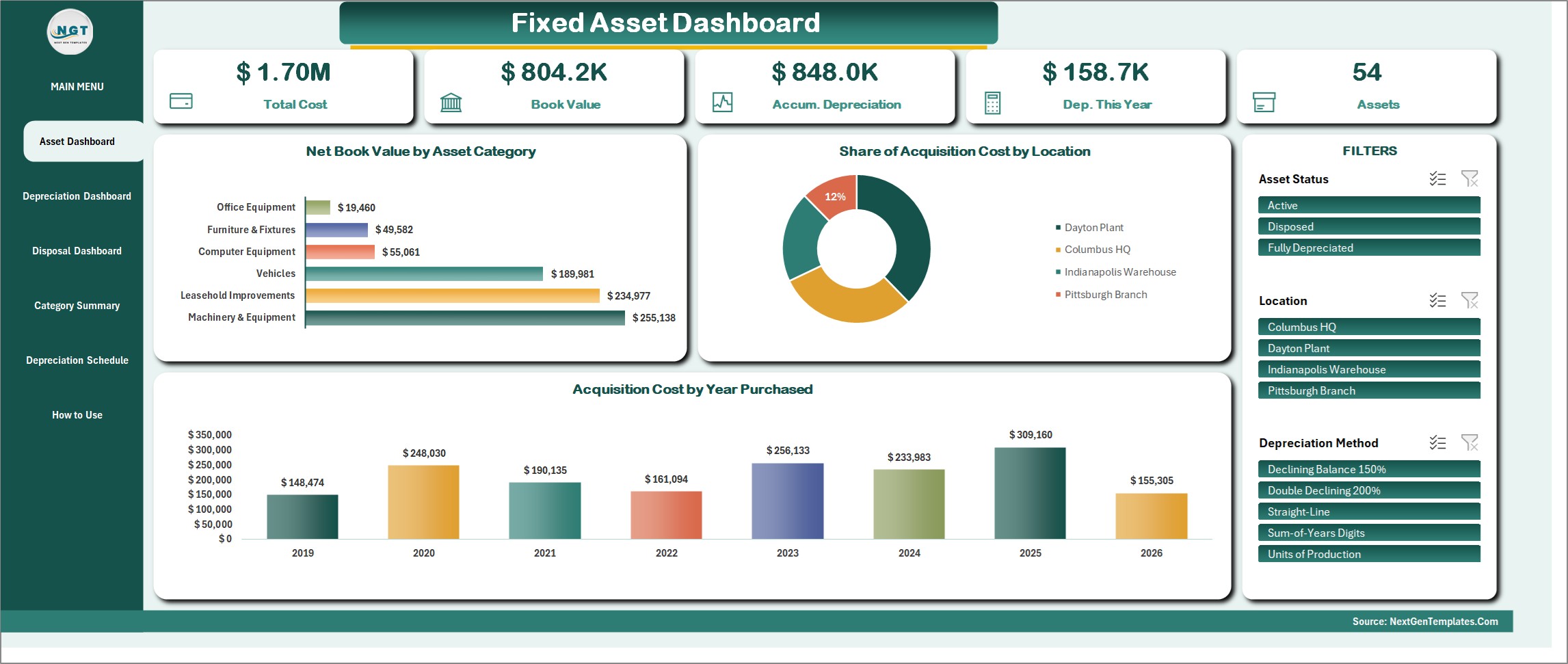
Total Cost, Book Value, Accumulated Depreciation, Depreciation This Year and the number of assets, with Net Book Value by Asset Category, Share of Acquisition Cost by Location and Acquisition Cost by Year Purchased. Slicers for Asset Status, Location and Depreciation Method drive every figure and chart on the page.
Depreciation Dashboard
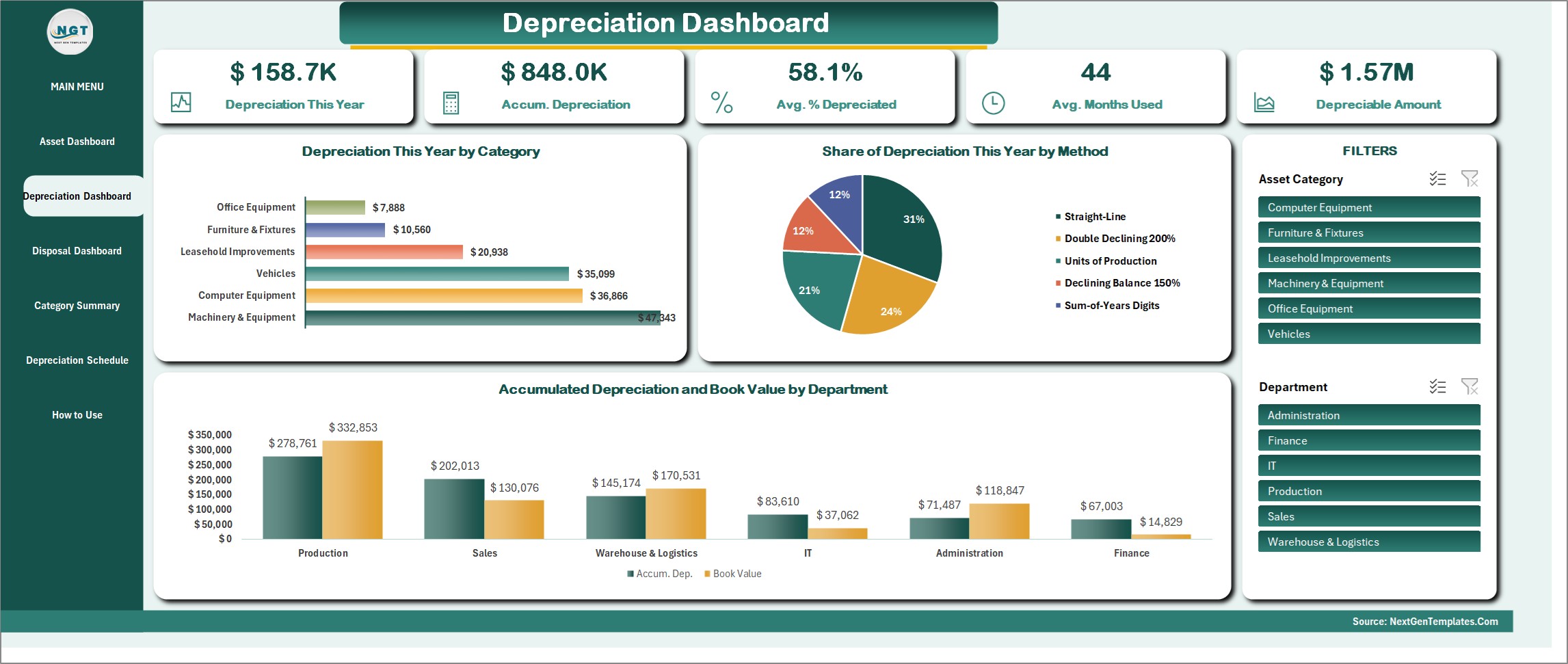
Depreciation This Year, Accumulated Depreciation, Average Percent Depreciated, Average Months Used and the Depreciable Amount, with Depreciation This Year by Category, Share of Depreciation This Year by Method and Accumulated Depreciation and Book Value by Department. Filter by Asset Category or Department.
Asset Disposal Dashboard
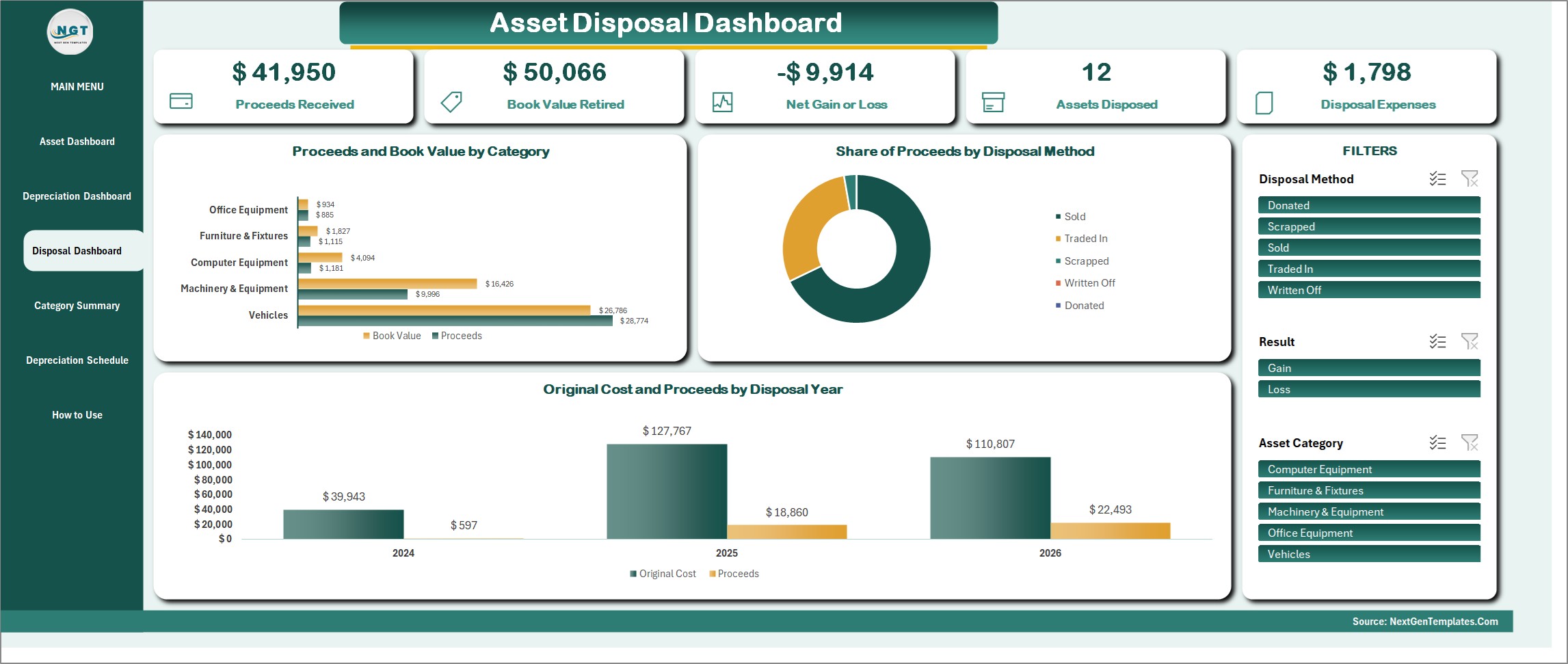
Proceeds Received, Book Value Retired, Net Gain or Loss, Assets Disposed and Disposal Expenses, with Proceeds and Book Value by Category, Share of Proceeds by Disposal Method and Original Cost and Proceeds by Disposal Year. Slicers for Disposal Method, Result and Asset Category.
Category Summary
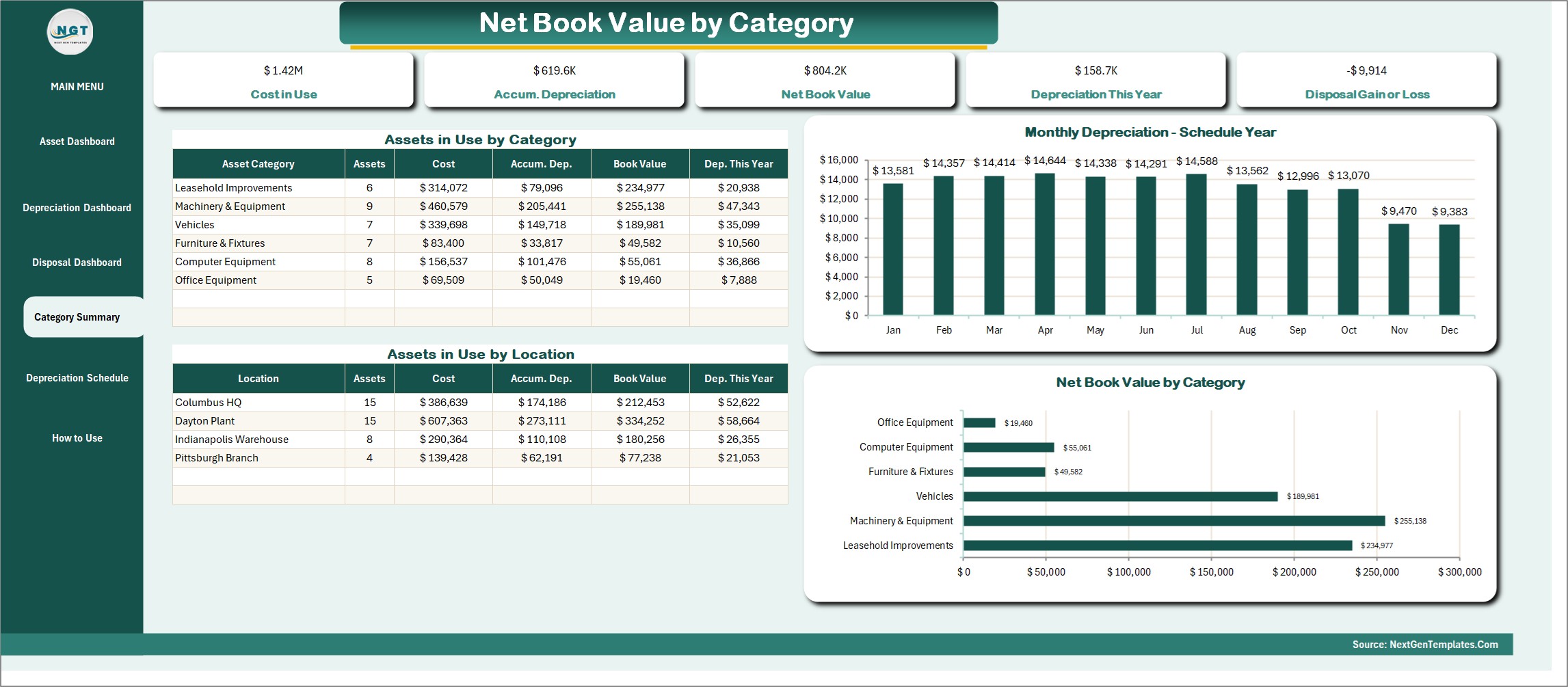
Net book value by asset category and by location in two tables, with a Monthly Depreciation chart for the schedule year and a Net Book Value by Category bar chart. Cost in Use, Accumulated Depreciation, Net Book Value, Depreciation This Year and Disposal Gain or Loss sit across the top.
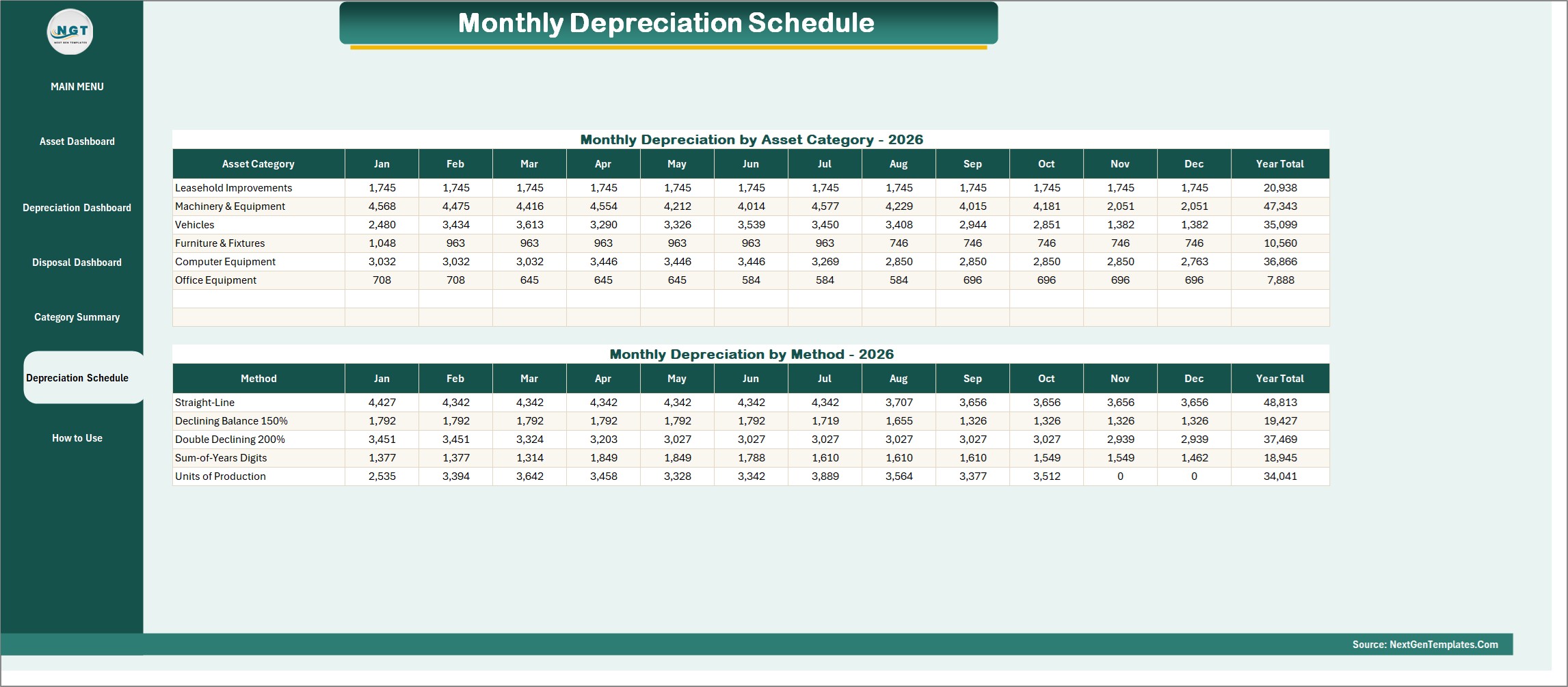
Monthly Depreciation Schedule
Depreciation for January to December by asset category, then again by depreciation method, each with a year total. Pick the schedule year in Settings and press Refresh All Reports.
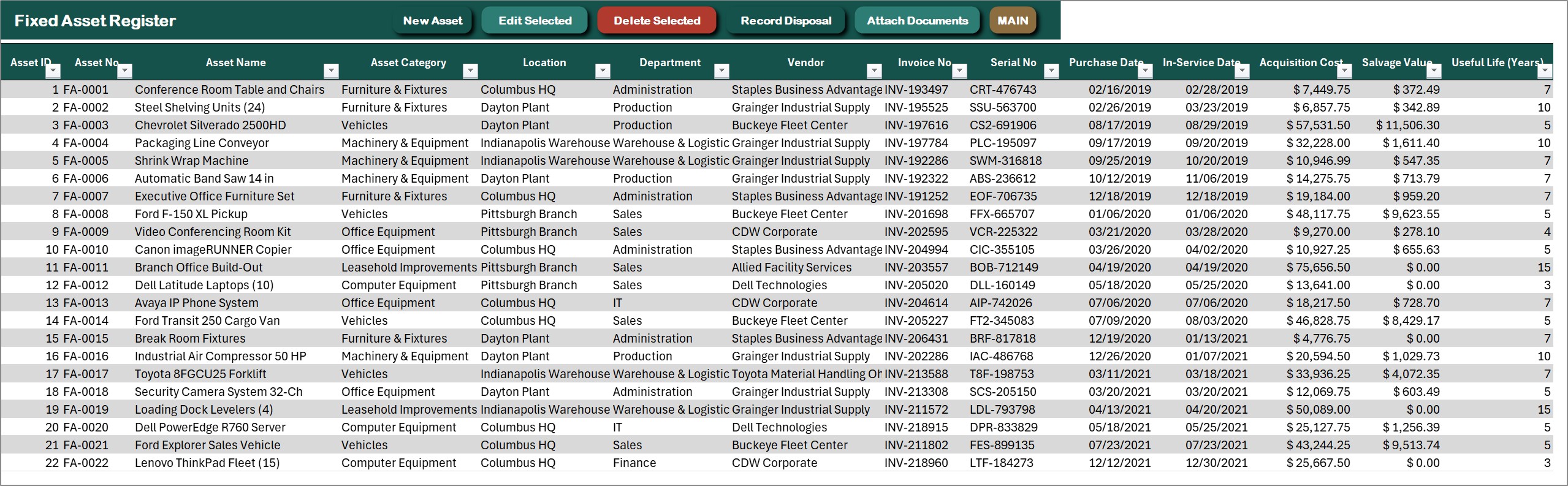
Fixed Asset Register
One row per asset: asset number, name, category, location, department, vendor, invoice and serial number, purchase and in-service dates, acquisition cost, salvage value, useful life and method, with the depreciable amount, months depreciated, accumulated depreciation, net book value, percent depreciated, status and the monthly schedule worked out by formulas. New Asset, Edit Selected, Delete Selected, Record Disposal and Attach Documents sit on the action bar.
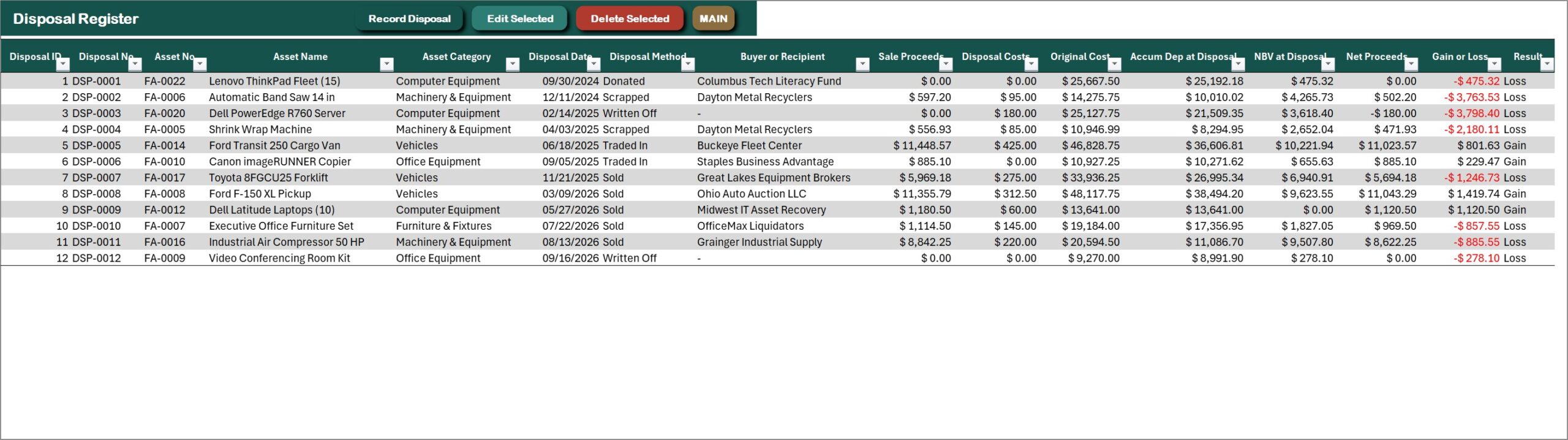
Disposal Register
Every disposal with its date, method (sold, traded in, scrapped, donated or written off), buyer or recipient, sale proceeds, disposal cost, the original cost and accumulated depreciation at disposal, the net book value at disposal and the gain or loss, with losses in red.
How depreciation runs in the file
Most businesses follow the same loop, and the workbook is laid out in that order.
Registering an asset. Open New Asset from the MAIN menu and fill in the name, category, location, department and vendor from the dropdowns. Add the invoice and serial number, the purchase and in-service dates, the cost, the salvage value and the useful life in years, then pick the depreciation method. Saving adds one row to the Fixed Asset Register, and the depreciable amount, months depreciated, accumulated depreciation and net book value are worked out for you.
Choosing a method. Straight-line spreads the depreciable amount evenly. Declining balance 150% and double declining 200% take more in the early years and switch to straight-line when that gives a larger charge. Sum-of-the-years digits front-loads the charge by the remaining life, and units of production follows the readings in the Usage Log instead of the calendar. The full-month convention, the as-at (report) date and the Jan to Dec schedule year are set once on the Settings sheet.
Logging usage. For machines, vehicles and tools that wear by use, add a reading each month in machine hours, miles, units produced or cycles. The Usage Log keeps the date, the units used, the operator and any remarks.
Closing the month. Press Refresh All Reports and the three dashboards, the Category Summary and the Monthly Depreciation Schedule pick up every entry. The schedule shows each month by asset category and by method, ready to copy into your ledger.
Retiring an asset. Press Record Disposal, pick the asset and enter the date, the method, any proceeds and the disposal cost. The Disposal Register shows the net book value at disposal and the gain or loss, and the Asset Disposal Dashboard totals them by category, method and year.
Setting it up with your own data
The demo company is there so every chart has something in it on day one. To start your own register, replace the sample records with your assets. Asset categories, locations, departments, vendors, units of measure and document types are master lists you add to from the Manage Dropdown Lists form, so nobody edits a sheet by hand or fixes a broken dropdown.
Long lists filter as you type, and date boxes open a calendar picker, which stops 03/04 meaning March on one PC and April on another. Purchase invoices, warranty cards, insurance policies, asset photos and disposal certificates can be attached to their records and opened later from the Document Register. Editing and deleting can be switched off on the Settings sheet, although it is still one file on one PC, not a shared system with logins.
Fixed Asset Register and Depreciation System vs. a spreadsheet vs. cloud software
| Feature | This Excel VBA system | Plain asset list spreadsheet | Cloud asset software |
|---|---|---|---|
| Cost | $29 one-time ✅ | Free to $20 one-time | Monthly subscription |
| Five depreciation methods in one register | Yes ✅ | Manual formulas | Yes ✅ |
| Monthly schedule by category and method | Yes ✅ | Build it yourself | Yes ✅ |
| Disposal gain or loss | Yes ✅ | Manual | Yes ✅ |
| MACRS tax tables and barcode scanning | No | No | Often ✅ |
| Works offline, data stays on your PC | Yes ✅ | Yes | No |
Who it is for, and who it is not for
It suits small and mid-size businesses, bookkeepers and operations teams that want a register, monthly depreciation and disposal results in one file. It does not suit teams that need several people editing at once, Mac or Excel-for-web users, or anyone who needs MACRS tax tables, barcode scanning or an accounting connection. It is a single-user desktop workbook, and it needs Excel 2016 or later for Windows with macros enabled (Microsoft explains how to enable macros).
Related templates
If you want something to sit beside the register, these are the closest matches in the store:
- IT Asset Management System Web App: a browser-based system for tracking IT assets, if your assets are mostly devices.
- Profit and Loss (P&L) Template in Excel: bring the monthly depreciation charge into your results.
- Payroll Management System V1.0 in Excel VBA: another complete macro-enabled Excel system, for payroll.
Frequently asked questions
What does the Fixed Asset Register and Depreciation System track?
Every asset with its category, location, department, vendor, invoice and serial number, cost, salvage value, useful life and depreciation method, plus disposals, usage readings and attached documents. Three dashboards, a category summary and a monthly depreciation schedule report on top of the register.
Which depreciation methods does it support?
Five: straight-line, declining balance 150%, double declining 200% (which switches to straight-line when that gives a larger charge), sum-of-the-years digits and units of production. Pick the method for each asset on the New Asset form.
Can I try it before I buy?
Yes. A 7-day free trial with every form, register and dashboard working is on the product page. Enter your own assets and test it before you decide.
How are disposals handled?
Open Record Disposal, pick the asset, the date and the method (sold, traded in, scrapped, donated or written off) and enter any proceeds and disposal cost. The workbook works out the net book value at disposal and the gain or loss, and the asset stops depreciating.
Does it work out tax depreciation such as MACRS?
No. It uses the full-month convention and the five methods above, which suits management and book depreciation. It does not include MACRS tables or half-year and mid-quarter conventions, so confirm tax depreciation with your accountant.
Does it work on Mac or Excel for the web?
No. The entry forms are VBA, so it needs Microsoft Excel 2016 or later for Windows on the desktop, with macros enabled. It will open elsewhere but the buttons will not run.
Can several people use it at once?
No. It is a single-user desktop workbook and your data stays on your PC. Editing and deleting records can be switched off on the Settings sheet, but there are no separate user logins.
Is there sample data?
Yes. A demo company ships with 54 assets, 12 disposals, 226 usage readings and 14 documents, so every chart is populated when you open the file. Replace it with your own assets and the dashboards follow.
Get the Fixed Asset Register and Depreciation System
One-time payment, no subscription, instant download, illustrated PDF manual included. See the Fixed Asset Register and Depreciation System V1.0 in Excel VBA and try the 7-day free trial. More Excel VBA systems are in the Excel VBA Tools category.