

Direct answer: INDEX MATCH vs VLOOKUP vs XLOOKUP is not just an Excel preference question. For most HR trackers in 2026, XLOOKUP is the best default when your team uses Microsoft 365 or Excel 2021 or later. INDEX MATCH is still the best flexible fallback for older workbooks. VLOOKUP is fine for simple left-to-right lookups, but it becomes fragile when HR tracker columns move.
Why does this matter for HR? The U.S. Bureau of Labor Statistics reported 3.1 million quits and a 1.9 percent quits rate in May 2026. When employee retention is being tracked across calendars, duty rosters, project plans, and event sheets, one broken lookup formula can send the wrong follow-up date, manager, or retention action to the wrong row.
This guide uses realistic HR tracker examples, including employee retention calendar templates, so you can see exactly when to use VLOOKUP, INDEX MATCH, and XLOOKUP in a working Excel context.
Key Features of VLOOKUP, INDEX MATCH, and XLOOKUP
Microsoft’s own Excel documentation positions these functions differently: VLOOKUP searches the first column of a table range, INDEX and MATCH combine a return range with a matched row position, and XLOOKUP searches a lookup array and returns a matching value from another array.
| Decision point | VLOOKUP | INDEX MATCH | XLOOKUP |
|---|---|---|---|
| Best use | Simple left-to-right lookup tables | Flexible workbooks that need older Excel support | Modern Excel trackers and dashboards |
| Looks left | No, unless you rearrange the table | Yes | Yes |
| Column insert safety | Weaker because return column is a number | Stronger because return range is explicit | Stronger because return array is explicit |
| Missing value handling | Usually needs IFERROR | Usually needs IFERROR | Built-in optional not-found result |
| Ease for beginners | Easy at first | Moderate | Easy once learned |
| Best HR tracker example | Pull department from an employee master list | Pull a manager or retention action from either side of the ID column | Pull next check-in date, event owner, status, or duty assignment cleanly |
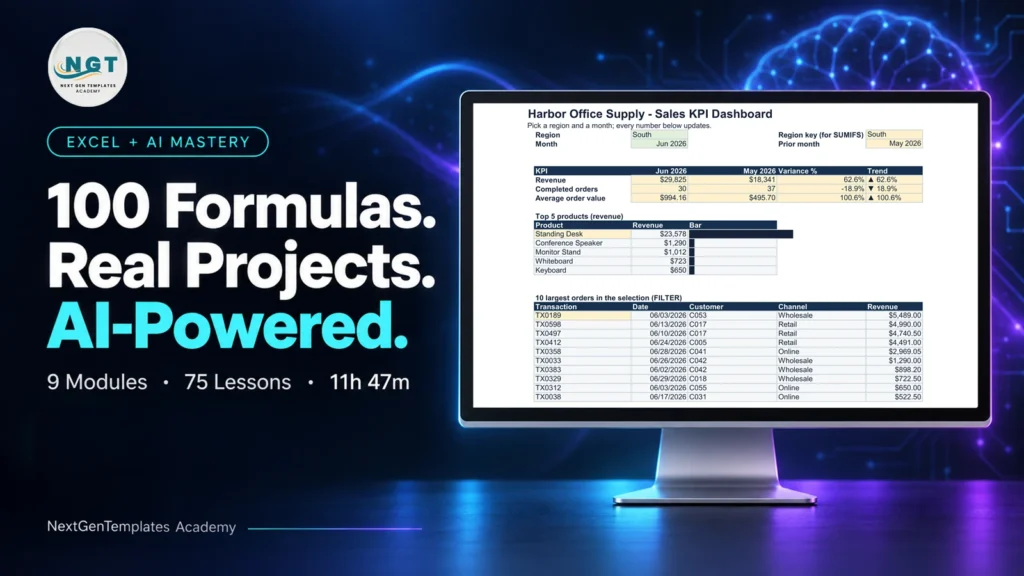 Launch offer
SUMIFS, XLOOKUP, FILTER, LAMBDA and checking AI-written formulas, with real business projects. 11h 47m of video by PK, with practice files, quizzes and a capstone.
Formula Setup for HR Tracker Examples
Imagine an Excel table named EmployeeEvents with these columns: Employee ID, Employee Name, Department, Manager, Next Retention Action, Event Date, Status, and Duty Owner. The goal is to type an Employee ID into a retention calendar and return the right event or owner automatically.
VLOOKUP Example
Use VLOOKUP when the Employee ID is the first column in your selected range and the return field sits to the right:
=VLOOKUP($A2,EmployeeEvents[[Employee ID]:[Status]],5,FALSE)
This can work well in a basic employee tracker. The issue is the 5. If someone inserts a new column before Next Retention Action, the formula may return the wrong field unless you update the column index.
INDEX MATCH Example
Use INDEX MATCH when you want more control over the lookup column and return column:
=INDEX(EmployeeEvents[Next Retention Action],MATCH($A2,EmployeeEvents[Employee ID],0))
This formula says: find the row where Employee ID matches A2, then return the value from the Next Retention Action column. It is a strong choice for legacy Excel files because it works in older Excel versions and does not depend on a numbered return column.
XLOOKUP Example
Use XLOOKUP when the workbook will be opened in Microsoft 365 or newer Excel versions:
=XLOOKUP($A2,EmployeeEvents[Employee ID],EmployeeEvents[Next Retention Action],"Not scheduled",0)
This is the cleanest formula for most 2026 HR tracker templates. It reads naturally, supports exact match, can return a friendly not-found result, and can look left or right without rearranging the table.
Excel HR Tracker vs Google Sheets vs HR SaaS – Feature Comparison
| Feature | Excel HR tracker template | Google Sheets tracker | Paid HR SaaS |
|---|---|---|---|
| Cost | Low one-time template cost | Low if your team already uses Google Workspace | Monthly or annual subscription |
| Platform | Microsoft Excel desktop or Microsoft 365 | Browser-based spreadsheet | Vendor-hosted application |
| Setup time | Fast for teams that already use Excel | Fast for collaborative teams | Longer setup, onboarding, and configuration |
| Formula control | High control with VLOOKUP, INDEX MATCH, and XLOOKUP | High control with similar lookup formulas | Lower formula control, more workflow configuration |
| Real-time collaboration | Good in Microsoft 365, weaker in offline files | Strong by default | Strong, depending on plan |
| Custom fields | Very flexible | Very flexible | Usually possible, but may need admin setup |
| Year-1 cost at 5 users | Usually lowest if Excel is already available | Low to moderate depending on Workspace plan | Often much higher than a template |
| Best fit | HR managers who need a practical tracker quickly | Distributed teams that edit together often | Organizations that need full HRIS workflows |
Who Should Use This Guide
This guide is for HR managers, operations leads, Excel template buyers, and analysts who maintain employee retention calendars or staff duty trackers. If your workbook needs to pull employee names, managers, departments, retention actions, follow-up dates, or duty owners from a source table, these lookup formulas will save time and reduce copy-paste errors.
It is especially useful if you sell, customize, or maintain HR templates. A buyer may not care which formula is underneath the workbook, but they will care when a schedule stays accurate after new employees, departments, or retention events are added.
Real-World Use Cases
Use Case 1: Pull the Next Retention Check-In
An HR manager enters an Employee ID into a monthly retention calendar. XLOOKUP returns the next scheduled retention action, such as probation review, manager check-in, training follow-up, or engagement meeting.
Use Case 2: Connect a Staff Duty Calendar to Employee Data
A department head uses INDEX MATCH to pull the correct duty owner from an employee database, even when the duty owner column is placed to the left of the Employee ID in another sheet.
Use Case 3: Keep a Simple Tracker Backward Compatible
A small business uses VLOOKUP because its workbook is simple, the Employee ID is always the first column, and some team members still open older Excel files. In that situation, VLOOKUP is acceptable as long as the table structure is stable.
Advantages of Choosing the Right Lookup Formula
The main advantage is trust. HR trackers are only useful when the data pulled into the calendar is correct. XLOOKUP and INDEX MATCH reduce the risk caused by column movement because they reference the lookup and return columns directly. That makes them safer for templates that evolve over time.
The second advantage is speed. A retention calendar can reuse one clean formula across hundreds or thousands of employee-event rows. Instead of manually typing manager names or follow-up dates, your team can maintain one employee event database and let formulas feed the calendar views.
Opportunities for Improvement
No lookup formula fixes poor source data. If Employee IDs are duplicated, blank, or typed inconsistently, VLOOKUP, INDEX MATCH, and XLOOKUP can all return confusing results. Before building formulas, standardize Employee IDs, convert the data range into an Excel Table, and define one unique key for each employee record.
Another improvement is version awareness. XLOOKUP is excellent for modern Excel, but if the file must work for users on older perpetual Excel versions, INDEX MATCH may be safer. For public template products, it is worth documenting which Excel versions are supported.
Best Practices
- Use exact match for HR records. Employee IDs and names should not use approximate match logic.
- Prefer structured Excel Tables. Table names like
EmployeeEvents[Employee ID]are easier to audit than raw ranges. - Use XLOOKUP for new Microsoft 365 templates. It is readable, flexible, and has a built-in not-found argument.
- Use INDEX MATCH for compatibility. It is still reliable when your buyers may use older Excel versions.
- Limit VLOOKUP to stable tables. If columns are likely to move, use XLOOKUP or INDEX MATCH instead.
- Keep formulas close to the workflow. In an HR calendar, formula outputs should match actions HR teams actually take: check-in date, action owner, status, and notes.
Explore Relevant Templates
The best way to learn lookup formulas is to apply them inside a workbook that looks like a real HR workflow. These paid Excel templates give you a practical employee retention context for formulas, calendars, event databases, and duty planning.
Employee Retention Maintenance Calendar in Excel
Employee Retention Maintenance Calendar in Excel is useful when HR teams want to schedule recurring retention activities, manager check-ins, engagement events, and follow-up actions. It includes annual, monthly, daily, and event database views, making it a realistic workbook for practicing XLOOKUP and INDEX MATCH against a retention event table.
View the Maintenance Calendar Template
Employee Retention Project Calendar in Excel
Employee Retention Project Calendar in Excel fits HR projects such as onboarding improvement, engagement campaigns, performance follow-ups, and department-level retention planning. It is a strong example for formulas that pull project owner, event date, and action status from a structured table.
View the Project Calendar Template
Employee Retention Staff Duty Calendar in Excel
Employee Retention Staff Duty Calendar in Excel helps teams plan staff duties, HR activities, schedules, and employee engagement events. It is especially useful for lookup examples where the workbook needs to return duty owner, department, or scheduled event based on an Employee ID or staff name.
View the Staff Duty Calendar Template
Frequently Asked Questions
Is XLOOKUP better than VLOOKUP in 2026?
Yes, for most modern Excel workbooks, XLOOKUP is better than VLOOKUP because it can look left or right, references return arrays directly, and includes an optional not-found result.
Should I still learn INDEX MATCH?
Yes. INDEX MATCH remains valuable for older Excel compatibility and for analysts who want precise control over lookup and return ranges.
When is VLOOKUP still acceptable?
VLOOKUP is acceptable for simple tables where the lookup value is always in the first column and the workbook structure is unlikely to change.
Which formula is best for HR trackers?
XLOOKUP is usually best for new HR trackers in Microsoft 365. INDEX MATCH is best when the workbook must work in older Excel versions. VLOOKUP is best only for simple, stable lookup tables.
Can these formulas work with employee retention calendars?
Yes. They can pull event dates, manager names, duty owners, retention actions, departments, and employee status fields into annual, monthly, and daily calendar views.
About the Author
Built by PK – Microsoft Certified Professional with 15+ years of Excel, Google Sheets, and Power BI experience. Founder of NextGenTemplates, reaching 300K+ subscribers across YouTube channels. Every template is hand-built and tested before release.
Conclusion
If you are building an HR tracker in 2026, the practical rule is simple: use XLOOKUP for modern Excel workbooks, INDEX MATCH for compatibility and flexibility, and VLOOKUP only for simple left-to-right tables. The formula itself is not the end goal. The goal is a retention calendar that stays accurate when employees, events, departments, and managers change.
For more Excel template walkthroughs and tutorials, visit the NextGenTemplates YouTube channel.
Last updated: July 20, 2026.